How to install OwnCloud on RHEL 8 / CentOS 8 server

In this article we will be performing an installation of OwnCloud directly from the official OwnCloud package. OwnCloud is a suite of client-server software to provide easy file sharing. The operating system to be used will be RHEL 8 / CentOS 8 server with MySQL, PHP and Apache web-server.

In this tutorial you will learn:

  • How to install Owncloud prerequisites
  • How to download and upzip OwnCloud source package
  • How to setup MariaDB database
  • How to setup OwnCloud

Read more

There are no enabled repositories RHEL solution

You may receive a There are no enabled repos error message when trying to install system updates on a fresh Red Hat Linux install. This occurs when you have not enabled your RHEL subscription. In this tutorial, we will take you through the step by step instructions to register your RHEL subscription, enable the package manager, and finally install updates and remedy the error message for good.

Read more

RHEL 8 / CentOS 8 enable/disable IPv6

An Internet Protocol Version 6 (IPv6) address is an identifier of a network interface of a computer or a network node involved in an IPv6 computer network. This article will guide the user via simple steps on how to disable or re-enable IPv6 network addresses on RHEL 8 / CentOS 8. To temporarily enable/disable the IPv6 address on RHEL 8 / CentOS 8 we will use the sysctl command. Additionally, to permanently disable the IPv6 address we will modify the GRUB boot options.

In this tutorial you will learn:

  • How to temporarily disable the IPv6 address.
  • How to permanently disable IPv6 by modifying the GRUB boot options.

Read more

Apache Solr Linux install

Apache Solr is open source search software. It’s capable of being implemented as an enterprise-level search engine thanks to its high scalability, advanced indexing, fast queries, and ability to integrate with a large variety of applications. It’s capable of tackling big data and also has high availability with its load balancing and failover configurations.

The platform is written in Java and can be installed on Linux systems. In this guide, we’ll show the step by step instructions for installing Apache Solr on some of the most popular Linux distros, including Ubuntu, Debian, CentOS, and Red Hat.

In this tutorial you will learn:

  • How to install Apache Solr on Debian based systems
  • How to install Apache Solr on Red Hat based systems
  • Initial configuration of Apache Solr
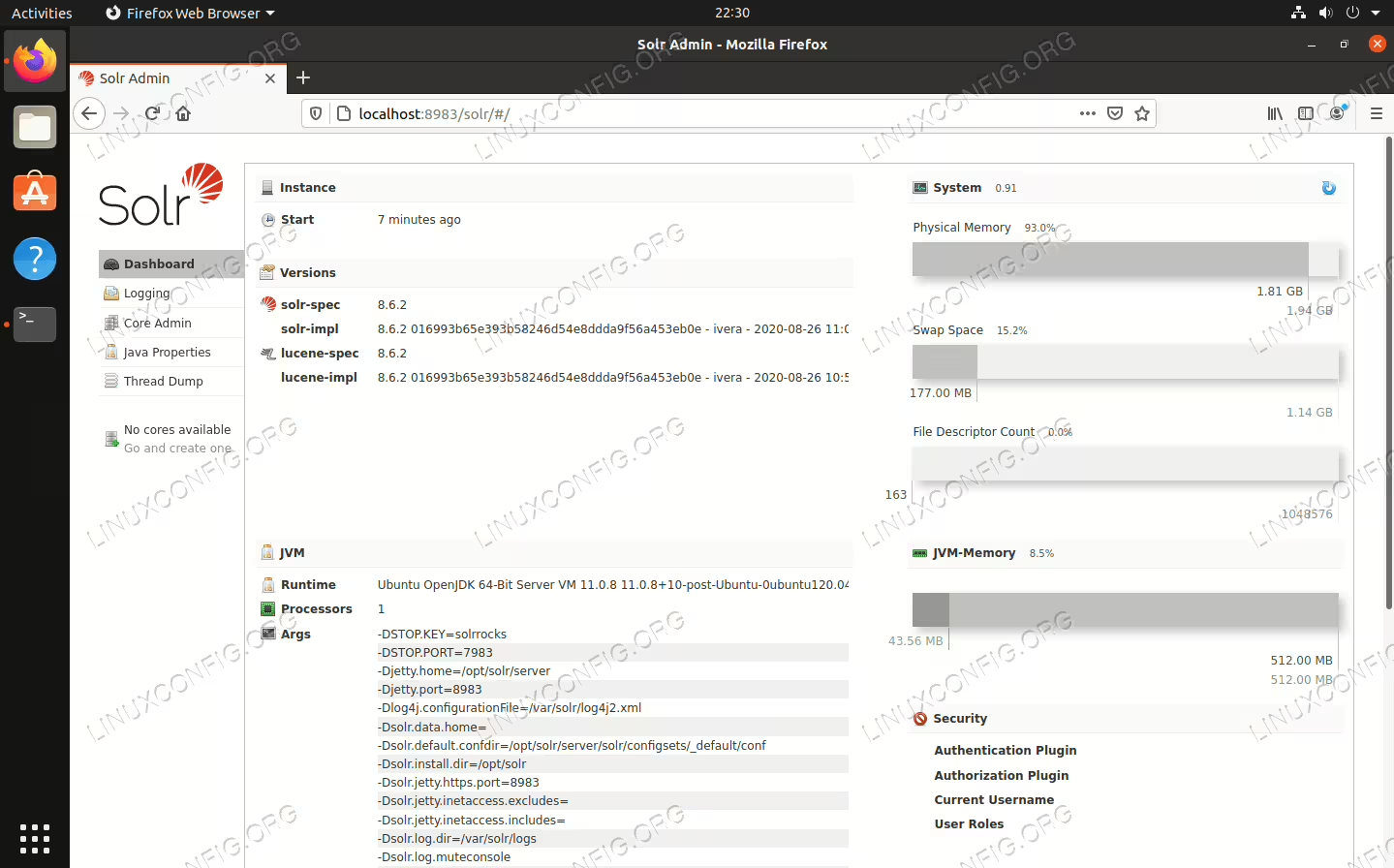
Apache Solr installed on Linux

Apache Solr installed on Linux

Read more

ERROR: Unable to find the kernel source tree for the currently running kernel – CentOS / RHEL / AlmaLinux

This article will provide you with an information on how to install kernel source on CentOS/RHEL Linux system. Alternatively it will guide you through a simple troubleshootng process in case you have already installed kernel sources/headers and yest still receiving the bellow error message:

  ERROR: Unable to find the kernel source tree for the currently running kernel.  Please make sure you have installed the kernel     
         source files for your kernel and that they are properly configured; on Red Hat Linux systems, for example, be sure you have 
         the 'kernel-source' or 'kernel-devel' RPM installed.  If you know the correct kernel source files are installed, you may    
         specify the kernel source path with the '--kernel-source-path' command line option.

In this tutorial you will learn:

  • How to install kernel-headers
  • How to install kernel-devel
  • How to check kernel version
  • How to check for installed kernel-devel version

Read more

Install development tools on RHEL 8 / CentOS 8

The development tools group acts as a transitional package for installation of multiple development, compilation and debugging tools. Most notably these include Automake, Autoconf, Gcc (C/C++) as well as various Perl & Python macros and debuggers.

See below list for a complete list of packages available as part of the development tools group. The entire development tools group can be easily installed on RHEL 8 / CentOS 8 Linux by using the dnf command.

In this tutorial you will learn:

  • How to list the content of the development tools group on RHEL 8 / CentOS 8
  • How to install the development tools group on RHEL 8 / CentOS 8
  • How to remove the development tools group from RHEL 8 / CentOS 8

Read more

How to install Docker CE on RHEL 8 / CentOS 8

The latest release of the RHEL 8 / CentOS 8. Red Hat has built its own tools, buildah and podman, which aim to be compatible with existing docker images and work without relying on a daemon, allowing the creation of containers as normal users, without the need of special permissions (with some limitations: e.g. at the moment of writing, it’s still not possible to map host ports to the container without privileges).

Some specific tools, however, are still missing: an equivalent of docker-compose, for example does not exists yet. In this tutorial we will see how to install and run the original Docker CE on Rhel8 by using the official Docker repository for CentOS7.

In this tutorial you will learn:

  • How to enable the docker-ce repository on RHEL 8 / CentOS 8
  • How to install docker and docker-compose on RHEL 8 / CentOS 8

docker-RHEL 8 / CentOS 8

Docker installed on RHEL 8 / CentOS 8

Read more

File conversion with alien doesn't take long

How to install deb file in RHEL 8 / CentOS 8 Linux

There may come a time when that package you want to install in RHEL 8 / CentOS 8 is simply not available as a RPM file. The alternative is to download the source and compile it yourself, or – alternatively – generate a RPM file from that source code later on.

But there is another way. Given the fact that Debian-based distributions have way more users than RPM-based ones, the number of available packages in their repositories is greater. Chances are you will be able to find a DEB file for that package you want. Here is how to install that DEB file in RedHat Linux with the help of a small utility called alien.

In this tutorial you will learn:

  • How to install alien in RHEL 8 / CentOS 8
  • How to convert a DEB package to a RPM one

Read more

How to install cpan on RHEL 8 / CentOS 8

Perl is a well-known programming language with long development history. The same long history provides the countless modules written in it, and distributed in various channels throughout the World Wide Web. As with most programming languages, if you implement something that you find useful, and maybe write it in a generic way, there are high chances others would find it useful too.

If you share your work with others, they don’t need to re-implement the wheel, they can spend time on other tools, thus making the community as a whole richer, and we have found the spirit of open source with a short walk. But as many people write perl modules, and perl runs on just about anything, it can be hard to find the module you are looking for, let alone build it in your environment. And that’s where cpan comes into play. CPAN itself is a large perl module repository, the cpan tool is a client that is able to fetch and compile needed modules to the local system.

In this tutorial we’ll install cpan on a RHEL 8 / CentOS 8, run the initial configuration, and install a module with this tool’s help.

In this tutorial you will learn:

  • How to install cpan
  • How to run initial configuration
  • How to install a perl module with cpan

Read more

How to install and configure Ansible on Redhat Enterprise Linux 8

This tutorial covers step by step installation and configuration of Ansible on Redhat Enterprise Linux 8.
Ansible is the leading Open Source configuration management system. It makes it easy for administrators and operations teams to control thousands of servers from central machine without installing agents on them.

In this tutorial you will learn:

  • Ansible Overview
  • Install and Configure Python
  • Set Password-less SSH
  • Install Ansible
  • Testing and Managing the Ansible

Read more