
[Book Review] Jun'ichiro Tanizaki's 'In Praise of Shadows' — Reclaiming the Wisdom and Sensibility of the Shadows in an Overly Bright Modern Age

Introduction: Reading Tanizaki in an Era of Too Much Visibility
We live in a remarkably bright world. City streets at night are illuminated by electric lights, and shadows rarely remain even in the corners of our rooms. When we open our smartphones, landscapes from distant lands, the emotions of others, and reviews of trending books or movies are immediately presented before our eyes. Searching brings us closer to answers, reading reviews helps us avoid mistakes, and notifications constantly pull our consciousness back to them. This is certainly convenient. Perhaps the need to endure darkness, wait by feeling our way, and face things that are not immediately understandable has become much less than it used to be.
However, is it truly a form of richness that everything looks bright?Were there not things that could only be felt because they were invisible, things that only emerged because they were not immediately understood, and things that could finally be heard only by straining our ears in the darkness? Jun'ichiro Tanizaki's 'In Praise of Shadows' is an essay that poses such questions quietly, yet deeply.
This book is written around the details of daily life, such as Japanese houses, lacquerware, Japanese paper, toilets, soup bowls, and yokan (sweet bean jelly). At first glance, it might look like a nostalgic piece about a Japanese aesthetic that is being lost. However, what is there is not mere nostalgia for the past.What Tanizaki was gazing at was the way of perception that we have inadvertently let go of by making things brighter, cleaner, more convenient, and more efficient. Western modernity was also a civilization of addition—making things brighter, faster, more rational, and more functional. Of course, the benefits of this are significant.Tanizaki does not simply deny the convenience of modernity. We want heating on cold days, and we choose convenient things over inconvenient ones. Tanizaki understands this human weakness well.
Even so, he asks: What has disappeared amidst the convenience? What has become invisible amidst the brightness?By riding the wave of Western modernity, have the life sensibilities of the East and Japan lost the possibility of growing into a different form? That is the significance of reading 'In Praise of Shadows' now. This is not a book that praises Japan as a form of nationalism. Rather, it is a book that re-examines whether only one form of modernity was the correct answer. It is a book that attempts to reclaim the wisdom and sensibility of the shadows in an overly bright world.

Chapter 1: What are Shadows?
Shadows are not just about being dark. Dark places are inferior, and bright places are superior. Tanizaki does not start from such a simple value judgment.For him, shadows are not things that make objects invisible, but things that show objects in a different way. For example, there is Japanese paper. While glass and Western paper reflect light sharply and illuminate things brightly and white, Japanese paper receives light softly. There, light does not bounce straight back, but sinks deep into the fibers, spreading into the space a little duller and a little warmer. What Tanizaki is looking at is not just the material of paper itself. It is the soft relationship that is born when paper meets light.
Lacquerware also exerts its power only within the shadows. Lacquerware placed in a bright spot might just look like a black, glossy vessel. However, in a dimly lit room, the lacquerware, receiving a faint light, holds deep darkness while letting a subtle glow float on its surface. There, the vessel is not just a tool, but becomes like a small space holding the night itself. In other words, for Tanizaki, beauty is not fixed within objects. It appears in the relationship between objects and light, objects and shadows, and objects and space.
This sensibility has become a bit distant for us today. Now, we try to see things as clearly as possible. Under bright lighting, we try to clarify outlines, capture colors accurately, and grasp them as information. There, it is often thought that seeing is the same as understanding. However,in Tanizaki's aesthetics, being seen too much can actually make objects thin. By being illuminated to every corner, the depth and atmosphere that objects possessed disappear. By understanding things immediately, the time spent with things that are not understood is lost.
Shadows might be a condition for reclaiming that lost time. Because we cannot see clearly, we strain our eyes. Because we do not understand immediately, we turn our consciousness to touch, scent, and weight.Darkness does not close off the senses, but rather opens up different senses. The charm of 'In Praise of Shadows' lies here.Tanizaki does not speak of darkness as an inconvenience, but as a place to deepen sensibility. There, knowing and feeling are inseparably linked. Shadows are knowledge before knowledge, a form of sensibility that has sunk into the body.

Chapter 2: Western Modern Addition and Japanese Subtraction
'In Praise of Shadows' contains a critique of Western modernity. However, that critique is not a simple anti-Western stance. Tanizaki does not reject all modern equipment and technology that came from the West. Electric lights, flush toilets, heating appliances, hygiene, and convenience all make human life easier. Once faced with those benefits, people cannot easily let them go. That is precisely why I think Tanizaki's question is troublesome and still new today. The problem is not convenience itself. It is what kind of sensibility convenience is built upon.
Western modernity, in many cases, proceeds in the direction of addition. If it is dark, make it bright. If it is far, bring it closer. If it is slow, make it fast. If it looks dirty, polish it white. If it is ambiguous, make it clear. There is a power there to make the world easier to see, easier to handle, and easier to manage. That is certainly the power of civilization. But at the same time, that addition erases the margins. It erases shadows, erases silence, erases the time spent feeling one's way, and erases the distance for things to slowly approach us.
What Tanizaki regrets is not simply old Japanese houses or old tools. What is being lost is the sense of life that was built on subtraction. Instead of adding strong light, soften the light. Instead of showing everything, hide a little. Instead of putting function to the front, blend it into the space. Instead of dominating objects, wait for objects to rise in silence. From the perspective of modern efficiency, that might look like a detour. However,there is a sensibility that only grows within that detour.
Seeing the luster of lacquerware in the darkness. Anticipating the soup sinking to the bottom of the bowl not with the eyes, but with the weight in the hand and the scent of the steam. Receiving the color and sweetness of yokan in the shadows, not under white light. These experiences are a little different from the sense of owning the world. Instead of understanding, using, and evaluating immediately, slow down the speed of approaching objects. Instead of dragging things out into the light from one's own side, align one's own senses to the atmosphere that objects carry within the darkness. I think that is where the beauty of shadows that Tanizaki speaks of lies.
'In Praise of Shadows' is worth reading even now, not just to reminisce about past Japanese beauty. It is to think about what we have become less sensitive to in a world that has become too bright, too fast, and too convenient. While there are things that have become richer through the addition of Western modernity, there are also things that have been quietly lost in the shadows of that addition. Tanizaki gave a name to those lost things. That is, shadows.

Chapter 3: Toilets, Lacquerware, Yokan — The Body Working in the Darkness
What makes Tanizaki's writing so interesting is that he does not discuss beauty as an abstract concept, but rather speaks of it through the details of daily life. Japanese houses, washi paper, lacquerware, soup bowls, yokan. And, the toilet. Tanizaki quietly observes even those things that would normally be kept away from discussions of beauty. This is because there is a relationship between the human body and space that cannot be measured solely by cleanliness, convenience, and bright management.
From a modern perspective, a toilet should be as bright, clean, and functional as possible. White walls, strong lighting, odor-eliminating mechanisms, and ease of cleaning. There, the act of excretion is processed hygienically so that it is as inconspicuous as possible. Of course, that is important. However, Tanizaki sees a completely different kind of beauty in the toilets of old Japanese houses and temples. A place slightly removed from the main house, where the presence of wood and earth remains, and where the sounds of the outside and the changing of the seasons gently enter. The sound of insects, the sound of birds, the moonlight, the presence of the garden. The most physical and mundane place is, at the same time, a quiet place that connects with nature.
This is not an argument for rejecting functionality. It is about not seeing the place of excretion merely as a space for processing. The human body is not something to be managed solely by rationality. It lives, including feelings of embarrassment, quietude, calmness, and a sense of the seasons. I believe Tanizaki speaks of the toilet as a space that embraces that totality. Here, the body is not placed as something to be hidden, but as something that touches the presence of the world.
The same can be said for his descriptions of lacquerware and soup bowls. When seen in a bright place, the color and shape of the vessel are immediately apparent. However, when looking at lacquerware in a dimly lit room, a depth is born that transcends mere black or vermilion. Receiving a faint light, the light flickers on the surface of the lacquer, and the maki-e quietly emerges from the sunken darkness. The vessel is not only a tool for holding food, but also a small place that embraces the night.
In the case of a soup bowl, the senses of the body work even more. The contents of the bowl are not clearly visible. However, through the weight and warmth transmitted to the palms, the steam when the lid is removed, and the faint aroma, the taste is anticipated even before it is brought to the mouth. Here, it is not just the sense of taste that creates the meal. As vision retreats slightly, the senses of touch, smell, and time begin to move. The passage about yokan is also impressive. Placed in the shadows, the yokan does not appear as just a sweet confection, but as something that contains the darkness of the room. It is not a food item cut up under bright light, but a sensation that unravels on the tongue along with the darkness. It shows that the act of eating is a communion with the entire space.
Not being able to see is not a lack of sensation. Rather, there is a body that begins to work precisely because it cannot see. Because it cannot see immediately, the hands feel. Because the contours are vague, one notices the scent. Because the brightness is suppressed, the depth of the taste increases. What Tanizaki called 'shadows' is what brings us back from a world centered on vision to a world received by the entire body..

Chapter 4: Could there have been another modernity in the East?
The depth of 'In Praise of Shadows' lies in the fact that it does not stop at the discussion of the aesthetics of daily life. Tanizaki does not just praise lacquerware, washi paper, and Japanese houses. From there, he advances his thinking to the very nature of science and technology.If a science different from that of the West had grown in the East. If technology that suited the Japanese sense of life and taste had developed. Wouldn't our houses, tools, lighting, and heating have taken a different form?
This question is not mere fantasy. Modernity is often spoken of as if it were a single path. Accepting the science and technology born in the West, developing industry, rationalizing life, and brightening cities. Riding that current has been considered the way to escape being 'behind.' Japan, too, has walked that path in a hurry. But Tanizaki sees a small sense of discomfort there.
Modern facilities are convenient. But when they enter a Japanese house, some kind of disharmony is born. Electric lights are too bright, toilets float out of the space, and heating appliances destroy the atmosphere of the tatami room. Being convenient and being compatible with life are not necessarily the same thing.I believe what Tanizaki is asking here is not whether to accept or reject modernity.. Rather, it is the question of why modernity was not transformed to fit the sensibilities of that land..
Technology looks neutral. But in reality, it carries the sense of light, the sense of cleanliness, the sense of space, and the sense of the body of a certain culture. Western modern technology came along with Western modern sensibilities. When we accept it as it is, we accept not only the convenience but also the way of seeing the world behind it. That is why the 'other modernity' Tanizaki imagined is important. It is not a word to make Japan absolute. It is not a word to boast of the East to the West. Rather, it is a word to re-question, was there really only one modernity?.
Could there have been technology that left more shadows, a civilization that softened the light more, a form of life that stayed closer to the slowness of the body? What was lost was not just tradition itself. What was lost was the possibility of modernizing in a different way.Room to think about a civilization that is not just about brightness, speed, and efficiency. I believe Tanizaki barely illuminated that room with the word 'shadows'.

Chapter 5: The overly bright modern age and the loss of shadows
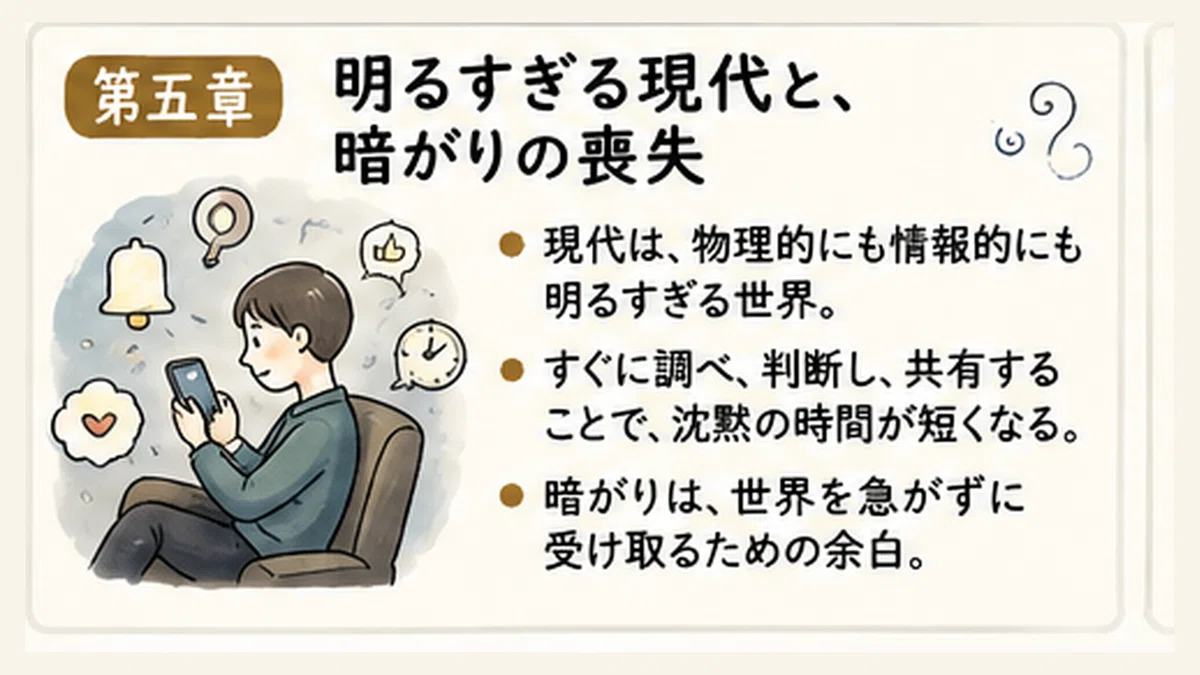
The light of modernity that Tanizaki saw has become even stronger now. It is not just electric lights. The light of screens, the light of notifications, the light of search results, the light of rankings, the light of reviews. We live in a world that is too bright, both physically and informationally. Things we don't understand are immediately looked up, recommendations are displayed before we are lost, evaluations enter our eyes before we read, and we know the atmosphere of a place through photos before we go.
That is convenient. We can avoid failure and save time. But on the other hand, we may be gradually losing the power to be with things we don't yet understand. Judging something immediately. Putting it into words immediately. Showing it immediately. Sharing it immediately. In such brightness, the time when things are silent becomes shorter.
The time spent walking while holding a feeling that has not yet become an impression after encountering a work. The time spent keeping someone's words within oneself for a while without immediately sorting them into pros and cons. The time spent leaving an unanswerable question right next to a sleepless night. It seems that such things are becoming increasingly difficult. Shadows are not a place to escape from the world. They are a margin for receiving the world without rushing. It is a space to avoid bringing things to light immediately, giving them meaning immediately, or consuming them immediately.
The shadows that Tanizaki praised are not just for old Japanese houses, but a sensibility that we in the modern age also need. Brightness certainly helps us. But there are things that cannot be received by brightness alone. Things we can approach precisely because they are not clearly visible. Things that remain precisely because they are not immediately understood. There are emotions, memories, and thoughts that finally begin to take shape in the shadows.
'In Praise of Shadows' reminds us of that. Seeing is not the only way to know. Making things bright is not the only way to enrich them. Sometimes we need to dim the lights a little, turn off the screens, not rush for answers, and place ourselves in the shadows. Only then might the lost wisdom and sensibility quietly return.
Conclusion: Literature as a House with the Lights Turned Off
I believe 'In Praise of Shadows' continues to be read today not just because it depicts the beauty of old Japan. Rather, this book is a volume that quietly asks us, what have we become less sensitive to in a world that is becoming brighter, faster, and more convenient?
Tanizaki did not completely reject the light of modernity. When faced with convenient things, people cannot help but use them. Understanding this, he still sought to record the value of the shadows that were disappearing. Even if shadows were being lost from actual houses and tools, he tried to preserve that darkness within his words.
Thinking of it this way, 'In Praise of Shadows' itself begins to look like a house with the lights turned off. Every time we open its pages, we step back from a place that is a little too bright and enter a space where things do not immediately reveal themselves. There, waiting becomes more important than seeing, and feeling becomes more important than understanding.
Precisely because we live in an age where we see too much, darkness is necessary. It is not a place to return to the past, but a place to receive the world once more, without rushing. 'In Praise of Shadows' still quietly keeps that place open for us.
