
Piggybacking is a technique where the receiver delays sending an acknowledgement (ACK) and attaches it to its next outgoing data packet. This reduces the number of separate control frames, improving network efficiency.
- Sliding window protocols allow the sender to transmit multiple packets before receiving acknowledgements, increasing throughput.
- Both sender and receiver maintain finite buffers to hold outgoing and incoming packets.
- Unacknowledged packets are retransmitted after a timeout.
Increasing Network Efficiency
Network efficiency can be improved by using full-duplex transmission, which allows simultaneous two-way communication between sender and receiver. Unlike simplex or half-duplex modes, full-duplex transmission enables both ends to send and receive data at the same time.
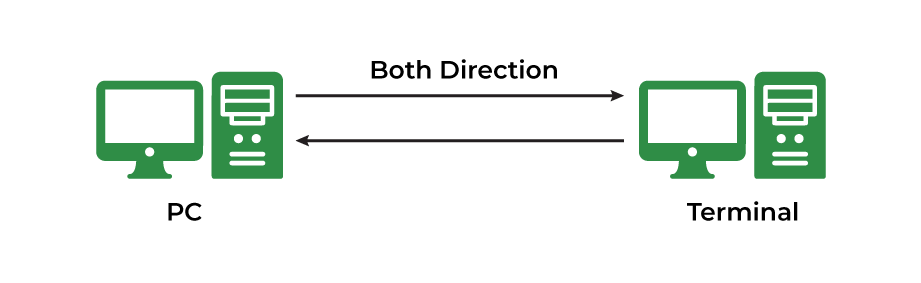
Full-duplex transmission can be achieved in two ways:
- Two separate channels: One channel is used for sending data, and the other for receiving data. However, this approach can waste bandwidth when traffic in one direction is low.
- Piggybacking: A more efficient method where data and acknowledgements share the same channel. The receiver delays sending the ACK and attaches it to the next outgoing data frame. The sender identifies data and ACK information using the frame header, reducing the number of separate control frames and improving overall network efficiency.
Working
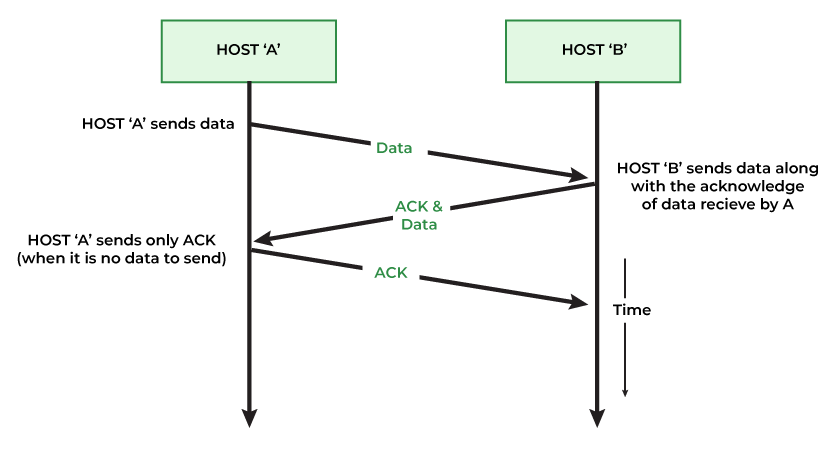
As we can see in the figure, we can see with piggybacking, a single message (ACK + DATA) over the wire in place of two separate messages. Piggybacking improves the efficiency of the bidirectional protocols.
- If a host has both data and an acknowledgment, it sends a single frame containing both.
- If only an acknowledgment exists, the host waits for some time to see if data is ready; otherwise, it sends the ACK separately..
- If only data is left, the last acknowledgment is included in the data frame.
Piggybacking makes better use of the available channel bandwidth by combining data and acknowledgment into a single frame, eliminating the need to send separate ACK frames. This reduces control overhead, lowers transmission costs, and improves the overall latency of data transfer, especially in bidirectional communication.
Piggybacking introduces additional protocol complexity because the sender must decide how long to wait before sending an acknowledgment. If the data link layer delays the ACK for too long while waiting for outgoing data, the sender may assume the frame is lost and retransmit it unnecessarily, leading to reduced efficiency.