
OSI and TCP/IP are both logical models. One of the main similarities between the OSI and TCP/IP models is that they both describe how information is transmitted between two devices across a network.
- OSI Model: It has 7 layers Physical layer, Data Link layer, Network layer, Transport layer, Session layer, Presentation layer, and Application layer. Each layer performs its task independently.
- TCP/IP Model: It has 5 layers named as Physical layer, Data Link Layer, Network layer, Transport layer, and Application layer. It can also be used as a communications protocol in a private computer network.
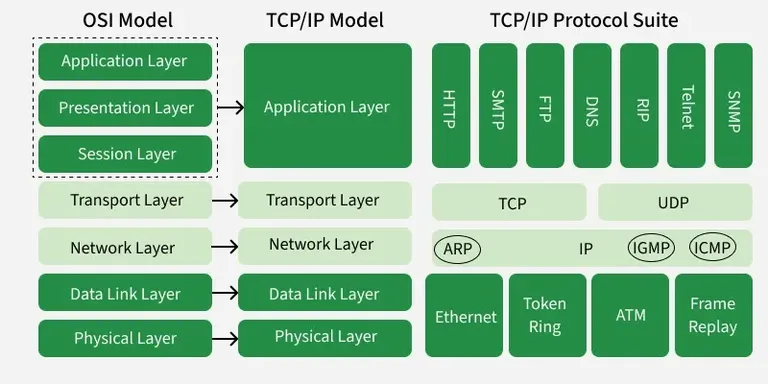
OSI Model
The OSI (Open Systems Interconnection) Model is a 7-layer conceptual framework used to understand and design network communication. Each layer has a clearly defined function and works independently of the others.
1. Physical Layer
Transmits raw bits over physical media.
- Deals with cables, connectors, voltages, signals
- Converts digital data into electrical/optical signals
- Defines hardware specifications (NICs, hubs, repeaters)
- Handles data rate, modulation, and physical topology
2. Data Link Layer
Provides reliable node-to-node data transfer.
- Uses MAC addresses for device identification
- Performs error detection and correction (Frame Check Sequence)
- Breaks data into frames
- Manages access to the physical medium (Ethernet, switches)
3. Network Layer
Handles logical addressing and routing of packets.
- Uses IP addresses for routing decisions
- Determines the best path to the destination
- Manages packet forwarding and routing tables
- Supports routers and Layer 3 protocols (IP, ICMP)
4. Transport Layer
Ensures reliable or fast delivery of data.
- Uses TCP (reliable) and UDP (fast, connectionless)
- Handles segmentation and reassembly of data
- Provides flow control (sliding window)
- Ensures error recovery and end-to-end communication
5. Session Layer
Establishes, manages, and terminates sessions.
- Controls dialog between devices (duplex/half-duplex)
- Maintains session checkpoints and recovery
- Handles session authentication and reconnection
- Used in RPC, SQL sessions, NetBIOS
6. Presentation Layer
Translates, encrypts, and formats data.
- Converts data formats (encoding/decoding)
- Applies encryption and decryption (SSL/TLS)
- Handles compression for efficient transmission
- Makes data readable for the application layer
7. Application Layer
Provides services to end-user applications.
- Supports protocols like HTTP, FTP, SMTP, DNS
- Provides network services such as email, web access, file transfer
- Interacts directly with user applications
- Identifies communication partners and resource availability
TCP/IP Model
The TCP/IP (Transmission Control Protocol/Internet Protocol) Model is a 5-layer practical networking framework used for real-world communication, especially on the Internet. It defines how data is packaged, addressed, transmitted, routed, and received across networks.
1. Physical Layer
Transmits raw bits over physical media.
- Deals with physical hardware: cables, signals, connectors
- Converts digital data into electrical/optical/radio signals
- Defines data transmission rate and physical topologies
- Supported devices include hubs, repeaters, and NICs
2. Data Link Layer
Provides node-to-node communication and framing.
- Uses MAC addresses for device identification
- Responsible for framing, error detection (FCS), and flow control
- Handles access to the transmission medium (Ethernet, Wi-Fi)
- Switches operate at this layer
3. Network (Internet) Layer
Handles logical addressing and packet routing.
- Uses IP addressing (IPv4/IPv6)
- Determines the best path to destination
- Performs packet routing and fragmentation
- Includes protocols: IP, ICMP, ARP, RARP
4. Transport Layer
Provides end-to-end communication and reliability.
- Uses TCP for reliable, connection-oriented communication
- Uses UDP for fast, connectionless, low-overhead delivery
- Handles segmentation, sequencing, and reassembly
- Provides error detection, correction, and flow control
5. Application Layer
Provides network services to end-user applications.
- Supports protocols like HTTP, FTP, SMTP, DNS, DHCP, SNMP
- Responsible for data formatting and communication services
- Directly interacts with user applications
- Handles resource sharing, remote file access, email, web browsing
Difference Between OSI Model and TCP/IP Model
Below are the main differences between OSI and TCP/IP model:
| OSI Model | TCP/IP Model |
|---|---|
| 7 layers: Physical, Data Link, Network, Transport, Session, Presentation, Application | 5 layers: Physical, Data Link, Network/Internet, Transport, Application |
| Separate Session layer manages connections/synchronization | No separate Session layer; handled in Application layer |
| Presentation layer handles data formatting/encryption | Data formatting/encryption done within Application layer |
| Theoretical model developed by ISO for standardization | Practical model developed by DoD for Internet use |
| Each layer strictly independent with clear interfaces | Layers more integrated, less strict boundaries |
| No specific protocols defined, just functions | Defines specific protocols: TCP, UDP, IP, HTTP, etc. |
| Used as reference for teaching/network design | Actual protocol stack used by Internet globally |
| Developed before widespread Internet use | Developed specifically for ARPANET/Internet implementation |