
[Mandala Dream Analysis] A dream of watching children go to school and learning that a nearby shrine was a round burial mound - An analysis example using the Dynamic Mandala Expansion/Contraction Model (β-Δ Model)

Mythological narratives and dream visionsarise from the same place in the"depths" of the human psyche.
In dream visions, the mysterious world that one can see, remember, and report in words after waking is a pattern that emerges when vibrations rising from the pulsations of the "depths" of the psyche are projected onto the very bottom of surface consciousness—the bundle of memories of sensory impressions. That pattern oftentakes the form of a mandala.
A mandalacombines a circle and a square.Because of the square, four terms and four poles naturally stand out, and four intermediate terms placed between those four terms emerge, depicting an eight-term relationship in total.
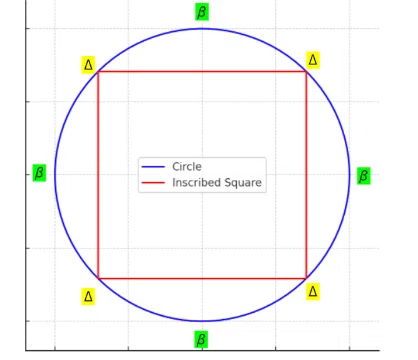
Thismandalacan be directlyvisualized (becoming a visual image)as an image of a four-term or eight-term relationship—a so-called mandala—or it canappear as an experience in a dream where the sense of distance between self and other expands and contracts.

For example, in a dream, it is a matter of four characters (of course, these four could be divided into more, or some of them could be omitted)repeatedly fighting, becoming friends, separating, and uniting.
In a dream, "I" and the other characters who are not meoscillate between separation and union, and between the poles of love and hate,unfolding in a certain space (within a circular space, inside a square room, or around a square table).
Alternatively, a mandala can be verbalized as a "mythological" narrative, as a story in which mythological gods or supernatural beings unite and separate, spin around, run away and chase each other, or split in half.
I am tentatively calling them "terms" in the sense that they appear to humans as something solid,butthey are more of apredicative aspectthat feels likemoving, pulsating, vibrating, oscillating, going back and forth.
The characters in a dream,are placed in the position of the subjectand reported as such. In other words, when the dreamer reports to the analyst, they are forced to speak—forced to verbalize—by saying things like, "A woman wearing a hat pulled down low..." but I would like to read this as actually being a case wherethe afterimage of the predicative aspect resonates and presents as a subjective aspect. I would like to focus not on "what," but on "how it is moving."
The predicate of expansion and contraction
This movementappears in dreams as an experience where the sense of distance between self and other expands and contracts.
In the preface to "C.G. Jung's Seminar on Pauli's Dreams,"the supervisor, Professor Toshio Kawai, writes the following.
Jung repeatedlyfocuses on the centrality of the mandala, but he also repeatedly points out thatacircular movement occurs around that center. As for the movement, the idea that what was once distilled upward falls back down is also interesting. Just as he states that "the unconscious isalso a movement," neither consciousness nor the unconscious are reified, but become movements. At the same time,the relationship and union of oppositesis not necessarily the relationship between consciousness and the unconscious, butbecomes, so to speak, something abstract. This would later come to fruition in his final work, 'Mysterium Coniunctionis,' as the 'union of conjunction and separation.'
The various terms that face and oppose each other on the mandala's circle (in this case, "consciousness" and "the unconscious") are bothmovements. The mandala and thevarious terms that oppose each other on it are "not reified", meaningthey are not things rolling around as solidified, defined, and characterized individual objects, but are events described by movements, motions, patterns of movement, or in other words, "predicates."
* *
From the perspective mentioned above, let us re-read the actual dream record using the diagram below as a guide.

The dream that a local shrine was a round burial mound
The dream I will attempt to analyze this time is a dream of my own, the person writing this text.
* * *
I am in the house where I lived when I was an elementary school student. In that house, I am already an adult, living with
two elementary school boys. These are my children,
a pair of brothers. In the morning
, I see them off at the entrance as they head to elementary school, saying "Have a good day." A while after they leave, I also head out of the house
. And I walk, trying not to be noticed
by the children, to follow them. I head toward the elementary school by taking a different route that runs parallel to the children's
commute path. * * * On the way, around the midpoint between the house and the elementary school, I
become anxious that I might have walked too fast and unknowingly overtaken the children, getting ahead of them. I look toward the commute path from a certain intersection to see the route the children would take. Then, I see the two of them walking along happily. Thank goodness, I haven't overtaken them. At this moment, I am aware of the children, but the children are not aware of me
. I feel relieved and start walking again. * * * Then, I arrive at the foot of a small hill surrounded by houses in a densely populated residential area. The area around the hill is filled with detached houses, and parts of the hill's perimeter are covered with retaining walls and have stairs. My inner voice tells me, "
This hill is an ancient burial mound." It says, "This burial mound is a
round burial mound
, and it is surrounded by a circular earthen rampart." Although it is hidden by the current residential development, I can see the image of a
round burial mound like an overturned bowl and the circle surrounding it
. I use the stairs to climb the burial mound. At the top, there is a magnificent shrine with a large main hall, and a giant "snake" shimenawa (sacred rope) made of woven dried vines of some plant
is hanging and dangling as if it is leaping out from under the eaves of the main hall. I stand under that snake and perform two bows and two claps respectfully.
When I catch a glimpse inside the dim main hall, I see a few people and lighting votive candles as if they are performing some kind of prayer, but the cloudy glass doors are closed so I cannot see well
. It is as if I can see them, yet I cannot. I try to descend the burial mound from the stairs opposite to the ones I climbed
. For some reason, there are two routes of stairs, and although the two sets of stairs are parallel, at the bottom of one of them, where it connects to the road, there is a large gate. It is not a shrine-like gate, but a modern one made of reinforced concrete with a built-in shutter, like the entrance to a parking lot. The shutter seems to be open, but I feel like this concrete structure itself might collapse, so I am cautious. Besides the route with the gate, there is another set of stairs next to it. This one does not have any gate-like structure at the connection to the road at the bottom. These stairs seem a bit narrower, but they are solidly built with stone masonry. I presume that these were likely the original stairs built on this burial mound a long time ago. I decided to go down these old-fashioned stairs without the gate. As I go down the stairs, I see the usual town. A town that looks very similar to the scenery of the town around my commute path to elementary school when I was a child spreads out before me. The end.
Let's read this dream by focusing on predicates that express the separation and union between two opposing terms, and the movement of expansion and contraction between them.
First, at the beginning, it is the scene of seeing the children off in the morning.
The children of the same gender are two, they are brothers. Two-as-one and one-as-two, a state where the β-binary terms are closely combined. This pair of elementary school students is also like myself. I also had a younger brother close in age, and we always went to elementary school together. However, these children in the dream are not us, but seem to be my own children.
Are they my current children, or are they us as brothers in the past?, it is an ambiguity that feels like both. This is also, in terms of mythologic, they are beings that are different yet the same, two-as-one and one-as-two, and they are moving together at the same speed in the same direction. This is a combined state of four β terms in total, an ambivalent mediating term β-binary term × binary term.
Past older brother 1 / younger brother 1
Present older brother 2 / younger brother 2
β
β * β
β

I see off these overly combined β-binary brothers. The predicate 'to see off' means that 'I' am temporarily separating from these children, the β-binary brothers.
However, as soon as I separate, I chase after the two. Chasing means, in other words, a movement to try to combine where there is separation.
Moreover, the dreamer, myself, chasing the children must not catch up to them. I, who am secretly watching over the children, must maintain a state of being combined yet separated, where I am looking at them but they are not looking at me.
β
↑↓
(maintaining an equal distance while expanding and contracting)
↓↑
β * β
・
・
・
(β)

This chase is carried out by the brothers and me moving in the same direction at about the same speed toward the route leading to the two lines.
---Older/Younger Brother (Child)----->
/
---Me (Parent)----->
Just like in special relativity, it is a phenomenon where between two parties moving at the same speed while maintaining an equal distance, they appear to be stationary to each other.
A stationary movement of trying to combine while remaining separated, and maintaining separation while remaining combined
I move with careful attention, knowing that it is not good to be too far apart, nor is it good to be too close. By maintaining a state of combining while separating, and separating while combining, I try to stabilize the expansion and contraction of the distance (moving apart and coming closer) within a certain range. It is exactly like the 'journey of the sun and moon in a canoe' analyzed by Mr. Lévi-Strauss in 'Mythologiques'. Through this stabilization of amplitude, an intermediate region that is neither too separated (too far apart) nor too combined (becoming one to the point of being indistinguishable) is secured between the β terms. This becomes the place where the Δ things that exist stably in an empirical and sensory sense reside.

For that reason, in the middle of this movement, I become anxious that I might have 'overtaken' them. If I were too fast and had overtaken them on a different route without knowing it, the stable state of moving in parallel in the same direction at the same speed, neither too close nor too far, would collapse.
In dreams, when things that should be separated are not, or things that should be combined are not, emotions that heighten tension such as anxiety, impatience, and confusion are often strongly felt.
*
I observe the other route from this route, confirm that the two children are moving through a point similar to mine (the midpoint between home and school), and feel relieved.
+ +
From here, the scene changes.
It is a round burial mound.
Climbing the round burial mound

The round burial mound is truly a circle.And at itscenteron the summit, a large, perhapssquare-shaped shrine buildingis standing.A square inscribed in a circle. It is a mandala.

Moreover, it is a "round burial mound" thatstands one level higher than the residential area.
Such a sacred site like a small hill isan ambiguous and mediating space that opens up between the two poles of heaven and earth.
And in this shrine on the round burial mound, there is adried "snake" hangingin mid-air along thevertical direction (the axis separating up/down). At this point, you might thinkthis sounds like an intentionally crafted story, but this is a dream I truly had. This shimenawa (sacred rope) is an artificial object, not a living snake. Moreover, thesnake, which should normally be moist and shiny, here has a dry and parched impression. This is also an ambiguous mediating term that brings together two empirically and sensually opposing poles into a single point.
Being suspended in mid-air also well expresses this intermediate nature. I enterunderneath this snake, that is, I approach it excessively on the vertical axis, andthen separate from it.By entering the center of the mandala, I too am becoming β-ized. In other words, it is a state where the distinction between being me and not being me is blurred and dissolved. There, while approaching the "suspended shimenawa in the form of a dried snake,"
I have my feet on the ground at the summit of the round burial mound, the snake's shimenawa is suspended in mid-air, and the distance between me and the snake is kept in a constant equilibrium.
Within the mandala of the shrine on the round burial mound, I am entering into the β-pulsation. There, the relationship between me and the priests inside the shrine alsotakes the form of being divided into the two poles of inside/outside, while being ambiguous, as if visible yet invisible, maintaining an equilibrium in the distance between them.
β1 Dreamer Me
β2 Snake Shimenawa
β3 Priests inside the shrine
The three ambiguous mediating terms gently stabilize their expanding and contracting movements and are inequilibrium.
Here, the ambiguous mediating terms are one short of "four."
With this, the shape of the mandala has not clearly emerged.
Is there not one more β-term?
Actually, the owner of the"inner voice" who told the β-dreamer me that"this hill is an ancient burial mound" is accompanying me, although they do not show their form. Thisowner of the inner voice is an existence like an older sister (or rather, the sister herself) who always appears in my dreams, so let's call herβ4.
* *
And then, another scene change.
Descending from the round burial mound
I (we) safely and calmly separate from this mandala. We head in the direction of
establishing a distinct empirical identity as Δ.
I descend in thedirection exactly opposite to the one I climbed up, crossing the diameter of the mandala's base. I leave in the direction opposite to where I originally came from.
East / West (South / North)
Up / Down
Come / Go
These binary oppositions stand out around the mandala.
At this point, let us note that there are two choices for the route to descend from the round burial mound. In the β-region, empirical and sensory entities are often "two." And this is not simply two of the same thing, but a two that is different yet the same, and the same yet different.
These two staircases are also different yet the same, and the same yet different.
One is a wide staircase that looks easy to pass at first glance, but there is a gate ahead, and it is unclear whether one can actually get through. One might not be able to exit. In other words, it has a feeling of <<being open, yet closed>>.
The other is a route that is narrow but has no gate to obstruct it. This one looks difficult to pass at first glance, but one can definitely get outside. It has a feeling of <<being closed, yet open>>.
<<Being open, yet closed>> / <<Being closed, yet open>>
Easy to pass but cannot pass / Difficult to pass but can pass
Easy to pass / Difficult to pass
×
Cannot pass / Can pass
The vague, unattainable β-feeling is well-expressed here.
I choose the "difficult to pass but can pass" route without hesitation.
Then, I return to this familiar world of the living.
Descending from the round burial mound, I find myself in a place like a small shopping street along the road between my house and the elementary school, where various shops I always see are lined up, and many neighbors are walking about on their daily errands.
Summary
The pulsation of the "depths" of the heart makes one speak in words or imagine the "one is four, four is one" principle, where one is divided into four or four are integrated into one.
This image of four-as-one and one-as-four is the mandala.
The mandala is sometimes experienced as a visual image in the form of a four-term or eight-term relationship, and sometimes reported as an experience in a dream where the sense of distance between self and other expands and contracts.
The mandala not only takes the form of an icon drawn on a flat surface, but also appears as a figure mapped onto the linear arrangement of language.
In the case of myths or dreams verbalized and reported after waking, it follows the linear arrangement of the surface of language, such as "A does x, B does y, then C is supposed to do z, and while doing that...", so at first glance it is difficult to see that it depicts a "mandala"-like four-term relationship or a double four-term relationship (eight-term relationship). However, it can be said that the linear narrative is also a mapping of the vibration pattern itself, which brings the mandala pattern to the surface on a two-dimensional plane, onto a one-dimensional straight line.

+ +
In the recollection of the transformation of dream visions in chronological order and in the linear arrangement of language reporting the dream, to evaluate whether a double four-term relationship (whether the four ambiguous mediating terms β are balanced without getting too close or too far, and whether a place where the Δ term can stably settle is precipitated in the middle of the amplitude of the expanding and contracting β terms. In other words, whether a <clean> mandala as a circle inscribed in and circumscribing a square is being drawn, or whether it fails to become a mandala and collapses, with only one of the terms protruding, moving around, or becoming solidified) is depicted, it seems good to pay attention to the movement that expands and contracts the distance (physical, psychological) between the ambiguous mediating terms, especially predicate-like visions related to such movements and the selection of predicates in the narrative.
In dreams, often, losing something important (something that should be connected to me) (separating from me) or not being able to make it to an important appointment I have to go to, or not being able to reach my destination even though I am supposed to be heading there (remaining separated from where I should be connected; the place where distance should be shortened is stretched), the expansion and contraction of the mandala appear as experiences of anxiety, heart-pounding, or walking a tightrope.
In this dream as well, predicative aspects related to expansion and contraction appeared, such as watching over the pair of children while maintaining an equal distance.
*
However, in this dream, although I, the dreamer, am caught up in the expansion and contraction, the color of anxiety is faint.
When I had this dream, my daily life during the day was not facing any particular <significant excessive separation (being forcibly separated from people or things I want to stay connected to)> nor was it facing any <significant excessive attachment (being hounded by people or things I do not want to be involved with or want to distance myself from)>.. If I had to say, whether the children are managing okay at school is a concern if you could call it that (the children who should be <attached> to me have <separated> from me and are going off on their own to places I don't know). That said, there is no major problem occurring that would make the children hesitate to go to school.
At times like this, the depths of the heart likely do not vibrate intensely, but rather drift while maintaining a moderate balance.
To be continued
<<Advertisement>>
Information on Personal Dream Analysis Sessions

In my primary work, I, the author of this text, provide coaching and other services to help people in corporate organizations articulate their organizational communication challenges and think for themselves about better forms of communication.
Dream analysis is similar in that it is a method that allows each of us to explore and develop our own style of 'communication with our own unconscious'.
With that said, for those who want to analyze their own dreams, learn how to analyze them, and thereby explore ways to communicate with their own 'self', I will be offering a personal coaching course (online) in the same format as my primary business.
・1-hour personal session x 3-session course (30,000 yen including tax)
・1-hour personal session x 5-session course (50,000 yen including tax)
・Companion course for executives and organizational leaders (estimate from 1.1 million yen (tax included) for 4 months)
→Held online using Zoom or Meet.
→Dates and times can be discussed individually.
→Continuing sessions beyond 3 or 5 times is also welcome (10,000 yen including tax per session)
'I want Dr. Way-finding to analyze my dreams!'
'I want to receive training so I can analyze my own dreams!'
'If there is anyone who wants to face the messages from the unconscious (dreams) and nimbly overcome a chain of stressful decisions', please feel free to knock on my door.
Using an analysis sheet that adapts the 'Dynamic Mandala Expansion/Contraction Model (β-Δ Model)' developed by the authors for dream analysis, we will clarify the issues that the unconscious knows even if the consciousness is not consciously aware of them, and which are being communicated to the consciousness through dreams. Of course, I will also generously teach you how to analyze your own dreams yourself.

Dynamic Mandala Expansion/Contraction Model (β-Δ Model)

For applications and inquiries, please use the email address below.
info.wayfin.office@gmail.com
・Please copy and use the email address above.
・Please include the following information in your email.
Name (a handle name is fine for inquiries)
Just write 'I would like a dream analysis session!'
Your preferred session start time (e.g., soon, from six months from now, etc.)
・We will get back to you with details.

Related Articles
いいなと思ったら応援しよう!
 最後まで読んでいただき、ありがとうございます。
いただいたサポートは、次なる読書のため、文献の購入にあてさせていただきます。
最後まで読んでいただき、ありがとうございます。
いただいたサポートは、次なる読書のため、文献の購入にあてさせていただきます。