
Stopping the Hollowization of Goal Management with 'Systems'—Concrete Steps to Balance Engagement and Results

"Our company's goal management system isn't working well." I hear this concern from managers and executives at many companies. Goals set with enthusiasm at the beginning of the term are eventually buried in daily tasks and forgotten until the rush of the year-end evaluation period. Isn't this scene playing out in your workplace as well? And do you dismiss the cause as a matter of individual character, saying things like, "The employees' awareness is low" or "They lack a sense of ownership toward their goals"?
However, if that is the case, you may be misjudging the essence of the problem. The real reason goal management falls into dysfunction is far more often due to an "absence of systems" rather than personal factors like employee awareness or ability. Unless people have an exceptionally strong will, it is difficult to keep medium- to long-term goals in mind while being chased by urgent daily tasks. This is a very natural behavioral characteristic of humans and is by no means solely the responsibility of the individual.

This time, I will uncover the fundamental reasons why goal management becomes hollow. Then, instead of relying on individual awareness, I will systematically explain what kind of "systems" are needed for an organization to steadily advance toward achieving its goals, from concrete construction methods to creating a culture that makes them stick. I hope this article will help transform your company's goal management from something that is "just set" into a powerful engine for "producing results."
Chapter 1: Why Does Goal Management Become Hollow? ~Before Blaming Employee Awareness~
A Common Misconception: The Easy Conclusion of "Low Awareness"
In many workplaces, the first reason cited for why goal management doesn't work is "low employee awareness." Managers say things like, "My subordinates forget the goals they set," "They don't see the goals as their own and feel forced to do them," or "I want them to act more proactively toward achieving their goals." These voices are the real feelings of managers struggling with daily management, and they are by no means wrong. However, if you conclude that it is a "problem of individual awareness," you cannot take effective measures. This is because that is a symptom, not the root cause.
If you seek the cause in something invisible and vaguely defined like "awareness," you tend to end up with mental arguments like "raise your awareness more" or "take initiative." However, such mental approaches rarely change employee behavior in a sustainable way.
In fact, there is even a danger of falling into a negative spiral where subordinates get fed up, thinking "it's that mental talk again," and supervisors feel helpless, thinking "no matter how many times I say it, it doesn't get through." Before seeking the location of the problem in the individual's inner self, you must first look at the "environment" and "systems" surrounding that individual.
Human Behavioral Principles: People Prioritize the "Urgent" Over the "Important"
The background to why goals are forgotten is related to universal human behavioral principles. Recall the "Time Management Matrix" proposed by management consultant Stephen R. Covey. Tasks are classified into four quadrants based on two axes: "importance" and "urgency."
Many people are chased daily by the first quadrant, which is "urgent and important" (such as handling complaints or work with deadlines). And the second quadrant, which is "important but not urgent" (activities toward achieving medium- to long-term goals, self-investment, building relationships, etc.), which should be the focus, tends to be put on the back burner.
Is this because their will is weak or their awareness is low? That is not the case. Responding to a phone ringing in front of you or emails arriving one after another is a very natural reaction for the human brain. Highly urgent tasks demand immediate response from us and give us a sense of short-term accomplishment.
On the other hand, steady activities toward achieving goals months or a year from now do not show results immediately, so their priority inevitably drops. There is a limit to resisting this instinct by relying on an individual's "willpower." That is precisely why a "system" that allows you to engage in second-quadrant activities without even thinking about it is essential.

Five Flaws in "Systems" That Lead to Hollowization
If it is not a problem of employee awareness but a problem with the system, what specific flaws can be considered? The following five are typical patterns seen in many companies.
Management by "Points": Setting goals at the beginning of the term and only checking the results at the time of the year-end evaluation. In an operation where you only touch on goals at these two "points," it is natural for goals to be disconnected from daily work. The process toward achieving the goals becomes completely black-boxed.
Divergence from Daily Work: A case where the set goals are far removed from daily work content. When "special activities to achieve goals" are required separately from regular work, they are perceived as "extra work" that puts pressure on original duties and are gradually avoided.
Lack of Opportunities for Dialogue: A state where there is no place for supervisors and subordinates to regularly talk about the progress of goals, or where that place has become hollow. Subordinates carry problems alone, and time passes without supervisors grasping the subordinates' situation.
Goals Only for Evaluation: When goal management only functions as an "evaluation tool" to determine raises or bonuses, employees start setting safe, achievable goals. The original purpose of "challenge" or "growth" is lost, and the entire system loses its vitality.
Inability to Respond to Situational Changes: The business environment is constantly changing. It is not uncommon for the prerequisites of goals set at the beginning of the term to change a few months later. Nevertheless, in a rigid operation where goals cannot be changed until the end of the term once set, employees feel that "this goal no longer has any meaning" and lose motivation.

These flaws are all problems in system design that have nothing to do with individual awareness. In other words, by building a "system" that resolves these flaws, goal management has the potential to improve dramatically.
Chapter 2: The Big Picture of a "System" That Makes Goal Management Function
From "Points" to "Lines": The Importance of Keeping the Cycle Turning
The core of regenerating hollow goal management is to evolve the way of management from "points" to "lines," and from "lines" to "circles (cycles)." Instead of managing only with two "points"—goal setting at the beginning of the term and evaluation at the end—you need to focus on the process in between, that is, the "line" of daily activities toward achieving the goals. Furthermore, building a system that keeps that line turning as a continuous "cycle" is the key to realizing living goal management.
This cycle is not just PDCA (Plan-Do-Check-Action). Of course, the concept of PDCA is important, but what I want to emphasize here is a cycle with blood in its veins that places more importance on "dialogue" and "reflection."
Specifically, it is an image of repeating a series of flows—"(1) Goal Setting (Set)" -> "(2) Daily Execution (Do)" -> "(3) Regular Progress Confirmation and Dialogue (Check & Dialogue)" -> "(4) Course Correction and Learning (Action & Learning)"—many times over a short span. By embedding this cycle into the organization as a system, goals become "one's own business" for the first time and begin to live within daily work.

Three Elements That Hold the Key to Success: "Visualization," "Dialogue," and "Flexibility"
To effectively turn this goal management cycle, it is necessary to incorporate three important elements as a system.
Visualization (Visibility)
It is a major premise that the set goals are in a state where anyone can easily check them at any time. The ideal is a state where not only your own goals but also the goals of your supervisor, colleagues, and the entire team are open. If goals are in an environment where they are always visible, people will find it easier to be aware of them. It is not enough for them to be saved in an individual's notebook or a local file on a PC. The first step is to "visualize" goals as shared organizational assets by utilizing internal SNS, goal management tools, or physical whiteboards.Dialogue
The heart of the system is the opportunity for regular 'dialogue.' The most effective method is likely 1-on-1 meetings between managers and subordinates. This is not a venue for managers to manage or evaluate a subordinate's progress. It is a 'co-running' space where subordinates can safely discuss current challenges or issues, and managers can listen and think through solutions together. It can be a short session of about 30 minutes, once a week or every other week. Through this dialogue, concrete next actions toward achieving goals become clear, and the subordinate's motivation is maintained and improved.Flexibility
There is no need to be fixated on goals once they are set. A system is needed that allows for the flexible review of goals themselves or the approach to achieving them in response to changes in the external or internal environment, such as market shifts, competitor moves, or changes in organizational strategy. If there is no environment where employees can honestly report when they feel a goal no longer fits the current situation and revise it through constructive discussion, they will end up continuing meaningless activities. This 'flexibility' ensures the realism and effectiveness of goal management.

The Great Positive Impact of a 'System' on the Organization
A goal management cycle that incorporates 'visualization,' 'dialogue,' and 'flexibility' does more than just increase the probability of achieving goals. It brings the following positive impacts to the entire organization.
Improved Engagement: Through regular dialogue, employees can realize how their work contributes to the company's goals. Also, by feeling supported by their managers, their sense of belonging to the company and enthusiasm for their work increase.
Fostering Psychological Safety: An environment where progress delays or failures can be discussed honestly, such as in 1-on-1 meetings, enhances psychological safety. Employees become more willing to take on new challenges without fear of failure, improving the organization's overall learning capacity.
Cultivating Autonomous Talent: By shifting from a 'management' style to a 'co-running' style, subordinates begin to think and act for themselves. Through the process of achieving goals, each employee's problem-solving ability and autonomy are nurtured.
Improving Organizational Agility: By repeating progress checks and course corrections in short cycles, the organization becomes able to respond quickly to environmental changes. It becomes possible to drive business at a speed that cannot be matched by annual plan reviews.

In this way, rebuilding the goal management system is an important management strategy to strengthen the foundation of the organization and enable sustainable growth.
Chapter 3: Concrete Steps for Introducing a 'System'
So, how should we actually introduce a 'system' that makes goal management function within an organization? Here, I will explain it in four concrete steps.
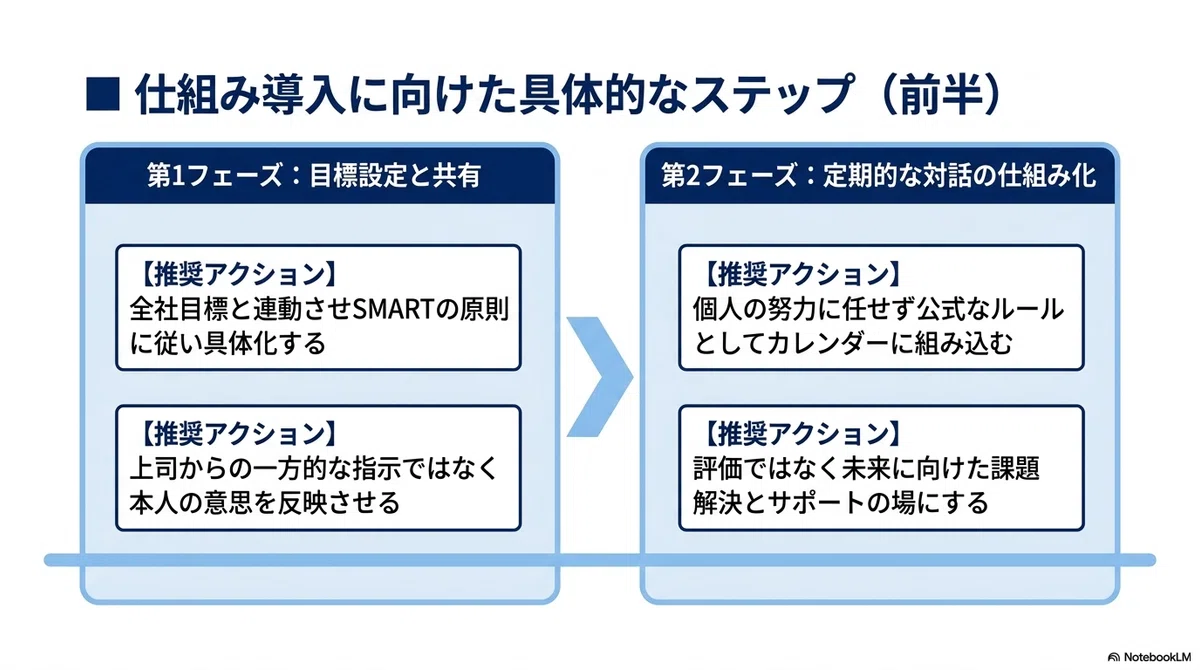
Step 1: Fundamentally Review the Quality of Goal Setting
Everything begins with high-quality goal setting. If you stumble here, the subsequent cycle will not work well.
Alignment with Company-wide Goals
First and most importantly, individual goals must be clearly linked to departmental goals and the company's overall goals. Why are we working on this goal, and what does its achievement mean for the entire organization? We aim for a state where every employee understands and is convinced of this connection.
Utilizing frameworks like OKR (Objectives and Key Results) to break down the company's major Objectives into concrete Key Results for each team and individual is highly effective. This creates a sense that daily tasks are connected to the company's larger purpose, or in other words, a 'sense of contribution.'
Re-thoroughly Applying the 'SMART' Principles
It is important to thoroughly re-apply the 'SMART' principles (Specific, Measurable, Achievable, Related, Time-bound), which are known as the basics of goal setting. Instead of vague goals like 'increase sales,' make them concrete to a level where anyone who hears them will have the same interpretation, such as 'increase sales from new customers by 10 million yen in 3 months through such-and-such initiative.'
Eliminating the 'Forced' Feeling and Making it 'Personal'
Goals should not be unilaterally imposed by a manager but should reflect the individual's own will. After conveying the company's direction and the team's role, the manager should ask questions like, 'What kind of contribution can you make to achieve this team's goal?' or 'What would you like to challenge yourself with for your own growth?' and provide a process for the subordinate to think about and propose their own goals. Of course, final alignment with the manager is necessary, but this feeling of 'I decided this myself' is the first step toward viewing the goal as a 'personal matter.'
Step 2: Incorporate Regular Dialogue as a 'System'
The core of managing goals as a 'line' is the space for regular dialogue. The secret to success is not to leave this to individual effort, but to incorporate it into the calendar as an official company 'system.'
Introduction and Establishment of 1-on-1 Meetings
The most powerful tool is the 1-on-1 meeting between manager and subordinate. The ideal frequency is 30 minutes once a week or every other week. The important thing is not to make this a 'progress report meeting.' It is better to let the subordinate lead the agenda and have them talk about 'progress since last week,' 'what I am currently struggling with or feeling is a challenge,' and 'next action plans.' The manager's role is not as an evaluator, but as a coach or mentor who listens deeply to the subordinate (active listening), asks questions that prompt realization, and offers necessary support. This psychologically safe space for dialogue makes the path to achieving goals steady.
Sharing Progress in Team Meetings
In parallel with 1-on-1s, it is also effective to regularly set aside time in team meetings to share each member's goal progress. However, this should not be a mere report meeting either. It is important to share each member's progress and challenges with the whole team and make it function as a space for mutual cooperation and learning, such as saying, 'I might be able to help with that challenge of yours using this method,' or 'That knowledge seems applicable to another project in the team.'
Step 3: 'Visualization of Progress' Visible to Everyone
To improve the quality of dialogue and focus the entire organization on goals, it is essential to make progress status open.
Utilization of Goal Management Tools
While operation is possible with spreadsheets, I recommend introducing a dedicated goal management tool if possible. Many tools are equipped with features to visualize goal alignment, dashboard features to display progress rates in graphs, and features to keep minutes of 1-on-1s, which will dramatically increase operational efficiency.
Opening Up Progress Status
By utilizing tools or the company intranet, as a general rule, make the goals of each individual and team, as well as the progress of their Key Results, public to all employees. This makes it immediately clear whose work is connected to whose. Also, it becomes easier for positive interactions to occur, such as being stimulated by the progress of other members or teams, or naturally helping a team that is struggling. Transparency becomes the soil that cultivates a culture of healthy competition and collaboration.
Step 4: Revamp the Approach to Evaluation and Feedback
When goal management is freed from the shackles of being 'for evaluation purposes only,' it truly unleashes its potential.
Evaluate Processes and Challenges
At the end of a period, you should stop using goal achievement (results) as the sole 100% standard for evaluation. While results are certainly important, it is equally vital to include the 'process' in your evaluation—what challenges were taken on, what ingenuity was applied, and what was learned even from failures. This allows employees to take on high goals without fear of failure.
Feedback is for the 'Future'
The purpose of feedback is not to judge past actions. It is to increase the potential for future success. Instead of past-oriented questioning like 'Why couldn't you do it?', strive for future-oriented, constructive dialogue such as 'How can we apply this experience next time?' or 'What other methods could be considered to achieve the goal?' Providing feedback in real-time through 1-on-1s and other means, rather than just at the end of the period, maximizes learning effectiveness.

Chapter 4: Building a Culture to Embed the System
No matter how precisely a system is designed, if it does not take root as an organizational culture, it will eventually become obsolete. To make the system come alive and operate continuously, conscious efforts to foster culture are essential.
The Most Important Factor: Strong Commitment from Management
Organizational culture transformation always starts from the top. When revamping the goal management system, it is an absolute prerequisite for management to deeply understand its essence and promote it with strong will. Executives must repeatedly speak to employees in their own words about why this reform is being undertaken and what its purpose and significance are. Continuously sending a powerful message that 'This is not just a change in personnel policy, but a fundamental transformation of organizational management to ensure we win in the market and grow sustainably' is essential to gaining employee buy-in and cooperation.
It is also important to lead by example, not just with words. Management should make their own goals open, provide regular progress reports, and show themselves practicing this new cycle. By integrating this system into the management decision-making process itself—such as by including goal progress checks on the agenda of executive meetings—their seriousness will be conveyed to the entire company.

From 'Evaluator' to 'Partner' for Managers
In the new goal management system, managers play the most important role. It is no exaggeration to say that their mindset and skills determine the success or failure of the system. They need to shift their role perception significantly from the traditional 'managing and evaluating subordinates' to 'a partner supporting the growth and success of subordinates.'
To achieve this, sufficient training for managers is essential. Beyond just conveying the purpose and background of the new goal management system, provide opportunities to acquire specific skill sets. For example, it is important to prepare practical training programs on how to conduct effective 1-on-1s, listening skills, how to ask coaching-style questions that prompt awareness, and methods for future-oriented feedback. The company should provide maximum support so that managers themselves understand the significance of this change and can confidently engage in their new roles.
Accumulate Success Stories with a Small Start
Attempting to roll out a major transformation across the entire company at once increases the risk of resistance and confusion from various departments, leading to failure. This tendency is particularly pronounced in organizations that have had a strong top-down culture.
Therefore, a 'small start' approach is effective. First, select specific departments or teams that are positive about the change as a pilot (test) group and introduce the new goal management cycle there. Operate it in that small unit for several months to identify what went well and what needs improvement. Through this process, operational know-how optimized for your company will be accumulated, and success stories will be created.
These 'small success stories' are extremely important. They become concrete model cases for other departments, fostering a positive atmosphere that says, 'If it works in that department, maybe we can do it too.' By sharing the insights and success stories gained from the pilot introduction across the company and gradually expanding the scope of implementation, you can soften resistance to change and enable a smoother company-wide rollout.

Summary
The deep-seated problem that 'goal management doesn't work.' The cause was not in individual qualities like employee 'consciousness' or 'proactivity,' as previously thought. The real cause lies in the 'absence of a system' that allows goals to be separated from daily work and forgotten. Humans are creatures that instinctively prioritize urgent tasks and put off goals that are important but not urgent. An approach that ignores this human characteristic and relies on mentalism or individual willpower has reached its limit.
Truly functional goal management does not depend on individual consciousness, but on building an environment as a company system where everyone can naturally face their goals. The core lies in incorporating the cycle of 'remembering, discussing, and reviewing' goals regularly into the rules, in the form of 1-on-1 meetings and team meetings. 'Visualize' goals and progress, 'dialogue' frequently between supervisors and subordinates, and 'flexibly' adjust course according to the situation. When this cycle begins to turn, goals change from something 'forced upon you' to something you 'pursue,' and the energy of each employee is focused in the direction the organization should head.
This is not just a minor change in personnel policy. It is the first step in a grand organizational transformation that changes the role of managers from 'administrators' to 'partners,' transforms the organization's communication style, and fosters a culture that celebrates challenge and learning. If you change the system, people's actions change, and the organization changes. Beyond that, a future awaits where each employee works vibrantly, and the organization as a whole grows flexibly and powerfully.

