


Recently Published
Stay up-to-date with the latest content from NASA as we explore the universe and discover more about our home planet.

NASA and its international partners are set to receive scientific research samples and hardware as a SpaceX Dragon spacecraft is scheduled to depart the International Space Station on Tuesday, June 16, for its return to Earth. Watch NASA’s live undocking…

This March 20, 2026, image of Messier 64, or the Black Eye Galaxy, is a composite view from NASA’s Hubble Space Telescope and James Webb Space Telescope. It shows Messier 64 captured at near- and mid-infrared wavelengths by Webb, while…

Meet the astronauts who will fly on Artemis III: Commander Randy Bresnik, Pilot Luca Parmitano, and Mission Specialists Frank Rubio and Andre Douglas. In this special presentation of Houston We Have a Podcast, the Artemis III astronauts discuss their backgrounds…

The Artemis III astronauts discuss their backgrounds and training ahead of them to prepare for one of the most complex human spaceflight missions in history. Episode 426.

Looking somewhat like a swarm of bees returning to their hive, this NASA Hubble Space Telescope image features the galaxy cluster MACS0329-0211.

The city’s metro area has pushed westward since it last hosted World Cup matches in 1986, expanding across a landscape shaped by ancient volcanoes.

NASA is introducing a new funding opportunity to accelerate academic research and technology development. The Minority University Research and Education Project Space Technology Artemis Research (M‑STAR) application window opened Thursday and will remain open through 11:59 p.m. EDT on Tuesday,…
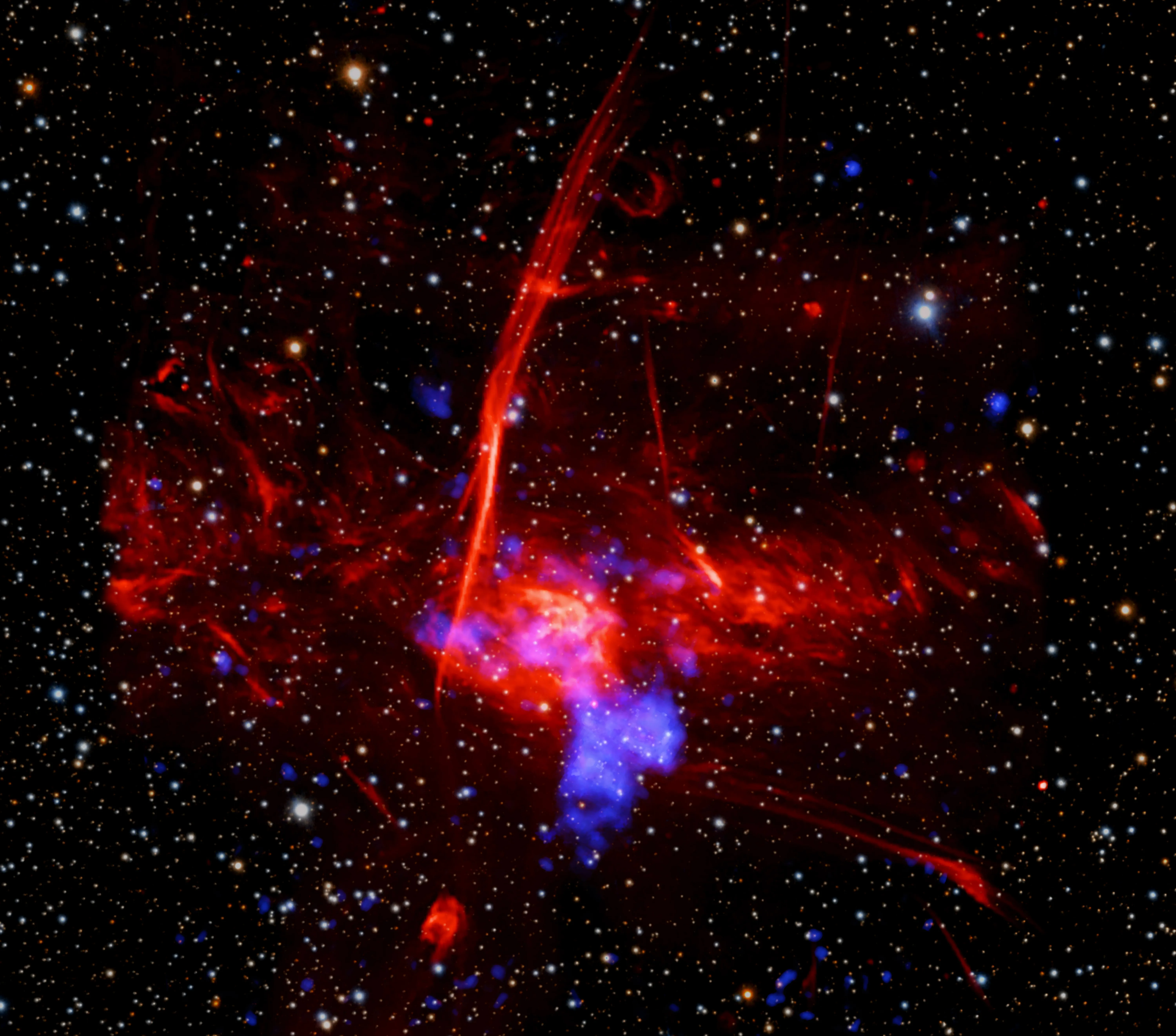
Using data from NASA’s Chandra X-ray Observatory, astronomers may have found a supernova remnant in an intriguing neighborhood in the middle of our galaxy. A paper describing these new findings published in The Astrophysical Journal. Supernova remnants are the expanding…

Listen to this audio excerpt from Elkin Norena, resident management officer, NASA’s Space Launch System Program: NASA’s Elkin Norena has helped the agency launch more than a dozen space shuttle missions – that’s more than a dozen crews to low…

Microbiology dominated the research schedule aboard the International Space Station on Thursday helping doctors protect health on Earth and in space. The Expedition 74 crew also tested a new spacesuit, packed a U.S. cargo spacecraft, and kept up lab maintenance…

A new type of gamma-ray sensor developed by NASA will take part in a robotic arm demonstration on the agency’s upcoming Fly Foundational Robots mission.

A soccer ball floats in microgravity in this March 2, 2026, picture from the International Space Station. The space station crew tested soccer balls to study how internal mass affects motion and stability in microgravity. The findings have improved understanding…

At NASA, remaining a global leader in exploration and innovation includes having a skilledand dedicated workforce. Technicians play a critical role in advancing the agency’sresearch and missions, applying hands-on expertise across engineering, fabrication,electronics, and countless other technical fields. To help…

NASA’s Parker Solar Probe completed its 28th close approach to the Sun on June 8, again matching its record distance of 3.8 million miles from the solar surface. The flyby allowed the spacecraft to continue its measurements of the solar…

Equipped with rock picks and hand lenses, a team of geoscientists deployed to the Mojave Desert recently to investigate a tantalizing “fingerprint” detected by a NASA sensor. Their target: a cache of topaz hiding in plain sight. The geologists weren’t…

NASA will host an audio-only media teleconference at 11 a.m. EDT, Wednesday, June 17, to preview the Katalyst Space mission to boost the orbit of NASA’s Neil Gehrels Swift Observatory. Katalyst’s robotic servicing spacecraft, called LINK, will attempt to rendezvous…

The TEMPO mission helped scientists track morning nitrogen dioxide that contributed to afternoon ozone along the New York–Washington corridor in May 2026.

Written by Catherine O’Connell-Cooper, APXS Strategic Planner and Payload Uplink/Downlink Lead, University of New Brunswick, Canada Earth planning day: Friday, June 5th, 2026 In a very broad sense, Curiosity has two modes of doing science – one centred around a…

Space nuclear power and propulsion engineering could play a key role in sending robots and humans to deep space, enabling faster and farther journeys.

NASA has selected multiple small businesses for the Western Regional Multiple Award Construction Contract, which supports a broad range of facility enhancement, modernization, and sustainment work at NASA’s Armstrong Flight Research Center in Edwards, California, NASA’s Ames Research Center in…

A dozen students participating in NASA’s 2026 Student Airborne Research Program collected data about the atmosphere, using a weather balloon that measures ozone concentrations as it rises.

Engineers completed installation of Katalyst’s LINK into a Northrop Grumman Pegasus XL rocket on June 9 at NASA’s Wallops Flight Facility.

Abstracts are now being accepted for the session, which will take place at the 2027 AMS Annual Meeting.

Scientific hardware installations and biomedical monitoring topped the research schedule aboard the International Space Station on Wednesday. The Expedition 74 crew members also adjusted a spacesuit to prepare for a spacewalk and explored space physics to round out their day.

As NASA plans long-term missions on the Moon, the agency could use robots to perform routine tasks, allowing crew members to dedicate more time to science and exploration. However, robotic motion control requires complex technology and advances in features like…