No fluff, no deep dives into unsafe code. Just the ownership model, translated into Java terms you already know.
If you’ve spent years writing Java, you already have a solid mental picture of how memory works — objects live on the heap, the JVM’s garbage collector sweeps up after you, and NullPointerException is your oldest frenemy. So when you first hear about Rust’s borrow checker, it’s easy to think: “Why would I need that? I already have a GC.”
That’s exactly the mental block most Java developers hit. And honestly, it’s a fair one. The GC is invisible, it mostly works, and you’ve learned to live around it. But Rust is solving a fundamentally different problem — and once you see it through a Java lens, the borrow checker stops feeling like an obstacle and starts feeling like a very strict (but very helpful) senior engineer on your team.
In this guide, we’ll walk through ownership, borrowing, and lifetimes using Java analogies. No memory addresses, no pointers, no unsafe blocks. Just practical mental models to get you past the initial confusion.
Why Java developers are looking at Rust right now
Before we get into the mechanics, it’s worth understanding why this matters. Rust has been the most admired programming language on Stack Overflow’s Developer Survey for nine consecutive years. In 2024, it earned an 83% admiration rate, and in 2025 it still held the top spot at 72%. Meanwhile, Java sits at around 55–60% — respected, but rarely “loved.”
Developer Admiration: Rust vs. Java (Stack Overflow Survey)

Additionally, JetBrains’ State of Developer Ecosystem 2024 found that Rust developers already command salaries approaching Java’s — despite Rust having a fraction of the job market share. That gap is closing. Furthermore, the White House and the NSA have both issued guidance recommending memory-safe languages like Rust as alternatives to C/C++ in critical infrastructure — a signal that the industry is shifting.
In short: Rust isn’t going away, and if you’re a Java developer curious about systems programming, performance-critical services, or just wanting to understand what all the fuss is about, the borrow checker is the first — and biggest — conceptual wall to climb.
The core difference: compile time vs. runtime
Here’s the single most important thing to understand before anything else. Java and Rust both prevent you from shooting yourself in the foot with memory — but they do it at completely different moments in time.
The security guard analogy
Java (GC)
Imagine a concert venue where anyone can walk in. After the show, a cleanup crew sweeps through to remove everyone who left trash behind. The experience is smooth for attendees, but the cleanup has a cost — and sometimes it interrupts the next performance.
Rust (borrow checker)
Now imagine a venue where a strict security guard at the door checks every ticket. Some people get turned away and have to fix their ticket first. But once inside, there’s zero cleanup needed — ever. No pauses, no GC overhead, no surprises.
The garbage collector is a runtime safety net — it’s reactive. The borrow checker is a compile-time gatekeeper — it’s proactive. This is why Rust programs, once they compile, tend to “just work.” As the popular Rust community saying goes: if it compiles, it usually runs correctly.
Ownership: one object, one owner — sound familiar?
In Java, when you do String name = "Alice"; and then pass name to a method, both the caller and the method have a reference to the same object. The GC figures out when nobody holds a reference anymore and cleans it up. Multiple parties can hold references simultaneously — that’s entirely normal.
Rust works differently. Every value has exactly one owner at a time. When that owner goes out of scope, the value is automatically freed. No GC needed. Think of it like this:
Rust Ownership Rule
Ownership in Rust is like a house deed. Only one person holds it at any time. If you hand your deed to someone else (a “move”), you no longer own the house. You can’t sell it, rent it, or demolish it — the new owner controls it entirely.
The Java equivalent you might reach for is AutoCloseable resources in a try-with-resources block. You open a file, use it within the block, and it’s automatically closed and released when the block ends. That’s ownership thinking — a resource is tied to a specific scope, and it’s deterministically released when that scope exits.
The key difference is that in Rust, everything works this way, not just resources you explicitly open.
Borrowing: references with rules
Of course, real programs need to share data. Rust handles this through borrowing — you can lend a value to another part of your code without transferring ownership. However, the borrow checker enforces strict rules about how borrowing can happen.
- 1Many readers, no writers. You can have as many immutable references (read-only borrows) as you want, at the same time. This is like multiple threads calling a
synchronizedgetter in Java — reads are fine in parallel. - 2One writer, no readers. If you have a mutable reference (a write borrow), no other reference — mutable or immutable — can exist at the same time. This is the rule that surprises most Java developers at first.
- 3References must not outlive the data. You can’t hold a reference to data that has already been freed. This eliminates dangling pointers entirely — a class of bugs Java’s GC also prevents, but Rust does it without any runtime overhead.
The second rule is where many Java developers hit confusion. Let’s translate it directly.
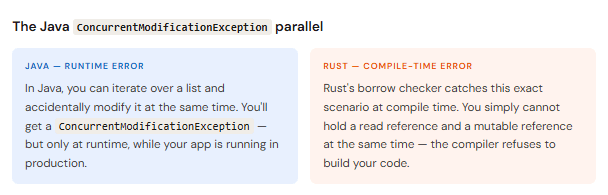
Think about that. An entire category of bugs that Java catches (or fails to catch) at runtime, Rust eliminates at compile time. Furthermore, this is the same pattern that causes data races in multi-threaded Java — two threads reading and writing shared state simultaneously. Rust’s type system makes data race freedom a compile-time guarantee, not a discipline or a convention.
Side-by-side: Java memory concepts vs. Rust equivalents
Rather than treating Rust as an entirely alien language, it helps to map its concepts directly onto things you already know. Here’s a reference table that should make the mental model much more tangible:
| Concept | ☕ Java | 🦀 Rust |
|---|---|---|
| Memory cleanup | Garbage collector (runtime) | Ownership system (compile time) |
| Sharing data | Multiple references freely | Borrowing with strict rules |
| Thread safety | synchronized, volatile, locks | Send/Sync traits + borrow checker |
| Null safety | Optional<T> (by convention) | Option<T> (enforced by compiler) |
| Resource cleanup | try-with-resources / AutoCloseable | Drop trait (automatic, always) |
| Read-only access | Unmodifiable wrappers, final | Immutable reference (&T) |
| Mutable access | Regular references | Mutable reference (&mut T) — exclusive |
| Use-after-free bugs | Prevented by GC (at runtime cost) | Impossible by construction (compile time) |
Lifetimes: the concept Java developers fear most
If ownership and borrowing are the first wall, lifetimes are the second. They look intimidating in Rust code — you see annotations like &'a str and wonder what on earth that apostrophe means.
Here’s the reassuring truth: lifetimes are not a new concept. They’re always been there in every language. Rust just makes them explicit when the compiler can’t figure them out automatically. In Java, you trust the GC to handle reference validity. In Rust, you occasionally have to describe how long a reference will be valid so the compiler can verify it’s safe.
💡 Mental Model
Think of a lifetime annotation as a contract comment that the compiler actually enforces. In Java, you might write a Javadoc comment saying “this reference must not outlive its parent object.” In Rust, you write a lifetime annotation that does the same thing — but the compiler verifies the contract automatically.
The good news? In practice, Rust’s lifetime elision rules mean you rarely need to write lifetime annotations explicitly. The compiler infers them in the vast majority of everyday code. You’ll typically only encounter them when writing library code or complex generic functions — not in day-to-day application code.
Does the GC actually matter? The performance picture
Java developers often wonder whether GC pauses are really that big a deal in modern JVMs. For most business applications — CRUD services, REST APIs, batch jobs — the answer is honestly “not much.” But for latency-sensitive systems (trading platforms, audio processing, game engines, embedded systems), GC pauses are a genuine problem.
Here’s how the memory management strategies compare in terms of runtime overhead across different workload patterns:
Runtime Memory Management Overhead by Workload Type

The key insight here is that Rust’s zero-cost abstractions mean ownership and borrowing vanish at compile time — they impose no runtime overhead whatsoever. The borrow checker only runs during compilation. Once your program is compiled, it runs as fast as carefully written C. Java’s GC, by contrast, must run in the background at all times, occasionally pausing your application to collect garbage.
Practical tips for Java developers learning Rust
1. Stop fighting the compiler — listen to it instead
Rust’s compiler error messages are famously detailed and helpful. Rather than treating a borrow check error as a roadblock, read it as a senior developer explaining exactly why your design has a potential memory issue. The compiler is almost always right, and the fix it suggests is usually the correct one.
2. Start with owned types, not references
When you’re just starting out, avoid borrowing altogether where possible. Clone data instead of passing references. Yes, it’s less efficient — but it compiles. Once your program works, you can optimize by introducing borrows where they make sense. This mirrors the “make it work, make it right, make it fast” principle you already know from Java.
3. Embrace Option<T> — it’s just Optional<T> done right
If you’ve used Java’s Optional<T>, you already understand the concept. Rust’s Option<T> works the same way — Some(value) or None — but the compiler forces you to handle both cases. You literally cannot access the inner value without acknowledging the possibility of None. Java’s Optional was a convention; Rust’s Option is a contract.
Common stumbling block
The single most common mistake Java developers make in Rust is trying to pass the same value to two different functions sequentially — which works fine in Java but causes a “value moved here” compile error in Rust. The fix is usually either borrowing (
&value) or cloning (value.clone()). Once you internalize this, it becomes second nature.
4. Think of structs, not classes
Rust has no inheritance. Instead, it uses traits for shared behaviour — which maps closely to Java’s interfaces (especially since Java 8 added default methods). If you can design well with interfaces over inheritance in Java, you’ll find Rust’s trait system quite intuitive. The data-behaviour separation feels clean once you stop reaching for extends.
5. Use the official learning resources
The Rust Book (The Rust Programming Language) is free online and widely regarded as one of the best language learning resources in existence. For interactive practice, Rustlings gives you small exercises with immediate compiler feedback — perfect for building muscle memory around ownership rules.
When should a Java developer actually use Rust?
Not every Java project needs to become a Rust project. To be clear: Java is still the right choice for most enterprise systems, Android development, and large-scale backend platforms. However, Rust starts to make a compelling case in the following scenarios:
| Use case | Stick with Java | Consider Rust |
|---|---|---|
| Business logic APIs | Mature ecosystem, fast development | Overkill for most cases |
| Latency-sensitive services | Possible with GC tuning | No GC pauses, predictable latency |
| Embedded / systems programming | JVM too heavy | Near-C performance |
| CLI tools | Slow startup (JVM) | Instant startup, small binary |
| WebAssembly | Limited GraalVM support | First-class Wasm target |
| Security-critical modules | Memory safety via GC | Compile-time safety guarantees |
What we’ve covered
In this guide, we translated Rust’s ownership model into Java terms — without getting lost in system-level details. Here’s what we walked through together:
- Java’s garbage collector and Rust’s borrow checker both prevent memory bugs, but at completely different stages — runtime vs. compile time — with very different performance implications.
- Ownership in Rust means every value has exactly one owner; this maps intuitively to Java’s
AutoCloseablepattern, but applied universally to all data. - Borrowing follows two key rules: many immutable references are fine, but one mutable reference must be exclusive — a pattern that eliminates data races at the compiler level.
- Lifetime annotations, despite looking scary, are mostly inferred by the compiler and represent a concept (reference validity) that exists in all languages — Rust just makes it explicit when necessary.
- Rust’s zero-cost abstractions mean ownership rules vanish after compilation, producing no runtime overhead — in contrast to the background cost of Java’s GC.
- For most Java developers, the best entry points into Rust are latency-sensitive services, CLI tooling, WebAssembly targets, and security-critical modules where GC pauses are unacceptable.