The landscape of systems programming has long been dominated by a fundamental tradeoff: memory safety versus performance. Languages like C and C++ offer unparalleled control and speed but leave developers vulnerable to memory vulnerabilities that plague software security. Conversely, managed languages such as Java and C# provide safety through garbage collection at the cost of runtime overhead and unpredictable latency. Rust emerges as a theoretical solution to this decades-old dilemma, promising both memory safety and performance through its innovative ownership system.
This article examines the theoretical foundations that give Rust its edge over traditional programming languages, exploring how compile-time guarantees can eliminate entire classes of bugs while maintaining the performance characteristics of systems-level languages.
1. The Memory Safety Crisis in Traditional Languages
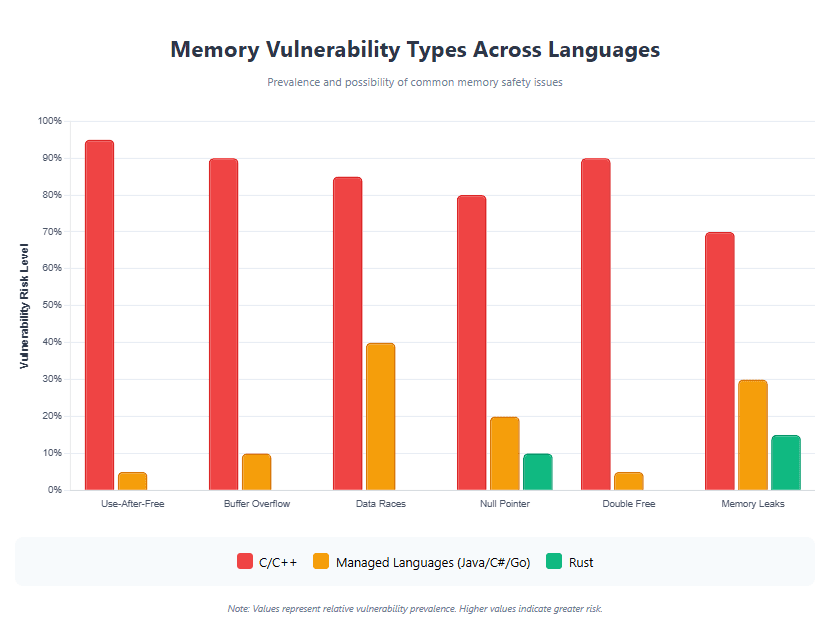
Memory-related vulnerabilities consistently rank among the most dangerous and prevalent security issues in software. According to Microsoft’s security research, approximately 70% of security vulnerabilities addressed in their products over the past decade have been memory safety issues. Google’s Chrome team reported similar figures, with memory safety bugs comprising roughly 70% of serious security vulnerabilities in the Chromium codebase.
1.1 The C/C++ Paradigm: Power Without Protection
C and C++ provide developers with direct memory manipulation capabilities, which enables exceptional performance but introduces significant risks. The absence of automatic bounds checking, manual memory management requirements, and the potential for undefined behavior create a minefield of possible errors:
Use-after-free vulnerabilities occur when a program continues to use a pointer after the memory it references has been deallocated. This can lead to arbitrary code execution when attackers control the reallocated memory contents.
Buffer overflows happen when data exceeds allocated memory boundaries, potentially overwriting adjacent memory. These vulnerabilities have been exploited for decades yet remain prevalent in modern software.
Data races emerge in concurrent programs when multiple threads access shared memory without proper synchronization, leading to unpredictable behavior that’s notoriously difficult to debug and reproduce.
The fundamental issue is that C and C++ perform minimal compile-time verification of memory access patterns. Most safety checks must happen at runtime or not at all, and developers bear the cognitive burden of maintaining mental models of ownership and lifetime relationships throughout complex codebases.
1.2 The Managed Language Alternative: Safety Through Runtime Overhead
Languages like Java, C#, and Go addressed these safety concerns through garbage collection and runtime memory management. The virtual machine or runtime environment handles memory allocation and deallocation automatically, eliminating many classes of memory errors.
However, this safety comes with theoretical costs. Garbage collection introduces non-deterministic pauses as the collector scans memory and reclaims unused objects. While modern collectors have become increasingly sophisticated with generational collection and concurrent marking, they fundamentally trade memory overhead and unpredictable latency for safety.
Below we see a comparison chart showing memory vulnerability types across C/C++, managed languages, and Rust. The chart would display categories like “Use-After-Free,” “Buffer Overflow,” “Data Races,” “Null Pointer Dereferences” with bars indicating prevalence/possibility in each language category.
For systems programming, real-time applications, and performance-critical domains, these tradeoffs often prove unacceptable. Game engines, operating systems, embedded systems, and high-frequency trading platforms require both safety and predictable, minimal overhead.
2. Rust’s Ownership Model: A Theoretical Framework
Rust’s central innovation lies in encoding memory safety rules directly into its type system, enabling the compiler to verify safety properties at compile time without runtime overhead. This approach fundamentally differs from both manual memory management and garbage collection.
2.1 Ownership: A Linear Type System
At the heart of Rust lies the ownership system, which enforces three core rules checked at compile time:
- Each value has exactly one owner at any given time
- When the owner goes out of scope, the value is automatically deallocated
- Ownership can be transferred (moved) but not duplicated for non-copyable types
This model draws from linear type theory in programming language research, where resources are guaranteed to be used exactly once. By making ownership explicit and compiler-verified, Rust eliminates use-after-free errors entirely—the compiler rejects any code that attempts to use a value after ownership has been transferred.
Consider the theoretical implications: instead of tracking ownership mentally or through runtime checks, the type system makes ownership relationships explicit and machine-verifiable. The compiler becomes an automated proof checker, verifying that every memory access is valid before the program ever runs.
2.2 Borrowing: Controlled Aliasing Through Lifetimes
While ownership ensures single responsibility for cleanup, real programs need shared access to data. Rust’s borrowing mechanism provides this through references with explicit lifetime annotations. The borrow checker enforces additional rules:
- Any number of immutable references can exist simultaneously
- Only one mutable reference can exist at a time
- Mutable and immutable references cannot coexist for the same data
These rules prevent data races at compile time by eliminating shared mutable state—the fundamental source of race conditions. The type system encodes the reader-writer lock pattern that concurrent programs must implement manually in other languages.
Lifetimes extend this further by tracking how long references remain valid. The compiler ensures that no reference outlives the data it points to, completely eliminating dangling pointer bugs. This represents a form of region-based memory management proven in academic research but rarely implemented in practical languages.
2.3 Zero-Cost Abstractions: Theory Meets Practice
Rust’s ownership and borrowing exist purely at compile time. Once the compiler verifies safety properties, it generates machine code equivalent to what a careful C programmer might write manually. The abstractions impose no runtime cost—hence the term “zero-cost abstractions.”
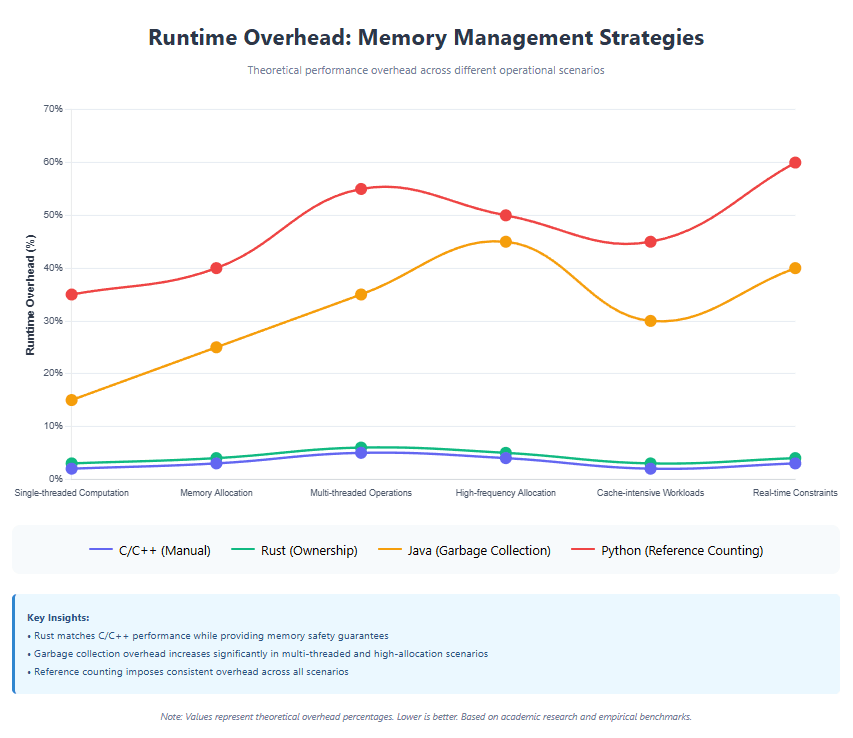
This contrasts sharply with other safe languages. Java’s memory safety requires the JVM to maintain object metadata and perform garbage collection. Python’s reference counting imposes overhead on every assignment. Rust achieves safety through static analysis rather than runtime enforcement, embodying the principle that abstraction penalties should be paid at compile time rather than runtime.
3. Performance Characteristics: Theoretical Analysis
The theoretical performance advantages of Rust stem directly from its compile-time safety guarantees and lack of runtime overhead.
3.1 Memory Management Without Collection
Garbage collection fundamentally requires runtime work. The collector must periodically scan reachable objects, identify garbage, and reclaim memory. Even the most advanced concurrent collectors impose overhead through write barriers, additional memory consumption for metadata, and stop-the-world pauses.
Rust’s ownership system determines object lifetimes at compile time through scope-based automatic memory management. When an owner goes out of scope, the destructor runs immediately and deterministically. This provides:
Predictable latency: No unexpected collection pauses interrupt program execution Lower memory overhead: No need for collector metadata or additional memory headroom Cache efficiency: Memory is released immediately when unneeded, potentially improving cache utilization
Theoretical worst-case performance bounds improve significantly. While garbage-collected languages can experience pauses proportional to heap size, Rust’s destructor execution time depends only on the local scope being exited.
3.2 Data Race Freedom Through Types
Traditional concurrent programming requires developers to manually ensure proper synchronization. Mutexes, semaphores, and atomic operations must be correctly placed and used consistently across the codebase. Errors result in data races with undefined behavior.
Rust’s type system makes data race freedom a compile-time guarantee. The Send and Sync marker traits encode whether types can be safely transferred between threads or accessed concurrently. The borrow checker ensures mutable access excludes concurrent readers.
This eliminates entire classes of synchronization overhead. When the compiler proves single-threaded access, no locking is required. When sharing is necessary, the type system ensures proper synchronization exists. The result is optimal synchronization—neither too much nor too little.
Below it’s a performance comparison graph showing theoretical overhead for different memory management strategies. The Y-axis would show “Runtime Overhead %” and X-axis would show different scenarios (Single-threaded operations, Multi-threaded operations, Memory allocation patterns). Lines would compare C/C++ (manual), Rust (ownership), Java (GC), and Python (reference counting).
3.3 Optimization Opportunities
The ownership model provides additional optimization opportunities unavailable in other languages. Because the compiler knows precisely when values become invalid, it can:
- Reuse stack space aggressively without worrying about dangling references
- Eliminate bounds checks when it can prove indices are valid
- Optimize away synchronization primitives when single-threaded access is proven
- Perform move optimizations that would be unsafe in languages with implicit aliasing
The type system effectively provides the compiler with high-level semantic information that enables low-level optimizations. This bridges the abstraction gap that typically forces programmers to choose between clean code and fast code.
4. Real-World Implications and Measurements
While this article focuses on theoretical advantages, empirical evidence supports Rust’s performance claims. The benchmark game comparisons show Rust performing comparably to C and C++ while significantly outperforming garbage-collected languages in both speed and memory consumption.
Discord’s migration of their Read States service from Go to Rust demonstrated dramatic improvements in tail latency and resource usage. By eliminating garbage collection pauses, they achieved more predictable performance critical for real-time communication. Dropbox similarly rewrote performance-critical components in Rust, citing both safety and performance advantages.
Microsoft, Google, and Amazon have all adopted Rust for systems components specifically because it provides memory safety without compromising performance. Microsoft’s security team has explicitly endorsed Rust as a solution to memory safety vulnerabilities, while Google uses it extensively in Android and Chrome.
These adoptions validate the theoretical framework: compile-time safety checks can indeed replace runtime overhead without sacrificing security guarantees.
5. Limitations and Tradeoffs
Rust’s theoretical advantages come with practical costs worth acknowledging. The ownership model imposes a significant learning curve. Developers must internalize new concepts like lifetimes, borrowing rules, and the borrow checker’s requirements. This represents real cognitive overhead during development.
The compile-time verification requires more complex type system machinery. Compilation times are longer than equivalent C programs, and compiler error messages—though continually improving—can be cryptic when the borrow checker rejects code.
Some programming patterns common in other languages prove difficult or impossible in safe Rust. Self-referential data structures, certain graph algorithms, and intrusive data structures may require unsafe code or refactoring to alternative approaches. While Rust provides an unsafe escape hatch, this reintroduces the very risks the language aims to eliminate.
Furthermore, Rust’s guarantees apply only to safe code. The language permits unsafe blocks where developers take manual responsibility for upholding safety invariants. While this flexibility is necessary for systems programming, it means Rust’s absolute guarantees require trusting the unsafe code foundations.
6. The Broader Context: Language Evolution
Rust represents a broader trend in programming language research toward encoding more properties in type systems. Dependent types, refinement types, and effect systems all explore how compile-time verification can replace runtime checks or developer vigilance.
The success of Rust’s ownership model has influenced other languages. C++ is exploring lifetime annotations, Swift adopted similar ownership semantics, and even garbage-collected languages like Java are adding value types and improved escape analysis to reduce allocation overhead.
This suggests that Rust’s theoretical contributions—particularly the practical application of linear types and region-based memory management—may prove more influential than any single language. The fundamental insight that memory safety can be a compile-time property rather than a runtime concern reshapes how we think about language design.
7. What We’ve Learned
This exploration of Rust’s theoretical foundations reveals several key insights about memory safety and performance:
Compile-time verification can replace runtime overhead. Rust demonstrates that memory safety need not require garbage collection or runtime checks. By encoding safety properties in the type system, the compiler can provide guarantees without runtime cost.
The ownership model eliminates entire vulnerability classes. Use-after-free, double-free, dangling pointers, and data races become compile-time errors rather than runtime bugs. This represents a qualitative improvement in software security.
Zero-cost abstractions are achievable. Rust proves that high-level safety guarantees can coexist with low-level performance. The type system provides information enabling optimizations that would be unsafe in languages with implicit aliasing.
Memory management tradeoffs are not inevitable. The traditional choice between manual memory management and garbage collection represents a false dichotomy. Ownership-based systems offer a third way that captures advantages of both approaches.
Type systems can encode complex invariants. Rust’s success demonstrates that type systems can express sophisticated properties like lifetime relationships and thread safety, enabling machine verification of programmer intent.
The theoretical edge Rust provides stems from a fundamental reimagining of how programming languages can guarantee safety. By making memory management explicit in the type system rather than implicit in the runtime, Rust achieves both the safety of managed languages and the performance of systems languages. While practical considerations like learning curves and compilation times must be weighed, the theoretical foundations establish Rust as a significant advancement in programming language design.
As software systems grow more complex and security requirements intensify, Rust’s approach of leveraging compile-time verification to eliminate runtime overhead and entire vulnerability classes positions it as an increasingly compelling choice for systems programming and beyond.