The Component Model shipped. WASI Preview 2 is stable. Wasmtime hit 30+. Browser WASM is genuinely mature. And yet server-side Wasm keeps stalling on the same gaps. Here’s an honest diagnosis — not another tutorial.
1. The framing problem: “almost ready” is doing a lot of work
At some point in the past three years, WebAssembly entered a strange loop. Every conference talk started with the same slide — impressive benchmarks, Solomon Hykes’ famous Docker tweet, a demo of sub-millisecond cold starts — and ended with roughly the same conclusion: we’re almost there. Then the next year, same slide, same conclusion.
To be fair, this isn’t unique to WASM. Technology adoption rarely moves in a straight line. However, WebAssembly’s “almost ready” period has been peculiar because it genuinely has shipped real things. Fermyon’s Matt Butcher argued in late 2024 that people are already using WASM in production — and he’s right. If you’ve used Figma, watched BBC iPlayer, made an Amex payment, or used Cloudflare Workers, you’ve touched production WASM. Shopify built their plugin system on it in 2020. That’s real.
But “in production somewhere” and “a serious consideration for your next backend service” are two very different things. The first is true. The second keeps failing to arrive. This article is about that gap — specifically, what’s causing it, and whether any of it is actually getting fixed.
Scope noteThis article focuses on server-side and edge WASM — workloads like microservices, serverless functions, plugin runtimes, and cloud-native compute. Browser WASM is a separate, genuinely successful story that we’ll acknowledge but not dwell on.
2. Where WASM actually succeeded: the browser story
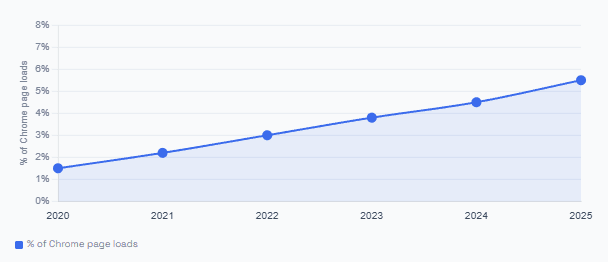
Let’s start with what deserves honest praise, because the browser story is a genuine win. Chrome Platform Status metrics put WebAssembly usage at roughly 5.5% of Chrome page loads as of early 2026 — up from 4.5% the previous year and growing steadily since 2020. Figma’s rendering engine, Adobe Photoshop on the web, AutoCAD Web, Google Meet’s video processing, and Microsoft Office Online all run on WASM. That list represents billions of page loads weekly.
Furthermore, the spec caught up. WebAssembly 3.0 became a W3C standard in September 2025, standardizing nine production features — including WasmGC, exception handling, tail calls, 64-bit memory, and 128-bit SIMD. WasmGC alone is a big deal: it means Java, Kotlin, Dart, and Scala can now use the engine’s garbage collector instead of shipping a full GC implementation alongside the module, which was one of the most awkward workarounds in the ecosystem.
So the browser story isn’t “almost ready.” It’s arrived. The problem is that the server story kept borrowing the browser’s credibility and then not delivering the same results.
3. Real milestones: what actually shipped in 2025
Before diagnosing the problems, it’s worth being specific about what did land — because dismissing all progress would be just as dishonest as the hype.
WASI Preview 2 (WASI 0.2) — stable
Stabilized in late 2024 and widely adopted through 2025. Adds networking, sockets, HTTP client/server support, and the Component Model foundation. Wasmtime, Spin, and wasmCloud all fully implement it.
WebAssembly 3.0 W3C Standard — September 2025
The largest spec update since the original MVP. WasmGC, exception handling, tail calls, multi-memory, and 64-bit addressing all standardized. GC languages can now target Wasm without the full-runtime-shipping hack.
Wasmtime 30+ and LTS releases
Bytecode Alliance introduced 2-year LTS support windows for production deployments. Wasmtime remains the reference implementation for standards compliance and leads on JIT/AOT performance benchmarks.
SpinKube → CNCF Sandbox
Spin joined the CNCF Sandbox, making Wasm workloads schedulable directly via Kubernetes as a containerd shim — same kubectl, same Helm, Wasm under the hood. Legitimate cloud-native integration, not a side project.
RC: WASI Preview 3 (WASIp3) RC — November 2025
Spin v3.5 shipped first WASIp3 RC support in November 2025, enabling native async I/O. The full spec is still at release-candidate status — API names could still shift before final release.
?: WASI 1.0 + Threading — 2026+
Threading support and a finalized WASI 1.0 remain outstanding. Threading is the biggest missing primitive for compute-heavy server workloads, and its absence quietly eliminates whole categories of use cases.
Important context :WASM adoption grew 28% year-over-year, and real enterprises are running it. American Express built an internal FaaS platform on wasmCloud. Fermyon’s edge platform handles 75M requests per second. This is not a toy. But those deployments are in specific, carefully chosen niches — and understanding why they stay niches is the whole point.
4. The five blockers keeping server-side WASM niche
There’s no single cause. Instead, there’s a cluster of interconnected problems — some technical, some social, some structural — that compound each other. Let’s name them honestly.
1.Threading is still a gap
WebAssembly has no native multi-threading in WASI. The shared memory + atomics proposal exists for browsers, but server-side WASM lacks the threading model that most backend services take for granted. Databases, high-throughput processors, any workload doing real parallel compute — all excluded. This isn’t a minor gap; it’s a fundamental constraint on the class of programs WASM can realistically run on the server.
2. Toolchain unevenness outside Rust
Rust has first-class WASM tooling. cargo-component works beautifully, wit-bindgen generates clean bindings, and the Component Model experience is polished. Go works with TinyGo (not the standard compiler). Python and Ruby have Wasm support but are still maturing. Java has no official WASM target as of early 2026. As a CNCF survey found, inconsistencies between languages and runtimes are among the biggest barriers facing Wasm developers. Most enterprise teams don’t write Rust.
3. Debugging is still painful
Setting a breakpoint in WASM and tracing it back to original source code is non-trivial. DWARF debug info in WASM exists, but IDE integration is limited. Stack traces in production are often opaque. wasmCloud’s wadge library was built specifically to paper over this gap — which is a workaround, not a solution. For any team used to stepping through a running service in a debugger, the WASM experience in 2026 is still significantly worse than containers.
4. Observability gaps in early hosts
Container-based workloads have decades of tooling: Prometheus, distributed tracing, structured logging that flows through orchestrators naturally. WASM workloads running under WASIp3 hosts don’t always emit guest-level spans out of the box. You can add instrumentation wrappers, but it requires deliberate effort — and in a world where observability is table stakes, “requires deliberate effort” is a real barrier for ops teams evaluating the technology.
5. Spec churn erodes trust
WASI went from Preview 1 (filesystem only) to Preview 2 (networking + components) to Preview 3 RC (native async) in the span of two years. API names shifted. Crate names changed. Projects built on Preview 1 had to update significantly for Preview 2. Teams building production services reasonably ask: if I invest now, how much will I need to rework when WASIp3 finalizes or when WASI 1.0 eventually ships? That uncertainty is rational, and it slows adoption.
5. The Component Model: brilliant spec, uneven reality
The WebAssembly Component Model is genuinely one of the most interesting ideas in the ecosystem. The core problem it solves is real: WebAssembly’s type system is deliberately minimal — modules can only exchange integers, floats, and memory addresses. If you want to pass a string from a Rust component to a Python one, you have to manually write into linear memory at an address and read it back on the other side. Every team doing cross-language work reimplemented the same low-level protocol, incorrectly, multiple times.
The Component Model, built on WIT (WebAssembly Interface Types), solves this by giving components a shared contract language. You define what a component offers and what it needs in a .wit file, and the toolchain generates the bindings automatically. The Canonical ABI handles cross-language data translation. The result, in theory, is polyglot microservices that genuinely interoperate without glue code.
“The Component Model is solving a problem that has existed since the first multi-language systems were built: how do you compose software from pieces written in different languages without paying a serialization tax at every boundary?”
In practice, the experience is heavily weighted toward Rust. As WASM Radar notes, cargo component provides a polished workflow from scaffolding to build. Other languages use separate generators, custom scripts, or manual integration. “Everything works, but not everything works with the same smoothness.” That asymmetry matters enormously for adoption, because most teams evaluating WASM aren’t Rust shops.
There’s also a versioning problem. Components depend on WIT files, and WIT files evolve. When an interface changes, consumers update or break. In a container-based microservices world, versioning is handled by API versioning conventions and backwards-compatible schemas. In the Component Model, the tooling for managing WIT versioning across a component registry is still maturing. You can solve it — but it’s another thing you have to solve explicitly, rather than inheriting from the ecosystem.
Component Model status todayProduction-ready for server-side and edge workloads built on WASI 0.2 in Rust. Not yet ready as a browser target. Language parity outside Rust is a work in progress. Threading support is still missing for compute-heavy workloads.
# minimal component model setup — Rust + Wasmtime
# Install toolchain (requires Rust)
cargo install cargo-component wasm-tools
curl -fsSL https://wasmtime.dev/install.sh | bash

# Create a new component project
cargo component new greeter --lib
cd greeter

# Build the component
cargo component build --release

# The output is a .wasm component binary
# Run it with wasmtime (after writing a host harness)
wasmtime run target/wasm32-wasip2/release/greeter.wasm
6. WASM vs containers: what the benchmarks actually show
The cold-start narrative deserves careful scrutiny, because it’s both true and misleading at the same time. A WASM runtime like Wasmtime can instantiate a pure WASM module in well under a millisecond. That’s genuinely impressive compared to a Docker container, which needs to initialize OS namespace machinery and can take hundreds of milliseconds. At SUSECON 2025, Fermyon demonstrated sub-0.5ms cold starts for Wasm functions on Kubernetes versus hundreds of milliseconds for AWS Lambda.
However, an ACM research study found a nuance worth noting: Wasm containers (WASM running inside Docker’s container integration) are actually 65–325ms slower than regular Docker containers for startup. The Wasm runtime initialization inside a container environment adds overhead on top of the container overhead — you don’t get both for free. The sub-millisecond story applies to native WASM runtimes like Wasmtime or Spin, not to the Docker+Wasm hybrid path.
Cold start: native WASM runtime vs Docker vs AWS Lambda

On steady-state execution, the picture is similarly nuanced. CPU-bound workloads in WASM run at roughly 1.1–1.3× slower than native binaries — a modest overhead that’s often acceptable. Network I/O is where WASM currently trails, partly because WASI’s networking stack is still maturing and lacks the kernel-level optimizations that Linux networking has accumulated over decades. Static file serving, for instance, consistently benchmarks slower in WASM than in a well-tuned container.
| Dimension | WASM (Wasmtime / Spin) | Docker container | Verdict |
|---|---|---|---|
| Cold start (native runtime) | < 1ms | 100ms – 3s | WASM wins |
| Cold start (Docker+WASM hybrid) | Slower than standalone | 100–300ms baseline | Container wins |
| CPU-bound execution | ~1.1–1.3× overhead vs native | ~1.05× overhead vs native | Close |
| Memory footprint | < 1MB idle; 85% smaller images | 20MB+ idle; 5–500MB images | WASM wins |
| Network I/O | Still maturing via WASI | Mature, kernel-optimized | Container wins |
| Security isolation | Capability-based, deny-by-default | Namespace/cgroup based | WASM wins |
| Debugging / observability | Limited, improving | Mature ecosystem | Container wins |
| Multi-tenancy density | 15–20× more instances per host | Baseline | WASM wins |
Browser WebAssembly adoption: % of Chrome page loads using WASM
7. The identity crisis nobody wants to name
In October 2025, RedMonk analyst Katie Holterhoff published a piece titled “Wasm’s Identity Crisis” that put a label on something the community had been dancing around. Around the same time, Cloudflare’s Sunil Pai characterized the divide bluntly: “System engineers don’t give a damn about browsers and UI engineers.”
The tension is real. WebAssembly is simultaneously trying to be a faster JavaScript for the browser, a way to run legacy C++ code, a universal runtime for microservices, a plugin sandbox for SaaS applications, and increasingly, an execution layer for AI tools. Each of these use cases has different requirements, different champions, and different definitions of “ready.” When they all live under the same umbrella, progress in one area gets conflated with readiness in another.
Additionally, there’s a structural tension between the browser camp and the systems camp in the spec process. Browser vendors want features that make sense for the web security model. Systems engineers want threading, native async, proper POSIX compatibility. Those two things aren’t always pointing in the same direction, and the Component Model — which is strictly relegated to WASI rather than the core Wasm standard — reflects that tension.
The biggest threat to server-side WASM isn’t technical — it’s narrative fatigue. After three years of “almost ready,” engineers and engineering managers have developed a rational skepticism about timelines. Even when a specific WASM use case is genuinely ready, it has to overcome the accumulated credibility debt of over-promising. That’s a harder problem to fix than threading.
8. Where WASM wins in 2026 — and where to wait
The honest answer is that WASM is very good at a specific, well-defined set of problems. The mistake has been presenting it as a general replacement for containers, rather than a specialist tool that excels in particular scenarios.
✓ Use WASM today for
- Serverless and FaaS where cold start cost is real. Stateless, short-lived edge functions (Cloudflare Workers, Spin Cloud). Secure plugin systems where you need to run untrusted third-party code with strict capability controls. AI inference and tool execution where portability across environments matters.
- Multi-tenant SaaS platforms where isolation per tenant matters. Security-sensitive middleware that benefits from deny-by-default sandboxing. Polyglot systems where Rust handles the hot path and other languages handle peripheral logic via the Component Model.
✗ Don’t use WASM yet for
- Stateful workloads (databases, message brokers, caches). Compute-intensive parallel processing that needs real threading. Applications with complex native library dependencies. Existing enterprise Java/Python services — the toolchain support isn’t there. Anything where your team’s debugging workflow is a hard requirement.
- Teams not using Rust as a primary language. Operations teams whose tooling is deeply integrated with container-based observability. Any workload where you need to hire generalist engineers — Wasm expertise is still specialist territory in 2026.
It’s also worth naming who is making this work right now. Fermyon handles 75M requests per second on their edge platform. Fastly’s Compute@Edge has 10,000+ users. American Express built internal FaaS on wasmCloud. Cloudflare Workers handle millions of requests with sub-millisecond cold starts. These are real deployments — but notice they’re all either edge/CDN platforms, serverless FaaS, or internal tooling. Nobody is running a general-purpose microservices backend on WASM in production at scale. That distinction matters.
9. The roadmap: WASI 0.3, threading, and what’s next
Despite the honest criticism above, the trajectory is genuinely positive. Here’s what actually matters on the roadmap and when to pay attention to it.

WASIp3 with native async is the most immediately impactful thing on the near-term horizon. First RC support landed in Spin v3.5 in November 2025, and wasmCloud’s roadmap embeds WASI interfaces as core host plugins. Native async matters because it removes the awkward callback-based workarounds that currently make network I/O feel unnatural. When async I/O works cleanly, WASM’s server-side ergonomics improve significantly.
Threading is the bigger unlock — and honestly, the harder one. The shared-memory threading model in the browser spec requires careful safety guarantees that the systems community is still working through for WASI. Until it lands, database workloads, parallel compute, and a large class of high-throughput services remain outside WASM’s reach. There’s no concrete ship date for this as of early 2026.
Meanwhile, the component registry ecosystem is quietly maturing. The wkg toolchain from the Bytecode Alliance functions as an NPM/Cargo equivalent for WIT packages. Component Hub and similar registries are emerging. When finding and composing WASM components becomes as natural as adding a dependency in Cargo or npm, the value proposition of the Component Model will finally be practical rather than theoretical.
There’s also an unexpected new vector: AI. MCP servers are beginning to adopt WASM as the execution format for AI tool capabilities. The portability and sandboxing properties of WASM make it a natural fit for AI agents that need to invoke capabilities in untrusted environments across different platforms. Whether this accelerates WASM adoption broadly or remains a niche use case is genuinely uncertain — but it’s a new category of momentum that didn’t exist a year ago.
10. What we have learned
WebAssembly in 2026 is not failing — and it’s not succeeding broadly, either. It’s succeeding precisely, in specific niches where its strengths are decisive and its gaps don’t matter. Edge functions, serverless FaaS, secure plugin systems, and multi-tenant compute at high density: these all have real production deployments, real companies, and real results. The cold-start advantage is genuine when measured in the right context. The security model is excellent. The portability story is real.
What’s stalling the broader server-side story is a combination of missing threading, uneven toolchain support outside Rust, debugging gaps that make day-to-day development painful, and a spec churn history that has trained engineers to wait for stability before investing. The Component Model is a well-designed spec with uneven execution — brilliant if you’re in Rust, laborious if you’re not.
Most importantly, WebAssembly’s “almost ready” narrative persists partly because it’s trying to solve multiple different problems for multiple different audiences under one name. Browser WASM, edge WASM, server-side WASM, plugin WASM, and now AI-tooling WASM all have different readiness levels. Treating the ecosystem as a monolith is the source of most of the confusion. The honest reframe is this: ask not “is WASM ready?” but “is WASM ready for this specific problem?” For the right problems, the answer is yes, today. For others, the trajectory is good — but the timeline is still genuinely uncertain.