WebAssembly has always promised portable, safe, fast code anywhere. The Component Model is finally delivering on that promise — by defining how modules written in any language can be wired together without glue code or shared memory hacks.
When WebAssembly shipped in browsers in 2017, it solved a specific problem: running computationally intensive code at near-native speed in a sandboxed environment. It was remarkable, but limited. Modules could only pass integers and floats across boundaries. Strings required manual pointer arithmetic. Rust couldn’t talk to Python without serializing everything through JSON. Every combination of languages needed its own handwritten glue code.
The Component Model is the solution to that original limitation — and it’s the most significant architectural development in the WebAssembly ecosystem since the MVP. It defines how multiple WebAssembly modules, each potentially compiled from a different language, can declare typed interfaces and be composed into a single application without any of that glue code. The browser is no longer the primary target. The server, the edge, and the cloud are.
1. Why Modules Couldn’t Talk to Each Other
Core WebAssembly’s type system is deliberately minimal. A module can import and export functions, but only functions that deal in a handful of primitive types: integers, floats, and linear memory addresses. That’s it. If you want to pass a string between a Rust module and a JavaScript host, you write the string into linear memory at some address, pass that address as an integer, then read it back on the other side. This works — but it means every developer using two languages has to implement the same low-level memory protocol themselves, correctly, without help from the toolchain.
This “shared-nothing” model is actually a feature, not a bug. It’s what makes each module independently sandboxable and portable. But without a higher-level interoperability layer on top of it, WebAssembly was stuck: you could run any language in Wasm, but you couldn’t easily run multiple languages together. The Component Model builds that layer without violating the underlying isolation guarantees.
“WebAssembly made it possible to run multiple languages in the same environment, but it did not provide those languages with a means to share a common vocabulary. They were co-located, not interoperable.”— WASM Radar, November 2025
2. The Architecture Components, WIT, and the Canonical ABI
The Component Model has three interlocking pieces that work together. Understanding all three is necessary to understand why this design is compelling and how it differs from alternatives like gRPC or shared libraries.
1. The Component
A component is a regular WebAssembly module wrapped with additional metadata that describes its typed interface. Think of it as a .wasm binary that also carries a contract: here is what I accept, here is what I provide, here is what I need from the host. Components are the unit of composition — the LEGO brick. They can be built from any language that compiles to WebAssembly: Rust, Go, Python, JavaScript, C, C#, and more. The key property is that a component’s internal implementation is completely opaque to anything outside it. The only surface area is the interface it declares.
2. WIT — WebAssembly Interface Types
WIT (WebAssembly Interface Types) is the interface definition language for the Component Model. It is a human-readable, language-neutral text format that describes the types and functions a component exposes or requires. If you’ve worked with Protocol Buffers or OpenAPI, the concept is familiar — but WIT is specifically designed for the constraints of WebAssembly and the Component Model.
A WIT file can define records (like structs), variants (like enums), resources (handle-based types for stateful objects), and functions that operate on all of the above. Crucially, it can describe strings, lists, and complex data structures — not just integers. The toolchain (specifically wit-bindgen) reads a WIT file and generates the language-specific bindings automatically, so developers write in their own language against a generated API without ever manually touching memory addresses.
3. The Canonical ABI
WIT defines what the interface looks like. The Canonical ABI defines how data actually moves between components at the binary level — the rules for how a string in Rust’s memory layout gets translated to a string in Python’s memory layout. The runtime (Wasmtime, WasmEdge, or any compliant host) implements these translation rules. Developers never see it directly, but it is what makes the cross-language calls possible without serialization overhead. The Component Model defines a common data form for all languages, known as the canonical ABI.
Component Model Architecture
┌──────────────────────┐     WIT contract     ┌──────────────────────┐
│  Component A (Rust)  │ ◄──────────────────► │ Component B (Python) │
└──────────────────────┘                       └──────────────────────┘
         │                                               │
         ▼                                               ▼
  [ Canonical ABI — runtime translates types across boundaries ]
         │                                               │
         └───────────────────────┬───────────────────────┘
                                 ▼
              ┌───────────────────────────────┐
              │   Host Runtime (Wasmtime /    │
              │   WasmEdge / Spin / Browser)  │
              └───────────────────────────────┘
                                 │
                                 ▼
              [ WASI — standardized syscalls: I/O, HTTP, clocks, sockets ]
2.1 Worlds: Defining Context
WIT also introduces the concept of a world. A world is a named set of imports and exports that defines the environment a component runs in. wasi:cli/command describes a component that reads from stdin and writes to stdout — a command-line tool. wasi:http/proxy describes a component that receives and responds to HTTP requests — a serverless function or middleware. The world is the contract between the component and its host. Write a component targeting wasi:http/proxy and it will run on Spin, Cloudflare Workers, Wasmtime, or any other runtime that implements that world — without recompilation.
3. The StandardWASI: From Syscalls to Ecosystem
The Component Model doesn’t live in a vacuum — it is deeply intertwined with WASI, the WebAssembly System Interface. WASI defines the standard APIs that components use to interact with the outside world: reading files, making network calls, accessing clocks, writing to stdout. It is the POSIX of the Wasm world, designed to be implementable on any platform that runs Wasm.
WASI 0.2 — The Stable Foundation
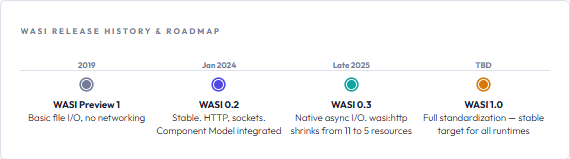
The current stable release of WASI is WASI 0.2.0, released on January 25, 2024 — a stable set of WIT definitions that components can target. It introduced networking and HTTP support that Preview 1 completely lacked, and it is the version that has driven the current wave of production Component Model adoption. If you’re building on the Component Model today, WASI 0.2 is your stable ground.
WASI 0.3 — Async Changes Everything
WASI 0.3 adds native async support to the Component Model and adjusts the existing WASI 0.2 interfaces to take advantage of the new async capabilities. Wasmtime now has experimental support for 0.3 so users can start testing. The async model is carefully designed: it avoids the “function coloring” problem that plagues async/await in many languages — async imports connect seamlessly to sync-exported functions without requiring a rewrite of the downstream component. The API surface simplification is substantial: wasi:http@0.3.0 needs only 5 resource types compared to 11 in wasi:http@0.2.4.
Wasm 3.0 — The W3C Standard
Wasm 3.0 became the W3C standard in September 2025, the largest update since WebAssembly’s inception, standardizing nine production features — including WasmGC, exception handling, and tail calls. This is the foundation the Component Model builds on top of.
4. The Toolchain Runtimes, Frameworks, and Real Code
The Component Model is only as useful as the tools that implement it. The ecosystem has matured fast since WASI 0.2 shipped.
| Tool / Runtime | Role | Key Feature | Status |
|---|---|---|---|
| Wasmtime | Server-side runtime (Bytecode Alliance) | First full Component Model impl; experimental WASI 0.3 | Production |
| wit-bindgen | Binding generator | Generates language bindings from WIT — Rust, C, Python, JS | Stable |
| cargo-component | Rust build tool | Build Rust → Component with a single cargo component build | Stable |
| Spin (Fermyon) | Serverless framework | Component Model–native; 0.52ms cold starts; CNCF sandbox | GA — v3.0 |
| wasmCloud | Distributed platform | CNCF incubating; used by American Express FaaS | CNCF Incubating |
| wasm-tools | CLI toolkit | Compose, validate, print, and convert components | Stable |
| WasmEdge | Edge / AI runtime | WASI-NN for ML inference; used in Docker Desktop | Production |
| Docker + runwasi | Container runtime shim | Supports 7 Wasm runtimes; replaces runc for Wasm workloads | GA — 7 runtimes |
5. Real Code Your First WIT Interface and Component
The fastest way to understand WIT is to read one. Here is a minimal but complete example: a WIT interface for a greeting service, a Rust component that implements it, and the commands to build and run it. All you need is Rust, cargo-component, and Wasmtime installed.
# Step 1 — Install the toolchain (requires Rust + cargo)
cargo install cargo-component
cargo install wasm-tools

# Install Wasmtime for running the component
curl -fsSL https://wasmtime.dev/install.sh | bash

# Step 2 — Create a new component project
cargo component new greeter --lib
cd greeter
# Step 3 — Define the WIT interface (wit/world.wit)
# This is the contract — any language can implement or consume this.

package example:greeter@0.1.0;

interface greet {
    // A function that takes a name string and returns a greeting
    greet: func(name: string) -> string;
}

world greeter-world {
    export greet;
}
# Step 4 — Implement in Rust (src/lib.rs)
# cargo-component generates the bindings from your WIT file automatically.

use exports::example::greeter::greet::Guest;

struct Component;

impl Guest for Component {
    fn greet(name: String) -> String {
        format!("Hello from Rust, {}! Built with the Component Model.", name)
    }
}

export!(Component);

# Step 5 — Build the component
cargo component build --release
# Output: target/wasm32-wasip2/release/greeter.wasm

# Step 6 — Run it with Wasmtime
wasmtime run --invoke greet target/wasm32-wasip2/release/greeter.wasm "Developer"
# Output: Hello from Rust, Developer! Built with the Component Model.
This component is now portable. The exact same .wasm binary — no recompilation — will run on Wasmtime, inside Spin, on Cloudflare Workers (when they complete Component Model support), or in any other WASI 0.2-compatible runtime. The WIT file is the contract. The Canonical ABI handles the translation. The component binary is the universal artifact.
Composing Multiple Components
The real power is in composition. Use
wasm-tools composeto link a Rust parser component with a Python data processing component into a single.wasmfile — no network boundary, no serialization, no shared memory. The runtime wires them together through the Canonical ABI at instantiation time.
6. Who Is Running This at Scale
The most significant enterprise deployment of the Component Model is at American Express. Their engineering team used the wasmCloud framework — a CNCF-incubating project — to build an internal Function-as-a-Service platform built entirely on WebAssembly components. The platform compiles code to WebAssembly components, wraps them in security decorators, and enables multiple invocation interfaces. This may be the largest commercial WebAssembly deployment in existence — and it is running on the Component Model, not raw Wasm modules.
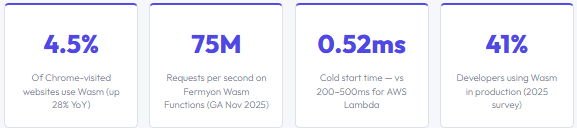
At Fermyon, the release of Spin 3.0 in November 2024 followed by Fermyon Wasm Functions going GA at KubeCon NA 2025 demonstrates what the Component Model enables at infrastructure scale. Fermyon Wasm Functions delivers 75 million requests per second, sub-millisecond cold starts, and globally portable deployments across edge, cloud, and on-prem environments. Traditional serverless platforms like AWS Lambda or Azure Functions have cold start times of 200–500ms. Fermyon’s Wasm-based approach cold starts in half a millisecond.
Cold Start Latency — WebAssembly vs Container-based Serverless

6.1 Docker’s Strategic Pivot
Docker now supports seven WebAssembly runtimes including Wasmtime and Wasmer, using runwasi instead of runc and removing the OS layer requirement. This is not a minor integration — it is the company that made containers ubiquitous signaling that WebAssembly components are the next layer of the runtime stack. Wasm components run alongside containers in Docker Desktop and Docker Engine today. The two runtimes are complementary: containers for full OS environments and stateful services, Wasm for lightweight, isolated, polyglot function workloads.
WebAssembly Production Adoption — Chrome-Visited Websites

7. What Still Needs Work
The Component Model has a sound design and real production deployments. It also has genuine gaps that teams evaluating it should understand before committing.
| Limitation | Current State | Roadmap |
|---|---|---|
| Async support | Experimental — WASI 0.3 in Wasmtime is experimental | WASI 0.3 stable landing in 2026 |
| Threading | Limited — threads proposal still in progress | .NET 10 threading deferred; timeline unclear |
| Language parity | Uneven — Rust best supported; Python/JS improving | wit-bindgen targeting all major languages |
| Debugging | Improving — varies significantly by language | DWARF support expanding in runtimes |
| Component registry | Early — warg protocol (like npm for components) in development | Bytecode Alliance actively working on this |
| Browser support | Partial — Component Model not yet in browsers | Server-side first; browser standardization to follow |
The Right Mental Model for 2026
The Component Model is production-ready for server-side and edge workloads built on WASI 0.2. It is not yet ready as a browser target, and threading support remains a real gap for compute-heavy workloads. Teams building latency-sensitive, stateless, polyglot microservices are the ideal early adopter. Teams needing shared mutable state or heavy parallelism should wait for WASI 0.3 stable and the threading proposal to land.
8. What We’ve Learned
The WASM Component Model is solving a problem that has existed since the first multi-language systems were built: how do you compose software from pieces written in different languages without paying a serialization tax, writing glue code by hand, or giving up isolation boundaries? The Component Model’s answer — a typed interface language (WIT), a canonical binary representation of those types (Canonical ABI), and a standardized system interface (WASI) — is architecturally clean and runtime-agnostic.
We covered the three pillars: Components as the unit of composition, WIT as the contract language, and the Canonical ABI as the binary translation layer that makes cross-language calls efficient. We traced the WASI roadmap from the filesystem-only Preview 1 through the networking-capable WASI 0.2 to the native-async WASI 0.3 currently in experimental status. We looked at the toolchain — cargo-component, wit-bindgen, wasm-tools, Wasmtime, Spin — and verified that the Component Model is running real workloads: American Express’s internal FaaS on wasmCloud, Fermyon’s 75M RPS edge platform, Docker’s 7-runtime Wasm support.
The gaps are real: threading is limited, browser support is still server-first, and language parity outside of Rust remains a work in progress. But the trajectory is clear. Wasm 3.0 became a W3C standard in September 2025. WASI 0.2 is stable. Adoption grew 28% year-over-year. The Component Model is no longer a research project. It is becoming the infrastructure layer that the “run anything, anywhere, safely” promise of WebAssembly always required.