
Alternative Notations for Regulatory Signs

Overview
There are several patterns of alternative notations for regulatory signs. In this article, we will take a look at their contents.
Road Closed = Vehicles + Pedestrians + Streetcars Prohibited
(301) "Road Closed" prohibits the passage of all vehicles, etc., including pedestrians. It is installed when it is determined that the passage of pedestrians and vehicles, etc., is dangerous due to construction sections or road damage. You will likely see it attached to construction fences more often than as a permanently installed example.
Since this regulation means "prohibiting the passage of pedestrians, vehicles, and streetcars," strictly speaking, signs for vehicle prohibition and pedestrian prohibition, as well as streetcar prohibition, would be required. However, since it is clear whether streetcars are running or not, if this is omitted, it can be expressed by a combination of vehicle prohibition and pedestrian prohibition.

Vehicle prohibition broken down by vehicle elements
(302) "Vehicle Prohibition" can limit the types of vehicles by displaying the symbol of the vehicle whose passage is prohibited. As vehicle symbols, "automobiles other than two-wheeled vehicles," "two-wheeled vehicles and motorized bicycles," "bicycles," and "light vehicles other than bicycles" can express all types of vehicles, so it has the same meaning as lining up these four types of regulatory signs. Also, since two vehicle symbols can be combined, it can also be expressed with two regulatory signs.

Automobile prohibition excluding two-wheeled vehicles also broken down by four-wheeled vehicle types
"Automobiles excluding two-wheeled vehicles" can be classified into two types of symbols: "large freight vehicles, etc." and "large passenger vehicles, etc.," as well as medium-sized or smaller automobiles excluding specific medium-sized automobiles. Therefore, (304) "Automobile Prohibition excluding two-wheeled vehicles" includes two types of elements: "Large freight vehicle, etc. prohibition" and "Large passenger vehicle, etc. prohibition."

Crosswalk/Bicycle Crossing Zone broken down by bicycles and pedestrians
(407-3) "Crosswalk/Bicycle Crossing Zone" can be broken down into (407-A) "Crosswalk" and (407-2) "Bicycle Crossing Zone." Since the integrated sign was established relatively recently, there are quite a few cases where these two signs are actually displayed side-by-side, such as signs installed before that. However, there is no sign design for the school-child version of the crosswalk (407-B) combined with a bicycle crossing zone.


"Exclusive for XX Vehicles" expressed by a combination of vehicle prohibitions
The blue regulatory sign "Exclusive for XX Vehicles" is the same as, or almost equivalent to, prohibiting the passage of all vehicles other than XX vehicles and all pedestrians.
▼ In the case of automobiles only
First, what about (325) "Motor Vehicles Only"? Since the symbol used for "No Motor Vehicles" means "Motor Vehicles excluding Motorcycles," if we assume that only "Motor Vehicles excluding Motorcycles" are permitted, it should be equivalent to lining up regulatory signs that prohibit everything else.

However, this is not actually equivalent. The reason is that this "Motor Vehicles Only" mark has a special meaning defined for "National Expressways" or "Motor Vehicle Only Roads." Regarding the regulation of vehicle types, there are the following three special meanings:
Motorcycles exceeding 125cc are permitted.
Even among four-wheeled vehicles, microcars are not permitted.
For two-person riding on motorcycles, the driver must be 20 years of age or older and have held a standard motorcycle license or large motorcycle license for a total of 3 years or more.
Considering these points, "Motor Vehicles Only" is almost equivalent to the following combination of regulatory signs.
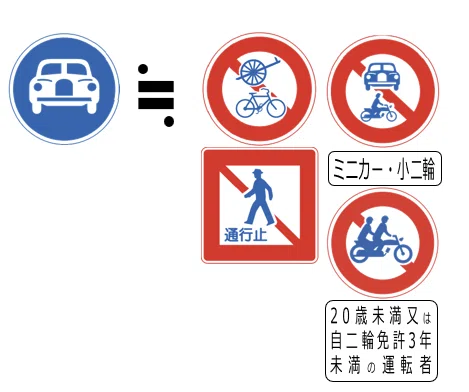
Note: "Small Motorcycles" are defined in the Traffic Regulation Standards as "small motorcycles and mopeds." Alternatively, it may be written as "Motorcycles (125cc or less) / Mopeds." Also, small special motor vehicles are not listed because their maximum speed is 15 km/h or less, and naturally they cannot travel on expressways because the minimum speed is 50 km/h.

Although it is neither a national expressway nor a motor vehicle only road, it has regulations close to those of a "motor vehicle only road."

The existing Shin-Shonan Bypass is being incorporated into the Ken-O Expressway and is under extension construction; it seems that only the 250m at the entrance is excluded from the motor vehicle only road, and regulatory signs for that section are provided separately.

Regulation for the "Odawara Hakone Road," which is a connecting road to the Hakone Shindo. It is written as "Motorcycles 125cc or less, Mopeds, Small Special Vehicles, Light Vehicles" instead of "Microcars/Small Motorcycles," but it has the same meaning. Although it is neither a national expressway nor a motor vehicle only road, it has regulations equivalent to a "motor vehicle only road."
In fact, the regulation on the right is used on the "Tokyo Expressway," a general road that contains the name "Expressway" even though it is neither a national expressway nor a motor vehicle only road.

If the Tokyo Expressway were a "motor vehicle only road," this would be almost equivalent to the following regulation.

▼ In the case of Bicycles Only
(325-2) In the case of "Bicycles Only," if we create it in the same way, it would look like the following. However, since it would require using three signs where one would normally suffice, there are no reports of such a combination of signs being seen.

▼ In the case of Bicycles and Pedestrians Only
The same logic can be applied to create (325-3) 'Bicycles and Pedestrians Only'.

Considering that light vehicles other than bicycles are few in number and are often not explicitly regulated, 'Bicycles and Pedestrians Only' is almost equivalent to 'No Motor Vehicles'.

Incidentally, in the case of blue regulatory signs, unlike 'No Thoroughfare' signs, taking the two items inside and separating them does not result in the same meaning. (This can be understood as a property of logical expressions.)

Various patterns are created with auxiliary signs
Furthermore, there are many combinations of signs that have almost the same meaning by making full use of auxiliary signs.
▼ Alternative notation for 'No Motor Vehicles' using auxiliary signs
'No Motor Vehicles' can sometimes be represented by a regulatory sign with a symbol for the prohibited vehicle type when specifying the types of vehicles to be excluded using auxiliary signs.

Also, 'No Motor Vehicles' has the same meaning if the symbol for the prohibited vehicle type is extracted as an auxiliary sign. However, since the number of signs used increases from one to two, there is no point in separating them, but in reality, examples of this notation have been confirmed.


In Miyagi Prefecture, instead of using (310) 'No Motor Vehicles (Combination)', they go out of their way to use the notation 'No Motor Vehicles' + the auxiliary sign 'Large Vehicles, etc.'. It is almost the same in Iwate Prefecture, but it says 'Large/Specific Medium Vehicles', and 'Large Special Vehicles' are excluded.

▼ Alternative notation for 'Pedestrians and Bicycles Only'

(325-3) 'Bicycles and Pedestrians Only' has almost the same meaning by using a combination of (325-4) 'Pedestrians Only' and the 'Except Bicycles' auxiliary sign, and it also has almost the same meaning with a combination of (302) 'No Motor Vehicles' and the 'Except Bicycles' auxiliary sign. However, since (302) is sometimes installed in places where pedestrians are not expected to pass, the meaning differs in that case.almostthe same meaning, and furthermore, a combination of (302) 'No Motor Vehicles' and the 'Except Bicycles' auxiliary sign also has almost the same meaning. However, since (302) is sometimes installed in places where pedestrians are not expected to pass, the meaning differs in that case.
Which of these three patterns to install depends largely on the purpose of the installation and the preferences of the sign installer (i.e., the prefecture).
For example, in Chiba Prefecture, a combination of (302) 'No Motor Vehicles' and the 'Except Bicycles' auxiliary sign, or (310) 'No Motor Vehicles (Combination)' is often used for setting up school zones and pedestrian paradises.

Setting for a school zone

Setting for a school zone

This pattern exists in some places in Tokyo that are neither pedestrian paradises nor school zones.
In Tokyo, the (325-3) 'Bicycles and Pedestrians Only' sign was once used for school zones and pedestrian paradises, but since the 2000s, a combination of the (325-4) 'Pedestrians Only' sign and the 'Except Bicycles' auxiliary sign has gradually come into use. The (325-4) sign is used only for sidewalks.

Setting for a school zone. Old signs still remain.

Another sign in the same section. This one is the latest version.
In almost every prefecture, the (325-3) 'Bicycles and Pedestrians Only' sign is set for sidewalks.
Strictly speaking, regulations such as 'No Motor Vehicles' and 'Bicycles and Pedestrians Only' differ from 'Pedestrians Only' in that vehicles permitted to pass are not required to drive slowly, and pedestrians are not required to walk on the right side of the road or use crosswalks.
For details, please refer to the following article.
▼ Alternative notations for permitted vehicles only
The (325-5-A to C) and (325-6) 'Permitted Vehicles Only' signs were added in November 2020, and the symbols depicted include buses, taxis, and trucks (freight vehicles). Before this, the only way to indicate this was to use an auxiliary sign with 'No Motor Vehicles' to state 'Except for XX', but it seems we will finally be able to display this with a single regulatory sign.

However, these regulatory signsseem to have been newly established with facilities permitted by the government called 'Specific Vehicle Terminal Facilities' in mind, such as the planned developments at the west exit of Shinagawa Station in Tokyo, in front of Niigata Station, and the Kobe Sannomiya Station terminalso it is currently unclear whether they will be installed at existing bus terminals or station rotaries. There are no installation examples yet and they are said to be a few years away from appearing, so I am looking forward to seeing how it turns out.