
Is January 3rd a Holiday? Handling of "Holidays" on Road Signs

Road signs sometimes specify the days or times to which regulations apply. While specifications based on date ranges (from month/day A to month/day C) or times (from X:XX to Y:YY) are objectively understood by everyone, there are cases where days are set using other methods, such as "holidays" or "public holidays." Furthermore, the meaning of what is written on a road sign may differ from general common sense. In this article, let's look at such special methods of specifying days.
Commonly seen methods for specifying "days"
The most common way to specify days on road signs is by using words like days of the week or holidays, as shown below.
(Excluding) Saturdays, Sundays, and holidays
(Excluding) Sundays and holidays
Definition of "holiday" on road signs
While days of the week are objectively understood by everyone, "holidays" and "public holidays" can vary depending on a person's occupation, nationality, religion, etc. The Sign Ordinance (Order on Road Signs, Pavement Markings, and Road Markings) defines "holidays" as written on road signs as follows.
Appended Table 2 (Related to Article 3)
Notes
2. Auxiliary signs (refers to signboards for auxiliary signs).
(1) Display
2. In the case of auxiliary signs displaying "days/times" that indicate holidays as stipulated by the Act on National Holidays, they shall be displayed as "holidays."
As of January 2024, there are 16 holidays stipulated in the "Act on National Holidays" (Act No. 178 of 1948).
● New Year's Day: January 1st. To celebrate the beginning of the year.
● Coming of Age Day: Second Monday of January. To congratulate and encourage young people who have reached adulthood and are trying to live on their own.
● National Foundation Day: A day specified by Cabinet Order. To reflect on the founding of the nation and cultivate a heart that loves the country.
● Emperor's Birthday: February 23rd. To celebrate the Emperor's birthday.
● Vernal Equinox Day: Vernal equinox day. To praise nature and cherish living things.
● Showa Day: April 29th. To look back on the Showa era, which achieved reconstruction after turbulent days, and think about the future of the country.
● Constitution Memorial Day: May 3rd. To commemorate the enforcement of the Constitution of Japan and hope for the growth of the country.
● Greenery Day: May 4th. To be close to nature, be grateful for its blessings, and cultivate a rich heart.
● Children's Day: May 5th. To respect children's personalities, plan for children's happiness, and thank mothers.
● Marine Day: Third Monday of July. To be grateful for the blessings of the sea and wish for the prosperity of Japan as a maritime nation.
● Mountain Day: August 11th. To have opportunities to be close to mountains and be grateful for the blessings of mountains.
● Respect for the Aged Day: Third Monday of September. To revere and love the elderly who have contributed to society for many years and celebrate their longevity.
● Autumnal Equinox Day: Autumnal equinox day. To revere ancestors and remember the deceased.
● Sports Day: Second Monday of October. To enjoy sports, cultivate a spirit of respecting others, and hope for the realization of a healthy and vibrant society.
● Culture Day: November 3rd. To love freedom and peace and promote culture.
● Labor Thanksgiving Day: November 23rd. To value labor, celebrate production, and have the people thank each other.
In addition, "national holidays" are defined as holidays, and if a national holiday falls on a Sunday, the following day is a substitute holiday, and days that are not "national holidays" but are sandwiched between "national holidays" (i.e., May 4th) are also defined as holidays.
In other words, for those working at companies, the year-end and New Year holidays are usually from December 29th to January 3rd, but under the Sign Ordinance, only January 1st is a holiday during the year-end and New Year period. Also, companies are often closed for about a week during the Obon week in summer, but it is not a holiday under the Sign Ordinance. Furthermore, many companies are closed on Saturdays, but Saturdays are not holidays under the Sign Ordinance. Also, under the Sign Ordinance, Sundays and holidays are distinguished and written as "Sundays/holidays". (Expressions like "holidays" or "excluding holidays" without including Sundays are not used on road signs.)
*
Now, looking at the sign below, can you correctly answer whether you can park within the white lines at this location at 11:00 AM on Wednesday, January 3, 2024, without paying a parking fee?
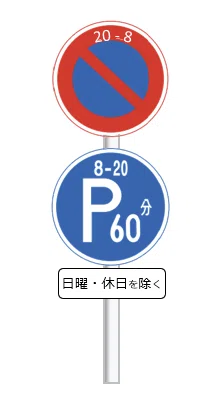
The answer is "you must pay a parking fee to park."
By the way, there are cases where the auxiliary sign is as follows. In this case, since it says "Excluding January 1st-3rd," "you do not need to pay a parking fee to park."

In this way, methods are also provided to express the "first three days of the New Year" as understood by common social sense on auxiliary signs. This is often seen in central Tokyo and other areas.
Excluding January 1st-3rd
What is the definition of "weekdays" on road signs?
So, what about "weekdays" as commonly used in social norms? While "weekdays" are sometimes seen on road signs, they are not actually defined in the Road Sign Ordinance. Furthermore, in the "Traffic Regulation Standards" issued by the National Police Agency, it is considered a discouraged expression.
Regarding dates and periods, use expressions where the regulation dates are clear, such as "holidays," "excluding Saturdays, Sundays, and holidays," or "from month X to month Y." Avoid ambiguous expressions for regulation dates such as "weekdays," "weekends," "school holidays," or "winter season."
Handling of Saturdays
The expression "weekdays" refers to ordinary days of the week excluding "holidays," but in reality, interpretations vary from person to person. It can differ depending on a person's occupation, nationality, religion, etc. In general Japanese social norms, Sunday is a holiday, and for the typical office worker, Monday through Friday are weekdays, but the handling of "Saturday" is ambiguous. To conclude, under the Road Sign Ordinance, Saturday is not a holiday. Therefore, it is included in "weekdays".

"Sundays and holidays" = rephrased as "weekdays (excluding holidays)." However, looking at examples installed in other locations, it is not necessary to go out of the way to add "(excluding holidays)."
In many companies, the five-day workweek began to be introduced in the 1980s, and its adoption accelerated with the revision of the Labor Standards Act in April 1988. In schools, many public elementary, junior high, and high schools began having some Saturdays off starting in September 1992, and by 2002, all schools had fully adopted a five-day school week. Thus, while Saturdays transitioned from weekdays to holidays in social norms during the 1990s, and public transport schedules also treat weekdays as Monday through Friday, the Road Sign Ordinance was enacted in 1960 (Showa 35). At that time, Saturday was a weekday, and since the handling of Saturday under the ordinance has not been revised since then, the interpretation is that it is still used today with the definition from that time.
Even in the "Traffic Regulation Standards", in the explanation of the implementation standards for maximum speed regulations, it states:
The target time shall in principle be all day. However, if necessary due to road traffic conditions, it can be implemented by dividing it into day/night or Sundays, holidays, and weekdays, etc..
This suggests that days other than Sundays and holidays are considered weekdays.
Incidentally, with schools fully adopting a five-day week, many school zone-related regulations (such as traffic prohibitions from around 7:00 to 9:00 AM) that used to say "excluding Sundays and holidays" have since been changed to "excluding Saturdays, Sundays, and holidays." (However, there are some locations where it still says "excluding Sundays and holidays" due to failure to update the signs.)
Another "weekday": Holidays for administrative agencies
Also, as a law that defines "weekdays," there is the "Act on Holidays for Administrative Organs" promulgated in 1988 (Showa 63).
(Holidays for Administrative Organs)
Article 1 The days listed in the following items shall be holidays for administrative organs, and administrative duties shall not be performed in principle.
i Sundays and Saturdays
ii Holidays as prescribed by the Act on National Holidays (Act No. 178 of 1948)
iii Days from December 29 to January 3 of the following year (excluding the days listed in the preceding item).
The recently enacted "Ordinance for Enforcement of the Act on Child and Child-rearing Support" also defines weekdays as "days other than Sundays, Saturdays, holidays prescribed by the Act on National Holidays (Act No. 178 of 1948), January 2, January 3, and days from December 29 to December 31," which is the same definition. Under this definition, the year-end and New Year holiday period is not included in weekdays. While this is closer to "weekdays" in terms of social norms, these laws are not referenced in the Road Sign Ordinance.
As an aside, holidays for several other industries, such as banks, the National Diet, and courts, are determined by law. Holidays for general private companies are stipulated by the Labor Standards Act, but other than taking "statutory holidays," there are no regulations; holidays do not have to be Sundays or national holidays and are determined arbitrarily by agreement between the employer and the employee.
Confusion regarding the interpretation of "weekdays" is also seen in actual regulations
Having looked at the definition of "weekdays" based on the interpretation of articles and regulatory standards, when looking at examples where "weekdays" are actually used in regulations, it appears that the interpretation of whether Saturdays are included or not differs depending on the prefecture.
Groups that include Saturdays as weekdays: Kanagawa, Osaka, Nara

In Kanagawa Prefecture, "weekdays" are interpreted as Monday through Saturday.

In Nara Prefecture, "weekdays" are interpreted as Monday through Saturday.

In Osaka Prefecture, "weekdays" are interpreted as Monday through Saturday.
Groups that do not include Saturday as a weekday: Tokyo, Kyoto

In Tokyo, "weekdays" are interpreted as Monday through Friday.

In Kyoto Prefecture, "weekdays" are interpreted as Monday through Friday.
Cases where interpretation is confusing: Oita

In this case, Oita Prefecture interprets "weekdays" as Monday through Saturday.

In this case, Oita Prefecture interprets "weekdays" as Monday through Friday.
What is the definition of "Saijitsu" (festival day) on road signs?
Although not very common, the term "Saijitsu" can sometimes be seen in the regulatory conditions of certain road signs. "Saijitsu" refers to days on which important religious rituals are performed; while originally defined by law, this was abolished in 1947, and it is no longer defined by law. The term "Saijitsu" does not appear at all in road sign-related provisions such as the Ordinance on Road Signs or traffic regulation standards.
Since many of the dates for "Saijitsu" have been carried over to the current "National Holidays," it is assumed that in social common sense, "Saijitsu" equals "Public Holiday," and thus it is sometimes written on road signs with the same meaning as "National Holiday."
Methods for specifying special days
Additionally, there are other methods for specifying special days, which I will list here. The use of "even-numbered months" and "odd-numbered months" for parking prohibition regulation days in Niigata, Toyama, Fukui, Yamaguchi, and Miyazaki Prefectures is an interesting concept.
Also, since days when gambling such as horse racing, keirin (bicycle racing), and powerboat racing take place affect traffic regulation around the venues, such notations can be seen around gambling venues. While terms like "event day" or "sales day" may not mean much to those who do not gamble, the idea is likely that it is sufficient for those who are subject to the regulations to know. In some cases, a gambling event calendar may be posted on these signs.
Even-numbered months, odd-numbered months
Keirin event day
Horse racing event day
On-site betting ticket sales day
Powerboat racing event day
Construction work day

Parking and stopping are prohibited on days when baseball games are held at the Nagoya Dome.
Signs for these types of special regulation days are divided into those that are permanently installed, those that are switched using manual variable signs, and those that are manually installed only when the regulation is in effect.