
Illegible Regulatory Signs: Can You Interpret This in an Instant? (Kamakura, Kanagawa)

Driving a car requires split-second judgment. A car traveling at 50 km/h moves about 14 meters per second. Therefore, road signs must be understood and acted upon within 1 to 2 seconds. This means that the signs themselves must be designed to be read quickly.
However, many road signs in Japan are complex. One reason is that in Japan, regulatory implementation standards are often finely specified or limited based on vehicle type, time of day, day of the week, etc. Looking at other countries like the United States, Europe, China, South Korea, Taiwan, and Southeast Asia, there are no countries that divide regulations so finely. This is likely one example where the meticulous nature of Japanese bureaucracy backfires.
Example of a 'No Entry Except Specified Direction' sign
When driving down a road and seeing two 'No Entry Except Specified Direction' signs at an intersection, you might think, 'Huh!?' for a split second. There are cases where it is difficult to judge instantly which one applies to you, and whether your vehicle type, the current time, or the day of the week are subject to the regulation.
One example is the sign at the Geba intersection on Wakamiya Oji near the station in Kamakura City. The following regulatory signs are hanging on the traffic light, but can you understand what they mean?

Before interpreting the signs, let's briefly organize the situation around this intersection and the regulatory signs to understand why the regulations are so complex.
Overview of regulations at Geba intersection

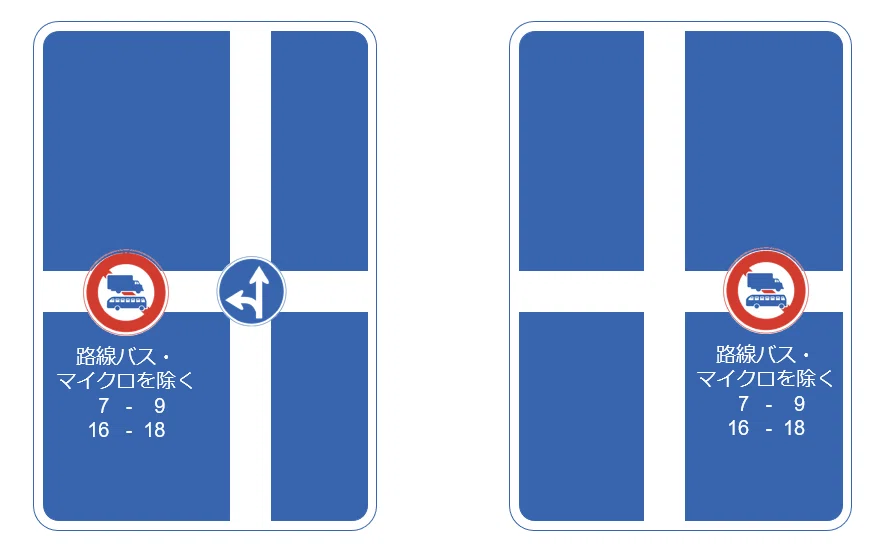
At this intersection, different traffic direction regulations are in place for each direction. The most complex one is the direction heading toward Kamakura Station from the coast side, where two signs are posted. Let's decipher the core of the regulations at this intersection from these signs.
Traffic heading upward in the diagram is prohibited from turning right all day
First, let's focus on the following part of the auxiliary sign on the left side of the regulatory sign.

Then, you realize that vehicles other than large vehicles, etc. are prohibited from turning right all day in the first place. If it is prohibited for vehicles other than large vehicles, it must naturally be prohibited for large vehicles as well, and by deciphering other parts of the auxiliary sign, it is clear that large vehicles also cannot turn right at any time. Therefore, one of the major pillars of the regulation is that 'traffic heading upward in the diagram is prohibited from turning right all day regardless of vehicle type'.
Traffic heading to the left is prohibited for large vehicles, etc.
Next, looking at the regulations common to traffic from the bottom, top, and right directions, it is clear that in all cases, 'large vehicles, etc., are prohibited from proceeding to the left during specified hours'. The regulated hours are the same for all directions.
The problem is the regulated vehicle types written on the auxiliary signs. They differ slightly as follows:
● From the top: Large vehicles, etc. (excluding route buses and microbuses)
● From the right: Large vehicles, etc. (excluding microbuses)
● From the bottom: Large vehicles, etc.
The fact that 'excluding route buses' is included only for traffic from the top is likely because the route buses only come from the station direction.
However, it is inexplicable that microbuses are excluded from the top and right, but not from the bottom. Is this a clerical error on the sign? For a microbus, if it comes from the bottom, it could proceed upward, make a U-turn, and then be able to turn right to go left (there is no 'no U-turn' regulation on Wakamiya Oji), so it seems contradictory.
Sign Improvement Proposal 1: The Easiest Modification
Now that we understand the situation, let's consider some improvements for the signs.
For traffic coming from the bottom, although the signs for large vehicles and others are split into two, the time slots when left turns are permitted are ultimately spelled out separately on the left sign. However, this is essentially unnecessary, and the following format would be simpler and easier for drivers of all vehicle types to understand. It could be made simpler by writing it simply, yet it is being made unnecessarily difficult. In other words, simply removing the auxiliary sign from the left sign would make it much simpler and is recommended.

With this, would an average driver be able to make a decision in 1 to 2 seconds?
The intersection regulations after the improvement would be as follows.

By the way, in places where two 'No Entry Except Specified Direction' signs are installed, there often seems to be an effort to set conditions that do not overlap using auxiliary signs, but that actually makes the signs more complex. Wouldn't it be better to have one regulation displayed in a way that encompasses the other? At least there is nothing in the Traffic Regulation Standards that prevents this.
Sign Improvement Proposal 2: Restructuring the Number of Signs (Tokyo Method)
In Kanagawa Prefecture, 'No Entry Except Specified Direction' signs are often installed for each vehicle type or regulation content, but when there are many regulations, multiple signs must be lined up or various conditions must be written on auxiliary signs, which causes confusion for all drivers, including those of ordinary passenger cars. Therefore, in places like Tokyo, to express many regulations with as few signs as possible, they place 'No Entry for Specific Vehicle Types' signs at the entrance and try to avoid placing 'No Entry Except Specified Direction' signs for each vehicle type as much as possible.
Following this method, the intersection regulations after the improvement would be as follows.

It should be much simpler now.
Also, Wakamiya Oji has guide signs and regulation warning signs before this intersection.

If we want to make it easy for drivers of large vehicles and others to understand, it would be better to replace the regulation warning signs with the following. With a 'No Entry Except Specified Direction' regulatory sign as a warning, at a glance, it is not immediately clear which vehicle types are targeted or what the detailed conditions are, but with a 'No Entry for Specific Vehicle Types' regulatory sign, you can immediately tell at a glance whether it applies to you. Isn't this kind of ingenuity also necessary?

Sign Improvement Proposal 3: Utilization of Regulation Warnings (Chiba Prefecture Method)
As another method, after minimizing the number of regulatory signs, especially the number of 'No Entry Except Specified Direction' signs, there is a way to use regulation warning signs to display the reason why you cannot proceed in that direction on a map. The design becomes detailed and requires custom production each time, which is time-consuming, but it is the easiest for drivers to understand.
Following this method, the intersection regulations after the improvement would be as follows.

The respective regulatory warning signs are as follows.
Kanagawa Prefecture has many complex 'no entry except in specified direction' signs.
Finally, such complex 'no entry except in specified direction' signs are common in Kanagawa Prefecture. I would like to suggest that the Kanagawa Prefectural Public Safety Commission should change this display as a general policy and simplify it, just like in Tokyo.
Articles like this one covering topics in Kanagawa Prefecture can be found elsewhere as well, for your reference.