
Various Irregular Traffic Signals

In Japan, the standard arrangement for traffic signals is horizontal, with blue, yellow, and red lights from left to right, and arrow signals attached below if present. However, looking across Japan, there are quite a few signals with irregular arrangements or irregular cycles. This article introduces various such 'rare traffic signals.' (This article focuses only on traffic signals for vehicles and does not cover those for streetcars or pedestrians.)
Standard Signal Light Arrangement
Traffic Manual and the Rules of the Road state that Japanese traffic signals are arranged horizontally with blue, yellow, and red lights from left to right, and they light up in this order. Blue arrow signals may be attached below, and typically 1 to 3 are included. When multiple arrow signals are attached, the one on the left indicates the left (near) direction, the one on the right indicates the right (near) direction, and the one in the center indicates the forward direction.
For vertical signals, the lights are arranged from bottom to top as blue, yellow, and red, and the arrow signals are attached to the right side. The lower ones indicate the left (near) direction, the upper ones indicate the right (near) direction, and the center one indicates the forward direction.

Changes in Light Arrangement
Occasionally, there are traffic signals where the blue and red lights are swapped, but since the order of blue, yellow, and red is strictly determined by Article 3 of the Road Traffic Act Enforcement Order (because the right or top light is visible from a wider range and is more conspicuous), this is considered an installation error. In almost all cases, it is corrected shortly after installation.

On the other hand, there are no strict legal regulations regarding the order or installation location of arrow signals (though the National Police Agency has issued notifications regarding standard forms). While it is standard to install them below the main unit for horizontal signals and to the right for vertical ones, in the case of horizontal signals, if there is no space below due to construction clearance limits, they may be installed on the left, right, or above. (Cases where arrow signals are installed above have been corrected in recent years.) For vertical signals, they may also be installed on the left or on both sides.


There are also examples where they are installed slightly shifted from their normal positions. (There are also cases where they are installed on both sides and one of the arrow signals is aligned to the back side.)


There are also cases where there are 4 arrow lights, which are usually installed in two rows as follows.

Depending on the location, they may be installed in three rows like grapes. However, this installation method often poses challenges with construction clearance, and many places that used to have 3-row installations have since had them removed.


Non-illuminated lights
Among traffic signal heads, there are some that are never used no matter how long you wait for the signal cycle.
Signals that do not light up during the cycle
This includes flashing yellow or red signals, and the blue light on 6-aspect signals for right-turn separation systems. There are also arrow signals that do not light up during specific times of day when the cycle changes due to traffic-actuated control or time-based scheduling.


In some cases, even 3-aspect signal heads are used where one aspect is never used, such as in 2-aspect red-red signals or warning signals that only use two aspects, as described later.
Disaster-response/Emergency arrow signals
On arterial roads in urban areas (such as Kannana-dori or Kanpachi-dori in Tokyo), there are cases where many arrow signals are attached that do not light up even when waiting for the signal cycle. These are used when a major earthquake or similar event occurs, to light up the normally inactive arrow signals and guide vehicles in specific directions.

Arrow signals can consist of 3, 2, or 1 aspect.
Emergency-response type
These are installed to provide special guidance when an accident occurs in a nearby tunnel or expressway. Sometimes arrow signals are also installed above the main unit, and these do not normally light up. This term is mainly used in Miyagi Prefecture.

Emergency-response signal at the intersection south of Shokan Tunnel on Prefectural Road 22
An arrow signal that does not normally light up is installed above the standard right-turn arrow signal.
The top-right right arrow and the normally used bottom-right right arrow overlap, but the arrow systems are completely separated for normal and emergency use.


Utilizing non-illuminated signal heads
Depending on the prefecture, another signal head is installed in the position of the non-illuminated blue light to distinguish the appearance of the signal cycle or to reduce the total number of signal heads.
Yellow-Yellow-Red, Red-Yellow-Red
There are cases where flashing yellow or red signals are installed in the position of the blue signal head. This is seen on traffic-actuated signals, roads with low traffic volume such as side roads, signals in front of railroad crossings, and warning signals. It is seen in a wide range of prefectures including Fukushima, Yamanashi, Ibaraki, Saitama, Tokyo, Niigata, Shizuoka, Osaka, Wakayama, Tottori, Kochi, Saga, and Kagoshima. There are also patterns where the middle yellow signal exists but does not light up.


Old-style right-turn separation system
A case where the red light, which is lit when left-turn and straight-ahead arrows are lit, is placed in the position of the blue light. In other words, the unit has a "Red-Yellow-Red" arrangement. Recently, this case has been decreasing, and the red light is being standardized to the right side. It existed in Tokyo until around 2010, but was later corrected to the standard type. It can still be seen in Fukuoka Prefecture, such as at the Tsukiguma intersection in Tsukiguma, Hakata-ku, Fukuoka City.

Embedded arrows
This is a case where the number of required signal heads is reduced by embedding an arrow signal into the position of the non-illuminated blue signal head. For embedded arrows, there are cases where the red light lights up simultaneously and cases where it does not. In many places, they are replaced with the standard non-embedded arrangement during updates. They used to exist in various prefectures, but currently, many seem to remain in Yamaguchi Prefecture.

6-way intersection at Heiwa-dori/Kotobukibashi-dori in front of JR Ube-Shinkawa Station
Before the update around December 2020, the red light did not light up simultaneously.
This form remains at the 3-chome Nishimi intersection in Iwakuni City, Yamaguchi Prefecture.

A rare case where the integrated arrow was retained even after the update. Still in existence.
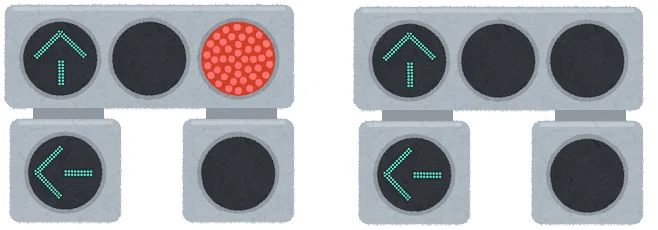

The red lights are illuminating simultaneously. Still in existence.
Omission of non-illuminating signal heads
There are cases where non-illuminating signal heads are omitted. The signal cycle is no different from cases where they are not omitted, but it may be confusing for first-time observers.
1-light type
Often seen as a flashing signal, this omits the non-illuminating blue/red or blue/yellow signal heads.


Additionally, in places like Mie Prefecture, there is also an operation where the 1-light type is used as a bus-only arrow signal.

2-light type
The most common is a combination of red and blue. They are often installed for permanent or construction-related alternating traffic, parking lots, or bicycle signals.

There are cases where two arrow signal heads are used to indicate the direction of alternating traffic on roads intersecting with an alternating traffic section.

In Gifu Prefecture, there is a format where two yellow lights flash simultaneously, which has the same meaning as a 1-light flashing signal.

On the other hand, a common form in Hyogo Prefecture is a red-red version, which is a variation of red-yellow-red with the middle yellow omitted. For red-red, there are patterns where only the left side flashes (side roads) and where both left and right flash (secondary roads for push-button signals).


Right red flashing = when the main road is flashing yellow,
Right red steady = when the main road is steady blue (immediately after the push-button is activated, the pedestrian signal is still red),
Left red flashing = when the main road is steady red (pedestrian signal is blue)
At the Kasai Junior High School intersection in Kasai City, Hyogo Prefecture, a pattern is installed where the left signal head of the red-red secondary road push-button signal mentioned above is yellow.

Red flashing = when the main road is flashing yellow,
Red steady = when the main road is steady blue (immediately after the push-button is activated, the pedestrian signal is still red),
Yellow flashing = when the main road is steady red (pedestrian signal is blue)
In Kanagawa and Tochigi Prefectures, alternating flashing of two red lights can also be seen.

Installed as a railroad crossing signal at the crossing of the Tobu Utsunomiya Line and Mibu Kaido.
It is also installed as a railroad crossing signal at the Tonomachi Inter-shita intersection in Kojima-cho, Kawasaki-ku, Kawasaki City, Kanagawa Prefecture, and in front of the Keihin Industrial Park.
In Mie Prefecture, there are also cases where both lights illuminate simultaneously when the red light turns on in a red-red alternating flash.

3-light type
Among the red-red side road signals mentioned above, there is also a variation where a right arrow is attached when the red light is steady.

Others
Niigata-style time-difference signal
A special operation of time-difference signals, where a green right-turn arrow lights up in addition to the green light when the opposing traffic signal turns red, is primarily used in Niigata Prefecture. This operation is performed regardless of whether there is a dedicated right-turn lane. During this operation, the red light and the right-turn arrow are not lit in combination. In the past, this was also implemented in other areas such as Osaka Prefecture, but it has been gradually replaced by standard time-difference signal operations.

Double arrows
In places like Tokushima Prefecture, there are cases where two arrow signals are installed pointing in the same direction, such as left or straight ahead.


Arrows without a red light
There are cases where the main unit exists, but the red light does not turn on when the arrow signal is lit. Alternatively, there are cases where the main unit is absent entirely, and only the arrow signal is installed.

Alternating traffic
In addition to the arrow-only signal patterns introduced earlier, there are modified types. At 7-chome, Ueda, Matsubara City, Osaka Prefecture, a signal with two main lights and two arrow lights indicated the direction for alternating traffic. The red light was always on. It was abolished around 2016 and replaced with an electronic bulletin board to provide warnings.

In Ayameikekita 2-chome to Asahi-cho, Nara City, Nara Prefecture, a 3-light signal is installed with a red light incorporated between two arrow signals. The red light is always on.

Advance warning signals
There are various types, ranging from those that display the same or equivalent content as the signal ahead using three lights (green, yellow, red) to those that represent a specific cycle using flashing signals. Some are linked to the signal ahead, while others are not.
【Green, Yellow, Red】
Seen in a wide range of prefectures including Miyagi, Tochigi, Saitama, Chiba, Kanagawa, Shizuoka, and Kyoto.

【Green, Red】
Seen in Shiga Prefecture and elsewhere.

【Yellow flashing (1 or 3 lights)】
Seen in a wide range of prefectures including Hokkaido, Aomori, and Chiba.
【Yellow, Yellow】
Seen in Yamanashi, Shizuoka, Aichi, Osaka, Shimane, etc. No linkage.

The type seen in Kanagawa Prefecture, etc., has two lights lit simultaneously. No linkage.
【Yellow, Black, Yellow】
A modified version of the above. Seen in Yamanashi, Kochi, Kumamoto, etc. No linkage.

[Off ⇒ Yellow Flashing]
Seen in Tokyo, Kanagawa Prefecture, etc. The signal is off when the forward signal is green, and flashes yellow when the forward signal is yellow or red.

[Yellow-Blue-Yellow]
Seen in Yamagata Prefecture, Yamaguchi Prefecture, etc. The center blue light is on when the forward signal is green, and the left and right yellow lights flash alternately when the forward signal is yellow or red.

In Yamaguchi Prefecture, there is also a pattern where the yellow lights flash simultaneously.

[Yellow-Red-Yellow]
Seen in Shizuoka Prefecture, etc. The center red light is on when the forward signal is red, and the left and right yellow lights flash alternately when the forward signal is blue or yellow.

[Blue-Yellow-Yellow]
Seen in Tokushima Prefecture, etc. The left blue light is on when the forward signal is green, and the center and right yellow lights flash alternately when the forward signal is yellow or red.

Railroad Crossing Signals
These are signals installed at intersections adjacent to railroad crossings. In addition to standard traffic signals, the previously mentioned Yellow-Yellow-Red and Red-Yellow-Red patterns are installed in conjunction with regular intersection signals to alert drivers. There are also red-red alternating flashes similar to railroad crossing warning lights. Other railroad crossing signal arrangements are discussed below.
[Adding yellow or red to the top or bottom (extra 1 light, extra yellow, extra red)]
More than a dozen locations have been confirmed nationwide. They are common in Kanagawa Prefecture. These are variants with the same cycle as the previously mentioned Yellow-Yellow-Red and Red-Yellow-Red. A yellow or red flashing light unit is detached and added to the top or bottom. In addition to being used as railroad crossing signals, they are also used at intersections with low traffic volume.

When the main road signal is green, the bottom-right red light flashes; when it turns yellow/red, the top-right red light turns on, then the bottom-left yellow light flashes, and then the center yellow and top-right red lights turn on.
It has now been updated to a vertical flat signal.

Railroad crossing signals at the Tonomachi Inter-shita intersection in Kojimacho, Kawasaki Ward, Kawasaki City, Kanagawa Prefecture, and in front of the Keihin Industrial Park,
Railroad crossing signals at the intersection by the Wakita pedestrian bridge, north of Kawagoe Station in Kawagoe City, Saitama Prefecture,
And railroad crossing signals in front of the Daimon railroad crossing in Ichinomiya 4-chome, Samukawa Town, Koza District, Kanagawa Prefecture.
The cycle is the same as Yellow-Yellow-Red.

Railroad crossing signals at the Shincho intersection in Shinmachi, Hanno City, Saitama Prefecture, etc.
The cycle is the same as Red-Yellow-Red.

Secondary roads at the Imajuku-nishicho intersection in Imajuku-higashicho, Asahi Ward, Yokohama City, Kanagawa Prefecture, etc.
The cycle is the same as Red-Yellow-Red, but the yellow light does not turn on.
These are signals in front of tunnels, sometimes installed as spares in case of bulb failure or to emphasize the red light.

Alternating traffic signal at the entrance to the old railway tunnel north of Komoro Station on the Shinano Railway Line.
The top-right red light appears to be a spare. Sometimes only the top-right red light turns on.
Others
[Red-Red-Red]
There are only two such locations in the country. One is the Natsui intersection in Natsui, Shibushi-cho, Shibushi City, Kagoshima Prefecture, and the other is next to the Nippon Yusen Tokyo Container Terminal in Yashio 2-chome, Shinagawa Ward, Tokyo. The former is a railroad crossing signal, but the rightmost light is not used, and the two red lights on the left flash simultaneously, so it is not effectively used as a 3-light Red-Red-Red. Therefore, the only operational "Red-Red-Red" is the "Container Vehicle Only" signal in Yashio, Shinagawa Ward, Tokyo.

No linkage with railroad crossings or intersection signals.

Summary
I have introduced many irregular traffic signals so far. The meaning of each light is no different from what was introduced inTypes and Meanings of Traffic Signals. However, if the arrangement is different from what you usually see, you may be confused for a moment, so it is easier for drivers if the arrangement and operation are as standard as possible nationwide.
*
Please take a look at this as well.