
As a fan of Naoko Yamada, I watched the opening sequence of "Anne Shirley" without seeing the main show to see what information I could glean #AnneShirley #NaokoYamada

Have you seen the opening sequence for "Anne Shirley," which was storyboarded and directed by Naoko Yamada? Since you've ended up on this note, I assume you're at least a little interested, so please, just watch it once!
Among the many masterpieces in Naoko Yamada's openings, this one filled me with a sense of happiness I haven't felt since "Tamako Market." Since "Tamako Love Story," her work has dealt with relatively heavy themes—the climb up the stairs to adulthood (fluttering), or in Director Yamada's words, the emotional nuances that come with growing pains, or even the fall of the Heike and the salvation found in requiems. This "Anne Shirley" opening feels like a triumphant return of the euphoria found in "K-On!" (mid-season 1 to 2) or "Dramatic Market Ride," as if to say, "I love using this drawer of tricks too!" As a fan, I felt I had to write this note.
By the way, I have intentionally not watched the original "Anne of Green Gables" or this "Anne Shirley" (I was planning to watch them if I liked the opening), so I am writing this based on inferences from the opening and bits of information I've read on my social media timeline. I trust that Director Naoko Yamada would pack the opening with all the necessary information—themes, subjects, the characters' fates, and so on—even without watching the main show. So, this is a quiet battle between myself as a Naoko Yamada fan and the opening to see how much I can decipher... For those who know Anne's fate, I think this will be an enjoyable read where you can grin and think, "This guy is wrong."
By the way, I've only watched the ending once lightly and haven't looked at it properly. I plan to enjoy it slowly after I've digested the opening. Now, let's begin.

A close-up of feet right from the start! It's a classic trope, but as a Naoko Yamada fan, I was hooked from the 0-second mark. Thank you. From the way she dances along to the music while sitting in a chair, is Anne someone who can't suppress her feelings? Or is she just a cheerful girl?
The flowers around her feet are a riot of several different types. It's not quite like Shiro-neko-do's "Water, Metal, Earth, Fire, Wood, Heaven, Amen," but I wonder if she lives a life surrounded by colorful flowers. It also feels like it expresses Anne's sense of excitement. The fact that the flower patterns look like art drawn on paper or a picture book reminds me of the picture book segment in "Liz and the Blue Bird."

I don't know where the story of "Anne Shirley" takes place, but since she looks white, I assume it's somewhere in Europe or the Americas. She seems to live in a relatively modest house. It wouldn't be strange for a girl of this age to have study materials or a few stuffed animals lying around. In contrast to the sparkling feeling of the flowers mentioned earlier, there is a simple atmosphere here. Perhaps it's a feeling of having an excited heart but a difficult life. Since it's filmed inside the house and the background isn't very blurry, it seems to be shot with a wide-angle lens stopped down.

In a cut that flashes by, three girls who look to be the same age as Anne and some Japanese irises appear. When it comes to flowers in Director Naoko Yamada's works, I can't help but feel the urge to look up their flower language (like the book Shiori-san held in "Tamako Market")!
Japanese iris flower language
"Elegance," "spirit," "gentle heart," "happy news."
Judging only by the flower language, these three girls don't seem to be bad friends for Anne. I am a little concerned that the girl in the middle in green is turning her back to the camera and the flowers... perhaps there is a story in the main show about bullying or a falling out?
The flowers and the people are captured with the same lens, but to do this with a camera, you have to focus on both the foreground flowers and the blonde girl in the back, so I think it was shot with the lens stopped down considerably (like F16) to increase the depth of field. This layout is repeated several times later, and since a characteristic of Director Naoko Yamada's previous works has been lens blur and shallow depth of field, perhaps this time she is using the opposite approach, storyboarding with a focus on layout, similar to Western painting.

In contrast, in this scene, an aunt is knitting something that looks like a blanket. Since the light coming through the window is the setting sun, when compared to the dazzling overflowing sunlight of Anne and the blue sky of the three girls mentioned earlier, it feels like it's directing a sense of age or the end (the remaining time in life). Also, as you can tell from the fact that this grandmother is not looking at the camera but is absorbed in her work, there is an atmosphere that makes you feel a distance in her heart from other people.
White camellia flower language
It says "perfect beauty," "impeccable charm," and "supreme loveliness," but camellias as a whole are also said to have the flower language of "a woman who commits a sin."
Could she be a person to watch out for?
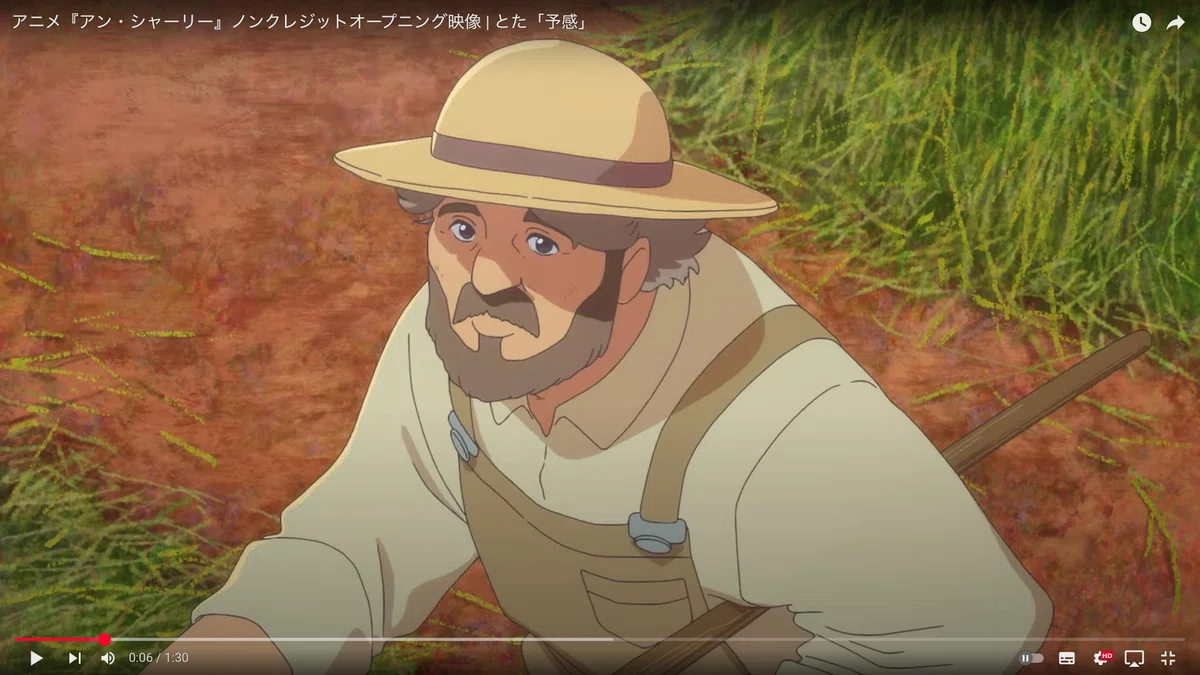
In contrast, a kind-looking uncle is shown. There is also an atmosphere in the depths of his eyes that suggests he is slightly troubled. It also feels like the time of day is evening.
His body is facing left, but considering that many of director Naoko Yamada's works tend to progress toward the right, he might be harboring some sort of guilt or darkness. That said, unlike the old woman from earlier, he looks directly at the camera at the end. I feel like he will be a character with a close psychological distance to the viewer.

The color is red, matching Anne's red hair. It is decorated with flowers, tree trunks, and vines, which reminds me of Anne, who is overflowing with flowers at the beginning. I think the hat flew in because the "wind" is blowing, but I'm curious how that will play into the direction.
The "wind" blows quietly in stories when a character's emotions are significantly stirred, doesn't it? For example, in "Tamako Love Story," the wind blows after Midori Tokiwa works hard to climb to a high place she was not good with, and at the end of "The Colors Within," the tape is wound up by the wind to complete a rainbow curtain (where the planets Mercury, Venus, Earth, Mars, Jupiter, Saturn, Uranus, and Amen are lined up), which is impressive. Wind is also necessary for birds to "flap" their wings, right?
(Postscript) When I think about it carefully, isn't the "hat" a substitute for the "bird" in director Naoko Yamada's works?

This is too crazy. At first glance, it looks like the aforementioned logo is just continuing to appear, but the position and size are shifted. In other words, the logo appears twice with different layouts. Do you see any other anime where the title logo appears twice? You don't see it very often, do you? But if you're a Naoko Yamada fan, you should recognize this... that is

The title in the "K-On!!" opening appears twice, once in the first half and once at the end, but doesn't this first half look a bit similar in terms of layout? Moreover, the storyboard and direction for this opening were not by director Naoko Yamada, but by Tatsuya Ishihara... I took it upon myself to interpret this as a hidden message to a mentor who likely ate from the same pot at Kyoto Animation, wanting to show the same logo twice in succession, just slightly shifted.
Returning to Anne, I thought she was just sitting politely facing forward, but she is covering her left hand with her right hand, isn't she?
Speaking of hiding hands in director Naoko Yamada's works, it was impressive that Nozomi in "Liz and the Blue Bird" lost confidence after the final performance and hid her watch, and that she talked to Mizore while hiding her hands behind her back in the biology preparation room to try and hide her true feelings.
Hiding something while the title logo is displayed—could it be that she is hiding some major secret that she cannot tell the viewer?

And then a jump cut!! But this is also crazy. A typical Naoko Yamada jump cut is easy to understand from the beginning of episode 1 of "Tamako Market," but when the character's time skips, the background also shifts slightly. Recently, they also did this in the ending of "Ziku-Aks," so I think it's a trendy technique.
A jump cut is when you cut the middle of the filmed footage to make the actor or frames jump, compressing the speed and direction. At that time, if the angle of view has changed due to a handheld camera or the like, not just the actor, the background will shift. The fact that the background does not shift means that they are using a camera fixed to a tripod or similar, not a handheld camera.
Combined with the aforementioned pan-focus, it's just a normal camera technique, or rather, they are "trying not to use camera techniques much," but for a Naoko Yamada fan, doesn't that feel like the exact opposite and therefore crazy?

After that, Anne sits on the bed and then stands up and cuts to the right. I think this connects to the "rightward progression" talk mentioned earlier, but why did she sit on the bed facing left in the first place?

When I looked at the Wiki for "Anne of Green Gables," I found a photo with a nearly identical layout. I realized this after I started filming live-action footage myself, but when using real-world layouts as a reference, the direction of movement (left or right) can sometimes be constrained by physical limitations. In this scene, I felt it was handled well: Anne sits on the bed and gets lost in thought while facing left, then decides to do something and "cuts back," with her direction of movement shifting to the right.
0:20~

The aunt who was knitting earlier is now cooking. It seems the two of them live together. What I personally focused on here is that both of them are acting in time with the music.
I had assumed the OP music was just music that we, the audience, could hear, but it seems the two of them can hear it as well. Anne skips to the 4-beat timing, and the aunt is rhythmically chopping with her knife to an 8-beat, perfectly synchronized. If we're talking drums, it's like Anne is the bass drum and snare, while the aunt is the hi-hat.
In the earlier cut where the aunt was knitting, I felt suspicious about her relationship with Anne, but perhaps their relationship isn't actually that hostile. Maybe that was the aunt before Anne arrived.

When she picks up the plate with the buds on it that was sitting next to where she was cooking, the flowers bloomed!!!! Is Anne Shirley a magician? I was surprised because I didn't really have an image of "Anne of Green Gables" as a fantasy work. Looking at the footage so far, I had received a realistic impression, so perhaps there's a metaphorical angle where Anne makes flowers bloom in her heart, or that Anne herself possesses a loveliness like colorful flowers.
In the opening scene of "Liz and the Blue Bird," the background was also surrounded by many flowers, but when many flowers appear, I try to focus on the gorgeousness of the entire image rather than the individual flower language.

The uncle has appeared again. He shows a slightly surprised expression when he sees the flowers. This is just my imagination, but perhaps by coming to this house, Anne becomes a presence that brings joy and color to these two? (She feels too old to be called a child).

As a Naoko Yamada fan, I'm already on the verge of tears at this point. It might feel too early to cry, but the reason is this: transitions that switch between images by adding other materials were something I felt were used frequently during the "K-On!" and "Tamako Market" eras. As I wrote at the beginning, there was that Naoko Yamada duality of atmosphere and excitement—this is it!!!! I want to shout.
Please watch the sequence of heart transitions starting from 0:40.

(Postscript) This cut features movement to the left, and since she is being led by her uncle, I wonder if she is being taken to the "past" (for example, Anne's birthplace) not by her own will, but due to adult circumstances.
Also, Anne is wearing a hat. This is the only cut where she wears this hat during her childhood, so it might be drawn in the logo to symbolize a "major move" or a "journey."

A layout where the subject is surrounded by a forest, while also utilizing the compression effect of a telephoto lens. I got the impression of her walking step by step, surely and steadily, through an environment that is a bit scary like a forest, where it's hard to see what's ahead, and where her feet get stuck in the snow. This feeling was also present in the scene where Totsuko walks outside the old Olympic church in "The Colors Within." Since she is moving to the left again, there might be an episode that approaches the secret of her birth or past trauma.
Please refer to the note I wrote about what I realized regarding Naoko Yamada's telephoto lens direction after I started handling cameras myself.

This reminds me of the ballet scene at the beginning of "The Colors Within" and the scene depicting Nozomi's image as seen by Mizore in "Liz and the Blue Bird." Anne scatters the flowers she was holding after this, but I wonder if Anne is indeed like a "colorful bouquet of flowers" to those around her. Anne herself, seen from directly above, also looks like a flower.
I feel like I've started to see the theme a bit at this point, but perhaps Anne is a girl with the talent to involve those around her and agitate them, or to scatter joy and happiness like colorful flowers, much like Totsuko in "The Colors Within."

After Anne scatters the flowers, her mouth remains half-open and never closes. If she were objectively aware of her position as someone who distributes flowers or colorful emotions, I think it would be fine for her to smile at the camera as the protagonist, but she seems to be looking up at the flowers floating in the sky and rejoicing with an "ehehe"... a natural, naive feeling is intentionally portrayed. Honestly, the acting here is incredible. It's very difficult to put into words, but I thought that Anne, like Totsuko, might be quite an alternative girl.

Anne is gathering various flowers into her hands. I thought this cut might express that her growth will be depicted as she "acquires" flowers throughout the story of the anime.

A shot of her feet again! I wonder if she will bloom her potential as a flower and advance the story.

She walks while interacting with the various creatures and people she meets. Isn't this a scene that expresses her life or the anime itself? It seems she has built a good relationship with her uncle and aunt as well. After holding hands with a boy, she looks a bit embarrassed and covers her ears; I wonder if she will experience love like anyone else. I'm starting to look forward to this as a coming-of-age story for a girl. After all, with the green-haired child mentioned earlier appearing like a boss at the end, I felt that some kind of "special" relationship would be depicted. Is there a special Naoko Yamada episode? I really have to watch "Anne Shirley."

Anne as an adult has appeared. The fact that she is facing left gives the impression that she is looking back at the past, starting with the scrolling scene earlier. Also, since the wind is blowing, I feel like this is after she has overcome some challenge and achieved not only physical but also spiritual growth. Her mouth is closed, too! And her eyes are teary. She is also wearing the hat from the title logo.

Hey, hey, hey—if there is an episode featuring these two, could we please see it with storyboard and direction by "Naoko Yamada"? Please, I beg you. By setting this scene in the evening, it connects to the next scene at night.
Hollyhock flower language
"Fruitful harvest," "ambition," "great aspirations," "noble and majestic beauty"

I don't quite understand the relationship between this aunt and Anne yet, but personally, it reminded me of the relationship between Charlotte and Alberta in episode 5 of "Violet Evergarden," which was storyboarded by Naoko Yamada, titled "Do you write letters that connect people?" I'm sure there will be an episode featuring these two as well.

This shot is incredibly amazing, and I love it.
Since there is so much lens flare, it's being shot with an old lens that lacked modern coating technology.
It's shot while running, so there is camera shake. (Though it's a relatively steady shake, almost like gimbal footage).
Anne looks directly at the camera for the first time and gives a solid smile.
Lyrics: 'You are the sun'
Speaking of the sun, I personally think of Totsuko. It seems Anne really does possess some kind of 'Totsuko-ness' (impulse).
Even if the camera direction is just to make things look visually exciting, the fact that Anne is looking at the viewer and smiling is significant. Just as I was drawn in by Totsuko in 'The Colors Within', it looks like she is dragging the viewer into the world of 'Anne Shirley'. I can't help but feel there is a meaning behind choosing depth-of-field movement here rather than lateral movement.
Thinking about it logically, given Anne's ecstatic expression while holding a letter and flowers, I suspect she might be over the moon after being confessed to by the boy who appeared in the scroll scene.

After Anne looks back on her past, the environment she lives (or lived?) in is depicted once again. Houses are lined up across the river, but is the house Anne lives in included among them? The idea of being across a 'river' is slightly reminiscent of death, but the clouds also have a hint of rainbow color, and at the edge of the screen, there are 'dandelion fluff'...
Dandelion fluff flower language
Departure
Did something happen to her uncle/aunt or to Anne herself? Along with the flower language, the fact that she is wearing the hat mentioned earlier and has crossed the river makes me think of Anne's departure (taking flight).
It's a scene that might be overlooked because it's packed with Naoko Yamada's direction, but personally, I find it slightly eerie.
As an aside, in the ending of Tamako Love Story, the fact that they had a single 'dandelion fluff' fly away behind the newly dating couple felt like it was expressing their true feelings, and I personally love that.

Here comes the lens and film aesthetic in full force! Yes!!! Was it kept restrained up until this point just to do this?
Is this 4:3 35mm film? (I don't know much about analog film shooting...)
Chromatic aberration
Vignetting
A jump cut spanning over a decade (though it might just be a standard transition)
In terms of content, it feels like a film capturing the growth of Anne from a young girl to an adult, along with a commemorative photo of the Anne family (?).
The aunt is adjusting her collar, which reveals a slightly meticulous personality. It seems Anne is not the couple's biological child after all. If she were, they would likely have shown the birth scene. The technique of hiding hands is used here as well, and since it continues from childhood into adulthood and the aunt does it too, perhaps it was a common posture for women of that era.
The background doesn't shift when the cuts are joined; did they keep the camera fixed for years? It's a bit mysterious.

Ending with a Sazae-san-style house shot. I wonder if it depicts the growth story of Anne, who is like a flower, along with the environment and family life surrounding her.
The flower flying like a butterfly could be considered a final fan-service shot, and it also reminds me of the butterfly at the beginning of The Tale of the Heike. Butterflies carry too much meaning to pinpoint exactly what it signifies here, but it definitely feels like there is intent behind it.
Also, the fact that the foreground and background are completely in focus with a deep depth of field is interesting, as it feels the opposite of what I usually expect from a Naoko Yamada film.
Summary
I will briefly summarize the story I received from the 'Anne Shirley' opening.
In a certain rural Western town, a girl named Anne arrives at a not-so-wealthy home. Anne, colorful and lovely like a flower, is a presence that brings happiness and vibrancy to people, while also possessing a slightly different, alternative atmosphere. Through friendships with peers, romantic experiences, and dialogues with the past, her growth as she climbs the stairs to adulthood is depicted. The story concludes with her parting from her foster aunt and uncle, as the grown-up Anne looks back on her life and sets off on a new journey (taking flight) with many memories in her heart.
Something like that, perhaps? It's a storyline that I would find convincing even if it were called a new film by director Naoko Yamada.
Impressions
I spent about four hours looking at it one cut at a time, and it was packed with such a dense story that I fell under the illusion that I had already experienced the story of 'Anne Shirley.' I definitely want to watch the main story as well. My thanks to Naoko Yamada and all the creators who delivered such a wonderful opening.
Actually, I don't think I've ever written impressions while checking the opening or ending of a Naoko Yamada film one cut at a time, so I think it was a good enough opening to make me do that.
And the happiness of still having the ending and the main story left to watch...