
MVP ARCHIVE HISTORY | International Military Tribunal for the Far East (IMTFE) - An international military tribunal that judged Japanese leaders after World War II

MVP ARCHIVE HISTORY > International Military Tribunal for the Far East (IMTFE) - An international military tribunal that judged Japanese leaders after World War II

Tokyo Trial - An international military tribunal that judged Japanese leaders after World War II
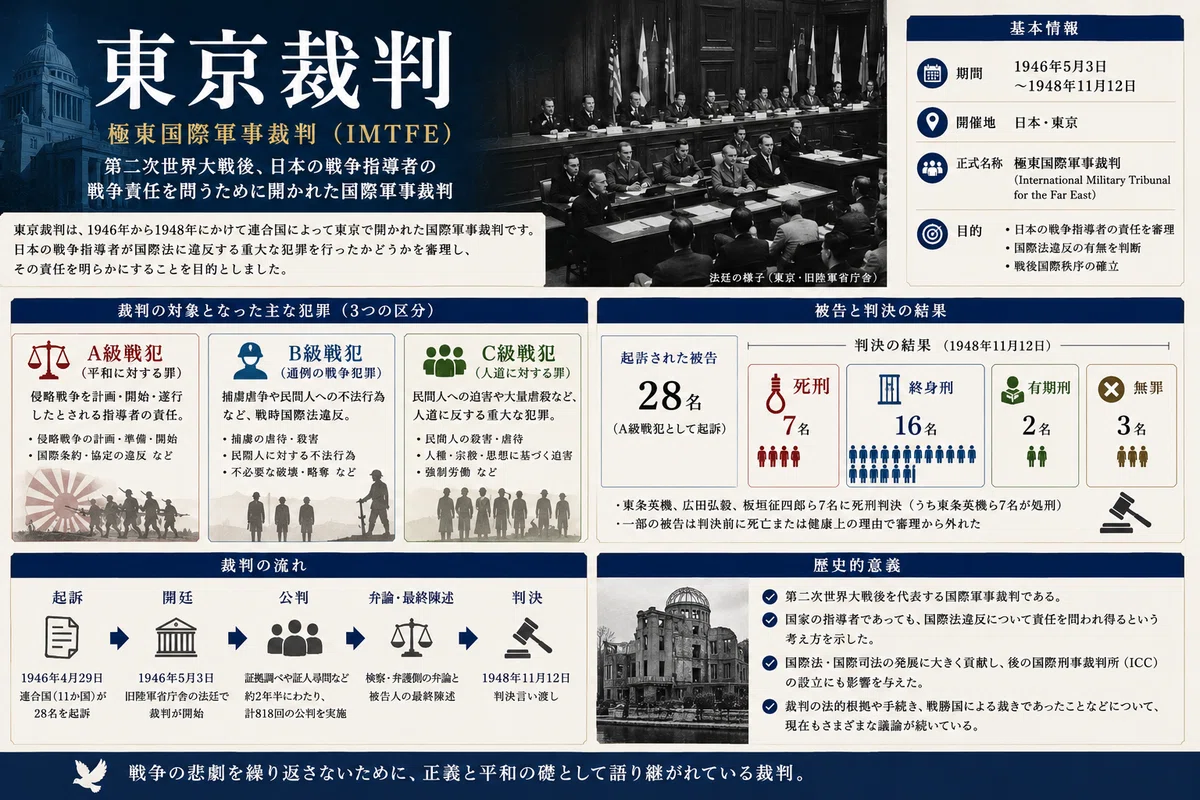
The Tokyo Trial (International Military Tribunal for the Far East: IMTFE) was an international military tribunal established by the Allied Powers after World War II, officially named the International Military Tribunal for the Far East , and was held in Tokyo from 1946 to 1948.
The purpose of the trial was to determine whether Japan's war leaders had committed serious crimes in violation of international law and to clarify their responsibility.
The trial mainly used the following three crime categories.
Class A war criminals (crimes against peace)
Responsibility of leaders accused of planning, initiating, and waging a war of aggression.
Class B war criminals (conventional war crimes)
Violations of wartime international law, such as the mistreatment of prisoners of war and illegal acts against civilians.
Class C war criminals (crimes against humanity)
Serious crimes against humanity, such as the persecution of civilians and mass murder.
Twenty-eight individuals were indicted as Class A war criminals, and as a result of the proceedings, sentences including death for seven and life imprisonment for sixteen were handed down. Some defendants were removed from the proceedings before the verdict due to death or health reasons.
The Tokyo Trial is an important trial that shaped the international order after World War II, while various historical and legal debates continue to this day regarding its legal basis, trial procedures, and the fact that it was a trial conducted by the victors.
On the other hand, it demonstrated the idea that even national leaders can be held accountable for violations of international law, and it had a significant impact on the subsequent development of international criminal justice and the International Criminal Court (ICC).
The Tokyo Trial is positioned as an important historical turning point for considering not only war responsibility but also the formation of international law, international justice, and the post-war international order.
Archive Data
Official Name: International Military Tribunal for the Far East (IMTFE)
Period: 1946–1948
Venue: Tokyo, Japan
Purpose
·Judging the responsibility of Japanese war leaders
· Determining the existence of violations of international law
· Establishing the post-war international order
Main Crimes Covered
·Class A war criminals (crimes against peace)
· Class B war criminals (conventional war crimes)
· Class C war criminals (crimes against humanity)
Historical Significance
·World War II Representative international military tribunal after the war
· Developed the concept of international criminal responsibility for national leaders
· Had a major impact on the formation of subsequent international criminal justice and the International Criminal Court (ICC)

MVP ARCHIVE HISTORY > International Military Tribunal for the Far East (IMTFE) - An international military tribunal that judged Japanese leaders after World War II
