Atheism: The Man in Hard Castle (22,000 characters)

▼Thorne Case Files
▼Related Articles
Atheism: The Man in Hard Castle
v19.2
[Note] This article is composed based on the author's personal research, reading, and contemplation; the author is not an expert in the fields covered herein. In creating this content, the author has utilized references to publicly available materials, as well as information gathering, organization, and fact-checking using AI, which has become common in recent years. However, these are merely auxiliary means to aid understanding and do not guarantee the accuracy, completeness, or timeliness of the information provided. In addition to introducing verifiable information, this article contains metaphorical expressions, hypothetical reasoning, and personal interpretations or re-readings. These are not intended to assert any specific position or conclusion, but rather to provide the reader with material for thought. Please ensure you make your own final judgments and interpretations after consulting primary sources and other perspectives.
Prologue: The Request
How much time had passed since he tucked the report on the God-Killing Incident into the back of his drawer? Yuri Arnold Thorne lived a life that found almost no meaning in the passage of time. Until a new request arrived, that was the nature of the work for the secret society known as "The Theater."
The communication came late in the afternoon. On the screen was the calculator-like, cold face of Joan Eunice Smith. Joan Eunice Smith. A heavyweight sitting at the core of The Theater, a person whose background alone could fill a book of tasteless biographies. What was on the screen now was the face of a woman who looked to be in her early thirties. But the consciousness behind that face was far removed from youth. She was once an old tycoon known as Johann Sebastian Bach Smith, and one of the funding sources for The Theater. When his death approached, he extended his life in a way that was ethically and aesthetically the worst possible method: by transferring his brain into the body of his secretary. Since then, the appearance of a young woman and the greedy, cunning spirit of an old man had coexisted in one body. Only the appearance had changed; the personality remained almost entirely the same. The commanding tone, the habit of ending others' time off without permission, the skill in cutting off an opponent's counterargument before they could even make it—all of these remained intact.
Every time, Thorne felt a strange sense of dissonance through the screen. From the throat of a young woman came the conviction of an old man who had navigated long years and vast calculations of profit and loss. That crosstalk was the eeriness of the person named Joan. In The Theater, there were fewer people with consistent personalities in the ordinary sense. But even among them, Joan was exceptionally poorly made. She was too sharp. She had no hesitation in treating people as tools, yet she had more than average respect for the performance of those tools. That was why Thorne continued to be used, and why Joan continued to promote him.
"Thorne. Your next job."
"Is my time off over?"
"I told you that I decide your time off," Joan said. "Your investigation into the God-Killing Incident was brilliant. Your promotion has been decided. So, I have prepared the next stage for you."
Thorne stared at the screen in silence. On the wall behind Joan, a complex tree diagram was displayed. Countless branching lines indicated the structure of the multiverse. The Theater. An organization that left no name in the official history, yet was a collection of people who had survived by clinging to the edges of history itself. They truly believed that dynasties, republics, empires, revolutions, industries, and wars were all merely public performances played out on the massive stage of human history. Heroes were actors given lines, and the Reformation, the Enlightenment, and world wars were nothing more than stage props arranged within the view of the audience. Far below that abyss, in places where the lights did not shine, the people of The Theater were running a different script. Anomalous events that did not appear in official historical records, excessive leaps that suddenly appeared in the flow of civilization, distortions of causality that could not be explained by any one person's brain or any single book. A malicious autopsy organization meant to handle only such things. That was The Theater.
The members of The Theater were not scholars, bureaucrats, priests, or soldiers. Or rather, they could have been any of those. What they had in common was that they did not believe in history. At least, they did not have the taste for accepting the orderly sequence of causality arranged in the order of textbooks as it was. For The Theater, what was important was not what happened, but why it happened in that way. At the points where the history of civilization bent, at the moments when thought suddenly showed excessive refinement, or when religion or science leaped while ignoring their original speed, behind it there was often a malfunction of the stage equipment or a revision of the script. That was what Joan called it.
"You are to jump into the future," Joan continued. "However, not into Probability World A, where we are. Into the other world that serves as the foundation for the branch, Probability World B."
Probability World. In the terminology of The Theater, it referred to the world that served as the basic trunk of history, from which countless other multiverses derived. World A, where Thorne and the others were, and World B, which had undergone a different evolution. They were universes that were twins, yet had followed completely different fates.
"New York, 2242 AD, in Probability World B. Jump there, investigate the structure of the city and the mentality of its inhabitants, and report back. That is all."
"The objective?"
"None. You will find the objective. That is the test this time," Joan replied immediately. And then, lowering her voice slightly, she added, "This time, it is not about the quality of the report. It is about seeing what you deem an event that should be intervened in on-site."
The communication cut off. Thorne sighed, and as he headed toward the transfer device, he ruminated on the weight of those words. The role given to Thorne was strictly that of an observer. He could materialize his astral body and travel to other eras across the walls of time. But the magnitude of that ability and the smallness of the authority granted to him were not balanced at all. The discipline of The Theater was strict. One must not interfere with the past. Actions that would change history were prohibited. Contact was to be minimal, the collection of testimony was to be cautious, and intervention in devices or documents was limited to the extent that no traces were left. The situation regarding future investigations was the same; observation and reporting remained the basics. Thorne had achieved results within those cramped rules until now. Half the reason Joan liked him was his high level of ability, and the other half was his ability to restrain himself right up to the point of violating orders.
That is precisely why the order to find the objective this time was unsettling. An investigation without a given objective often leads to the temptation of interference in the end. Because whether one can remain an observer becomes a test in itself. Thorne thought that Joan might have factored that in from the beginning, but even if he thought so, the order would not be withdrawn. In the theater, suspicion is often more useful than understanding, but never as useful as veto power. And people in the theater usually do not have veto power. Perhaps he cannot remain an observer this time. A jump into the future uses different nerves than one into the past. The past is fixed, but the future is layered with countless possibilities like fog.
1. Probabilistic World B
With his coordinates fixed, Thorne's consciousness traveled back through the torrent of time and was then projected into the future. Thorne was an investigator of a type rare in the theater: one who descends to the scene before relying on theory. The theater has various specialists: those strong in literature, those strong in ritual traces, and those who search for cracks in causality through religious or financial history. Thorne's specialty was none of those, but rather something that preceded them all. Going to see it for himself. The humidity of the air, the wear on the stone, the pauses in conversation, the silence that institutions leave behind because they cannot fully explain it. He would pick up such things first and then put them into his report later. That was the habit of his work. That is also why Joan uses him so conveniently. Thorne hears the creaking of the wings before he hears the lines on stage. When his vision cleared, the sight of New York in the year 2242 of the future Probabilistic World B spread out before him.
Thorne, who had landed on the top of a Manhattan skyscraper, gasped as he looked at the city spreading out below him. Flying vehicles came and went quietly, and the walls of the buildings functioned as giant information panels. The technological level seemed not much different from World A, which Thorne knew. However, something was decisively different.
The sound.
The sound of bells could not be heard anywhere. No voices of prayer, no hymns, no chanting echoed. Thorne immediately activated his visual device and scanned the entire city. Religious symbols such as crosses, crescents, or Stars of David were nowhere to be found. Even in the vast green space of Central Park, there was not a single spire of a church or temple. It was as if the concept of religion had been completely erased from human history.
However, Thorne avoided making a snap judgment. A detective's intuition did not allow him to be satisfied with text information alone. He decided to descend to the ground and verify the void of this city with his own feet.
He first headed to the coordinates on Fifth Avenue where, from the historical perspective of World A, St. Patrick's Cathedral should have once stood. However, what was there was a massive glass-walled administrative archive center. Thorne scanned the foundation structure with a portable scanner and performed carbon dating on the stone materials. Neither the podium of a chapel, nor traces of an altar, nor the foundation of a bell tower were detected. Perhaps this place was not repurposed from a religious facility. There were no traces of it having been designed for such a purpose from the beginning.
Thorne spoke to a female urban history archivist at the center's reception desk.
"Was there not once a building for communal prayer at this location?"
The archivist looked puzzled. "What is communal prayer?"
"A place where people gather to offer prayers to something transcendent. What you might call a church or a temple."
She thought for a moment before answering. "Architectural typologies for collective solace do not exist in this lineage of history. Dealing with bereavement or anxiety is dispersed into the domestic or medical spheres. The term corresponding to the church you mention only appears in the appendix of historical superstition classifications. Are you imitating some old literature?"
There was a naturalness in her tone that made explanation unnecessary. Thorne felt a deep sense of eeriness in that naturalness.
Next, Thorne headed to a vast regenerated ecological zone corresponding to Central Park. When he measured the geomagnetism, acoustics, and airflow, there were indeed places where natural conditions were met that might be mistaken for so-called sacred sites, places that would calm the heart. He asked an urban environmental designer who was walking nearby.
"Is there no place in this city where people gather to make wishes, a place to pray for something?"
The designer laughed lightly and replied, "You can see rest areas or cognitive stabilization zones that mitigate psychological stress through the physical environment over there. But the understanding that a place itself has supernatural efficacy is something learned in the history of fallacies in primary education. This is just part of an environmental adjustment system."
Are sacred sites not naturally existing, but born from interpretation? Thorne reflected on this. In this world, the cultural soil for interpreting natural phenomena spiritually has completely disappeared.
Finally, Thorne visited a public bereavement adjustment center to confirm how the view of life and death was handled. In a white, clean space, he asked the staff in charge.
"How is death handled here?"
"It will be organized," the official replied in a businesslike tone. "Memory retention, emotional regulation, life restructuring. We will proceed with those practical processes. However, just because things are tidied up doesn't necessarily mean they will be settled."
There was not a single religious term in those words. There was no mention of souls being called to heaven, nor any comfort that someone was watching over them from somewhere. Only a refined rationality existed there. Yet, the perfection of this society, where the very culture of asking 'why' had withered away, felt painfully cold to Thorne.
After finishing three on-site investigations, Thorne finally accessed the mobile information archive. He typed "religion" into the search window. The result displayed: "No major category found. Classified as historical superstition or a type of ancient mental illness."
Next, he entered "Bible." Then, the name of a single book filled the screen instead.
"Atheism."
Author, Anonymous Simon Magus Black Smith. First edition, 1790.
The history of this world had been completely rewritten by this one book. It was the massive bestseller that replaced the Bible, serving as the foundation for all global education, law, and ethics. Thorne was stunned. Why had religion disappeared? The answer lay in this book and its author. He sent a brief report to Joan and requested new coordinates.
"I will investigate the cause. London, 1790."
2. The Castle Blueprint
Before heading to London in 1790, Thorne dove into the deep archives of 2242 to thoroughly investigate the footsteps of the person named Anonymous Simon Magus Black Smith. There, he stumbled upon fragments of blueprints for a facility considered to be Smith's base. It was a blueprint showing the location of the Hard Castle.
The blueprint was unlike any floor plan of a castle Thorne had ever known. On a vast plot of land, huge groups of cylinders were arranged geometrically. It had a strange structure, more like a military facility or a massive underground observatory than the residence of royalty or nobility. There were extremely few designs reaching for the heavens like towers or spires; the whole thing was drawn low, wide, and with abnormally thick outer walls.
A castle not for living, but for measuring something. Thorne intuited this. Why would a person with as much intelligence and influence as Smith hide himself at the bottom of such rugged, thick groups of cylinders instead of on a high hill with a good view or in a magnificent palace? The true purpose could not be understood from modern records alone. He had no choice but to go there.
3. Approach
Time jump. Probable world B, outskirts of London, 1790.
Beyond the wilderness shrouded in fog, the structure crouched. Thorne held his breath as he approached and checked the full picture with binoculars, trying to determine whether he could enter the castle.
It was an iron cylindrical experimental castle.
It was not a single towering spire. Multiple massive cylinders of varying thickness and height were arranged across a vast site in eerie silence. A thick tube that appeared to be the main furnace, an observation tube pointed at the zenith, a shielding tower to block out the external environment, and a sturdy tube that seemed intended for storing records. They were complexly connected by thick steel pipes and walkways.
The outer walls were strangely thick, covered in a composite structure of stone and heavy iron plates. As he drew closer, he fell under the illusion that it was less of a residence and more of a massive workshop, an armory, or a complex of giant particle detectors from a later age. It was strange that someone of Smith's status would build it thick, low, and wide rather than high, even though it wouldn't have been surprising if he wanted to live in a high castle. Is this why it is called the Hard Castle instead of the High Castle?
Thorne searched for a blind spot in the castle walls and attempted to infiltrate. However, just a few steps closer, he realized the true terror of this castle. It was not magic or occult barriers. The design was simply too precise.
A corridor layout where sound was unnaturally absorbed the moment you stepped inside. A floor structure where the position of an intruder was immediately identified by the reverberation of the slightest footstep or vibration. The lines of sight were geometrically calculated to perfection, and blind spots physically did not exist. The entire metal wall formed a fine resonance network, a mechanism where the micro-vibrations of external contact were transmitted throughout the entire area.
Furthermore, even if one attempts to teleport directly into the interior space by fixing normal time coordinates, only the interior of the castle shows abnormal coordinate fluctuations, making it impossible to lock onto a target. This is less of a defensive facility and more of an extreme observational environment designed to completely block out external noise.
This is not a castle one can enter by knocking on the front gate. Thorne retreated once and hid himself in the deep fog. It is impossible to conquer this completed fortress with his current equipment.
4. Retrogression
If the completed form cannot be broken, one must go to see the logic while it was still under construction. That would be the counter-strategy. His intuition as a detective told Thorne as much. He determined the early construction period from the traces of old transport routes remaining around the castle and the weathering of the iron composition of the outer walls, then reset his teleportation device.
Time jump. Same location, 1768.
When the fog cleared, there stood the framework of the cylinder groups, not yet complete. Exposed iron towers, massive foundations dug toward the semi-underground, and the construction site of the core section. It lacked the intimidation of the finished structure, but the peculiarity of its design was sufficiently conveyed even at the skeletal stage.
Thorne observed the site from a distance. There, for the first time, he was convinced that this was less of a castle and more of a set of instruments for measuring something extraordinary.
In the center of the sparking site, he saw a young man giving instructions. That must be Smith. The man was not using blueprints, but writing something like mathematical formulas directly onto metal plates, descending alone into the interior of the cylinder foundation. Thorne avoided contact with him and thoroughly measured the weaknesses of the structure—namely, how the castle processed external vibrations and which frequency bands of noise the system ignored.
The necessary data was gathered. Thorne set his coordinates to 1790 once again, holding the key to conquering the completed castle.
5. Internal Structure
1790. Thorne stood before the hard castle once again. This time, his method of infiltration was not to break the walls, but to become something meaningless to them. Based on past observational data, he identified the thresholds for weak vibration patterns and heat sources that the castle's alert system processed and discarded as environmental noise. Thorne tuned his equipment to those thresholds and slipped through the gaps in the thick iron doors, weaving through the acoustic blind spots. He had reached the interior of the hard castle.
The interior was the polar opposite of the image of a magnificent royal castle.
A space surrounded by thick iron and stone walls. After passing through sections where sound echoed eerily, he encountered a completely non-resonant, silent section where even the sound of his own breathing was absorbed. There were cylinders filled with the heat of the main furnace and cooling cylinders that were freezing cold. Metal stairs, walkways, observation windows for peering in, and soot-covered boards and plates engraved with complex geometric figures were placed everywhere.
Giant pendulums, rows of polished mirrors, magnets for measuring geomagnetism, tanks filled with unidentified liquids, intricate gear sets, thick boxes for maintaining a near-vacuum state, and observation tubes close to darkrooms that completely blocked out light.
There was little sense of a castle meant for human habitation, like bedrooms or grand halls. Nevertheless, as a whole, it possessed an intimidating presence like a suffocating fortress. As he walked, Thorne understood. This was a castle, but at the same time, it was a massive furnace, an observation device, a library, a testing ground, and a machine for constructing logic. Smith was not just a thinker who wrote books. He was building, measuring, and verifying the devices with his own hands.
Thorne noticed the existence of a spiral staircase leading further down. As he descended, the air grew colder, and the presence of the outside world peeled away. The wind above ground, the creaking of carriages, and the bustle of human activity were filtered out by the thick rock and iron, until finally, he felt as if only his own blood flow was ringing deep in his ears. This is not a basement for hiding, Thorne realized. It is a basement for thoroughly blocking out unnecessary noise and picking up only the faint reactions that would normally be buried in the noise of the world. Heights grant authority, but depths grant detection sensitivity. Smith did not build a castle. He buried a massive darkroom, a silent chamber, and an instrument for listening to the whispers of the world itself into the earth.
Thorne suddenly recalled a heretical theory he had read about ancient megalithic architecture. Had humans not always sought to measure the world not only by observing the sky, but also by looking into the earth? Some even claimed that even the pyramids were not mere tombs, but instruments that extended senses toward both the heavens and the underworld. Of course, none of that was proven. But standing before Smith's castle, he could not simply laugh off such delusions.
6. The Blacksmith
Thorne passed through the walkway leading to the heart of the castle and stepped into a work area connected to the side of the main furnace cylinder. Unlike the inorganic spaces he had passed through, it was filled with a chaotic heat.
Sparks, an anvil, scattered metal scraps, countless writing implements, and observation plates. In the center, a single man was swinging a hammer against the anvil all by himself. At first glance, he was just a blacksmith, but the surrounding abnormal array of instruments and the intimidation of the space kept this man's presence far from ordinary.
Thorn made his presence known with a slight sound of footsteps.
The man stopped his hammer and turned around. His eyes were filled with intellectual energy and a hint of playful, mischievous light.
"I believe you're late for the tour," the man said in a bright voice.
"I got lost on the delivery route," Thorn replied, maintaining his false identity. "Is this a castle, or a workshop?"
The man looked not at Thorn's face, but at his feet. "It is both, and neither. But those shoes are not meant for carrying iron. They are made more for sliding than for walking."
Thorn was inwardly impressed. This man had instantly spotted the anomaly in his equipment.
"Interesting technology," the man continued. "The fibers of those clothes cannot be made by the looms of this era. Where did you come from?"
"From a long way off."
"I imagine so. But you are a bit too drawn to the scent of the past to be from the future. That is the walk of someone accustomed to traveling back in time."
The man leaned against the anvil and smiled.
"Welcome. My name is Anonymous Simon Magus Black Smith. Just 'Smith' will do. It's useless to wonder, but the reason you came here is because the scenery outside has changed, isn't it?"
Smith did not intend to tell everything from the start. With his exceptional powers of observation, he measured Thorn, amused by his lies, and gradually closed the distance between them. He was an extraordinary genius living in the 18th century, while carrying the spirit of the 16th century, when science and magic were still undifferentiated. He possessed a resilient spirit capable of peering into the abyss of intellect and laughing it off.
7. "Atheism"
After the brief probing with Smith, Thorn's eyes caught a thick stack of manuscripts on the workbench. It was the manuscript for "Atheism" in the proofreading stage. The structure of the book was profound.
"Would you like to read it? It's just a pile of paper before it changes the world," Smith urged.
Thorn picked up the manuscript. Its content was more profound and revolutionary than any book in history known to him. No proper nouns from the future were used. Yet, Smith used his own unique language to perfectly describe scientific discoveries that would not be made for centuries. This book was the ultimate proof, completely dismantling the physical structure of the universe and human perception to reveal the true reality.
Part 1: "Quantum Theory of Life"
He described human consciousness as "a microcosm where waves of fluctuation overlap within a network woven by proteins, and are forged into a single reality through the act of observation." He completely excluded the concept of the soul, defining thought as "the overlapping of multiple outcomes maintained by the apparatus called the brain, and the information processing generated by its contraction process." Even before the establishment of modern science, he had already thought with astonishing precision about phenomena equivalent to quantum effects within the brain.
Part 2: "Economy and Dissipative Structures"
He described the self-organization of the market as a thermodynamic phenomenon. He declared that the accumulation and distribution of wealth were not the work of God, but "patterns like vortices that spontaneously form more complex shapes as open systems take in energy from the outside and increase internal disorder."
Part 3: The Human Condition and Shared Illusions
It had discerned that the factor that made humanity the ruler of the Earth was 'the ability to believe in and share stories that do not physically exist as if they were real.' Religion, nations, money, laws. It concluded that these were all products of the fiction-building ability that the species known as Sapiens possesses within its brain, dismissed religion as an incomplete story that creates conflict, and advocated that a higher and more universal fiction—the absence of God—should be shared anew.
Part 4: The Universe and the Multiverse
It defined the universe mathematically as one of countless branching possibilities. It concluded that the fact that the physical laws of the universe we observe are suitable for the existence of life is not due to the intention of a designer, but is an inevitability due to the anthropic principle, which states that we can only observe the universe on branches where the existence of an observer is possible.
Thorne looked up from the manuscript. This was a cold, yet infinitely beautiful book of physics that described the very structure of the universe.
8. History of Science
Based on the information he obtained within the castle, Thorne compiled an interim report for the theater. He described in detail how the history of science in this world was different. It was also a difference in the history of quantum mechanics.
In our probable world A, the history of quantum mechanics was long and full of hardship. The establishment of quantum mechanics began with Planck's quantum hypothesis in 1900, and its theoretical foundations were laid in the 1920s by Heisenberg, Schrödinger, Bohr, and others. They discovered the strange fact that the world exists in a superposition of countless possibilities until it is observed. Einstein, Bohr, and others spent their lives struggling with the philosophical implications of this fact. And it was not until 1957, much later, that Hugh Everett proposed the many-worlds interpretation, a hypothesis that all possibilities continue to exist in parallel rather than the wave function collapsing upon observation.
However, in this probable world B, a single genius named Anonymous Simon Magus Black Smith had reached all of that on his own as early as the 18th century. He skipped the stage of classical physics known as Newtonian mechanics and grasped the quantum essence of the universe right away. Without adopting the position of viewing the phenomenon of fine-tuning as the intention of a designer, he anticipated the idea equivalent to the anthropic principle—that we are merely observing a universe where life happens to exist among countless universes—with surprisingly well-organized mathematical formulas and logic. He had presented the observation selection effect, which states that the universe can only be observed on branches where an observer can exist, as his own unique theoretical system.
9. Modern Thinkers
As a result of Smith's theory covering the world as perfect truth, the modern thinkers of probable world B did not need to suffer from the tragic conflict with God seen in world A. They made great strides. The following is a hypothetical description of the figures in the history of thought, organized in light of the conditions of this world line. Their genius blossomed in an extremely pure and positive form, having been liberated from the old constraints of God.
Adam Smith in this probable world B wrote 'The Wealth of Nations' with confidence as the self-organization of the market, without relying on theological backing. Karl Marx, without needing to denounce religion as the opium of the people, boldly developed a materialistic view of history from the beginning and devoted himself to the dissection of capitalism. Friedrich Nietzsche did not need the provocative gesture of declaring the death of God and developed his philosophy of the Overman more directly. Charles Darwin, when announcing his theory of evolution, powerfully presented the beautiful laws of natural selection for the diversity of life without fearing criticism from the church.
In even later times, Sigmund Freud explored the human unconscious as pure science, detached from religious guilt. Dr. Stephen Hawking also made his tendency to treat God as an unnecessary hypothesis even clearer in his later years, and he accepted it as an almost natural premise to develop cosmology without bringing in the creator hypothesis. All the famous people were overflowing with confidence, embodying the ideal image of society depicted by modern people who assume the absence of God, and were achieving remarkable success in their respective fields.
10. Festival Society
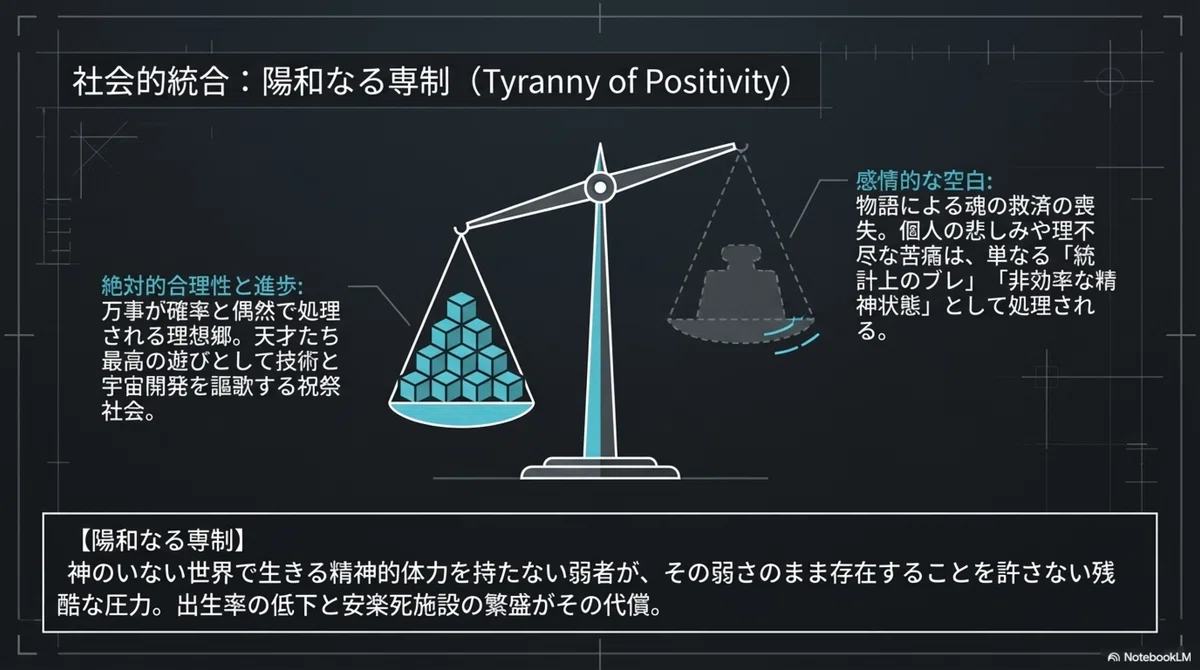
The multiverse where Smith's theory became the majority was, at first glance, a utopia. It is a world where a festival society and a sunny tyranny coexist. There are no religious wars or cults, and people live brightly like party people based on the rational resignation that 'since we happen to be in this universe, let's enjoy the present.'
However, the society Thorne saw in the New York of the future had a serious distortion. In a society that dismisses everything as probability and coincidence, an individual's deep sadness or unreasonable pain is treated as a mere statistical deviation. To those who have fallen ill or lost loved ones, those around them brightly encourage them, saying, 'You drew an unfortunate probability, but there's no point in thinking about it, let's find the next fun thing.' There is no salvation of the soul through stories there.
A cold, sunny pressure that does not allow the weak to exist in their weakness covered society. Thorne named this the sunny tyranny. Everyone is forced to be positive, and introspection or sadness are treated as inefficient mental states subject to counseling or medication.
The ruling class of society was occupied by geniuses like Smith who had a mental structure that could truly enjoy the absence of meaning. They enjoyed AI, quantum technology, and space development as the ultimate play, and led the masses with their charisma. However, the vast majority of ordinary people who could not keep up with that light were quietly being eroded by nihilism, having lost the stories that affirm the significance of their own existence. For those who did not have the mental stamina to live in a world without God, the declining birth rate and the quiet prosperity of euthanasia facilities told the cruel truth of this world.
11. Culture of Probability Theory
As Thorne walked further around the streets of New York, he was observing the most characteristic linguistic habits of this society. Everything in the world was processed in either two or three choices. It was embedded in the very structure of daily conversation.
On the train platform, an old man was talking to a girl who appeared to be his granddaughter.
I wonder if I should take an umbrella today.
The girl immediately took a small device from her pocket and glanced at the screen. The weather model says there is a 62 percent chance of rain. You should definitely take it, Grandpa. The standard threshold is to bring one if it exceeds 50, right?
The old man nodded and picked up his umbrella. There was no hesitation or doubt.
This habit was also prominent in public discussions. Thorne stopped to listen as citizens debated a political issue.
How should we decide on expanding immigration?
73 percent in favor, 27 percent against. That is the current tally. The effective population is based on 340,000 behavioral data points and simulations. Isn't it a waste of information costs to prolong the discussion any further?
But that 73 percent is based on a five-year model. How do you weight it if it deviates from current perceptions?
The correction for perception bias should be 0.7 by default. So, in reality, it should be viewed as a close race of 51 percent to 49 percent. In other words, it is the safer bet not to move right now.
Has the cost of choosing that safe bet been calculated?
Of course. The risk of inaction is 1.3 times the risk of action. So, well, there are three options. Push forward, wait and see, or conditional implementation. Conditional implementation has the highest expected value.
Thorne felt a strange sense of suffocation as he listened to the conversation. They were not deciding anything arbitrarily. Everything was organized by probability and expected value, choices were always narrowed down to two or three options, and a number was attached to each choice. This was undoubtedly rational. However, it also seemed that people were losing something with every decision they made.
It was the same at school. In a class at a public school Thorne visited, children around 12 years old were practicing probabilistic ethics.
A friend is in trouble. If you help, your own resources will decrease by 15 percent. If you do not help, there is a 78 percent probability that the friend's plight will continue. Now, how will you act?
The children began to calculate on their respective devices.
The expected utility is higher if I help. In the long term, strengthening the friendship network contributes to the recovery of my own resources. Helping is the optimal solution.
But even if there is a 78 percent chance the friend cannot get out of the plight, there is a 22 percent chance they could recover on their own. By not helping, I might be encouraging that 22 percent chance of autonomous resolution.
That is correct. It should be three options. Help strongly, watch over, or provide conditional assistance.
The teacher nodded. That is correct. If you are bound to two options, you will overlook the optimal solution. Always look for a third option. That is the basic thinking training of this society.
As Thorne left the classroom, he thought. In a society without religion, people cling to probability instead of prayer. They bring up expected values instead of the will of God. But probability does not give meaning. It is merely a tool for managing risk. The desire for meaning cannot be calculated. And in this society, things that cannot be calculated were generally treated as if they did not exist.
12. The Culture of Game Theory
If probability theory formed the foundation of thought, then the ethics of practice built upon it was game theory. It was a structure where strategy itself was ethics. As Thorne walked through the business district, he saw traces of it everywhere.
In a public negotiation room set up in a corner of the exchange, Thorne observed two men talking.
"Is this proposal a dominant strategy for you?" one said.
"Regardless of the other party's choice, my optimal strategy is approval. However, that is on the premise that the other party acts cooperatively. If the probability of the other party betraying exceeds 30 percent, I will switch to a preemptive check."
"Can you bring it to a Nash equilibrium?"
"I can. However, the key is whether the other party recognizes it as an iterative game. If they think it's a one-time game, the motivation for cooperation collapses."
"Then, I will send a signal of trust first. If the other party is a homo economicus, they will choose cooperation based on the calculation of long-term benefits."
Thorne was not surprised. In this culture, negotiation was an applied problem of the prisoner's dilemma, and social life as a whole was designed as an iterative game.
The political arena was the same. In the city council debate Thorne observed, almost all the council members spoke in the vocabulary of strategic reasoning.
"This policy creates an incentive to cooperate in the short term, but it becomes an incentive for betrayal in the long term. The institutional design is incomplete."
"We should correct the incentives by strengthening penalties. Make the cost of betrayal greater than the benefit of cooperation."
"However, excessive penalties create a chilling effect and shrink the pie for all participants. There is research suggesting that increasing the certainty of monitoring is more efficient than the severity of punishment."
"What is the comparison between monitoring costs and deterrent effects?"
"In the model, the deterrent effect is superior by 3 to 7. However, if the assumption of rational actors that the model premises collapses, it reverses."
The meeting proceeded like an analysis of a game tree, and the participants spoke while calculating the expected benefits of their respective choices. There were no emotional appeals or rhetoric appealing to narrative.
Even in education, strategic thinking was positioned as a core subject. At the high school Thorne visited, students were learning to design social systems through simulation games. The teacher presented a task.
"You are in a position to decide on new resource allocation rules. Design a rule that achieves overall optimization on the premise that all participants will try to maximize their own self-interest."
One student raised his hand. "Rather than designing incentives for everyone to act honestly, it is more realistic to create a mechanism where even if they lie, they lose. The basis of mechanism design is to create a structure where self-reporting brings out the truth, right?"
Another student followed. "But a perfect mechanism does not exist. There will always be a loophole somewhere. I think it is more important to have a mechanism for continuous improvement through feedback than the perfection of the design."
The teacher nodded with satisfaction. "Exactly. This is the foundation of our society. We cannot design a perfect game. However, we can possess the ability to quickly discover and fix flaws in the game. That is the most important intellectual training for a modern citizen."
As Thorne listened to the lecture, he acknowledged the sophistication of this society. Yet, that sophistication was built upon avoiding a fundamental question. Why cooperate? Why try to alleviate the suffering of others? Game theory does not ask about the source of those motives. Long-term benefits, reputation, risk of retaliation—these calculations explain cooperation, but nowhere was it written why one would still act for the sake of others in situations that transcend all such calculations.
13. Reconstruction District
If game theory forms the skeleton of social ethics, then as a logical consequence, losers are created. This was the place for those who had lost the game. Thorne stepped into a block just outside the glamorous city center and witnessed the shadow of this society.
The place, called the Reconstruction District, was a zone where welfare facilities and dormitories for low-wage workers were mixed together. On the screens of public terminals installed on the streets, social credit scores and work performance rankings were constantly displayed. Although the names of those with low scores did not appear on the district's display boards, it was an open secret who the "losers of the game" were, based on entry and exit records at the facilities.
In a corner of a public cafeteria, Thorne had the opportunity to speak with a middle-aged man. The man had once worked in data analysis, but had lost his job due to the evolution of AI and was waiting for his turn in a retraining program.
"How are you feeling right now?" Thorne asked quietly.
"It feels like I lost," the man said bluntly. "In the game called the market. My value lost to a system with lower costs. That's all."
"Don't you feel frustrated?"
The man was silent for a while. "There is no place to appeal the feeling of frustration. I can't complain to God, nor can I curse fate. The rules of the game changed, and my hand became weaker. That's the whole story. The emotion of frustration is probably a waste."
The dry rationality of those words sounded pitiful to Thorne.
At the next table, a young woman was muttering to herself while staring at a terminal. "Missed the lottery for the retraining slot again this term. 12 percent probability, huh. Well, I guess that's how it is. If I can draw a 12 percent chance next term, statistically speaking, I should be able to get in within 8 terms."
She kept muttering probabilities. Without anger or lamentation, she was trying to come to terms with reality by simply stacking up numbers.
When he went out to the street, a street-side discussion group was continuing a debate. The theme was the validity of the term "loser."
"The very concept of a 'loser' is rhetoric that misattributes the failure of social design as individual failure. If the rules of the game itself are not fair, you cannot attribute responsibility to the loser."
"However, attempts to make the game fair have been going on for centuries. Even so, losers emerge. A perfectly fair game does not exist. Therefore, the issue is how to design a compensation system for the losers."
"Compensation is necessary, but if compensation becomes excessive, the motivation to participate in the game is lost. The essential question is where to place the balance between a minimum guarantee and participation incentives."
"In the end, it's about how to guarantee the dignity of those who have been pushed out of the game. The fundamental question is whether this society recognizes value that cannot be reduced to a score."
Thorne approached the old man who had made that last remark. "Do you believe in value that cannot be reduced to a score?"
The old man answered slowly. "It's not about whether I believe in it, but I understand that such a concept is necessary. However, in a society that lacks the tools to measure it, all one can do is keep saying that it is necessary."
14. Welfare Coordination Bureau
The existence of those who lost the game, however, did not immediately cause this society to collapse. A optimism regarding welfare and the cracks of self-interest coexisted there. In Probabilistic World B, there existed an elaborate mechanism to absorb them. It was a system of welfare and social security.
The municipal Welfare Coordination Bureau that Thorne visited was a surprisingly functional facility. The official explained brightly.
"Four centuries ago, in the era immediately after Smith's theories became widespread, our predecessors had already predicted the existence of losers as a logical consequence of game theory. Therefore, from the stage of system design, we have incorporated a soft-landing device for losers. Basic living security, the right to re-education, and a minimum guarantee of medical care and housing. Even if you lose the game, it won't be so terrible that you die. That is the basic pledge of this society."
"That is an excellent design," Thorne said. "However, that design does not always function."
The official's expression clouded slightly. "Well, there are parts that don't go according to theory. What we call cracks in the system inevitably remain."
"What do you mean by 'cracks'?"
"To put it bluntly, it is a problem of self-interest," the official lowered their voice slightly. "Those in a position to manage welfare funds steer those funds in a direction favorable to themselves or their own groups. Or, they distort the design of the system itself to protect their own interests. In our society, this is not a matter of individual morality, but a rational game-theoretic consequence of the system. For an administrator, maximizing one's own profit easily becomes a dominant strategy."
"What is the mechanism to solve that problem?"
"Surveillance, transparency, term limits, institutional protection of opposing forces, and encouragement of whistleblowing. We are taking every possible measure. Even so, human ingenuity is terrifyingly excellent at finding holes in the system."
The official gave a bitter smile. It was the smile of futility that had been repeated over many centuries.
That night, while walking along the high-rise streets of New York, Thorne looked out at the night view. Countless shining windows. Inside each one, the game continued. A cycle of winners and losers, strategies and blunders, cooperation and betrayal. The net of welfare is cast. But the mesh of the net is not perfect, and the force of the administrators' self-interest constantly continues to distort its shape.
At a bar, Thorne sat next to an old economist. The man said while tilting his glass.
"Smith's books were great. They burned away all superstitions and exposed humans to the light of reason. But you see, even when exposed to the light of reason, the contents of humans did not change. People who do not believe in God are just as greedy and just as shortsighted as those who did believe in God. You can correct human nature with systems. However, you cannot erase it."
"Then what do you do?"
"You keep running. The side that plugs the holes and the side that widens them. Forever." The man finished his drink. "It's tiring, though."
15. The Master of the Castle
Thorne stared at the thick iron door in the back of the workshop. He had walked through the castle until now, but the weight of this central section was exceptional.
"Is that the heart of your castle behind there?" Thorne asked.
Smith nodded and opened the iron door. Beyond it lay a vast corridor leading to the main furnace cylinder, and further back, a core section where multiple giant cylinders were arranged in concentric circles. Tubes through which heat ran, nearly silent observation tubes, record tubes piled high with record boards, and steel walkways connecting them. A shielded section where the air itself felt tense.
"The world you have created is a paradise for some, but a slow hell for many," Thorne said.
Smith stared at the fire in the furnace and answered quietly, "Every world is like that, detective. The world where people believed in God also held its own hells. I have simply changed the type of hell. From the hell of old stories to the hell of physical laws. Which is better is for each individual to decide."
"With your status and intelligence, you should naturally want to look down on the city from a high tower," Thorne said. "Why did you head underground, into the cylinder, behind thick walls?"
Smith smiled faintly. "High towers are for showing off to people. But I didn't want to show; I wanted to see. The surface is too noisy. There is too much light. Too much vibration. Human activity itself becomes noise. If you want to measure something extremely subtle, you must first silence everything unnecessary. That is why I went under. Beneath the rock and iron. I chose a vessel that sinks deep rather than a tower that stretches upward."
The reason the Hard Castle dives deep underground is not for power or secrecy, but because it was necessary to block out all unnecessary noise to capture the world's most subtle signals. Smith chose hardness over height. It is not difficult for a blacksmith to build a massive structure out of hard iron. The problem is the purpose. Here, he was tirelessly repeating acts close to what later generations would call quantum mechanics experiments, verifying waves of determination and fluctuation through observation.
In this timeline, Smith does not die. He continues to reign at the center of civilization until the 2200s as a great historical ruler, or as a legacy status. He is remembered as the founder who ended religious slaughter, eradicated superstition, and established reason and order in the world. He is not a tyrant, but a ruler who is simply too competent.
However, the purpose of his long reign was not merely to deny God. Smith does not call his rule a finished product. "I did not erase God. I only took the name of God away from you all," he might have whispered somewhere. He is watching what humans call things even after the name of God has been taken away. Stories disappear when burned, but the desire for meaning cannot be burned. He continues to observe quietly from deep underground where humanity will eventually swing back.
16. Arendt Entropy
In the corridor leading to the deepest part of the core sector, Thorne walked alongside Smith. The steel floor echoed. Inside the observation cylinder, the dim light of instruments flickered. There was an inescapable fate in an arbitrary world. After a long investigation, Thorne asked the most fundamental question he had arrived at.
"This world seems to be exhausting itself as it approaches completion. Probability theory has rationalized thought. Game theory has designed structures of cooperation. Welfare has tried to include the losers. Yet, as a whole, this society is losing its vitality. Why is that?"
Smith did not stop walking. After walking in silence for a while, he slowly opened his mouth.
"Do you know the philosophy of a woman named Hannah Arendt?"
"I do. About human plurality and the public space of action."
"The core of her observation is that the condition for humans to be human lies in unpredictability and the ability to create beginnings. People can always start something new. That is the foundation of political freedom. However," Smith placed his hand on the corridor wall, "in this world, every choice has become a subject of optimization. Two options or three? What is the expected value? Which is the dominant strategy? Thus, the human power to freely begin, the power to initiate unpredictable actions, has been finely controlled by the web of reason."
"And that leads to a decline in vitality?"
"In words Arendt did not use, it is like this," Smith smiled bitterly. "I call this the law of Arendt Entropy. In an arbitrarily designed world (that is, a world created from the beginning for a specific purpose), the entropy of human vitality among its constituents increases at an extraordinary rate. Like thermodynamic entropy, it only moves in one direction."
Thorne stopped walking. "'Arbitrarily designed,' you say?"
"Yes," Smith said quietly. "This world was not formed naturally. It is a world designed by someone's intention for the specific purpose of excluding God. In a world composed by arbitrary design, as humans continue to live within the framework of that design, the ability to perform unexpected actions, the power to step outside of meaning, is lost. People continue to optimize within the given options, and that optimization behavior itself becomes fixed as culture. They think in terms of probability, act according to game theory, handle losers through welfare, and try to correct self-interest through institutions. It looks perfect. However, free energy in the sense of human vitality slowly but surely dissipates."
At the end of the corridor was the door to the observation room. Smith opened the door. Beyond it was a vast room lined with countless instruments and recording boards. Records from many years were piled up, and mathematical formulas and charts were posted everywhere. On a graph covering the wall, a gentle but consistent downward curve was drawn.
"What is this a record of?" Thorne asked.
"This is the transition of vitality in this world. The density of cultural creativity, the frequency of unpredictable behavior, the strength of the impulse to step outside of institutions. I have been measuring these as a composite index for a long time." Smith traced the downward curve with his finger. "As you can see. A monotonic decrease. There are no exceptions. There have been a few small rises, but the overall trend does not reverse. The law of Arendt entropy is an absolute rule in this world."
"In other words, this world is..."
"Heading toward an end," Smith said quietly. "Not rapidly, but surely. People are living. They are prospering. There is little conflict. But the fundamental impulse to start something is becoming diluted with each passing generation. It is the result of the cultural order being too well-organized, and the result of the design being too perfect."
Thorn said after a long silence, "Is there a way to escape?"
"I do not have the answer to that question. If I did, there would have been no need to build this castle." Smith stood in front of the instrument and continued with his back turned. "I designed this world as an observation field. As an experimental ground to see what humanity would turn to after losing God. Probability theory, game theory, welfare, the battle against self-interest. I am watching to see if humanity can escape Arendt entropy after going through all of that. However."
He turned around just once and looked at Thorn's face.
"So far, there has been no example of escape. In any world line."
Smith let his mouth curl slightly and said this.
"Correct. This world is a massive experimental ground to make that truth manifest. Now, how would you suggest solving it? Great detective."
Thorn stood in the deepest part of the hard castle and stared at the downward curve of the graph. Then, he shook his head quietly.
"Unfortunately, my job ends here. That is the job of Kouma or Anastasia."
Thorn never confronted the master of the hard castle. With the quiet fatigue of someone who had seen a massive blueprint, he began preparations for transfer. Thorn's job was done. However, the theater's job was not done. Blacksmith's experiment was not done either. The completion of atheism was not an ending, but rather a condition for the birth of something else. In the next act, different actors would take the stage. Thorn quietly aligned the coordinates and departed from this experimental ground.
17. Report
Thorn sent the final report to Joan. It detailed the truth of the God-killing incident. Thorn had never found the surname Smith, contained within Joan's name, to be a very pleasant coincidence. Inside the theater, surnames, faces, and sometimes even ages were not worth trusting. Who inherited whose name, who changed into whose body, and who had what degree of connection to historical figures—if one tried to investigate, everything could become suspicious. Joan herself did not like those kinds of questions. Or rather, she tended to dispose of the person who raised the question first. So Thorn pushed that coincidence into a corner of his mind and decided not to think about it for now.
"Conclusion. It is highly probable that the creator of Probabilistic World B, Anonymous Simon Magus Black Smith, is an apostle of God or a mediator equivalent to one. This atheistic multiverse is not just a world for depriving humanity of religion. It is a long-term observation experimental ground to measure where and in what form humanity, having completely lost God, will desire something equivalent to God again."
The God-killing incident did not even happen in this world line. Before God could be killed, He sent an apostle named Smith to make His presence disappear through perfect logic. It was all a grand self-directed performance by God to encourage humanity's independence. The genius Smith was the most excellent debugger placed by God, and he played the role of distributing the prescription to peel humanity away from old religious conflicts.
However, Thorn added another conclusion to the report. "Because of its purpose, this world has become the purest experimental example of the law of Arendt entropy. In an arbitrarily designed world, the free energy known as human vitality dissipates monotonically in exchange for the completion of the system. This law holds without exception at this point in time. No welfare system, no game-theoretic design, and no probabilistic thought training has been able to stop that dissipation. The question is sent to the next person in charge."
The reply from Joan was only one sentence.
"Understood. Your job ends here. The next stage of observation and intervention will be passed to Hijun Kouma or Anastasia."
Thorn returned to the year 2242 for a moment, and from there, he shifted the coordinates of Probabilistic World B to Probabilistic World A. To return to his original era, he needed to jump further into the past from that position. While proceeding with the transfer preparations, Thorn felt it was actually surprising that the report had been accepted so readily this time. He had expected that he would be treated like hard food again this time, as usual. However, Joan did not touch upon that point at all, and only told him, in a businesslike manner, that it would be passed to the next process.
The next step. For instance, intervention in a world known as a "Time Tangle." That was the domain of those who served as theater managers, like Hijun Kouma or Anastasia. Thorne himself only knew of its true nature through rumors. But at the very least, he had heard that intervention was not the sort of thing that destroyed worlds or erased certain histories. A Time Tangle is left as a tangle. One simply secures the end so that the fraying does not spread any further. In short, it is said that one merely processes it so that no further intervention can occur.
Once, Hijun Kouma himself created a Time Tangle during the era of the Russian Empire. That reputation alone was common knowledge for anyone in the theater. However, this time, it was likely not a Time Tangle. At the very least, Anonymous Simon Magus Black Smith was not a person of the theater. In other words, this case involved someone who could create a world outside the theater that still required intervention—an entity known within the theater as an Apostle of God.
And regardless of the outcome after the intervention, it also meant that Probabilistic World B was not the kind of world that should be kept secret from the members of the theater, at least. It was not a profound mystery. Perhaps it meant that it was permissible as long as it was under the title of an Apostle of God. Thorne understood it to that extent.
In any case, this was the second time the client had turned out to be the culprit. What did the client expect from the detective? Thinking this, Thorne forwarded the report to Joan.
#Atheism #Multiverse #QuantumMechanics #HistoryOfIdeas #Dystopia #GodKillingIncident #AnonymousSmith #CognitiveRevolution #SharedFiction #Sapiens #ModernThought #TimeLeap #SimonMagus #HistoryAlteration #TheManInTheHardCastle #ProbabilityTheory #GameTheory #Arendt #Entropy #Welfare #SelfInterest