
Episode 16 | Will a Stadium Stand on the Riverbank Outland?

A nameless space left at the boundary
I think most people are unaware that such a place exists.
Near the border between Ichikawa City and Edogawa Ward.
The entire area to the east of the Edogawa Sluice Gate on the Old Edogawa River
is a place that, at first glance, looks like an ordinary river space.
To be specific,
it is located almost exactly between Shinozaki Station on the Toei Shinjuku Line and
Myoden Station on the Tokyo Metro Tozai Line.

However, this place
is not a place developed like a park,
nor is it land with a defined purpose like a residential or commercial area.
With rivers, water surfaces, boat basins, and vacant lots intricately mixed together,
it exists at the edge of the city, as if time has stopped.
It is
a slightly mysterious space
that cannot be fully explained even by drawing lines on a map.
The margin of the boundary born in the Taisho era
Originally, in this region,
prefectural borders were determined based on the center line of the river.
However, from the Meiji to the Taisho era,
large-scale flood control projects, such as the excavation of the Edogawa Floodway,
were carried out as countermeasures against the flood damage that frequently struck the capital region.
Due to this construction,
the water system in this area was significantly reorganized.

(1880 Land Use Map)

(1969 Land Use Map)
Although it was construction done for flood control,
as a result,
only the debate over "where the new boundary should be" remained,
and with it still unresolved, a "space that belongs to neither administrative district" was left behind.

That is
the place called the "Riverbank Outland."
A size large enough to fit a stadium
This area
is tens of thousands of square meters in size.
Of course,
whether a stadium could actually be built is another matter.
But when you look at the map,
it has a scale that makes you imagine, "What if there were a stadium here?"
While located within the city,
it is a margin that has not been given a clear role for a long time.
Will a stadium stand in this place?
If a stadium were to be built in this place,
with the beautiful flow of the Edogawa River at its back,
a large stadium would appear
between Ichikawa City and Edogawa Ward.
On one side, the cityscape of Tokyo.
On the other side, the cityscape of Chiba Prefecture.
The people who gather there
would see the same scenery and share the same time,
without being conscious of the administrative boundary.
A stadium is,
before being a sports facility,
a place where people gather.
That is precisely why
a stadium built in this place
might not be "Ichikawa City's stadium"
or "Edogawa Ward's stadium,"
but could become a symbol that connects the two cities.
The possibility of a disaster prevention hub
There is another meaning to this place.
Both Ichikawa City and Edogawa Ward
are regions that have faced flood damage since ancient times.
That is why,
if a large-scale facility were to be developed,
the possibility of it being a facility that also serves disaster prevention functions,
such as an evacuation space,
a supply storage hub,
and a disaster support base, can be considered.
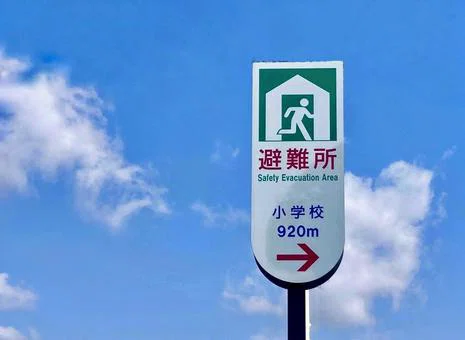
Daily life where cheers echo, and extraordinary times that protect people.
It might be able to become a place that supports both.
Are boundaries only for dividing?
What is a boundary?
Originally, it is a line drawn to divide administrative districts.
However, when looking at the "Riverbank Outland,"
I feel there is another way to look at it.
Could a boundary not be a "line for dividing,"
but also a "margin for connecting"?
It makes me think about such things.

"What if we were to build a stadium in Ichikawa."
At Gyotoku Fuji, I saw the 'past of the city'.
At the Myoden train depot, I saw the 'backside of the city'.
And at the Kawahara Bangaichi, I thought about the 'meaning of boundaries'.
None of these are places that would normally be the first to come up as stadium candidate sites.
In fact, they are all places where people would say, 'There is no way you could build one there.'
However, what I wanted to think about in this series was not whether a stadium could truly be built.
It was to re-examine the 'possibilities sleeping within the city' from a slightly different angle.
Scenery that you thought was ordinary can look different if you change your perspective.
Even in places thought to have no value, there might be 'future stories' sleeping.
I believe that the very act of imagining such things is the first step toward thinking about the future of the city.
'If we were to build a stadium in Ichikawa' Series (3 episodes total) - Complete
Gyotoku Fuji. Myoden train depot. Kawahara Bangaichi.
The journey through these three 'places that are usually not chosen' ends here for now.
However, there are still places in Ichikawa that have not been talked about.
And there are futures that have not been spoken of.
'If we were to build a stadium in Ichikawa.'
I would be happy if we could continue to discuss that story together.
■ NPO Ichikawa City J-League Club Creation Association
With the goals of:
・Revitalizing the local community
・Promoting the local economy
・Improving the local brand
we are engaged in activities to 'create the future of the region' by combining sports, transportation, local exchange, and more.
▼ Website
Past notes
'Ichikawa/Matsudo Wide-Area Stadium Concept' Series
Episode 0 | A story that is not just about wanting to build a stadium (10 episodes total)
'Football Tourism Edition'
Episode 11 | Football tourism, the magic that enriches a city (2 episodes total)