
My Story of Visiting the Cubism Exhibition Six Times - It Truly Was a Revolution in Beauty

●Updated March 23, 2024
I wrote an article about Cubism. Please take a look at this as well if you like.
This is a memoir about how I was so incredibly inspired by the "Cubism Exhibition: A Revolution in Beauty - From Picasso and Braque to Delaunay and Chagall" (10/3/2023–1/28/2024) held at the National Museum of Western Art, Tokyo, that I ended up going many times. It made me realize that Picasso and Cubism are by no means synonymous. What I want to convey is
“The less you know about Cubism, the more you should go! If you miss this opportunity because of a preconceived dislike for Picasso's paintings, that would be a huge waste!!”
That is all, and the text that follows is my personal account of having had a wildly good time. It turned into a major article with the largest word count I've ever written (about 15,000 characters), but please forgive me, as it was impossible to summarize this love for Cubism in a short space. For those who are interested, I think it makes for an engaging read... I have also chewed over and explained the definition of Cubism based on source materials. Also, be warned that there are too many spoilers; if you want to see it without any prior information, absolutely do not read this! (Read it after you've seen it.)
However, even if I say "go," by the time this is posted, the exhibition at the National Museum of Western Art will have ended. Since the Cubism Exhibition will also be held at the Kyoto City Kyocera Museum of Art from 3/20 to 7/7, I hope this will serve as a reference for that. I will be posting some of the works that were allowed to be photographed, but nothing beats the real thing, so please go see it, really. I felt that the claim of it being a once-in-50-years scale was no exaggeration.
Introduction: I, Who Did Not Know Cubism
Cubism. Actually, until about half a year ago, I had not a shred of interest in it. I had the assumption that Picasso was the kind of person who painted pictures like "Guernica," and honestly, I disliked those paintings and avoided them. And I foolishly mistook "Les Demoiselles d'Avignon," "The Weeping Woman," and "Guernica"—the "paintings I dislike" that I had seen in textbooks—as being Cubism, without thinking about the meaning of "Cubism" (立体主義). (Of course, one could probably recognize Cubist sculptural vocabulary in "Les Demoiselles d'Avignon" before the Cubist period, and in "Guernica" and others after it.) The two big names "Pablo Picasso" and "Cubism" continued to walk a discordant three-legged race in my mind, and the errors born from this lack of connection were becoming fatal over the long years.↑ For those who, like my former self, avoid Cubism because of their impression of Picasso, aren't you in this state?
Speaking of my Picasso...
A painting that fits the image perfectly ↓

National Museum of Western Art, Permanent Collection
However, there was an event that became the catalyst for overturning such a mistaken perception. Several friends I met on social media went to the Cubism Exhibition and shared their impressions with me, along with photos of the exhibits. I had thought that Cubism was an activity carried out by just two people, Picasso and Braque (whose name I only knew), but I learned that there were many other artists who participated in Cubism and that there were a wide variety of derived movements.
One of the people who shared their impressions
Itototo-shi's Cubism record ↓
Particularly shocking were the paintings of Juan Gris. “This isn't Picasso at all!” I thought. ...To put it into words, it is extremely obvious, a matter of course, but having only known the "paintings I dislike," I was genuinely surprised by his easy-to-understand, cube-like paintings and their beauty. Was the scope of Cubism this wide? I couldn't let a large-scale exhibition, said to be a once-in-50-years event, pass me by, and my interest was suddenly piqued. After all, over 50 works from the Centre Pompidou in Paris were being exhibited in Japan for the first time.

A photo from when I went the first time.
It really feels like a cube, and the composition is good too.
What is Cubism?
I could just write down my impressions of the exhibition, but I want to touch on the question: What is Cubism? Originally, it is difficult to understand the innovation of Cubism without knowing its history, but since it would be too long to include those stories, I will cut them for now.
I will introduce some YouTube videos I watched in the bibliography section. I highly recommend watching them if you want to know more about Cubism. Also, the book "Art Beginner's Collection: Want to Know More About Cubism" by Tokyo Bijutsu, which I also used as a reference, was just right for knowing the flow of Cubism and the art trends of the same era broadly, shallowly, and systematically, so please read it if you have the chance.
Regarding the definition of Cubism, I will insert some analysis and explanation. It is written like this in the National Museum of Western Art's information magazine "Zephyros 88."
“An attempt to break away from three-dimensional spatial expression using traditional perspective and shading, and to construct the screen planarly using geometric shapes.”
Arisu Kubota, Special Researcher at the National Museum of Western Art
Quoted from edited and published by the National Museum of Western Art (9/20/2023)
Huh, I see? That sounds like quite an amazing attempt. It is written in more detail in the exhibition catalog, so let's look at that too.
“An art movement that abandoned the traditional illusionist techniques of Western painting, such as perspective and shading, which make it appear as if there is three-dimensional space or volume on a two-dimensional picture plane, and instead used multiple viewpoints or constructed the screen in a grid pattern using figures simplified into geometric forms, thereby liberating painting from the role of depicting the subject in a reproductive, imitative, or realistic manner, and creating a more autonomous painting.”
To Understand Cubism: Several Perspectives
Masayuki Tanaka
Edited by the National Museum of Western Art et al., Nihon Keizai Shimbun (2023), quoted from p.16
Hmm, in short, it's like “an art movement that aimed for 'paintings that are not imitations of reality' by abandoning perspective and shading, using multiple viewpoints, and constructing the screen planarly using geometric figures.” Also, in the same book, there is this description as the words of Juan Gris and the poet Guillaume Apollinaire.
“To borrow the words of Juan Gris, Cubism is ‘a new way of representing the world.’”
To Understand Cubism: Several Perspectives by Mr. Masayuki Tanaka
*“He” refers to Guillaume Apollinaire.
“In ‘The Cubist Painters,’ which he published in 1913, it is written as follows: ‘The point where Cubism is clearly distinguished from traditional painting is that Cubism is not an art of imitation, but an art of conception that aims to rise to the level of creation.’”
To Understand Cubism: Several Perspectives
Mr. Masayuki Tanaka
Let’s unpack the meaning of these words a little more. For example, let’s say you draw a violin in front of you in an extremely realistic way—using traditional Western techniques, perspective, and shading. In this case, it could be said that the artist simply drew the violin as a representation of the real world, merely imitating what they saw and transposing it onto the medium of painting.In other words, perhaps Cubism is the movement that defined paintings created from such traditional Western modeling techniques as mere imitation, and instead sought art as a more creative concept, as well as a new methodology for representing the world.According to the audio guide for the Cubism exhibition, photography appeared in the mid-19th century, overturning the raison d'être of Western painting up to that point, which had been to depict nature exactly as it was. Cubism was one of the movements sparked by pioneers who were searching for forms of expression that only painting could achieve.
By the way, in the article by Itototo-san introduced earlier, the author renames Cubism as“The Jagged Art Movement.”Since the paintings actually look jagged when you see them, maybe it’s fine to understand it this way without thinking about the difficult things I’ve written so far. (Though I feel like I might get scolded by an expert for saying that...)
It’s faster to see it than to have it explained!So, from the next section, I will talk about my impressions of the special exhibition for each visit.
[Super Important] It is my personal hobby when visiting the National Museum of Western Art to take photos of the bronze statue outside, Émile-Antoine Bourdelle’s “Heracles the Archer” (specifically his butt), and the permanent collection piece, Joan Miró’s “Painting,” so I will include them every time.
1st Visit: Viewing Flatly
The first visit was on December 17th, and I went with my younger brother. At this time, I didn’t think I would end up going so many times, so I just kept taking photos of the works that were allowed to be photographed to keep a record.It felt like “viewing a painting flatly as a painting.”
●To UENO


─Entering the Cubism Exhibition─
●There are portraits, landscapes, and still lifes by Cézanne!
It is very educational to be able to see multiple paintings by the father of modern art up close.
●Henri Rousseau’s paintings might be a little scary
●African sculptures have mysterious forms!
I can see why they are attractive. But if you collect these and keep them at home, I feel like they would look eerie when seen at night.
●Landscape paintings of L'Estaque by Braque, etc.
These are the paintings that were described as being “reduced to cubes,” which later became the reason for the name “Cubism.” They are apparently called “Cézannian Cubism.” They certainly look like cubes.

“Terrace at L'Estaque (1908)”
So these are the paintings described as “cubes”~.
They really are doing the jagged art movement.

Right: “Musical Instruments (1908)”
They are jagged.
●Analytical Cubism really hits home
It’s chic and cool.The motifs are so deconstructed that I have no idea what is what, but I imagine they must have done more observation than one could guess from the appearance. You can see the traces of their research, and thinking that Picasso and Braque, the “two tied together by a rope,” must have been having fun, it made me smile.

I can’t tell at all that it’s a guitar player, but it’s good.

Still Life with Violin (1911)
Seriously cool. It was quite large and made a strong impact on me.It might be my favorite piece in this exhibition!
● Synthetic Cubism
This is also cool. At this point, I didn't really understand what 'synthetic' meant.


● Fernand Léger's paintings. Minecraft?

● Juan Gris's paintings
His paintings, which were what first got me interested in Cubism, are indeed blocky and cube-like. The colors are also more vivid and not as limited as those of Picasso and the others.

● Robert Delaunay and Sonia Delaunay'sI was also strongly impacted by Orphism and Simultaneism
In contrast to Analytical Cubism, which abandoned color and broke down and reconstructed objects while still remaining figurative, Simultaneism transformed into colorful abstract expression.They are polar opposites, but both are great!

The main visual of the exhibition. A masterpiece of scale!

I like abstract paintings, so this is very nice.

Prose of the Trans-Siberian and of Little Jehanne of France (1913)
If you look closely, you can see a person at the top and something like the Eiffel Tower at the bottom. Is it the view from a train window?
● Puteaux Group
They have a distinct impression, being geometric and full of movement. The name 'Section d'Or' (Golden Section) fits perfectly.

Chess Players (1911)
Just being able to see a painting by the 'urinal guy' is moving...

Colors like natural minerals and geometric lines.

Composition (1910-1911)
A beauty that could be mistaken for stained glass.
● Maison Cubiste
It's cool. I want to go inside and go wild.

● Modigliani!
I had a strong image of him as someone who painted portraits with long faces, but I didn't know he also made sculptures. And he was also influenced by Cubism.

It's long, as expected.
● Russian Avant-Garde, Cubo-Futurism
These were also quite unusual works that seemed to have undergone their own unique evolution.

It's cool.
● Cubism During World War I
The war separated Picasso and Braque, and Duchamp-Villon, the second of the three Duchamp brothers, fell ill at the front and died in 1918. It's too sad.

"Large Horse (1914, cast in 1966)"
I was breathless at the sight of it sitting in the gallery.
● 1918: The "Purism" Manifesto is Declared
Hmm... It's a beautiful painting, but I've been so overwhelmed by the works I've seen so far that, when compared to them,it leaves a weak impression. If it had appeared five years earlier, I would have given it a 90.
The reason for this is that about a week before this day, I participated in a game that could be called the "Artist's M-1 Grand Prix." Le Corbusier made it to the finals, but most of the judges, including myself, voted for Lucio Fontana's "Spatial Concept," which had also survived, and he ended up losing. Because of this, a strange fixed idea formed in my mind that "Purism lacks impact (compared to Spatial Concept)."That's so rude to Le Corbusier.

He's the amazing person who designed the main building of the National Museum of Western Art.

● The Video Work "Ballet Mécanique (1923-1924)"
Oh... oh? It's just too strange. I don't dislike it, but it's going to drive me crazy. [MoMA | Fernand Léger. Ballet mécanique. 1924] (English commentary article)
─ End of Cubism Exhibition Viewing ─
● You must buy the catalog!
I also bought postcards and stickers.

● A quick look at the permanent exhibition
I went around in about 30 minutes and took pictures of Miro's paintings.

● Afterword
I was so incredibly impressed by the Cubism exhibition that I drew a 4-panel comic for the art movement "Modern 4-Koma," which I also participate in, using "Analytic Cubism" and "Orphism/Simultaneism" as motifs. It's intentional that it's not clearly visible where the 4 panels are.
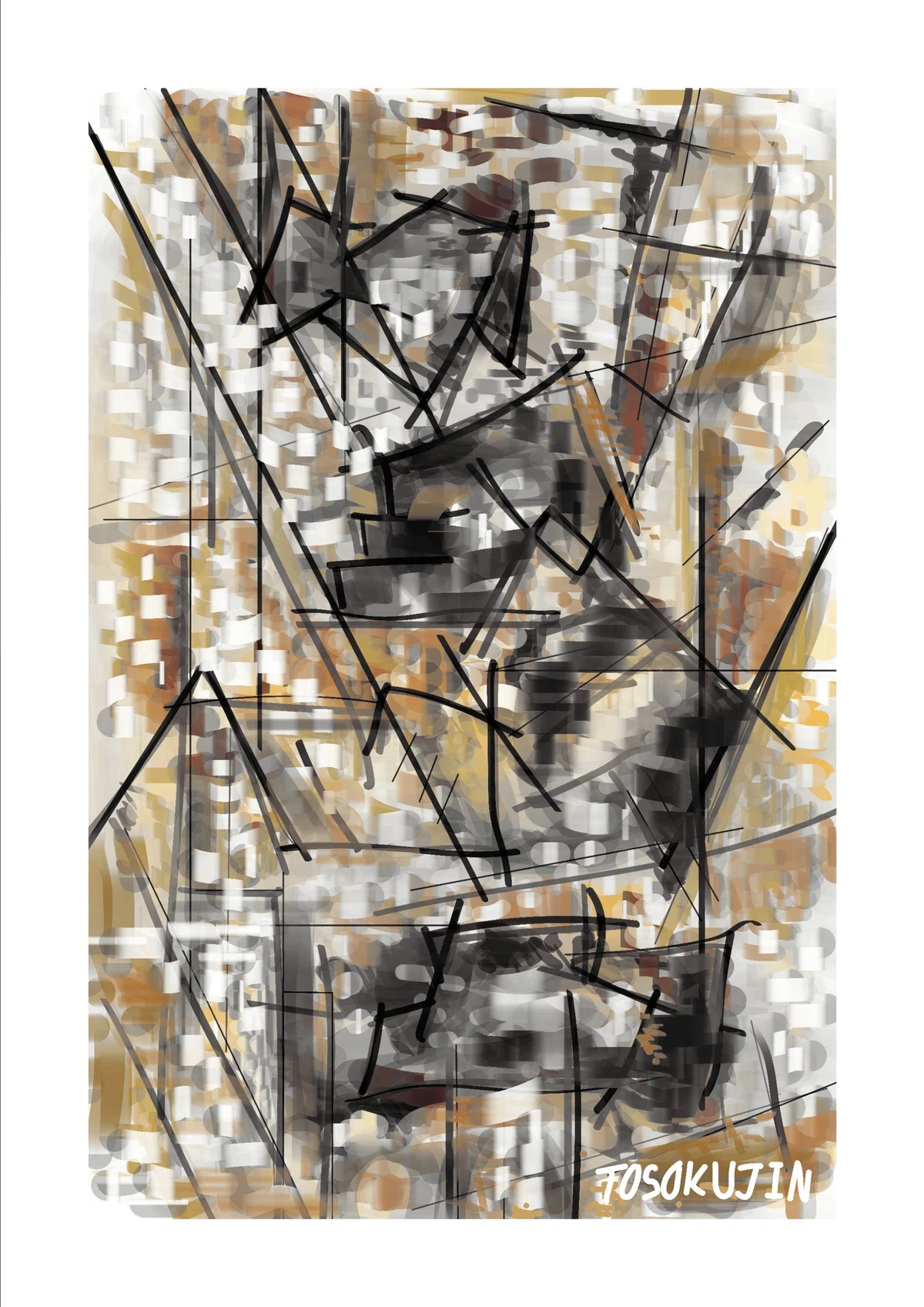
The painting style and color scheme are a tribute to Braque!

Expressing the process of eating a parfait in terms of space and time.
Click here for the work commentary ↓

Second time: Viewing it three-dimensionally
On January 8th, I went to Ueno by myself. A few days before this, an acquaintance had been raving about matière, so I decided to focus on the texture of the paintings while viewing them this time. The first time, I was distracted by taking photos and reading the commentary. I also got an audio guide, which I didn't use last time.It became a day of "viewing paintings from various angles and using the audio guide to see them three-dimensionally from multiple perspectives." Since I was doing movements like squats in front of the paintings, I must have looked like a suspicious person to others. I didn't take many photos, so I will pick out the ones where the texture caught my eye and share my thoughts.
● To UENO


─Entering the Cubism Exhibition─
● I still feel some resistance to Rousseau's paintings...
But knowing he was a self-taught person who worked hard, my perspective has changed a bit.
● Analytical Cubism is cool
As expected, the Analytical Cubism of Picasso and Braque is great. I want to hang it in my house...
● Re-observing Synthetic Cubism
It seems Braque's works sometimes have additives mixed into the paint, and you can indeed see the texture. This is something I didn't notice last time. (I forgot to take a close-up shot)

It seems sawdust is mixed into the paint,
and if you look closely, the surface is bumpy.
● Orphism and Simultaneism are also great!
● The texture of the Puteaux Group and Picabia's paintings is insane!


It's layered so heavily!
I want to touch it.
● Eastern European painter, Serge Férat
Perhaps influenced by Synthetic Cubism, the surface is rugged with additives.

"Still Life: Glass, Pipe, Bottle (1914-1915)"

There is sand in it. It's beyond just rugged!
● Likely Picasso from the later Cubist period

It's a fairly large work and very impressive.
I took this when I went the first time.

I took this when I went the second time.
It seems sand is mixed into the paint, so the surface is very rough.
● Purism
I had a much better impression than last time. Maybe I've lost my critical judge-like perspective.
● I still don't get "Ballet Mécanique" this time either
─End of Cubism Exhibition viewing─
● Bought stickers
I buy stickers every time I go and paste them into my travel notebook. By keeping them along with written records, I'll be able to remember the Cubism exhibition more vividly when I look back on it someday.

● I went through the permanent exhibition in less than 30 minutes this time too
As usual, I took a picture of Miró's "Painting".

3rd Visit: Viewing Analytically
January 19th. Unlike my previous visit, I had watched several explanatory videos about the Cubism exhibition and skimmed through the exhibition catalog. I also rented an audio guide, which allowed me to view things analytically by having gained a certain level of knowledge. I also learned about the existence of the Italian Futurists and that many Cubists transitioned from Pointillism to Fauvism and then to Cubism, which was also very informative. After spending about 4 hours at the special exhibition, I spent a solid hour at the permanent exhibition, which was longer than usual.
☆ Two videos from "Yamada Goro's Adult Liberal Arts Course"
※Available for a limited time
☆ One video from "MEET YOUR ART"
● To UENO


─Entering the Cubism Exhibition─
● My impression of Rousseau's paintings is changing
After seeing them three times, I've grown attached to them. You're welcome to come to my house.
● Staying in the section from Pre-Cubism to Synthetic Cubism
I probably stayed there for about an hour and a half. I always slow down here because I want to see the origins of Cubism and the collaborative experiments of Picasso and Braque.And I realized that I prefer the brushwork seen in Analytical Cubism and other works.

Part of "Still Life with Violin"
A directional brushstroke that I really want to touch...
It seems that before Cubism, he was doing colorful Fauvism.
I can't even imagine it from here.
● Let's also focus on the papier-collé and trompe-l'œil (trick art) that Picasso, Braque, and others incorporated
If you look closely, you can see pieces of paper pasted onto the paintings, or marble and wood grain patterns applied. It's interesting that this technique is used not only in the works of the two masters of Synthetic Cubism but also in the paintings of the Cubists who followed them.
What is papier-collé?
"Meaning 'pasted paper' in French. One of the painting techniques of Cubism, involving the pasting of fragments of newspapers, wallpaper, sheet music, etc., onto the canvas. It brings a raw sense of reality and impact to the picture plane."


There is a wood grain pattern on the right side of the canvas.
It seems he received training as a decorative painter when he was young.


You can see that papier-collé has been applied.
● Paintings that I was able to appreciate better thanks to the knowledge I gained from videos and the catalog

It seems he also went through a Pointillist phase,
and you can see those elements in this painting.
This is another one I like because it's cool.

Until my second visit, I just thought it was an interesting painting.
However, after learning about the existence of the Italian Futurists, looking at it again, I felt it was very Futurist.

"Venus of the Boulevard (1912-1913)"
As it was exhibited in the Rayonism/Futurism corner,
it looks like Cubism and is a very dynamic painting.
● The Measles of the 1910s
Mr. Goro Yamada mentioned in the audio guide and on his own YouTube channel that "Cubism was the measles of the 1910s," and that every artist of the time caught it. The essence of multi-perspective and geometric composition can also be gleaned from Chagall's paintings.

"I and the Village (1911)"
In Russian and Yiddish, it is said that a person who is lost in thought has their "head flying away."
(From the audio guide)
● Thinking about the relationship between Modernism and Cubism
Mr. Yamada, as with the previous topic, explained in the audio guide and videos why things that are difficult to understand, like Cubism, are liked, using "Modernism" as an example. Cubist paintings and abstract art likely suit modern white walls better than Renaissance or Impressionist paintings; Cubism was not just an art movement, but a movement that pioneered the larger trend of Modernism. Ah, I see. I would certainly like to hang a Cubist painting in a modern house.
And what was Le Corbusier thinking as he drew his blueprints after declaring Purism and becoming famous as an architect? When he designed the National Museum of Western Art, did he imagine that his own work would be exhibited there one day? ...The delusions that suddenly welled up know no bounds. (I found out later that a Le Corbusier exhibition was held in 1961, shortly after the museum opened.)

"Still Life with Carafe and Glass - A New World of Space (1926)"
It would be incredibly nice if this were hanging in my house.
Sorry for saying it lacked impact.
● I watched "Ballet Mécanique" for one and a half loops, about 20 minutes, but I don't really get it.
─ End of Cubism Exhibition viewing ─
● Committing a folly at the gift shop
Since I had a feeling the exhibition catalog would fall apart from repeated reading,I bought an extra one (idiot). I also bought a clear file, postcards, and stickers.

Also, my catalog stock increased by one.
● I spent about an hour looking at the permanent collection
Several paintings by artists who were also exhibited in the Cubism exhibition are on display. Specifically, as of January 2024, there are two by Paul Cézanne, two by Paul Gauguin, one by Fernand Léger, three by Pablo Picasso, and two by Le Corbusier. (Assuming I didn't miss any...)
In particular, since Picasso, Léger, and Le Corbusier are works from after Cubism and Purism respectively, it is very interesting to be able to perceive the changes in form and color. If you ever go to the National Museum of Western Art, I would like you to see these works as well.

● Appreciating works by Academy painters in the small special exhibition
I also took my time looking at this small special exhibition, which I had previously only glanced at. Works by Academy painters from the 1850s to around the 1900s are on display. There are many extremely figurative portraits, and it is interesting to compare them with something like Picasso's "Woman in an Armchair."

● Afterword
I end up buying a book on Cubism. I learned that the "directional brushwork" seen in the analytical Cubism of Braque and Picasso is likely what is called "constructive brushwork." It seems to be a technique invented by Cézanne. I also learned about "passage," where boundaries are blurred by brushwork.
By reading it alongside the exhibition catalog, I was able to systematically learn about Cubism, the art trends of the time, and the people involved, which was very educational. It is definitely a book I can recommend. ...If I mention this book too much, the length of the text will increase even more, so I will limit myself to referring to it as a reference in the future.

Ahahaha ahahahaha ahahaha
Full-color book 80 pages (5-7-5-7-7)
4th and 5th times: Viewing comprehensively
January 26th. By reading the newly acquired "I Want to Know More About Cubism" and the exhibition catalog, and watching other videos, I deepened my knowledge of Cubism more than the third time. Although it was a stopgap measure, I ended up "viewing it comprehensively using the knowledge I have."And I went in twice in one day. The first time was with audio, and the second time was without. During the first time, I re-recorded everything I could photograph and took many notes, and the second time, I kept my eyes wide open and focused on observation. No matter how many times I go, there are always thrills and new discoveries.
Actually, I intended to go see the Monet exhibition in between, but there were too many people, so I gave up...
☆ I'm going to explain art - Biju-Radio
● To UENO


─Cubism Exhibition Entry ①─
● (For a limited time) A cursed object I've seen more often than my own parents' faces

● Let's observe the structural brushwork and passage I've learned about
Unfortunately, I can only introduce one painting by Cézanne. Therefore, I will also pick one work each from Braque and Picasso.

Does the sky show the characteristics of structural brushwork?
The brushstrokes look uniform.
The boundaries between the sky and the trees are blurred due to passage.

“Viaduct at L'Estaque (1908)” (re-photographed)
Cézanne-esque Cubism. You can clearly see the structural brushwork.

Analytical Cubism.
Is this passage?
The boundary between the figure and the background is blurred.
● This time, too, I will stay for a long time in the section from pre-Cubism to Synthetic Cubism
● I can't take photos! Metzinger
I hadn't introduced it because I couldn't take photos, but I really like a work called “The Cyclist (1911-1912)” by Jean Metzinger. Besides being a colorful oil painting, it also incorporates sand and collage, making it a dynamic and interesting piece. I hope you look it up. It seems there are several works with the same title, but this one is in the collection of the Tokushima Modern Art Museum.
● The “Tubist” Léger
Léger was apparently also called a “Tubist” because he painted cylindrical Cubist paintings. Before this day, when I looked at the chronology written in the exhibition catalog, I learned that it was the critic Louis Vauxcelles who called Braque's paintings cubes and Léger's tubes. It's funny how everything ended up being named after art movements.
And this Léger ends up being involved in the production of that incomprehensible film, “Ballet Mécanique”...

It's a cylinder!
● I notice that Kupka's signature is cute
The signature, small, elegantly rounded, and neatly contained, is quite adorable.


● The paint texture of Picabia's “Red Tree” is amazing no matter how many times I see it
● A painting with a tremendously solemn impression
A painting by Léopold Survage depicting Baroness d'Oettingen. It is a very impressive work, with elaborate details such as the still lifes painted on the left and right edges, the figures going up and down the stairs at the bottom of the screen, and the decorations on the curtains and mattresses. The more times I see it, the more I like it.

“Baroness d'Oettingen (1917)”
● Watching Ballet Mécanique from a good spot
It's a mysterious work that I never get tired of but is interesting, and although I can't understand it, I gradually grow to like it.
─End of Cubism Exhibition viewing ①─
● Headed to the Ueno Royal Museum and got shut down
I went to the National Museum instead. On the way, I saw an old man drawing street art with water. I'll skip the story about the museum.

● To UENO

Round 2! It's getting dark!

─Cubism Exhibition Entry ②─
● Realizing that art dealer Kahnweiler lived a long life
Daniel-Henry Kahnweiler was an art dealer who signed exclusive contracts with Picasso, Braque, Gris, Léger, and others until World War I began in 1914. His lifespan was apparently 1884-1979. He lived an incredibly long life.
● Most of the exhibits here are over 100 years old, aren't they?
That thought suddenly crossed my mind while I was admiring my favorite, Braque's "Still Life with Violin." Today, a little while after I started getting interested in art, I have nothing but gratitude for being able to see 100-year-old works up close, and multiple ones at the same time. And I'm so glad the Cubism exhibition is being held now. If this had been a year ago, I probably wouldn't have come.
● Discovered a Torisan in Picasso's "Head of a Girl"
I found a Torisan at the bottom center of the painting. The Cubism exhibition feels fresh even on my fifth visit.

A tiny Torisan is drawn at the bottom.
● Even the invisible parts are being drawn in
Multiple perspectives are cited as one of the formal vocabularies of Cubism, but in Juan Gris's "The Musician's Table," parts that would normally be hidden are expressed as shadows? In a sense, this could also be said to be a synthesis of landscapes from multiple perspectives onto a single screen, which is very interesting.

● Picabia's "Red Tree" has the strongest matière no matter how many times I see it!
● Another Torisan
In the Neo-Primitivist painting, Mikhail Larionov's "Spring." I had noticed there was a boar-like animal on the left side of the screen, but there was also a Torisan in the upper right.

This is a photo from my fourth visit. Torisan...!
● Watching Ballet Mécanique from a great spot in the center of the seats
It's my fifth time and it takes about 14 minutes, so I didn't have to watch it, but I felt like I would regret it if I didn't, so I ended up getting sucked into the screening corner.
─Cubism Exhibition Viewing End ②─
● Purchases (from two visits combined)

● The permanent exhibition is just to meet my quota

● It's getting quite late
My first visit was about 4 hours, the second about 2 hours, and with about 2 hours of activity in between, I walked quite a lot. Even though I was in Ueno at 9:30 AM, almost exactly when the museum opened...

A look at it past 6 PM. Let's meet again on the final day...!
6th visit: Viewing it as a retrospective
January 28th, the final day of the exhibition. Following my 4th and 5th visits the day before yesterday, and having been out all day yesterday, the muscle pain in my lower body has not healed at all. For the titles of each previous visit, I used the character for "viewing" (視る) to imply "observing carefully." However, on this final day of viewing, I decided to just let my gaze wander as my heart desired and "watch" (観る) it. Just as Picasso and others were once inspired by Cézanne's major retrospective, this day was a Cubism retrospective for me. I used the audio guide this time as well.
● To UENO

● There are a lot of people in line
Although not as many as the Monet exhibition, there was a long line outside the National Museum of Western Art despite it being before the 9:30 opening.
● The main building designed by Le Corbusier

I took pictures of the main building of the National Museum of Western Art. The Thinker is getting in the way of people...
● Opened around 25 minutes past

─Entering the Cubism Exhibition─
※I didn't take many photos on this day, so there is more text than usual
● Cézanne's strokes (brushwork) are really nice
● Even Henri Rousseau the Customs Officer becomes endearing after seeing him 6 times
● Analytical Cubism is difficult no matter how many times you see it
It's quite abstract, isn't it? As always, I don't really know what is being depicted, but it's cool and the brushwork is wonderful.

"Rio Tinto Factories at L'Estaque (1910)"
The sense of perspective is completely dead. I can somehow identify it as a landscape painting by the shapes of the roofs visible here and there.

"Still Life with Violin (1911)" (re-photographed)
Farewell... I hope I can see you again someday.
● Everyone thinks the same thing
Looking at Fernand Léger's "Woman Sewing," which I introduced in the first entry, someone said, "Minecraf-?"
● The City of Paris too... someday again...

I'm glad I was able to see this masterpiece.
● I watched Ballet Mécanique thoroughly
Thinking that this would be the last time I could see it at an exhibition gave me an indescribable feeling.
●Thank you, Cubism Exhibition
Even though I didn't take many photos, I spent about three and a half hours in the special exhibition. Man, it was really fun. If I forced myself, I could talk about it forever, but I'll leave it at this and keep it in my heart.
─End of the Cubism Exhibition visit─
●Must write this up later...

If I record where each piece was located,
it will be easier to recall later.
●Purchases

I'll use this to organize the flyers and such.
●Exhausted, so I'll just take a quick look at the permanent collection


●Might as well take a proper photo for the last one

“Heracles the Archer (1909, original cast)”
●Farewell

●Writing on note
I left the museum around 13:40. Since it still seems like it would be crowded to eat lunch, I'm continuing my writing on a nearby bench. (Currently 14:25)
Summary: Cubism is a revolution in beauty!
Well, the title of this exhibition was "Cubism Exhibition: A Revolution in Beauty - From Picasso and Braque to Delaunay and Chagall."There is no room for doubt anymore. Cubism must have truly been a revolution in beauty.The power it has to captivate even someone like me, who had no interest in it, even 100 years later, feels worthy of the name revolution.
From the exhibits, I was able to glimpse the innovation of Cubism, the souls of the Cubists, and how much they influenced modern and contemporary styles like Modernism. Also, my impression of Picasso, who I thought was someone who painted "pictures I didn't like," changed significantly, and I became able to enjoy his paintings, which I had previously avoided, thinking, "This is nice," or "This is a bit sloppy..."
And above all, it was fun! They say there are people who watch the same movie in a theater multiple times, and I suppose it's a similar feeling. There is nourishment you can only get by actually going there and seeing it in person. For the approximately one month from my first visit to the Cubism exhibition until the final day, I think it's safe to say I was devoted to Cubism, dedicating my resources to viewing the exhibited works and reading and absorbing the language written about them. No, it would be more accurate to say I spent too much of my time and money resources. This article is participating in the "#ReflectingOnThisMonth" prompt, and it was a month soaked in Cubism.
I actually wanted to absorb more nutrients, but the exhibition escaped me, so I will put down my pen on my notes regarding the Cubism exhibition for now. Finally—
To those who haven't seen the Cubism exhibition yet: Don't be satisfied with just looking at this article! That's right, go to Kyoto!I want to go too...
Thank you very much for sticking with me until the end.
──────────

try my hand at a Cubism-style 4-panel comic. I don't know when it will be, though.
──────────
○ Editor's Postscript 2/11
As practice for a Cubism-style 4-panel comic, I drew a modern version of Synthetic Cubism to master the techniques of Picasso and Braque.
I set it up as if a scrap of paper with a sketch of grapes was pinned to the screen with a thumbtack (papier-collé), and the point I was particular about was making it a trompe-l'œil by drawing only the area around the thumbtack and the paper realistically.
↓The image is a link to the post.

──────────
References, etc.
Books
○ "Cubism Exhibition: A Revolution in Beauty - From Picasso and Braque to Delaunay and Chagall (Cubism Exhibition Catalog)", supervised by The National Museum of Western Art, et al., Nikkei Inc. (2023)
○ "Art Beginner's Collection: Want to Know More - Cubism", by Hiromi Matsui, Tokyo Bijutsu (2023)
Videos
○ Goro Yamada's Adult Liberal Arts Course *Both videos available for a limited time
【What is Cubism?】 It didn't start with Picasso!? "Cubism Exhibition" Collaboration Project ・
Super important painters who surpassed Picasso【Chagall! Le Corbusier! Delaunay!】 These are the guys who spread Cubism!! Goro Yamada's thorough explanation【Cubism Exhibition collaboration project, limited time release】
○ "Meeting Art" Contemporary Art Specialty Program【MEET YOUR ART】
・【Art Lecture】 Watch this video and you'll understand Cubism! | The Cubism Exhibition you absolutely must visit during winter break | Lecturer: Masayuki Tanaka
○ I'm going to explain art - Bijuradio
・Where was the revolution!? A former art teacher thoroughly explains the first Cubism exhibition in 50 years! Bijuradio #35 Art Explanation Art Commentary The National Museum of Western Art Cubism
Websites
○"Cubism Exhibition Official Website", The National Museum of Western Art
○MoMA | Fernand Léger. Ballet mécanique. 1924
○Papier collé - Kotobank - Encyclopedia MyPedia
○"Le Corbusier Exhibition", The National Museum of Western Art
Others
○ "Zephyros 88", edited and published by The National Museum of Western Art (2023/9/20)
○ "Cubism Exhibition Audio Guide", Art & Part Co., Ltd.
○ Cubism Exhibition, various explanatory texts within the exhibition rooms
Added on April 17, 2024
I also went to Kyoto!