
★[Batting] Stance ⇒ Initiation (Step)

(In this note, I am simulating the method of 'building a strong high school baseball team' from various angles using a virtual high school. I hope this will be of some help to everyone involved in baseball.)
Thinking about the 'Kudo Note High School Baseball Club' team development process to Koshien and becoming number one in Japan | Yasuhiro Kudo

🥎 To transfer power efficiently
To maximize your hitting distance with the power you have, you need to transfer power from the bat to the ball efficiently.
While also turning the ground's reaction force into power, you must link your body well—lower body → upper body → arms → bat → ball—to transfer that power. This is the basic concept of the entire flow from stance to hitting.
◉ Lower body/Core
When humans try to generate great power, they basically push off the ground. The way you push off changes the magnitude of the power you can draw out, and it also changes the power transferred to the upper body.
For example, when jumping high, you bend your knees slightly and tilt your pelvis forward, making it easier to push off the ground. This is the same for batting; tilting the pelvis forward is the key to receiving sufficient power from the ground. This makes it easier to draw out the power of not only the lower body but also the core. It also allows you to create 'tame' (loading/coiling) in your batting.

◉ Timing of weight transfer
To transfer the great power generated by the lower body and core to the bat and then to the ball, the timing of weight transfer is important, and this will significantly change your hitting distance.
When throwing a ball, you transfer weight from the axis foot to the front foot you stepped out with, and use that momentum to throw. Batting is the same; you transfer weight from the axis foot (back foot) to the front foot toward impact to send the ball flying. This timing is a major point.
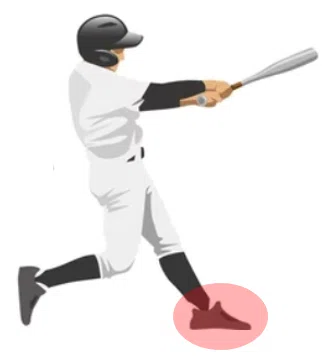
It is important to connect each of these movements smoothly as a continuous flow.

The latest high school baseball magazines are summarized in this link
(Updated once a month) 👇


To create and maintain a good, effective form, you need daily practice and effort to correctly understand and build the principles of form.
However, since form can have differences (individuality) for each player, you should understand the 'principles and fundamentals that should be mastered' in batting form in your head (this should be tackled as a team, not left to each player), and then aim to incorporate them into your ideal form through repetitive practice, improvement, and completion.
Also, since you cannot see your own form (though you can if you record video), the team should also provide opportunities to incorporate opinions from outside (teammates, etc.).
↓ Click here for items related to batting!
★[Batting: Start Here] Batting techniques polished in practice will pay off in crucial at-bats | Yasuhiro Kudo
↓ Click here for batting form!
★[Batting] Standing position in the batter's box | Yasuhiro Kudo
★[Batting] Stance in the batter's box | Yasuhiro Kudo
★[Batting] How to stand (batting form) | Yasuhiro Kudo
★[Batting] Stance ⇒ Initiation (Step) | Yasuhiro Kudo
★[Batting] Stance ⇒ Initiation (Takeback) | Yasuhiro Kudo
★[Batting] Stance ⇒ Initiation (Top) | Yasuhiro Kudo
★[Batting] Hitting (Swing) | Yasuhiro Kudo
★[Batting] Hitting (Impact) | Yasuhiro Kudo
★[Batting] Hitting (Follow-through) | Yasuhiro Kudo
🥎 Lifting the leg
The action of lifting the leg, which is the starting stage of the step, is an important action as a means of timing the pitcher.

◉ Pros and cons of lifting the leg
≪Pros of lifting the leg≫
It is effective for hitting powerful batted balls and sending the ball strongly and far.
⇒ By lifting the leg inward, the lower body twists, and when starting the swing,
that twist returns, allowing for a powerful swing.
Since lifting the leg puts weight on the axis foot, the subsequent weight transfer
can be done smoothly.
≪Cons of lifting the leg≫
It becomes easier to lose timing, and it becomes harder to respond to changes in ball speed.
⇒ When you lift your leg, vertical movement of the body occurs, making your eye level prone to shaking.
When returning the lifted leg, the upper body is prone to lunging forward.
≪* One-legged stance≫
The one-legged batting style where you lift your leg high can send more powerful batted balls, but since timing is easier to disrupt than usual, a strong lower body that can endure even if the timing is off is the key to success.
Although you are only standing on one leg for an instant during batting, it is important to train so that you can stand on one leg in your daily life.
◉ Pros and cons of not lifting the leg (sliding foot)
A step where you do not lift your leg is called a 'sliding foot'.
<<Benefits of the sliding step>>
It becomes harder to lose your timing, and it becomes easier to handle changes in ball speed.
=> Vertical body movement is less likely to occur, and your eye level is less likely to shake.
Because the movement of the lower body becomes smaller, the upper body is less likely to lunge forward.
<<Disadvantages of the sliding step>>
It is difficult to hit powerful batted balls, and the ball does not fly very far.
=> Because the twisting of the lower body is smaller, the swing lacks power.
🥎 Stepping forward
Since there are different types of steps, it is important to find the step that suits you.

◉ Types of steps
● Square step ... A step where you step forward straight
● Open step ...
A step where you open your front foot toward third base (for a right-handed batter) and step forward
● Closed step ... A step where you step forward toward home plate
◉ Square step

Since it is a basic step, you should try hitting with this step first, and if it doesn't feel right, try an open or closed step.
<<Step procedure>>
① When you lift your front foot and pull it back, put almost all your weight on your axis foot.
② When you step forward with your front foot, shift your weight from your axis foot to your front foot.
➂ Land your front foot. The weight distribution at this point is
Catcher side 6 : Pitcher side 4 (This balance prevents swaying)
* Swaying... The upper body moves forward from the waist, causing the axis to collapse
(④ The weight distribution at the point of contact is about Catcher side 3 : Pitcher side 7)
<<Benefits>>
● Easy to shift weight
<<Disadvantages>>
● Upper body is prone to lunging
=> When stepping and shifting weight,
the upper body may also lunge forward.
● The stepped-out foot is prone to opening
=> If it opens, the rotation of the upper body loosens,
making it impossible to generate sharp rotation.
◉ Open step

You almost never shift your weight to your front foot.
(If you shift your weight, your upper body will face the pitcher directly, making it impossible to reach outside pitches)
You keep your weight on your axis foot even when stepping, but if you don't have a strong lower body here, your weight will inevitably shift to your front foot.
Even for high school students who train daily, this is a difficult step to master without a strong lower body.
<<Benefits>>
● Can keep the contact point close to the body (inside pitches are also possible)
=> You can watch the pitch longer and start swinging the bat.
You can hit to a wide range of angles,
and hit powerful balls in the opposite direction as well.
<<Disadvantages>>
● Difficult to master the hitting method.
=> Especially difficult to handle outside pitches.
Requires lower body strengthening and a sufficient amount of practice.
◉ Closed step

A step where you step toward home plate to hit; it is easier to master than the open step.
<<Benefits>>
● (Because the bat can reach outside pitches)
You can hit powerful balls in the opposite direction.
=> Effective as a corrective method for batters who tend to open their bodies.
<<Disadvantages>>
● Handling inside pitches becomes difficult.
=> Because you will get jammed if you hit normally, trying to return the head early
makes it easy to hit foul balls.
* In this note, I earn income through qualified sales as an Amazon Associate.
↓ Article updates will also be announced on X and Facebook pages.
「工藤note高校 野球部」甲子園・日本一までのチーム育成プロセス を考える|工藤 @kud1021 #note #高校野球 https://t.co/pOiXB1K2lV
— 工藤 (@kud1021) August 30, 2023
↓ These are recommended books for understanding high school baseball and Koshien.
↓ I am registered for the popular blog ranking (high school baseball).
Please click the link.

いいなと思ったら応援しよう!
 よろしくお願いします!いただいたチップは、画像購入・AI利用等より充実したnoteを作るために使わせていただきます。