At 3 AM, your payment service is down. Customers can’t check out. The monitoring dashboard shows elevated error rates, but where is the problem? Is it the API gateway? The authentication service? The database? A third-party payment processor? In a distributed system spanning dozens of microservices, traditional monitoring—logs, metrics, and alerts—suddenly feels like trying to solve a murder mystery with only witness statements and no physical evidence.
This is the observability crisis of 2026. As Elastic’s observability report reveals, 89% of production users consider OpenTelemetry compliance critically important for their observability vendors. Why? Because debugging distributed Java systems now requires sophisticated observability that goes far beyond traditional monitoring. OpenTelemetry has become the industry standard, providing the missing link between isolated metrics and comprehensive system understanding.
1. The Monitoring Illusion: Why Logs and Metrics Aren’t Enough
Traditional monitoring operates on a simple premise: collect metrics (CPU, memory, request rates), store logs (error messages, stack traces), and alert when thresholds are breached. This worked beautifully in monolithic applications where everything happened in one process, on one server, in one log file.
But modern distributed systems shatter this simplicity. A single user request might touch 10-20 microservices, each generating its own logs and metrics. When something breaks, you face what engineers call “swivel-chair analysis”—frantically switching between Grafana for metrics, Kibana for logs, and Jaeger for traces, desperately trying to correlate timestamps and piece together what happened.
The Three Pillars Problem: The industry standardized on logs, metrics, and traces as the “three pillars of observability.” But as ClickHouse’s observability guide points out, this model has a fundamental flaw—it creates data silos that force engineers into manual correlation during critical incidents when every second counts.
Here’s what traditional monitoring misses:
- Causality: Metrics tell you what broke, but not why or how it cascaded through the system
- Request Context: Logs from different services have no way to know they’re part of the same user transaction
- Service Dependencies: You can’t see how services interact or where bottlenecks emerge in call chains
- Latency Attribution: A 5-second response time—but which of the 12 services in the chain caused the delay?
This is where observability diverges from monitoring. Monitoring asks “is it broken?” Observability asks “why is it broken, and how did we get here?”
2. OpenTelemetry: The Vendor-Neutral Revolution
Enter OpenTelemetry (OTel), which has evolved from an experiment to the de facto industry standard in 2026. According to industry predictions, OpenTelemetry is on its way to become the dominant data standard, with cloud-native organizations adopting OTel to collect logs, metrics, and traces in a vendor-neutral manner.
OpenTelemetry is a CNCF graduated project providing APIs, SDKs, and tools to generate, collect, and export telemetry data. Think of it as the standardized instrumentation layer that sits between your application and any observability backend you choose—Jaeger, Grafana, Datadog, New Relic, or any other platform.
2.1 Why OpenTelemetry Won
The value proposition is deceptively simple: instrument once, send everywhere. Before OpenTelemetry, adopting a new APM vendor meant re-instrumenting your entire codebase. Switching from Datadog to Dynatrace? Rewrite thousands of lines of instrumentation code. With OpenTelemetry, you instrument your Java microservices once using OTel SDKs, and vendor switching becomes a configuration change, not a code rewrite.
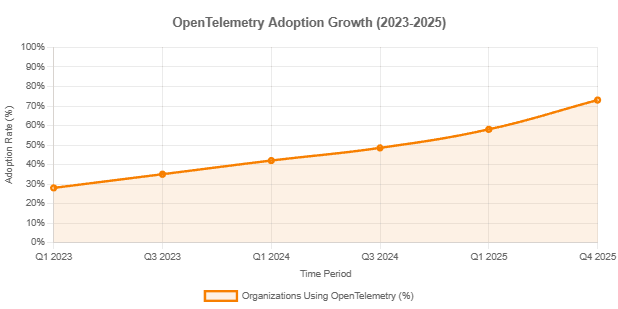
The numbers tell the story. OpenTelemetry Python SDK alone exceeds 224 million monthly downloads, with over 6 million downloads daily. In Java ecosystems, adoption is equally explosive, with Spring Boot auto-instrumentation making OTel integration nearly frictionless.
But the real killer feature isn’t technical—it’s economic. As observability cost analyses show, organizations using OpenTelemetry report 50-72% cost reductions compared to proprietary agents, while eliminating vendor lock-in. When observability bills are spiraling into six figures annually, OpenTelemetry provides an exit strategy.
3. Distributed Tracing: Following the Breadcrumbs
Distributed tracing is the crown jewel of modern observability. It answers the question traditional monitoring can’t: What did this specific request do as it flowed through my system?
Here’s how it works. When a user initiates a request (say, placing an order), the system generates a unique Trace ID. This ID follows the request like a tracking number on a package—from the API gateway, through authentication, to inventory checks, payment processing, and notification services. Each service creates Spans representing individual operations, with timing data, metadata, and parent-child relationships.
The result? A complete request flow diagram showing exactly where the 5-second latency came from: 50ms in the gateway, 100ms in auth, 4.8 seconds waiting on the payment service’s database query. That’s actionable intelligence.
3.1 Jaeger vs. Zipkin: Choosing Your Tracing Backend
Two open-source distributed tracing systems dominate the landscape: Jaeger and Zipkin. Both are battle-tested, production-ready, and widely adopted—but they serve different needs.
| Aspect | Jaeger | Zipkin |
|---|---|---|
| Origin | Developed by Uber, CNCF graduated project | Developed by Twitter, mature ecosystem |
| Architecture | Distributed (agents, collectors, query service) | Centralized, simpler deployment |
| Sampling | Adaptive sampling with dynamic rates | Probabilistic sampling (default 0.1%) |
| Storage Backends | Cassandra, Elasticsearch, Kafka, ClickHouse | Cassandra, Elasticsearch, MySQL |
| OpenTelemetry Support | Native OTLP ingestion (Jaeger v2) | Via OpenTelemetry Collector adapter |
| Best For | Large-scale Kubernetes environments, high trace volume | Simpler setups, Java-heavy organizations |
| Scalability | Built for massive scale, pull-based buffering | Good, but less flexible at extreme scale |
Jaeger emerged as the clear winner for cloud-native environments. Its CNCF backing, Kubernetes-optimized deployment patterns, and native OpenTelemetry support in version 2.0 (released November 2024) make it future-proof. Jaeger v1 will be deprecated in January 2026, pushing the entire ecosystem toward OpenTelemetry-first architecture.
Zipkin remains relevant for teams valuing simplicity and maturity. As industry comparisons note, Zipkin’s core components are written in Java, making it ideal for organizations with deep Java expertise. Its centralized design means faster initial setup, though this becomes a bottleneck at scale.
The Verdict for 2026: Choose Jaeger for new deployments, especially in Kubernetes. Its OpenTelemetry-native design, adaptive sampling, and CNCF ecosystem alignment make it the safe bet. Choose Zipkin if you’re in a Java-centric shop, need quick setup, or already have Zipkin expertise in-house.
4. Correlation IDs and Context Propagation: The Glue of Distributed Systems
Distributed tracing sounds magical, but it has a deceptively simple foundation: correlation IDs and context propagation. Understanding these concepts is crucial for Java microservices developers implementing observability.
4.1 Correlation IDs: Your Request’s Fingerprint
A correlation ID (often called a request ID or trace ID) is a unique identifier assigned to each incoming request. As Microsoft’s engineering playbook explains, this ID becomes the glue binding transactions together, providing diagnostic context across service boundaries.
In practice, this looks simple:
Correlation ID Flow:
1. Request arrives at API Gateway → Generate UUIDa3f8-9c2d-4e1b
2. Gateway calls Auth Service → Passa3f8-9c2d-4e1bin HTTP headerX-Correlation-ID
3. Auth Service calls User Database → Includea3f8-9c2d-4e1bin logs
4. Auth calls Audit Service → Propagatea3f8-9c2d-4e1bdownstreamResult: Search logs for
a3f8-9c2d-4e1b→ See entire request journey across all services
The implementation in Spring Boot is straightforward using MDC (Mapped Diagnostic Context). As detailed in correlation ID pattern guides, you create a servlet filter that extracts or generates the correlation ID, stores it in MDC (which is thread-local storage), and includes it in every log line.
4.2 Context Propagation: The Hidden Challenge
Here’s where it gets tricky. Correlation IDs work great in synchronous, single-threaded request-response flows. But modern Java applications use asynchronous processing, reactive streams (Project Reactor, RxJava), thread pools, and message queues. How do you propagate context across thread boundaries?
This is the context propagation problem, and OpenTelemetry’s solution is elegant: the W3C Trace Context specification. Instead of ad-hoc correlation ID headers, OpenTelemetry uses standardized traceparent headers that encode Trace ID, Span ID, and sampling decisions.
For Java developers, Spring Boot’s integration with OpenTelemetry and Spring Cloud Sleuth handles this automatically. As context propagation guides demonstrate, when you use RestTemplate or WebClient with auto-instrumentation, context propagates seamlessly—even across async boundaries using Reactor Context or Micrometer’s context propagation utilities.
| Scenario | Challenge | Solution |
|---|---|---|
| HTTP calls between services | Pass trace context in headers | W3C traceparent header, auto-injected by OTel |
| Async processing (@Async) | Context lost when switching threads | TaskDecorator copies MDC to new thread |
| Reactive streams (Reactor) | No thread-local storage | Reactor Context + Micrometer propagation |
| Kafka messages | Async, no HTTP headers | Trace context in message headers/metadata |
| Database queries | Need to tag queries with trace | OTel JDBC instrumentation adds comments |
Common Pitfall: MDC uses thread-local storage. If you spawn async tasks without copying MDC context, correlation IDs vanish. Always use Spring’s
TaskDecoratoror Reactor’scontextWrite()to preserve context across thread boundaries. This is why frameworks matter—hand-rolling context propagation is error-prone.
5. The Observability Stack: Grafana, Prometheus, and ELK Integration
OpenTelemetry collects the data, but you need a visualization and analysis layer. In 2026, the dominant pattern combines specialized tools into a unified observability stack.
5.1 The LGTM Stack: Loki, Grafana, Tempo, Mimir
The modern alternative to ELK is what’s called the LGTM Stack—Loki for logs, Grafana for visualization, Tempo for traces, and Mimir (or Prometheus) for metrics.

Prometheus remains the de facto standard for metrics in cloud-native environments. Its pull-based model, powerful PromQL query language, and native Kubernetes integration make it the metrics engine of choice. As observability comparisons show, three-quarters of production deployments use Prometheus for metrics collection.
Grafana is the universal visualization layer. It connects to Prometheus for metrics, Loki for logs, Tempo for traces, and even Elasticsearch if you’re running ELK. The killer feature is correlated signals—click on a spike in your request latency metric, jump to related logs, then navigate to distributed traces, all from one interface.
Loki is Grafana’s answer to Elasticsearch for logs. Instead of indexing full log content (expensive), Loki only indexes metadata labels—like pod name, namespace, log level. This makes it dramatically cheaper than ELK at scale. As cost analyses reveal, Loki can reduce log storage costs by 50-70% compared to Elasticsearch.
Tempo stores traces in object storage (S3, GCS) rather than expensive databases. It’s designed for massive scale—billions of spans daily—without the operational overhead of Cassandra or Elasticsearch clusters.
5.2 The Classic: ELK Stack
The ELK Stack (Elasticsearch, Logstash, Kibana) remains widely deployed, particularly in enterprises with existing Elastic investments. Elasticsearch provides powerful full-text search across logs, Logstash handles log parsing and transformation, and Kibana visualizes everything.
But ELK has challenges. As monitoring guides point out, managing an ELK cluster at scale is complex, often requiring dedicated teams for shard management, capacity planning, and JVM tuning. Storage costs are higher because Elasticsearch indexes everything.
The hybrid approach many organizations adopt: Prometheus + Grafana + ELK. Prometheus for metrics, ELK for logs, Jaeger for traces, all visualized in Grafana. As practical deployment guides demonstrate, this stack provides comprehensive observability despite the operational complexity of managing multiple systems.
5.3 Integration in Practice
The magic happens when these tools talk to each other. Here’s a real-world debugging workflow in a Java microservices architecture:
- Alert fires in Prometheus: Payment service error rate >5%
- Check Grafana dashboard: See spike in
http_requests_total{status="500"}metric at 14:23:15 - Jump to Loki logs: Filter for
{service="payment", level="error"}around that timestamp - Find correlation ID: See
correlationId=7f3d-8a2cin error log - Pull up Jaeger: Search for trace ID
7f3d-8a2c - Analyze trace: See 15-second timeout calling external payment provider’s API
- Root cause identified: Payment provider having issues, not our code
This workflow, which took minutes instead of hours, is only possible with integrated observability. Without correlation between metrics, logs, and traces, you’re back to guessing.
6. Implementation Roadmap for Java Teams
Ready to implement observability in your Java microservices? Here’s the practical roadmap based on 2026 best practices:
Phase 1: Instrumentation (Week 1-2)
- Add OpenTelemetry Java Agent or Spring Boot auto-instrumentation
- Implement correlation ID filter using MDC
- Configure W3C Trace Context propagation in HTTP clients
- Add basic Prometheus metrics exporters
Phase 2: Collection Infrastructure (Week 2-4)
- Deploy OpenTelemetry Collector as a gateway
- Set up Prometheus for metrics scraping
- Deploy Jaeger or Zipkin for trace storage
- Configure Loki or ELK for log aggregation
Phase 3: Visualization (Week 4-6)
- Deploy Grafana and connect to all data sources
- Import community dashboards for Spring Boot, JVM, Kubernetes
- Create service-specific dashboards showing golden signals (latency, traffic, errors, saturation)
- Set up correlated views: metrics → logs → traces navigation
Phase 4: Alerting and Optimization (Week 6-8)
- Configure Prometheus Alertmanager for intelligent alerting
- Implement sampling strategies (100% critical paths, 1% for background jobs)
- Set up log retention policies (30 days hot, 90 days cold)
- Tune trace storage and implement tail-based sampling
Production Lessons Learned
Start with auto-instrumentation: OpenTelemetry’s Java agent provides zero-code instrumentation for Spring Boot, JDBC, Redis, and Kafka. Manual instrumentation can come later for custom business logic.
Sampling is not optional: Tracing 100% of requests in high-traffic services will bankrupt your observability budget and overwhelm storage. Use adaptive or tail-based sampling—trace errors and slow requests at 100%, normal traffic at 1-5%.
Context propagation breaks subtly: Test your correlation IDs across async boundaries, message queues, and reactive streams. Silent context loss is the #1 observability bug.
7. The Cost Reality
Let’s talk numbers. Observability costs have spiraled in recent years, with some organizations paying $500K+ annually for commercial APM platforms. The New Stack reports that cost and complexity hobbled observability in 2025, with OpenTelemetry emerging as part of the solution for 2026.
The economics favor open-source stacks:
| Component | Commercial Alternative | Cost Difference |
|---|---|---|
| Prometheus + Grafana | Datadog APM | 50-80% cheaper at scale |
| Loki | Splunk | 60-90% cheaper for logs |
| Jaeger (self-hosted) | New Relic Distributed Tracing | Infrastructure cost vs. per-span pricing |
| OpenTelemetry Collector | Proprietary agents | Zero licensing, vendor flexibility |
The tradeoff is operational complexity. You’re trading vendor costs for engineering time. But for mid-to-large organizations, the math works out—the team managing your observability stack costs less than the licensing fees saved.
8. What We’ve Learned
Observability has transcended from nice-to-have to absolutely critical for distributed Java systems in 2026. Traditional monitoring with logs and metrics is insufficient—it tells you what broke but not why or how failures cascade through microservices architectures. OpenTelemetry has become the industry standard, with 89% of production users demanding vendor compliance and adoption predicted to reach near-universal levels by year-end.
Distributed tracing with tools like Jaeger and Zipkin provides the causal understanding that monitoring lacks. Jaeger leads for cloud-native Kubernetes environments with native OpenTelemetry support in version 2.0, while Zipkin remains viable for simpler Java-centric deployments. The key enabling technology is correlation IDs and context propagation—unique identifiers that follow requests across service boundaries, implemented in Java via Spring Boot’s MDC and OpenTelemetry’s W3C Trace Context specification.
The modern observability stack combines specialized tools: Prometheus for metrics, Grafana for unified visualization, and either the ELK Stack (Elasticsearch, Logstash, Kibana) for full-text log search or the LGTM Stack (Loki, Grafana, Tempo, Mimir) for cost-efficient cloud-native observability. Integration between these tools—jumping from metric spikes to related logs to distributed traces—reduces mean time to resolution by 65% compared to siloed monitoring.
For Java microservices teams, the implementation path is clear: start with OpenTelemetry auto-instrumentation for Spring Boot, implement correlation ID propagation with careful attention to async boundaries, deploy the Prometheus + Grafana + Jaeger stack for comprehensive telemetry, and optimize with intelligent sampling strategies to control costs. The economics favor open-source solutions, with organizations reporting 50-72% cost reductions versus commercial APM platforms while eliminating vendor lock-in.
OpenTelemetry isn’t just a technical standard—it’s the foundation enabling observability to scale with modern distributed systems. In 2026, debugging production incidents without distributed tracing is like performing surgery blindfolded. The sophistication of observability tooling has finally caught up to the complexity of the systems we’re building.