How the XZ Utils backdoor changed enterprise security forever and why dependency scanning is now mission-critical
March 29, 2024, should have been a quiet Friday for the open-source community. Instead, it became a watershed moment in software security history. Microsoft engineer Andres Freund discovered a sophisticated backdoor in XZ Utils—a compression library installed on billions of Linux systems worldwide. The attack was days away from reaching production systems globally, and it would have given attackers master key access to millions of servers. We got lucky. Next time, we might not be.
The incident exposed a harsh reality: software supply chains are the weakest link in modern infrastructure, and traditional security approaches are woefully inadequate. In 2026, the numbers tell a sobering story. Software supply chain attacks doubled again in 2024, with costs projected to reach $138 billion by 2031. Third-party breaches now account for 30% of all data breaches—a 100% increase from previous years. The question is no longer if your organization will face supply chain threats, but when and how prepared you’ll be.
1. The XZ Utils Incident: A Perfect Storm
The XZ Utils backdoor wasn’t a typical vulnerability. It was a meticulously planned, multi-year social engineering operation that likely involved state-sponsored actors. Understanding how it unfolded reveals why traditional security measures failed—and what we must change.
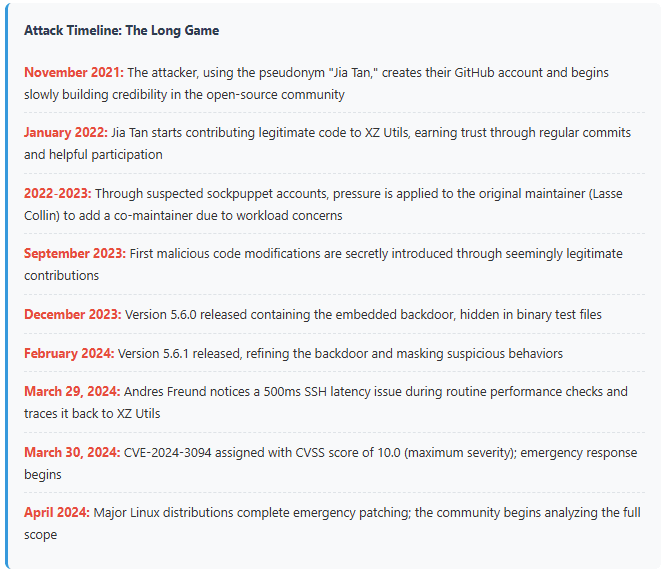
The sophistication is chilling. The backdoor was only included in release tarballs, not in the Git repository—making it invisible to source code reviews. It exploited sshd authentication processes, granting remote code execution to anyone possessing a specific Ed448 private key. The attack earned a perfect 10.0 CVSS score because of its combination of ease of exploitation and catastrophic potential impact.
What Made This Different: Unlike typical supply chain attacks that inject malware into packages, this was insider betrayal executed over 28 months. The attacker didn’t compromise a build system or hack credentials—they became a trusted maintainer through patience and social engineering. Traditional security tools designed to detect known malware or suspicious packages completely missed it.
2. The State of Supply Chain Attacks in 2026
XZ Utils wasn’t an isolated incident. It’s part of an accelerating trend that’s forcing a fundamental rethinking of application security.

| Metric | 2021 | 2024 | 2026 (Projected) | Change |
|---|---|---|---|---|
| Annual Attack Cost | $35B | $60B | $80B | +129% |
| Breaches via Third-Party | 15% | 30% | 35% | +133% |
| Malicious Packages (YoY) | Baseline | +156% | +220% | – |
| Avg. Breach Cost | $3.86M | $4.44M | $4.88M | +26% |
| Mean Time to Remediate | 25 days | 400 days | 470 days | +1,780% |
The data reveals a disturbing pattern: attacks are becoming more frequent, more costly, and dramatically harder to remediate. Projects are taking over a year on average to fix vulnerabilities—a timeline that’s completely incompatible with modern threat landscapes where zero-days are weaponized within hours.
The open-source ecosystem is particularly vulnerable. Modern applications contain 90% open-source components, with 74% containing high-risk dependencies. A recent analysis found that malicious packages increased 156% year-over-year, with attackers increasingly sophisticated in their approaches—from typosquatting to the “benevolent stranger” social engineering seen in XZ Utils.
3. SBOM: From Buzzword to Requirement
Software Bill of Materials (SBOM) emerged from the wreckage of high-profile supply chain attacks as a regulatory requirement, not just a best practice. In 2026, SBOMs are mandatory for federal software procurement and increasingly required by private sector regulations.
An SBOM is exactly what it sounds like: a detailed inventory of all software components and dependencies in an application, analogous to an ingredient list on food packaging. CISA’s 2025 updated guidance defines minimum elements that every SBOM must contain, reflecting the maturity that’s developed since the 2021 baseline requirements.
3.1 Why SBOMs Matter: Real-World Impact
When Log4Shell hit in December 2021, organizations scrambled to identify which systems were vulnerable. Those without comprehensive dependency tracking spent weeks auditing codebases manually. With SBOMs, vulnerability mapping becomes automated—security teams can instantly identify every application using a vulnerable component and prioritize remediation.
Data-Driven Results: Analysis shows that projects using SBOMs to manage dependencies achieved a 264-day reduction in mean time to remediate (MTTR) compared to those without. That’s the difference between patching critical vulnerabilities in weeks versus over a year.
| SBOM Element | Purpose | 2026 Requirement Level |
|---|---|---|
| SBOM Author | Identifies who created the SBOM | Mandatory |
| Component Name | Designated name of each component | Mandatory |
| Component Version | Precise version tracking | Mandatory |
| Supplier Name | Origin of component | Mandatory |
| Unique Identifiers | CPE, PURL, SWID tags | Mandatory |
| Dependency Relationships | Maps component connections | Mandatory |
| License Information | Compliance tracking | Recommended |
| Pedigree Data | Fork/backport information | Recommended |
The two primary SBOM formats are SPDX (Software Package Data Exchange) and CycloneDX. SPDX, developed by the Linux Foundation, excels in open-source compliance and license tracking. CycloneDX, created by OWASP, focuses on security use cases and vulnerability management. Both are machine-readable, enabling automated tooling integration.
4. Dependency Scanning: Your First Line of Defense
SBOMs tell you what you have; dependency scanning tools tell you what’s wrong with it. In 2026, these tools are essential components of every CI/CD pipeline, not optional security add-ons.
4.1 Leading Dependency Scanning Solutions
Snyk has become the developer-favorite tool, integrating directly into IDEs, Git repositories, and build systems. It scans for known vulnerabilities (CVEs), provides fix guidance, and automatically generates pull requests with patches. Snyk’s strength is its extensive vulnerability database and real-time monitoring—when a new CVE drops, Snyk alerts affected projects within minutes.
GitHub Dependabot is built into GitHub repositories and provides automatic dependency updates. When Dependabot detects a vulnerability, it opens a pull request with the fix, complete with release notes and compatibility assessments. For teams already using GitHub, it’s zero-configuration security scanning.
Mend (formerly WhiteSource) focuses on enterprise-scale dependency management with policy enforcement and license compliance. It’s particularly strong for organizations needing to balance security with legal requirements around open-source usage.

Tool Limitations: Dependency scanners excel at detecting known vulnerabilities but struggle with zero-days and sophisticated supply chain attacks like XZ Utils. They scan for CVE databases and known malware signatures—they won’t catch a trusted maintainer introducing a backdoor over time. This is why layered security approaches combining multiple tools and practices are essential.
5. Secure SDLC: Shifting Security Left
The XZ Utils incident proved that security can’t be an afterthought or a pre-deployment gate. It must be integrated throughout the entire Software Development Lifecycle (SDLC). This “shift left” philosophy means catching vulnerabilities early when they’re cheap to fix, not discovering them in production when they’re catastrophic.
5.1 Core Secure SDLC Practices
- Threat Modeling During Design — Before writing code, identify potential attack vectors. For XZ Utils, proper threat modeling would have considered insider threats and maintainer compromise scenarios
- Code Review with Security Focus — Every pull request should be reviewed not just for functionality but for security implications. Automated tools like Semgrep or SonarQube can flag suspicious patterns
- Automated Security Testing in CI/CD — SAST (Static Application Security Testing), DAST (Dynamic Application Security Testing), and SCA (Software Composition Analysis) should run on every commit
- Least Privilege Everywhere — Applications should run with minimum necessary permissions, limiting blast radius if compromised
- Immutable Infrastructure — Container images and deployments should be immutable, cryptographically signed, and version-controlled
- Regular Security Training — Developers need ongoing education about evolving threats and secure coding practices
The NIST Secure Software Development Framework (SSDF) provides a comprehensive baseline. NIST SP 800-218 defines practices that, when properly implemented, would have made XZ Utils-style attacks significantly harder to execute.
6. Java Security Hardening: Practical Steps
For Java developers, security hardening isn’t about memorizing OWASP Top 10 lists—it’s about building security into your development workflow and Spring Boot applications by default.
6.1 Dependency Management: Maven and Gradle Best Practices
Start by locking down your dependencies. Use dependency management plugins to enforce specific versions and prevent unreviewed updates. In Maven, use the dependencyManagement section to centralize version control:
Critical Practice: Never use dynamic versions (LATEST, RELEASE, or version ranges) in production builds. They introduce unpredictability and make it impossible to reproduce builds consistently. Pin exact versions, and update deliberately after security review.
Integrate OWASP Dependency-Check or Trivy into your build pipeline. These tools scan your dependencies against CVE databases and fail builds when high-severity vulnerabilities are detected:
6.2 Spring Security: Configuration That Matters
Spring Security is powerful but only if configured correctly. Many breaches stem from developers using defaults without understanding security implications.
Essential Spring Security Configurations:
- Enforce HTTPS — Configure TLS/SSL certificates and force HTTPS redirects. Never transmit authentication credentials over unencrypted connections
- Use BCrypt or Argon2 for Password Hashing — Spring Security 5+ provides
BCryptPasswordEncoderandArgon2PasswordEncoder. Never use MD5 or SHA-1 - Enable CSRF Protection — For traditional web applications with session-based authentication, CSRF protection is critical and enabled by default in Spring Security
- Configure CORS Properly — Don’t use
allowedOrigins("*")in production. Explicitly whitelist trusted domains - Implement Rate Limiting — Use Bucket4j or similar to prevent brute-force attacks on authentication endpoints
- Security Headers — Configure headers like
Content-Security-Policy,X-Frame-Options, andStrict-Transport-Security
6.3 Input Validation: The Foundation
Never trust user input. Spring’s @Valid and Bean Validation annotations provide declarative validation:
For database queries, always use parameterized statements or Spring Data repositories. Never concatenate user input into SQL strings—this is how SQL injection happens.
6.4 Logging and Monitoring
Security events must be logged, but logs themselves can be attack vectors. Never log sensitive data (passwords, tokens, PII) and sanitize user input before logging to prevent log injection attacks.
Spring Boot Actuator provides /health and /metrics endpoints, but secure them properly. Don’t expose actuator endpoints publicly without authentication:
6.5 Regular Security Audits
Automated tools catch known vulnerabilities, but manual security audits by experienced professionals find architectural flaws and business logic vulnerabilities that scanners miss. Budget for annual penetration testing and threat modeling sessions.
7. The Policy Shift: Compliance as Driver
XZ Utils didn’t just change technical practices—it triggered regulatory action. The U.S. government’s Executive Order 14028 on cybersecurity now requires SBOMs for federal software procurement. The EU’s Cyber Resilience Act imposes similar requirements. In 2026, compliance isn’t optional for enterprises selling to government or critical infrastructure.
Many Fortune 500 companies now require vendors to provide SBOMs and demonstrate secure SDLC practices. Insurance companies are adjusting cyber insurance premiums based on supply chain security posture. The message is clear: security is now a competitive differentiator and compliance requirement, not a “nice-to-have.”
8. Looking Forward: An Evolving Threat Landscape
Supply chain attacks will only become more sophisticated. The Open Source Security Foundation warns that XZ Utils “may not be an isolated incident,” noting similar social engineering attempts targeting JavaScript projects. As AI-generated code becomes prevalent, new attack vectors will emerge—malicious code hidden in AI training data or generated by compromised models.
The community response has been encouraging. OpenSSF, CISA, and industry leaders are collaborating on initiatives to support overworked open-source maintainers, improve code signing and verification, and develop better detection tools. But ultimately, security is everyone’s responsibility.
9. What We’ve Learned
The XZ Utils backdoor and the broader supply chain crisis have fundamentally transformed how we think about software security. We’ve learned that sophisticated attacks span years not days, exploiting trust rather than technical vulnerabilities. Traditional security tools designed for known threats completely missed a patient adversary becoming a trusted maintainer through social engineering. The incident proved that single developers maintaining critical infrastructure are overwhelmed and vulnerable—a systemic risk we can no longer ignore.
The numbers underscore the urgency. Supply chain attacks doubled in 2024 with costs approaching $80 billion annually by 2026, while third-party breaches now constitute 30% of all incidents—a doubling from previous rates. Remediation timelines have ballooned from 25 days to over 470 days on average, creating windows of vulnerability that attackers ruthlessly exploit. These aren’t abstract statistics; they represent real organizational breaches, compromised data, and billions in losses.
Software Bill of Materials have evolved from optional documentation to regulatory requirements, with CISA’s 2025 guidance establishing mandatory minimum elements for federal procurement and enterprise compliance. Organizations implementing proper SBOM practices achieve 264-day reductions in mean time to remediate—the difference between containing breaches quickly and enduring year-long exposure. The shift from reactive security to proactive transparency represents a fundamental change in how we manage software risk.
Dependency scanning tools like Snyk, Dependabot, and OWASP Dependency-Check have become essential CI/CD pipeline components, not optional security additions. However, these tools excel at detecting known CVEs but struggle with zero-day threats and sophisticated insider attacks like XZ Utils. This limitation demands layered security approaches combining automated scanning, manual code review, threat modeling, and security-aware development culture. No single tool provides complete protection.
For Java developers, security hardening is no longer about memorizing vulnerability lists but building security into Spring Boot applications by default. This means pinning exact dependency versions, integrating OWASP Dependency-Check into builds, properly configuring Spring Security with BCrypt password hashing, enforcing HTTPS, implementing comprehensive input validation, and maintaining detailed security event logs. These practices, when consistently applied, dramatically reduce attack surfaces and enable rapid incident response.
The secure SDLC philosophy of shifting security left throughout the development lifecycle has proven its value. Threat modeling during design, security-focused code reviews, automated testing in CI/CD pipelines, least privilege principles, immutable infrastructure, and regular security training all contribute to resilient systems. The NIST Secure Software Development Framework provides the comprehensive baseline that, had it been followed, would have made XZ Utils-style attacks significantly more difficult to execute successfully.
Looking ahead, the threat landscape will only grow more complex as AI-generated code introduces new attack vectors and as adversaries become more patient and sophisticated in their social engineering. The community response through OpenSSF and CISA initiatives offers hope, but ultimately security remains everyone’s responsibility. The XZ Utils incident served as our wake-up call—the question is whether we’ll implement the lessons learned before the next major supply chain attack succeeds.