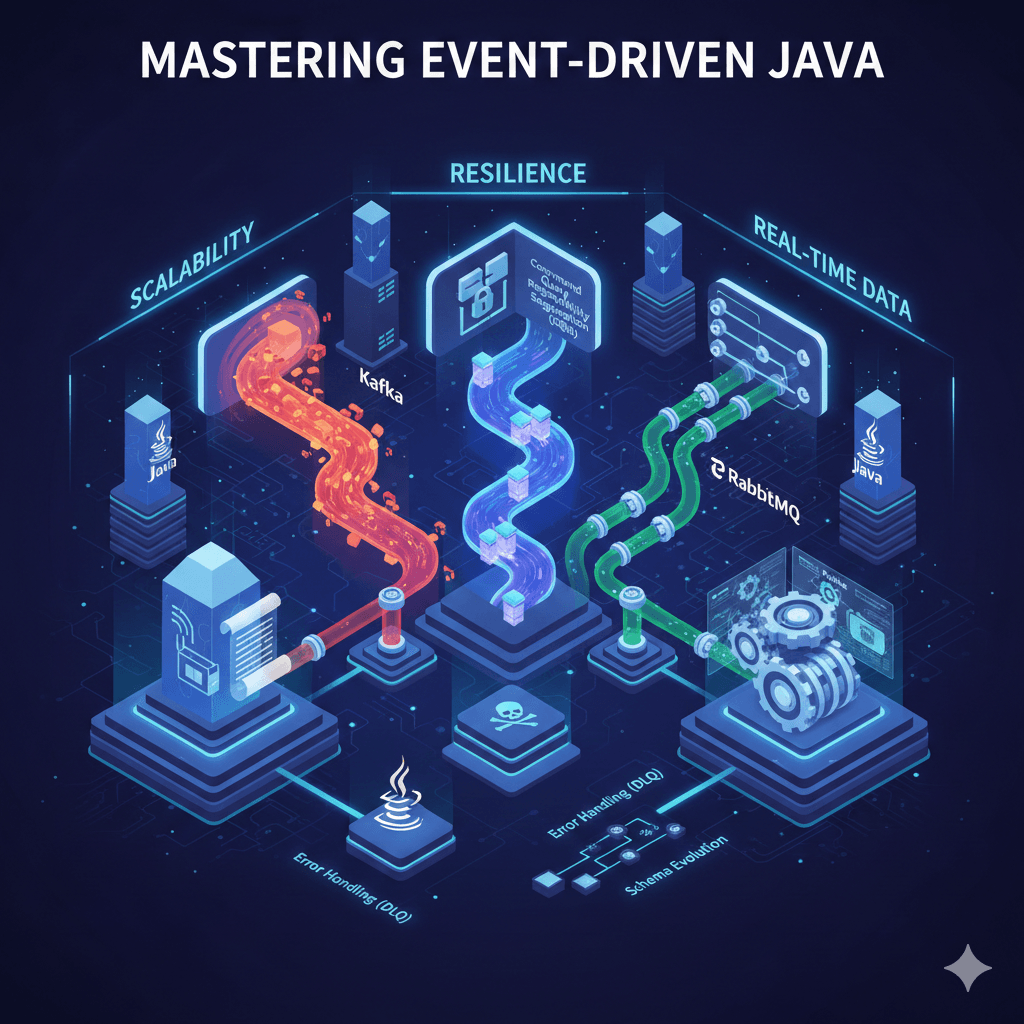
In today’s software landscape, responsiveness, scalability, and real-time data flow are no longer luxuries—they’re expectations. Event-driven architectures (EDA) offer a powerful way to meet these demands, and Java remains a top-tier language for building such systems. Whether you’re streaming millions of events per second or coordinating microservices, platforms like Kafka, Pulsar, and RabbitMQ provide the backbone. Let’s explore how they compare, how Java fits in, and what patterns and tools make these systems robust.
1. Event Sourcing and CQRS: Modeling Change Over Time
Event sourcing captures every state change as an immutable event. Instead of storing the latest snapshot, you store the full history. This enables time-travel debugging, auditability, and flexible read models. Java developers often turn to Axon Framework for implementing event sourcing and CQRS (Command Query Responsibility Segregation), which separates the write side (commands) from the read side (queries).
A simple event might look like:
public record ProductAddedEvent(String productId, String name, int quantity) {}
This event becomes the source of truth. Replay it, and you rebuild the state. CQRS complements this by allowing optimized read models without affecting the write logic.
2. Kafka vs. Pulsar vs. RabbitMQ: Choosing the Right Broker
Each broker has its own philosophy. Kafka is built for high-throughput streaming, Pulsar for cloud-native flexibility, and RabbitMQ for traditional messaging. Here’s how they stack up:
| Feature | Apache Kafka | Apache Pulsar | RabbitMQ |
|---|---|---|---|
| Core Model | Distributed commit log | Segmented log + BookKeeper | Queue-based messaging |
| Replay Support | Strong (offset-based) | Strong (cursor-based) | Limited |
| Multi-Tenancy | External tools needed | Built-in | Basic |
| Message Ordering | Per partition | Per topic partition | Not guaranteed |
| Use Cases | Streaming, analytics, event sourcing | SaaS, hybrid cloud, streaming + queuing | RPC, task queues, low-latency delivery |
| Operational Complexity | Moderate | Higher (more components) | Low |
Kafka dominates in analytics and stream processing. Pulsar shines in multi-tenant cloud environments. RabbitMQ remains ideal for transactional systems and service orchestration.
3. Stream Processing: Kafka Streams and Apache Flink
Once events are flowing, you need to process them. Java offers two standout options:
- Kafka Streams is a lightweight library that runs inside your Java app. It’s perfect for microservices needing embedded stream logic.
- Apache Flink is a distributed engine for stateful, large-scale stream processing. It supports event-time semantics, fault tolerance, and complex windowing.
Here’s a Kafka Streams snippet:
StreamsBuilder builder = new StreamsBuilder(); builder.stream("inventory") .mapValues(value -> value.toUpperCase()) .to("inventory-updated");
Flink, by contrast, is better suited for real-time dashboards, fraud detection, and large-scale analytics.
4. Eventual Consistency: Embracing Delay
In distributed systems, consistency isn’t always immediate. Eventual consistency means services react to events asynchronously. This reduces coupling and improves resilience—but requires careful design.
Java developers should build idempotent handlers, monitor lag, and accept that “correct” doesn’t always mean “instant.” Embracing this model leads to systems that scale and recover gracefully.
5. Error Handling and Dead Letter Queues
Failures happen. Dead Letter Queues (DLQs) catch unprocessable events for later inspection or replay.
- Kafka supports DLQs via consumer logic or Kafka Connect error handling.
- Pulsar has native DLQ support with configurable redelivery.
- RabbitMQ uses Dead Letter Exchanges (DLX) to reroute failed messages.
A good DLQ strategy includes logging the error, capturing the event, and providing tools for replay or manual intervention.
6. Schema Evolution and Versioning
As systems evolve, so do event schemas. Without proper management, this can break consumers. Tools like Confluent Schema Registry enforce compatibility and versioning.
Best practices include:
- Adding fields with defaults
- Avoiding removal of required fields
- Maintaining backward and forward compatibility
This ensures producers and consumers can evolve independently.
7. Scalability: Designing for Growth
Scalability depends on partitioning, consumer groups, and storage strategies. Kafka scales via partitions and brokers. Pulsar separates compute and storage, allowing elastic scaling. RabbitMQ scales horizontally but is best suited for smaller workloads.
Java frameworks like Spring WebFlux, Vert.x, and Quarkus offer reactive models that pair well with event-driven systems, especially under high load.
8. What We Learned
Event-driven systems offer flexibility, resilience, and real-time responsiveness. Java’s ecosystem—Kafka, Pulsar, RabbitMQ, Flink, Kafka Streams, Axon—makes it a powerful choice for building these architectures. By embracing event sourcing, handling schema evolution, and designing for eventual consistency, developers can build systems that scale and adapt with confidence.