The modern software development landscape presents a peculiar paradox: developers working with Java often complain about its perceived stagnation and bureaucratic tooling, while JavaScript developers frequently express exhaustion from the relentless pace of change in their ecosystem. This dichotomy reveals fundamental tensions in how programming communities approach tooling, innovation, and stability.
Java, approaching its fourth decade, has cultivated an ecosystem characterized by long-term support cycles, backward compatibility commitments, and deliberate evolution. JavaScript, despite being nearly as old, operates in a state of perpetual reinvention, with frameworks, build tools, and best practices shifting every few years. Neither approach is inherently superior, but each carries distinct costs and benefits that shape developer experience and project longevity.
This article explores the theoretical underpinnings of these contrasting philosophies, examining how different approaches to tooling stability affect developer productivity, project maintenance, and the broader software engineering discipline.
1. The Stability Paradigm: Java’s Enterprise Foundation
Java’s tooling ecosystem emerged from enterprise computing requirements where stability, predictability, and long-term maintainability trump cutting-edge features. This philosophy permeates every layer of the Java development experience.
1.1 Backward Compatibility as a Core Principle
Java maintains an extraordinary commitment to backward compatibility. Code written for Java 1.1 in 1997 can still compile and run on modern Java Virtual Machines. This isn’t accidental—it represents a deliberate design philosophy that prioritizes preserving existing investments over enabling rapid innovation.
The theoretical benefit is significant: organizations can upgrade their runtime environments without rewriting applications. A financial services company running critical systems can adopt new JVM versions to gain security patches and performance improvements while maintaining their decade-old codebase unchanged. The cost of this stability is measured in missed opportunities for cleaner API design and modern language features that would break backward compatibility.
This approach reflects a fundamentally conservative risk profile. For enterprises managing mission-critical systems with lifespans measured in decades, the risk of breaking changes far outweighs the benefits of radical innovation. The implicit calculation suggests that the cost of rewriting or updating code exceeds the value gained from new features—a calculation that holds true for established, working systems but may not apply to greenfield projects.
1.2 The Maven Standard: Convention Over Configuration
Maven, introduced in 2004, exemplifies Java’s stability-oriented approach to tooling. Despite criticisms of its verbosity and XML configuration, Maven has remained the dominant build tool for two decades. Its longevity stems from establishing strong conventions that persist across projects, organizations, and time.
The Maven standard directory layout, dependency management model, and plugin ecosystem create a shared mental model across the Java community. A developer joining a Maven-based project in 2024 encounters the same structure and patterns as one from 2010. This consistency reduces cognitive overhead when moving between projects and organizations.
However, this stability comes with inflexibility. Maven’s opinionated approach works elegantly for projects that fit its conventions but becomes cumbersome for those that don’t. The XML configuration grows unwieldy in complex scenarios, and customizing the build process often requires writing plugins—a higher barrier than scripting alternative build tools provide.
Gradle emerged as a more flexible alternative, offering programmatic build configuration while maintaining Maven’s repository system. Yet even Gradle’s innovation is constrained by the need for interoperability with the established ecosystem. Revolutionary changes remain impossible when the entire infrastructure depends on existing conventions.
1.3 Long-Term Support and Predictable Release Cycles
Java’s release cadence shifted in 2017 from multi-year major releases to a predictable six-month cycle. Crucially, this innovation preserved stability through LTS (Long-Term Support) versions released every three years with extended support commitments.
This model acknowledges different user needs. Enterprises can standardize on LTS releases, receiving security updates and critical fixes for years without confronting feature changes. Developers seeking cutting-edge features can adopt non-LTS releases while understanding these are stepping stones rather than stable foundations.
The theoretical elegance lies in separating innovation from stability. The community can experiment with new features in regular releases while organizations dependent on stability can ignore intermediate versions entirely. This contrasts sharply with ecosystems where every release potentially introduces breaking changes, forcing continuous adaptation.
2. The Innovation Imperative: JavaScript’s Evolutionary Pressure
JavaScript’s ecosystem operates under entirely different constraints and incentives, producing an environment of constant flux that bewilders newcomers and exhausts veterans alike.
2.1 The Framework Churn Phenomenon
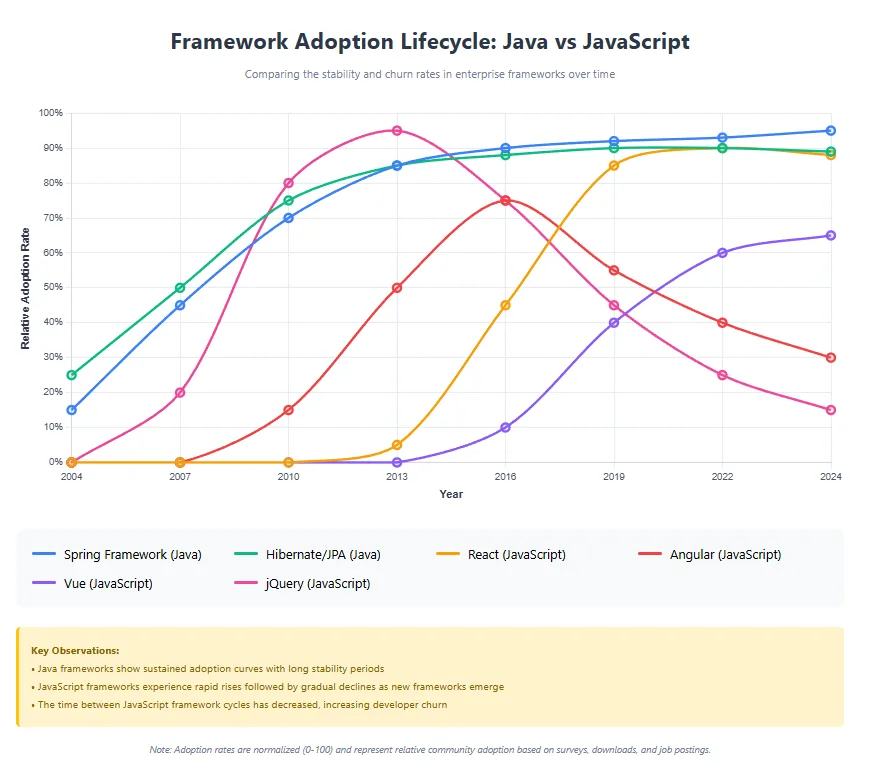
The JavaScript framework landscape has undergone complete paradigm shifts multiple times within a decade. jQuery dominated, then Angular emerged with a component-based model, followed by React’s virtual DOM approach, Vue’s progressive framework philosophy, and now signals-based reactivity and server components are reshaping mental models again.
Each transition doesn’t simply introduce new syntax—it represents fundamental reconceptualizations of how to structure web applications. Moving from jQuery’s DOM manipulation to React’s declarative components requires abandoning established patterns and learning entirely new architectures. The human cost is substantial: expertise depreciates rapidly, tutorials become obsolete within months, and project dependencies accumulate technical debt as libraries fall behind.
Yet this churn emerges from genuine innovation. React’s virtual DOM solved real performance problems. Hooks eliminated class component complexity. Server components address over-reliance on client-side JavaScript. Each wave of change responds to limitations in previous approaches, suggesting the instability stems from rapid problem-solving rather than mere novelty-seeking.
The theoretical question becomes: does the pace of innovation justify its disruption costs? For consumer-facing web applications competing on user experience, bleeding-edge frameworks may provide competitive advantages. For internal enterprise applications with 10-year lifespans, the calculus differs dramatically.
2.2 Build Tool Proliferation
JavaScript’s build tooling has evolved through at least five major generations: Grunt, Gulp, Webpack, Rollup, Parcel, Vite, esbuild, and numerous others. Each generation promises to solve problems created by previous tools—complexity, performance, developer experience—only to introduce new complications requiring subsequent solutions.
This pattern reflects JavaScript’s fundamental architectural challenge: the language evolved in browsers without native module systems, requiring tooling to bridge the gap between how developers want to write code and how browsers execute it. As ES modules gained browser support, this bridge became partially obsolete, but the accumulated complexity of transpilation, optimization, and asset bundling created its own ecosystem with persistent requirements.
The cognitive burden of choosing and configuring build tools represents significant overhead. A developer starting a new project in 2024 faces analysis paralysis: which bundler, which transpiler, which package manager, which testing framework? Each choice implies tradeoffs that may not become apparent until months into development.
Interestingly, the latest generation of tools like Vite attempts to eliminate configuration entirely through intelligent defaults—a convergence toward the “convention over configuration” philosophy that Java adopted decades earlier. This suggests the ecosystem may be rediscovering stability’s value through painful experience.
2.3 Dependency Versioning and the npm Dilemma
JavaScript’s npm registry contains over two million packages, orders of magnitude larger than Maven Central’s ecosystem. This abundance creates both opportunities and hazards. The average Node.js project depends on hundreds of packages when transitive dependencies are counted—a dependency graph so complex that understanding it fully exceeds human cognitive capacity.
The theoretical problem is dependency resolution in the face of semantic versioning ambiguity. When package A depends on lodash@^4.17.0 and package B depends on lodash@^4.15.0, npm must resolve which version to install. The caret operator allows minor version updates, theoretically backward compatible, but semantic versioning depends on maintainer discipline rather than technical enforcement.
This fragility manifests in the “works on my machine” problem at scale. Slightly different installation times can produce different dependency trees, leading to environment-specific bugs. The introduction of lockfiles (package-lock.json, yarn.lock) addressed this, but at the cost of yet another file to understand and maintain.
Moreover, the npm ecosystem’s social structure differs from Maven’s. Java libraries are often maintained by organizations with stability incentives. npm packages frequently originate from individual developers scratching personal itches, with no obligation to maintain long-term compatibility. When a popular package maintainer loses interest or faces controversy, projects depending on that package face existential risks.
3. Tooling Fatigue: The Psychological Dimension
Beyond technical considerations, the contrasting approaches to tooling stability create distinct psychological experiences for developers.
3.1 Cognitive Load and Decision Fatigue
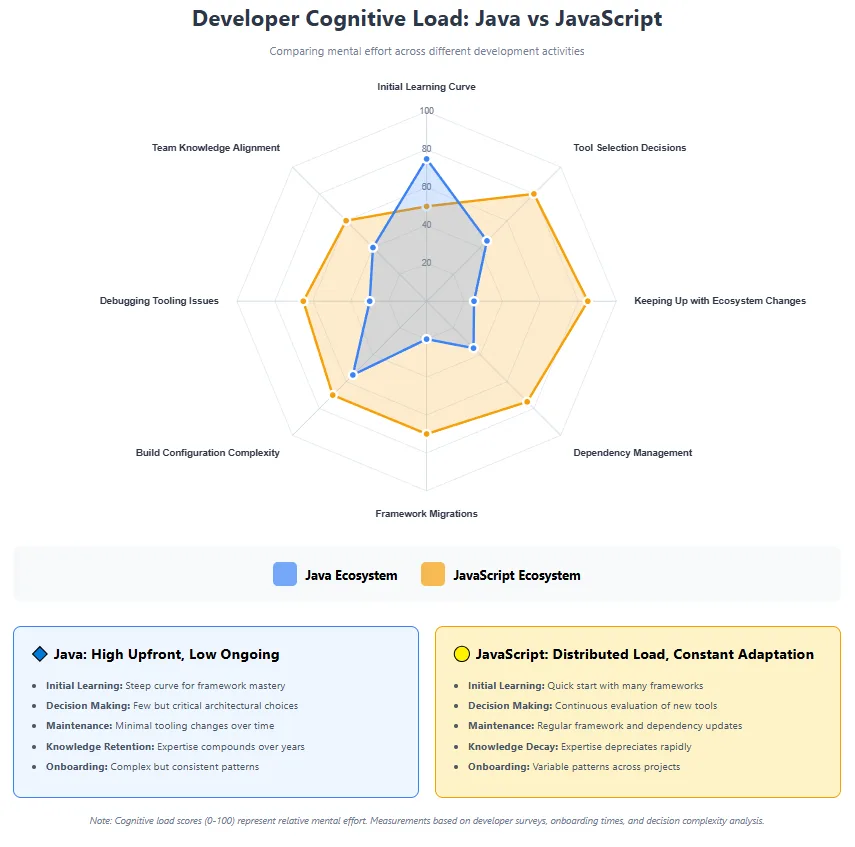
JavaScript developers face constant decision-making about which tools to use, when to upgrade, and whether to adopt new paradigms. This decision fatigue represents real cognitive cost. Each choice requires research, evaluation, and risk assessment—mental energy diverted from solving domain problems.
Java developers experience different cognitive demands. The stable ecosystem reduces choices but increases the importance of initial architectural decisions. Choosing a framework or approach in Java commits the project for years, placing greater pressure on upfront analysis. The cognitive load shifts from continuous tactical decisions to infrequent but high-stakes strategic ones.
Research on decision fatigue suggests humans have finite mental resources for making choices. Environments requiring constant re-evaluation deplete these resources faster than those with established patterns. This suggests JavaScript’s innovation pace may literally exhaust developers in ways stable ecosystems don’t, though it may also provide stimulation that prevents boredom-induced disengagement.
3.2 Learning Curve Permanence
Learning Java’s core ecosystem—Maven, Spring, JUnit—represents an investment with long-term returns. Knowledge acquired today remains relevant for years, encouraging deep specialization. Developers can develop true expertise in frameworks because those frameworks persist long enough to warrant mastery.
JavaScript’s rapid evolution undermines expertise accumulation. By the time a developer achieves mastery in a framework, the community may have moved on to its successor. This creates pressure for breadth over depth—knowing enough about many tools to adapt quickly rather than deep expertise in any single tool.
The theoretical implication concerns knowledge as capital investment. In stable ecosystems, knowledge accumulates like compound interest, with each year of experience building on previous years. In volatile ecosystems, knowledge depreciates like physical capital, requiring continuous reinvestment to maintain relevance. Neither model is superior in abstract, but they reward different learning strategies and cognitive styles.
3.3 Community Fragmentation
Java’s ecosystem stability fosters community cohesion. Developers across organizations share common toolchains and can collaborate effectively because their technical foundations align. Best practices evolve gradually, giving the community time to build consensus.
JavaScript’s rapid evolution fragments the community into subcommunities organized around framework choices. React developers may struggle to contribute to Vue projects not merely due to syntax differences but because the underlying mental models diverge. This fragmentation makes it harder to build collective knowledge and standardized approaches to common problems.
The network effects of stable ecosystems compound over time. As more organizations adopt similar tools, more resources emerge—tutorials, libraries, trained developers—creating self-reinforcing momentum. Fragmented ecosystems struggle to achieve these network effects, with resources dispersed across incompatible approaches.
4. The Hidden Costs of Both Approaches
Neither stability nor innovation comes without significant drawbacks that proponents sometimes overlook.
4.1 Java’s Innovation Deficit
Java’s stability preserves old code but can also preserve old problems. When the ecosystem standardizes on particular approaches, even flawed ones, changing direction becomes nearly impossible without breaking the backward compatibility guarantee. This path dependency can trap the ecosystem in local optima, unable to escape to better designs without revolutionary change.
The Spring framework exemplifies both the benefits and costs of long-term stability. Spring has evolved continuously since 2004, maintaining backward compatibility while adding features. However, this evolutionary approach means Spring carries conceptual baggage from earlier eras. Dependency injection configuration has evolved through XML, annotations, and Java configuration, but all three approaches persist in the ecosystem, creating cognitive overhead as developers must understand multiple paradigms.
Moreover, Java’s enterprise focus creates a conservative culture that resists experimentation. Proposals for language features undergo years of deliberation in the Java Community Process, ensuring thorough vetting but also missing opportunities for rapid iteration and learning from mistakes. When JavaScript experimented with promises, async/await, and other concurrency models in quick succession, Java methodically evaluated and adopted patterns only after they proved successful elsewhere.
4.2 JavaScript’s Sustainability Crisis
JavaScript’s innovation pace creates sustainability problems rarely discussed in enthusiastic framework announcements. Every new framework generates a portfolio of projects that will eventually need maintenance as the framework falls out of favor. The web is littered with applications built on Angular 1, Backbone.js, or Meteor—frameworks that seemed like safe choices when adopted but now feel like maintenance burdens.
This creates a tragedy of the commons. Individual developers and organizations benefit from adopting cutting-edge tools that improve productivity or capabilities. However, the collective cost of abandoned codebases and deprecated dependencies accumulates across the industry. Open source maintainers face pressure to support old versions while simultaneously developing new features, leading to burnout and abandonment.
The environmental dimension deserves consideration as well. Constantly rewriting applications to adopt new frameworks consumes developer time that could address actual user needs. The carbon cost of this churn—developers running build processes, continuous integration servers recompiling code—represents waste without corresponding value creation.
5. Convergence and Divergence: Learning from Contrasts
Interestingly, both ecosystems show signs of learning from each other’s approaches, suggesting optimal strategies lie between extremes.
5.1 Java’s Gradual Modernization
Recent Java development shows influence from JavaScript’s dynamism. The six-month release cycle, while maintaining LTS versions, allows faster iteration. Preview features let the community experiment with language changes before committing to them. Records, pattern matching, and virtual threads represent significant innovations delivered more rapidly than Java’s historical pace.
Project Loom’s virtual threads particularly illustrate learning from other ecosystems. Observing how languages like JavaScript (Node.js) and Go succeeded with lightweight concurrency models, Java developed a compatible approach that preserves backward compatibility while enabling modern programming patterns. This demonstrates that stability need not preclude innovation—it requires more careful design.
5.2 JavaScript’s Stability Movement
Conversely, JavaScript shows increasing appreciation for stability. TypeScript’s popularity reflects desire for stronger guarantees and better tooling—values the JavaScript ecosystem initially rejected. The movement toward standardization in areas like package management (with npm becoming the de facto standard despite alternatives) suggests maturation toward established patterns.
Frameworks like Svelte and Solid explicitly design for stability, promising fewer breaking changes and migrations. This contrasts with earlier frameworks that treated major version rewrites as normal. The community increasingly recognizes that the cost of instability exceeds the benefits of unfettered innovation.
6. Theoretical Frameworks for Understanding Tooling Evolution
Several theoretical lenses help explain these patterns and their implications.
6.1 The Lindy Effect and Software Longevity
The Lindy Effect—the theory that the future life expectancy of non-perishable things is proportional to their current age—suggests Java’s longevity itself indicates likely continued longevity. Tools and patterns that have persisted for decades have revealed their stability and will likely persist for decades more.
JavaScript frameworks exhibit anti-Lindy behavior: new frameworks constantly emerge claiming superiority to existing ones, and the community frequently abandons established tools for promising alternatives. This suggests either that JavaScript hasn’t found optimal solutions yet, or that the domain itself resists stable solutions due to continuously evolving requirements (browser capabilities, user expectations, device diversity).
6.2 Innovation Diffusion and Technology Adoption Curves
Rogers’ diffusion of innovations theory categorizes adopters into innovators, early adopters, early majority, late majority, and laggards. Java’s ecosystem primarily serves the early and late majority—organizations that adopt proven technologies. JavaScript serves innovators and early adopters who value cutting-edge capabilities over proven stability.
This creates a natural tension: innovators need rapid change to explore solution spaces, while the majority needs stability to operate reliably. Healthy ecosystems might need distinct tracks: an innovation track for experimentation and a stability track for production use. Java’s LTS model approximates this. JavaScript lacks similar structural separation, forcing all users to navigate the same turbulent waters.
6.3 The Cathedral and the Bazaar Revisited
Eric Raymond’s essay “The Cathedral and the Bazaar” contrasted centrally-coordinated development (the cathedral) with decentralized, community-driven development (the bazaar). Java’s governance through the JCP resembles cathedral development—centralized, deliberate, and slow. JavaScript’s npm ecosystem exemplifies the bazaar—decentralized, chaotic, and fast.
Raymond argued the bazaar model produces better software through rapid iteration and diverse contributions. However, this analysis predated the sustainability crises now visible in open source ecosystems. Perhaps the optimal model combines elements: bazaar-style innovation in early stages, transitioning to cathedral-style governance as solutions mature and require stability.
7. Practical Implications for Teams and Organizations
These theoretical considerations yield practical guidance for teams choosing technologies and managing tooling decisions.
7.1 Matching Ecosystem to Project Characteristics
Projects with long expected lifespans and stability requirements naturally align with Java’s philosophy. Financial systems, healthcare applications, and government infrastructure benefit from predictable evolution and long-term support. The higher upfront learning costs and verbosity are worthwhile when amortized over decades.
Projects requiring rapid iteration, frequent redesign, or cutting-edge user experiences may justify JavaScript’s instability costs. Consumer-facing web applications competing on features and experience can leverage the latest frameworks to deliver competitive advantages. The risk of future maintenance challenges is acceptable when market dynamics require speed over stability.
The mismatch problems arise when organizations choose ecosystems based on familiarity or trends rather than project requirements. Using JavaScript frameworks for long-lived enterprise applications invites technical debt as frameworks evolve or fall out of support. Conversely, using Java for rapid prototypes or experimental projects wastes time on ceremony and structure that may never pay off.
7.2 Strategies for Managing Tooling Decisions
Organizations can mitigate ecosystem volatility through deliberate strategies:
Adopt one version behind the cutting edge: Let early adopters identify problems with new frameworks or tools before committing. This provides innovation benefits while reducing risk from immature tools.
Limit framework scope: Isolate framework dependencies behind abstractions that could be reimplemented if frameworks change. This reduces coupling and migration costs.
Invest in fundamentals: Time spent learning core languages, protocols, and concepts provides more durable value than framework-specific knowledge. Understanding HTTP, DOM APIs, and language features transcends specific tooling choices.
Establish upgrade policies: Explicit policies about when and why to upgrade dependencies reduce decision fatigue and create consistency across projects. Some organizations adopt strategies like “upgrade dependencies annually” or “stay on LTS versions exclusively.”
7.3 Building Sustainable Teams
Team composition and culture should reflect ecosystem characteristics. JavaScript teams benefit from continuous learning cultures where developers expect to acquire new skills regularly. Java teams benefit from deep specialization and expertise accumulation.
Hiring strategies differ accordingly. JavaScript roles might prioritize adaptability and breadth of experience across multiple frameworks. Java roles might prioritize depth of expertise in core frameworks and strong fundamentals. Misalignment between team culture and ecosystem characteristics creates friction—Java developers frustrated by JavaScript’s instability, or JavaScript developers bored by Java’s deliberate pace.
8. The Future: Toward Sustainable Innovation
Both ecosystems face pressure to address their respective weaknesses, suggesting possible future directions.
8.1 Standardization Without Stagnation
The web platform itself provides a model for balancing stability and innovation. Browser APIs evolve through standards processes that ensure cross-browser compatibility and long-term support, yet new features arrive regularly. The platform’s success suggests that standardization need not prevent innovation if processes allow for evolutionary change within stable foundations.
JavaScript frameworks might adopt similar approaches—defining stable interfaces while allowing implementation innovation. If frameworks agreed on component interfaces or state management patterns, applications could potentially migrate between implementations more easily, reducing lock-in and abandonment costs.
8.2 Versioning and Compatibility Strategies
Semantic versioning attempts to communicate compatibility guarantees, but its social convention approach lacks enforcement. Future tooling might provide technical guarantees through type systems, compatibility tests, or contracts that verify compatibility claims. This would allow safer dependency updates and reduce the brittleness of complex dependency graphs.
Rust’s edition system provides an interesting model: incompatible changes can coexist within the same ecosystem through explicit version declarations. Code declares which edition it targets, and the compiler ensures compatibility within editions while allowing evolution across editions. This allows innovation without forcing synchronous updates across the entire ecosystem.
8.3 The Role of Static Analysis and Types
TypeScript’s success in the JavaScript ecosystem demonstrates appetite for stronger guarantees and better tooling. Static types enable refactoring tools, catch errors earlier, and document interfaces—capabilities that reduce the cost of change. As type systems become more sophisticated, they might enable compatibility verification that makes ecosystem evolution safer.
Java’s advantage here is its maturity: decades of IDE development produced refactoring tools that enable relatively safe large-scale code changes. JavaScript is slowly building equivalent tooling, but the rapid framework churn means tools must constantly adapt to new patterns. Stabilization would allow better tool development, creating positive feedback toward further stability.
9. Conclusion: What We’ve Learned
This exploration of Java and JavaScript’s contrasting approaches to tooling stability reveals several key insights about software development ecosystems:
Stability and innovation represent genuine tradeoffs, not simply different preferences. Java’s backward compatibility enables long-term investment in codebases but constrains design evolution. JavaScript’s rapid innovation enables exploration of solution spaces but imposes continuous adaptation costs. Neither approach dominates universally—optimal choices depend on project characteristics and organizational context.
Psychological and social dimensions matter as much as technical ones. Decision fatigue, learning curves, and community cohesion significantly impact developer experience and productivity. Tooling choices affect not just what developers can build but how they feel building it.
Ecosystems evolve toward synthesis. Java incorporates faster release cycles while maintaining compatibility guarantees. JavaScript gravitates toward standardization and stability after years of chaos. This convergence suggests both extremes are suboptimal and that mature ecosystems balance competing concerns.
Project longevity should guide ecosystem choice. Short-lived projects can tolerate instability in exchange for cutting-edge capabilities. Long-lived systems require stability that justifies initial investment in established ecosystems. Mismatches between project timelines and ecosystem characteristics create technical debt and maintenance burdens.
Community governance structures matter. Centralized governance (Java’s JCP) enables coherent long-term strategy but slows innovation. Decentralized governance (JavaScript’s npm ecosystem) enables rapid experimentation but risks fragmentation and sustainability crises. Hybrid approaches that separate innovation tracks from stability tracks may serve diverse user needs better.
Tooling fatigue is real and consequential. Constantly evaluating and adopting new tools drains cognitive resources and reduces time for domain problem-solving. Organizations and individuals should deliberately manage their exposure to ecosystem volatility rather than passively accepting whatever churn the community produces.
The tension between stability and innovation will persist as fundamental to software engineering. Perfect solutions don’t exist—only tradeoffs suited to particular contexts. By understanding these tradeoffs explicitly, developers and organizations can make more informed choices that align tooling characteristics with project requirements, team capabilities, and organizational risk tolerance.
As both ecosystems continue evolving, the lessons they teach through their successes and struggles will shape how future programming languages and platforms balance the eternal tension between preserving what works and exploring what might work better.