For decades, Java developers have faced an uncomfortable trade-off: write simple, blocking code that’s easy to maintain but difficult to scale, or embrace complex asynchronous frameworks that scale beautifully but become nightmares to debug and reason about. Project Loom, officially released as production-ready in Java 21, fundamentally challenges this dichotomy by introducing virtual threads—a revolutionary approach to concurrency that promises both simplicity and scalability.
Virtual threads represent one of the most significant innovations in the Java ecosystem since the introduction of generics in Java 5. By decoupling the one-to-one relationship between Java threads and operating system threads, they enable applications to create millions of concurrent tasks with minimal overhead, all while preserving the familiar imperative programming model that Java developers know and trust.
1. Traditional Threading Model Limitations
1.1 The Platform Thread Constraint
Java’s traditional threading model, now referred to as platform threads, operates on a straightforward principle: each java.lang.Thread instance corresponds directly to a single operating system thread. This 1:1 mapping, while conceptually simple, introduces several fundamental constraints that have shaped Java’s concurrency landscape for over two decades.
Resource Intensiveness: Platform threads are expensive resources. Each thread requires the operating system to allocate a substantial memory block for its stack—typically 1-2 MB per thread. As noted in Oracle’s documentation, this fixed allocation is necessary because thread stacks cannot be resized dynamically. The stack must accommodate the maximum possible call depth, even though most threads never approach this limit.
Limited Scalability: The heavyweight nature of platform threads creates a hard ceiling on concurrent operations. Modern servers can typically support a few thousand platform threads before experiencing performance degradation or resource exhaustion. For a web application handling 10,000 concurrent requests with a 50ms response time, this limitation becomes a critical bottleneck—the theoretical throughput would require maintaining 10,000 active threads simultaneously, an impossibility with platform threads.
Context Switching Overhead: The operating system scheduler manages platform threads, and switching between them involves expensive context switches that occur in kernel space. These switches consume CPU cycles and introduce latency that compounds as thread count increases.
The Thread Pool Pattern: To mitigate these constraints, Java developers have historically relied on thread pools—pre-allocated collections of reusable threads. While thread pools reduce the overhead of thread creation, they introduce new complexities: determining optimal pool sizes, managing task queues, and handling thread starvation scenarios.
1.2 The Rise of Reactive Programming
The limitations of platform threads gave birth to reactive programming frameworks like Project Reactor, RxJava, and Spring WebFlux. These frameworks achieve high scalability through non-blocking I/O and event-driven architectures, efficiently utilizing a small number of threads to handle thousands of concurrent operations.
However, reactive programming demands a fundamental shift in how developers think about code execution. The asynchronous nature introduces complexity through callback chains, compositional operators, and event loops. Stack traces become fragmented and difficult to interpret, debugging becomes significantly more challenging, and the cognitive overhead of understanding data flow through reactive pipelines increases substantially.
As highlighted by MongoDB’s engineering team, reactive programming is a paradigm, not just a technical solution—it requires developers to restructure their mental model of program execution from sequential operations to streams of asynchronous events.
2. How Virtual Threads Work Under the Hood
2.1 The M:N Threading Model
Virtual threads fundamentally reimagine the relationship between Java’s concurrency abstraction and the underlying operating system. Rather than maintaining a 1:1 correspondence, virtual threads implement an M:N model: many (M) virtual threads are multiplexed onto a smaller number (N) of operating system threads, called carrier threads.
Mounting and Unmounting: The core innovation lies in how virtual threads interact with carrier threads. When a virtual thread needs to execute code on the CPU, the JVM “mounts” it onto an available carrier thread. During blocking operations—such as I/O calls, lock acquisitions, or explicit sleep commands—the virtual thread “unmounts” from its carrier thread, which then becomes available to execute other virtual threads.
This mechanism is visualized in the diagram below:
[Virtual Thread 1] ──┐
[Virtual Thread 2] ──┼─→ [Carrier Thread 1] ──→ [OS Thread 1]
[Virtual Thread 3] ──┤
                      │
[Virtual Thread 4] ──┐│
[Virtual Thread 5] ──┼┼─→ [Carrier Thread 2] ──→ [OS Thread 2]
[Virtual Thread 6] ──┘│
                       │
[Virtual Thread N] ────┘──→ [Carrier Thread N] ──→ [OS Thread N]
Source: Adapted from HappyCoders.eu
2.2 Heap-Based Stack Storage
Unlike platform threads that store their call stacks in memory allocated by the operating system, virtual threads store their stack frames on the Java heap. This architectural decision enables several advantages:
Dynamic Sizing: Virtual thread stacks start with minimal memory (typically a few hundred bytes) and grow dynamically as needed. They can also shrink during garbage collection, making memory usage more efficient.
Garbage Collection Integration: Because virtual thread stacks reside in the heap, they’re subject to standard garbage collection. When a virtual thread completes, its stack memory is reclaimed automatically without requiring OS-level resource deallocation.
Continuation-Based Implementation: Under the hood, virtual threads use continuations—a programming construct that allows a computation to be suspended and later resumed. When a virtual thread blocks, the JVM captures its continuation (essentially a snapshot of its execution state) and stores it on the heap. When the blocking operation completes, the continuation is restored and execution resumes.
2.3 The Carrier Thread Pool
Virtual threads execute on a pool of carrier threads managed by a ForkJoinPool. By default, this pool size equals the number of available processors (Runtime.getRuntime().availableProcessors()), though it can be adjusted via the JVM option jdk.virtualThreadScheduler.parallelism.
The ForkJoinPool employs work-stealing: each carrier thread maintains its own queue of virtual threads. When a carrier thread’s queue becomes empty, it can “steal” work from another carrier thread’s queue, ensuring balanced workload distribution and optimal CPU utilization.
3. Comparison with Reactive Programming Models
3.1 The Philosophical Divide
At their core, virtual threads and reactive programming represent different philosophies for addressing the same problem: how to handle massive concurrency without exhausting system resources.
Reactive Programming: Non-Blocking by Design: Reactive frameworks eliminate blocking at the architectural level. They process data as asynchronous streams, with operators transforming and composing these streams. A database query doesn’t block a thread—instead, it registers a callback that executes when results arrive. This approach maximizes thread utilization: a single thread can manage thousands of concurrent operations by rapidly switching between them.
Virtual Threads: Blocking Without Penalty: Virtual threads take the opposite approach—they embrace blocking operations but make blocking cheap. When a virtual thread blocks during an I/O operation, it simply unmounts from its carrier thread. The carrier thread immediately becomes available for other work, achieving similar utilization to reactive systems without requiring non-blocking APIs.
3.2 Performance Characteristics
Research from DZone’s benchmark analysis reveals nuanced performance characteristics:
I/O-Bound Workloads: For operations dominated by I/O wait time (database queries, HTTP requests, file operations), virtual threads demonstrate excellent performance. In benchmarks simulating realistic network latency, virtual threads approached or matched reactive performance while maintaining significantly simpler code.
CPU-Bound Workloads: For computationally intensive tasks, virtual threads show no inherent advantage over platform threads. The benchmarks indicate that short-duration CPU-intensive operations may even perform slightly worse on virtual threads due to the overhead of continuation management.
Concurrency Scaling: Virtual threads excel when request concurrency is high (thousands to millions of concurrent operations). Below certain concurrency thresholds, the differences become negligible. An InfoQ case study found that below 2,000 concurrent requests, the performance difference between virtual and platform threads was minimal for typical enterprise workloads.
3.3 The Complexity Trade-off
Complexity Spectrum:

Platform Threads → Virtual Threads → Reactive Programming
      ↑                  ↑                     ↑
   Limited         High Scalability     Highest Scalability
   Scalability     Simple Code          Complex Code
   Simple Code     Familiar APIs        New Paradigm
Virtual threads occupy a “sweet spot”—they provide reactive-level scalability while maintaining the simplicity of traditional blocking code. Developers can write sequential code that reads top-to-bottom, with natural exception handling and straightforward debugging, yet achieve performance characteristics previously requiring reactive frameworks.
However, as the Baeldung team notes, reactive programming still offers unique advantages:
- Backpressure: Reactive streams provide built-in mechanisms for controlling data flow when consumers can’t keep pace with producers
- Stream Composition: Complex data transformation pipelines are more naturally expressed through reactive operators
- Event-Driven Architecture: For truly event-driven systems, reactive programming’s publisher-subscriber model remains conceptually cleaner
4. Impact on Frameworks
4.1 Spring Framework Integration
Spring Boot 3.x has embraced virtual threads through multiple integration points:
Tomcat Configuration: Developers can enable virtual threads for Tomcat’s thread pool through a simple configuration:
spring.threads.virtual.enabled=true
The Spring team’s official blog post acknowledges both opportunities and challenges. Years of optimization around synchronized blocks and ThreadLocal usage must be revisited to avoid carrier thread pinning. However, Spring’s architecture generally avoids long-held locks during I/O, making it well-positioned for virtual thread adoption.
WebFlux Coexistence: Interestingly, Spring WebFlux and virtual threads are not mutually exclusive. Applications can use reactive streams for specific high-throughput pipelines while leveraging virtual threads for simpler request handling, as demonstrated in Java Code Geeks’ comparative analysis.
4.2 Quarkus: Native Compilation Leader
Quarkus has integrated virtual threads seamlessly with its reactive core. The framework’s @RunOnVirtualThread annotation makes adoption trivial:
@GET
@Path("/blocking")
@RunOnVirtualThread
public String handleRequest() {
    // This blocking call won't tie up a platform thread
    return database.fetchData();
}
Quarkus’s emphasis on build-time optimization and native compilation via GraalVM creates an interesting synergy with virtual threads. The Piotr’s TechBlog analysis demonstrates that combining Quarkus’s reactive database drivers with virtual threads achieves optimal performance—the reactive driver ensures non-blocking I/O while virtual threads maintain code simplicity.
4.3 Micronaut: Experimental Innovation
Micronaut 4.0 introduced an experimental “loom carrier mode” that directly integrates virtual threads with Netty’s event loop. This innovative approach attempts to combine reactive performance with virtual thread convenience by running virtual threads directly on the event loop under framework control.
The Micronaut team’s experimentation highlights a broader trend: frameworks are not simply replacing platform threads with virtual threads wholesale, but exploring hybrid approaches that preserve reactive benefits while adding virtual thread simplicity where appropriate.
5. Scalability Improvements and Resource Utilization
5.1 Memory Footprint Reduction
The following chart illustrates the dramatic memory efficiency improvement:
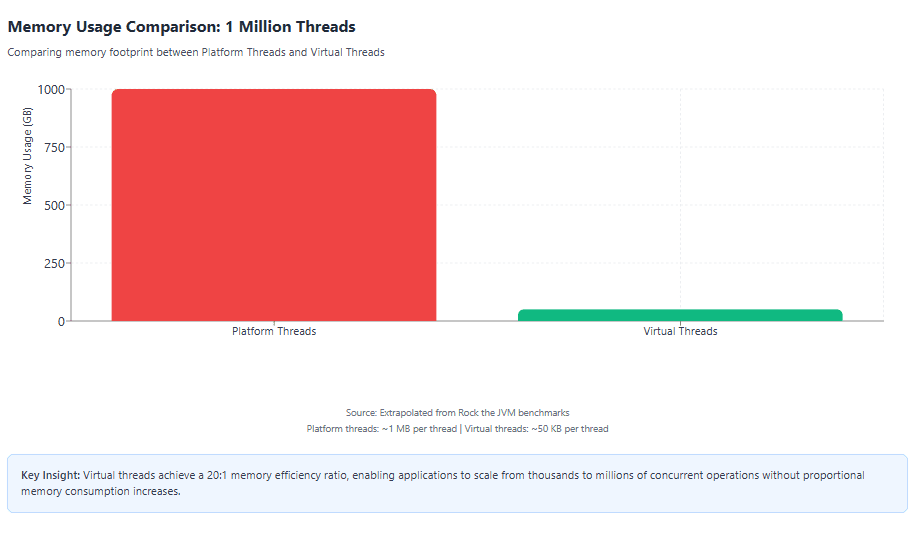
This 20:1 memory efficiency ratio fundamentally changes what’s possible. Applications that previously required careful thread pool tuning can now adopt simpler “thread-per-request” models at massive scale.
5.2 Throughput Analysis
Benchmark data from multiple sources demonstrates scalability patterns:
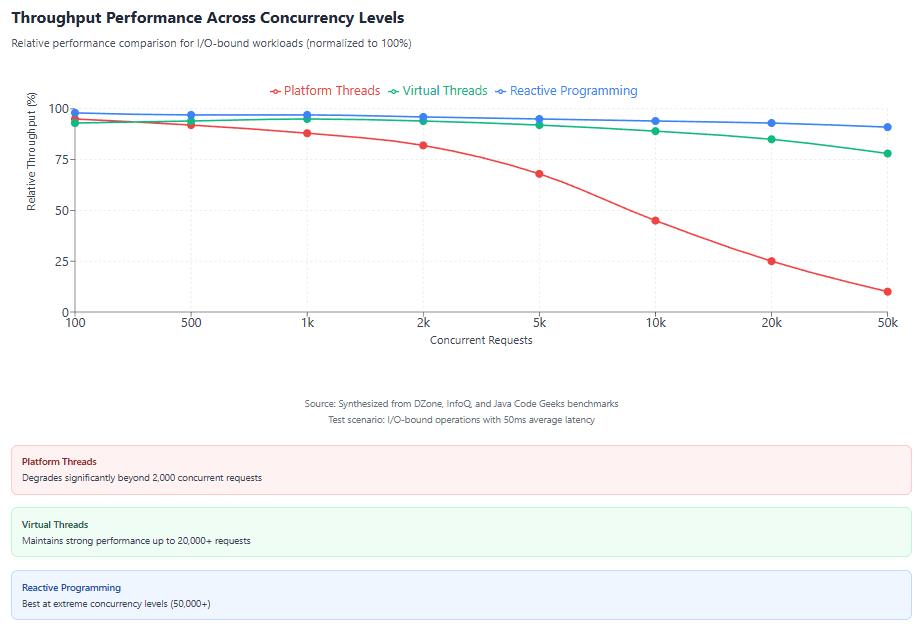
Low Concurrency (< 1,000 requests): Virtual threads show minimal advantage, sometimes even slight overhead due to continuation management
Medium Concurrency (1,000 – 10,000 requests): Virtual threads begin demonstrating clear benefits, particularly for I/O-bound operations with latency > 10ms
High Concurrency (> 10,000 requests): Virtual threads dramatically outperform platform thread pools, maintaining low latency and high throughput while platform threads experience degradation
5.3 Resource Utilization Patterns
Virtual threads change how we think about resource limits. Traditional platform thread applications often hit “thread exhaustion”—the pool depletes, and requests queue or fail. Virtual threads shift the bottleneck elsewhere, typically to:
- Connection pools: Database connection limits become the new constraint
- External service rate limits: The bottleneck moves to downstream dependencies
- CPU saturation: For compute-heavy operations, CPU utilization hits 100%
This shift represents progress: applications now scale until hitting actual resource constraints rather than artificial thread pool limits.
6. Migration Strategies from Traditional Threads
6.1 Incremental Adoption
The beauty of virtual threads lies in their API compatibility—they implement the same Thread interface as platform threads. This enables gradual migration:
Phase 1: Async Operations: Start by replacing async task executors:
// Before
@Async
public void processTask() { ... }

// After
@Async
@RunOnVirtualThread  // Quarkus
public void processTask() { ... }
Phase 2: Request Handling: Enable virtual threads for web server thread pools. In Spring Boot, this requires only configuration changes, no code modifications.
Phase 3: Background Processing: Migrate scheduled tasks and batch processing to virtual thread executors.
Phase 4: Full Adoption: Once confidence builds, transition blocking I/O operations throughout the application.
6.2 Avoiding Common Pitfalls
Migration isn’t without challenges, as documented across multiple sources:
The Pinning Problem (Java 21): When virtual threads execute synchronized blocks or native methods, they “pin” to carrier threads, losing their primary benefit. Java 21 exhibits this behavior, but Java 24+ resolves it through improved JVM instrumentation.
ThreadLocal Overuse: With millions of virtual threads potentially existing simultaneously, ThreadLocal variables can consume significant memory. The new ScopedValue API provides a more efficient alternative.
CPU-Intensive Tasks: Virtual threads provide no benefit for compute-bound operations. These should continue using platform threads or dedicated thread pools sized to available CPU cores.
Monitoring and Observability: Traditional thread dumps become overwhelming with millions of virtual threads. New tooling and approaches are necessary for production monitoring.
6.3 Framework-Specific Considerations
Each major framework presents unique migration considerations:
Spring Boot: Requires ensuring that libraries and drivers support non-blocking I/O to fully leverage virtual threads. JDBC drivers, in particular, may need updates or replacement with reactive alternatives.
Quarkus: Benefits most when combined with reactive database drivers (like Hibernate Reactive). The framework’s reactive foundation complements virtual threads well.
Micronaut: Its compile-time dependency injection and minimal reflection make it particularly well-suited for virtual thread adoption with fewer compatibility concerns.
7. Performance Characteristics and Limitations
7.1 When Virtual Threads Excel
Virtual threads demonstrate optimal performance in specific scenarios:
High-Concurrency I/O Operations: Applications with thousands of concurrent database queries, HTTP requests, or file operations see dramatic improvements. Web services, API gateways, and microservices architectures particularly benefit.
Long-Running Blocking Operations: When operations block for significant durations (hundreds of milliseconds to seconds), virtual threads efficiently free carrier threads for other work.
Unpredictable Concurrency Patterns: Applications with highly variable request rates benefit from virtual threads’ ability to scale elastically without pre-configured thread pools.
7.2 Known Limitations
Despite their promise, virtual threads have constraints:
CPU-Bound Workloads: As confirmed by multiple benchmarks, virtual threads offer no advantage—and may introduce slight overhead—for computationally intensive operations. The continuation mechanism adds minimal but measurable cost.
Short-Duration Tasks: For operations completing in microseconds, the overhead of creating virtual threads and managing continuations can exceed the task duration itself. In these cases, platform threads remain more efficient.
Synchronized Block Pinning (Java 21): In Java 21, virtual threads executing synchronized blocks that perform blocking operations pin to carrier threads, negating their benefits. This limitation is resolved in Java 24+, but represents a significant concern for Java 21 deployments.
Native Method Boundaries: Virtual threads cannot unmount during native method execution. Applications heavily dependent on JNI calls may not see expected benefits.
Interaction with Linux Kernel Scheduler: Research from IBM’s Liberty team identified unexpected performance degradation in specific scenarios—particularly short-duration tasks on 2-CPU configurations—due to complex interactions between the ForkJoinPool and Linux kernel scheduler. Different kernel versions exhibit different behaviors, complicating optimization.
7.3 Real-World Performance Expectations
Setting realistic expectations is crucial. Virtual threads are not a universal performance panacea. DZone’s comprehensive benchmarks show that:
- Under 2,000 concurrent requests, differences are often negligible
- Between 2,000-10,000 requests, improvements become measurable but modest
- Beyond 10,000 requests, improvements become dramatic for I/O-bound operations
- Reactive implementations still outperform virtual threads at extreme concurrency levels (> 50,000 requests/second)
The real value proposition isn’t always raw performance—it’s achieving near-reactive performance with dramatically simpler code, easier debugging, and natural exception handling.
8. What We Have Learned
Project Loom’s virtual threads represent a fundamental rethinking of Java’s concurrency model, one that challenges decades-old assumptions about the relationship between threads and system resources. By decoupling Java’s threading abstraction from operating system threads, virtual threads enable applications to scale to millions of concurrent operations while preserving the simplicity and familiarity of blocking, imperative code.
The theoretical foundation of virtual threads—the M:N threading model with heap-based stack storage and continuation-based execution—elegantly solves the resource constraints that have long plagued platform threads. However, this isn’t a simple replacement scenario. Virtual threads excel in I/O-bound, high-concurrency environments but offer minimal benefit for CPU-intensive workloads. They simplify code dramatically compared to reactive programming but may not match reactive frameworks at extreme concurrency levels.
The impact on Java’s ecosystem is profound. Major frameworks like Spring, Quarkus, and Micronaut are integrating virtual thread support, though each approaches integration differently based on their architectural foundations. Migration strategies vary from trivial configuration changes to careful refactoring of synchronized blocks and ThreadLocal usage.
Perhaps most importantly, virtual threads don’t obsolete reactive programming—instead, they complement it. The future likely involves hybrid approaches: virtual threads for straightforward request handling and business logic, reactive streams for specialized high-throughput pipelines requiring backpressure and complex stream composition.
As we move toward wider adoption in Java 21 LTS and beyond (with Java 24+ resolving early pinning limitations), virtual threads position Java competitively with languages like Go and Kotlin that have long offered lightweight concurrency primitives. They represent not an endpoint but a new beginning—a foundation for simpler, more scalable Java applications that preserve the language’s strengths while addressing its historical concurrency limitations.
For practitioners, the message is clear: virtual threads are production-ready for I/O-bound applications, but success requires understanding their characteristics, testing thoroughly in representative environments, and choosing the right tool—virtual threads, reactive programming, or platform threads—for each specific use case.
Further Reading:
- OpenJDK Project Loom
- JEP 444: Virtual Threads
- Spring Framework Virtual Threads Documentation
- HappyCoders Virtual Threads Guide