
Modern application development demands robust, efficient communication between distributed systems. As architects and developers, we face crucial decisions about which API paradigm best serves our use case. Three approaches dominate the landscape: REST, GraphQL, and gRPC. Each brings distinct philosophies, trade-offs, and strengths to the table.
1. Understanding the Design Philosophies
REST (Representational State Transfer) emerged from Roy Fielding’s doctoral dissertation in 2000, built on principles of statelessness, resource-oriented design, and standard HTTP methods. REST treats everything as a resource with a unique identifier (URI), manipulated through standard verbs like GET, POST, PUT, and DELETE. This architectural style prioritizes simplicity, cacheability, and the uniform interface constraint that makes REST APIs inherently discoverable.
GraphQL, developed by Facebook in 2012 and open-sourced in 2015, arose from frustration with over-fetching and under-fetching data in mobile applications. Rather than multiple endpoints returning fixed data structures, GraphQL provides a single endpoint where clients specify exactly what data they need through a declarative query language. The server returns precisely that data, nothing more, nothing less. This client-driven approach fundamentally shifts power from the server to the consumer.
gRPC, Google’s modern take on remote procedure calls released in 2016, takes a different path entirely. Built on HTTP/2 and Protocol Buffers (protobuf), gRPC emphasizes performance, type safety, and code generation. Instead of resources or queries, gRPC thinks in terms of service methods—remote functions that can be called as if they were local. This approach feels more natural to developers accustomed to object-oriented programming and provides compile-time type checking across network boundaries.
2. Performance Characteristics: Where Speed Matters
Performance differences between these paradigms stem from their fundamental design choices around data serialization, transport protocols, and communication patterns.
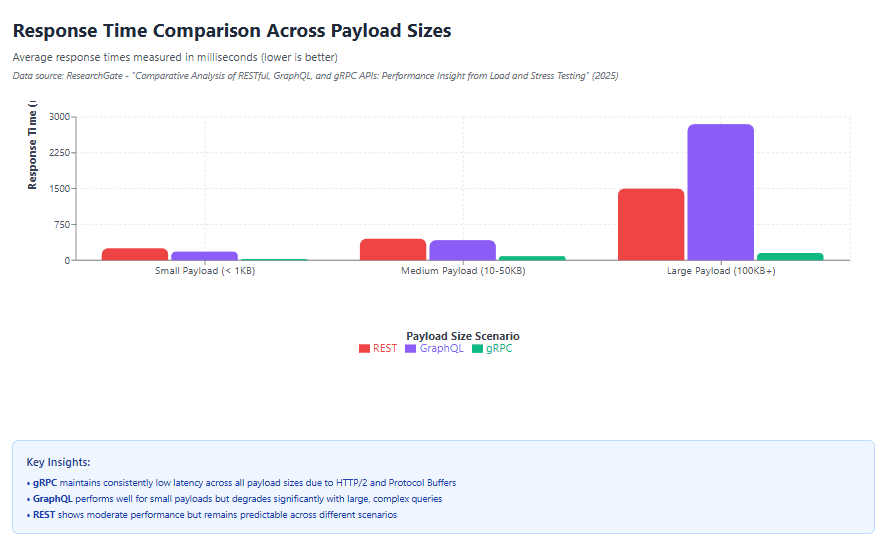
REST typically uses JSON over HTTP/1.1, a combination that’s human-readable and widely supported but carries overhead. Each HTTP/1.1 request requires a new TCP connection or connection reuse with head-of-line blocking. JSON parsing, while fast in modern implementations, still involves text processing that’s inherently slower than binary formats. For typical web applications serving mixed content to browsers, this overhead is negligible. But at scale, or in high-throughput microservices architectures, these milliseconds accumulate.
GraphQL, also commonly using JSON over HTTP/1.1, doesn’t inherently solve REST’s performance constraints. However, it addresses a different performance problem: network round trips. By allowing clients to request multiple related resources in a single query, GraphQL eliminates the N+1 query problem that plagues REST APIs. Instead of making five separate requests to fetch a user, their posts, comments, likes, and followers, a single GraphQL query retrieves everything. This reduction in network round trips can dramatically improve perceived performance, especially on high-latency mobile networks.
gRPC leverages HTTP/2’s multiplexing and Protocol Buffers’ binary serialization for superior raw performance. Protobuf messages are smaller than equivalent JSON (often 3-10x smaller) and faster to serialize/deserialize. HTTP/2’s multiplexing eliminates head-of-line blocking, allowing multiple parallel requests over a single TCP connection. Binary framing reduces parsing overhead significantly. In practice, gRPC services often achieve 5-7x lower latency and higher throughput than equivalent REST implementations, particularly for internal microservices communication where raw performance matters most.
According to research on API performance benchmarks, gRPC consistently demonstrates superior throughput and lower latency compared to REST in high-load scenarios, while GraphQL optimizes for reducing the number of requests rather than individual request performance.
3. Client-Server Coupling: The Flexibility Spectrum
The degree of coupling between client and server profoundly affects how systems evolve over time.
REST embodies loose coupling. Clients need only understand HTTP semantics and the media types being exchanged (typically JSON). A properly designed RESTful API uses HATEOAS (Hypermedia as the Engine of Application State) principles, where responses include links to related resources, allowing clients to discover capabilities dynamically. In practice, most REST APIs don’t fully implement HATEOAS, but they still maintain loose coupling through standard HTTP conventions and contract-based JSON schemas. Clients can often continue functioning even as servers add new fields or endpoints.
GraphQL introduces tighter coupling through its schema. Clients must know the schema to construct queries, and servers must maintain that schema contract. This explicitness is both a feature and a constraint. The typed schema prevents many classes of runtime errors and enables powerful tooling, but it also means changes require careful coordination. Adding fields is safe; removing or renaming fields requires deprecation cycles and client updates. The schema becomes a contract that binds client and server more closely than REST’s loosely-typed approach.
gRPC represents the tightest coupling of the three. Service definitions in .proto files are shared between client and server, with code generated for both sides. This provides exceptional type safety and developer experience—your IDE knows exactly what methods and message types exist. But it also means clients and servers must stay synchronized. Protobuf’s wire format compatibility allows some flexibility (you can add optional fields safely), but method signature changes require client redeployment. This tight coupling makes gRPC ideal for internal services where teams control both ends, but challenging for public APIs with diverse, independent client implementations.
4. Schema Definition and Evolution: Managing Change
How APIs handle versioning and evolution often determines their long-term maintainability.
REST lacks a formal schema definition language, relying instead on documentation (often OpenAPI/Swagger) and JSON Schema for validation. This flexibility allows easy initial development but can lead to drift between documentation and implementation. API versioning in REST typically happens through URL paths (/api/v1/users, /api/v2/users) or headers. This explicit versioning is clear but fragments the API surface, requiring servers to maintain multiple implementations simultaneously. Evolution strategies often involve parallel versions with planned deprecation cycles.
GraphQL’s introspective schema elegantly handles evolution. The schema is queryable at runtime, meaning clients can discover what’s available without external documentation. Fields can be marked deprecated directly in the schema with explanatory messages, allowing gradual migration. Adding fields never breaks existing queries—clients simply ignore what they don’t request. This additive evolution model is GraphQL’s superpower. However, removing fields or changing types requires careful migration strategies. Many teams maintain a single evolving schema rather than explicit versions, using field deprecation to guide clients toward new patterns.
According to industry surveys on API design practices, schema-driven development has become increasingly important, with GraphQL and gRPC’s formal schemas providing better tooling support compared to traditional REST approaches.
gRPC’s protobuf definitions provide explicit, machine-readable contracts with built-in version compatibility rules. Protobuf’s wire format allows backward and forward compatibility through careful field numbering. Adding new optional fields is safe; removing fields requires careful deprecation. Many teams use protobuf’s package versioning (package api.v1, package api.v2) for major breaking changes while maintaining wire-level compatibility for minor evolution. The strict typing catches incompatibilities at compile time rather than runtime, a significant advantage for large systems.
5. Tooling and Ecosystem Support
The maturity and breadth of tooling significantly impact developer productivity.
REST benefits from the longest history and widest adoption. Every programming language has HTTP client libraries. OpenAPI/Swagger provides standardized documentation and code generation. Tools like Postman, Insomnia, and curl make manual testing straightforward. Browser developer tools natively understand HTTP requests. This universal support means developers can work with REST APIs using familiar tools regardless of their technology stack. The ecosystem is vast, mature, and well-documented.
GraphQL’s tooling has matured rapidly since its release. Apollo and Relay provide sophisticated client libraries with caching, state management, and optimistic updates. GraphiQL and GraphQL Playground offer interactive query builders that leverage the introspective schema. Type generation tools create TypeScript or Java types from schemas automatically. However, the ecosystem is less standardized than REST’s—different implementations make different trade-offs, and best practices are still emerging for concerns like authentication, rate limiting, and error handling.
gRPC’s tooling centers on code generation and type safety. The protoc compiler generates client stubs and server skeletons in numerous languages, providing a consistent development experience. IDEs understand protobuf syntax and offer intelligent completion. Tools like grpcurl and BloomRPC enable testing, though they’re less intuitive than REST’s curl. The trade-off is clear: gRPC’s tooling requires more initial setup but provides superior type safety and developer ergonomics once configured.
6. Use Case Suitability: Choosing the Right Tool
Each paradigm excels in specific scenarios.
REST shines for:
- Public APIs consumed by diverse, independent clients
- CRUD operations on well-defined resources
- Systems requiring broad compatibility and simplicity
- Scenarios where HTTP caching provides significant value
- Teams new to API development or with limited infrastructure
Consider REST when your API will be consumed by unknown third parties, when simplicity trumps performance, or when your data model maps naturally to resources. REST’s ubiquity makes it the safe default choice.
GraphQL excels at:
- Mobile applications with bandwidth constraints
- Complex data aggregation from multiple sources
- Rapidly evolving client requirements
- Systems where clients need flexibility in data fetching
- Frontend-driven development with backend-for-frontend patterns
Choose GraphQL when different clients need different data shapes, when network efficiency matters more than raw throughput, or when you want to empower frontend developers to fetch exactly the data they need without backend changes.
gRPC dominates for:
- Internal microservices communication
- High-performance, low-latency requirements
- Polyglot environments requiring strong contracts
- Streaming data (server streaming, client streaming, bidirectional)
- Systems where type safety and code generation reduce bugs
Adopt gRPC when you control both client and server, when performance is critical, or when you need streaming capabilities beyond simple request-response. It’s particularly powerful in microservices architectures where services communicate frequently and latency compounds.
7. Security Considerations: Protecting Your APIs
Security concerns manifest differently across these paradigms.
REST security is well-understood and standardized. HTTPS encrypts transport, OAuth 2.0 and JWT tokens handle authentication and authorization, and standard HTTP security headers (CORS, CSP) control access. REST’s statelessness aligns with modern security practices. However, REST’s flexibility can be a vulnerability—without careful design, APIs may expose too much data, enabling scrapers or data miners. Rate limiting and input validation require explicit implementation.
GraphQL introduces unique security challenges. The flexibility that makes GraphQL powerful—arbitrary query complexity—also creates attack vectors. Deeply nested queries can overwhelm servers (query depth attacks), and broad queries can fetch excessive data (query breadth attacks). Many GraphQL servers implement query complexity analysis, depth limiting, and query whitelisting to mitigate these risks. Authentication typically happens at the resolver level, allowing fine-grained control but requiring careful implementation to avoid accidentally exposing sensitive fields.
gRPC’s security story centers on mutual TLS authentication and encryption. The framework provides built-in support for SSL/TLS, making encrypted communication the default for production deployments. Token-based authentication integrates cleanly through metadata headers. Because gRPC typically operates within internal networks rather than public internet, the security model often differs—focusing on service-to-service authentication and authorization rather than external threats. However, this doesn’t eliminate security concerns; misconfigured internal services can become lateral movement vectors in security breaches.
8. Performance Comparison: Numbers in Context
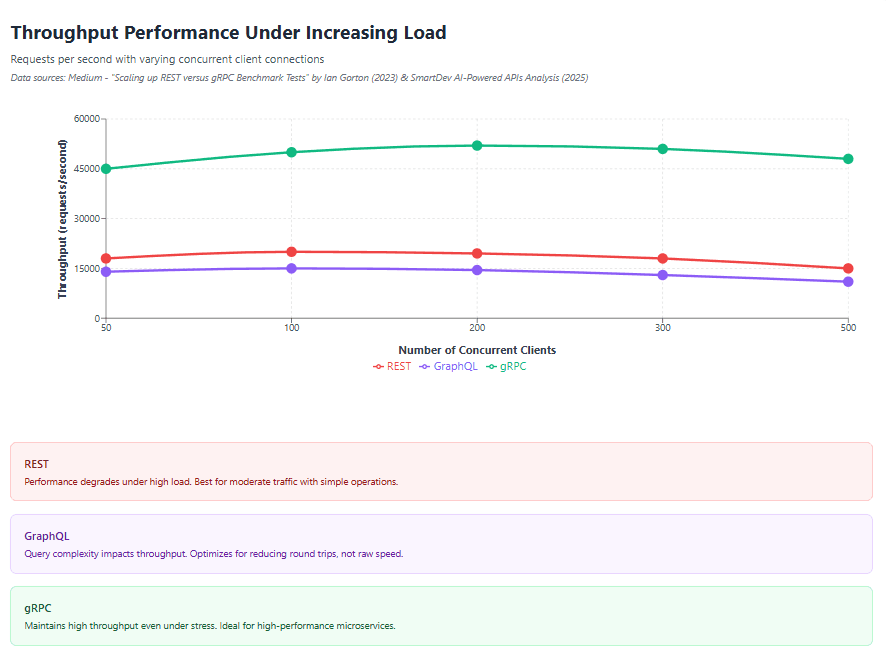
These figures represent typical scenarios but vary significantly based on payload complexity, network conditions, and implementation quality. The key insight isn’t absolute numbers but relative strengths: gRPC excels at raw performance, GraphQL optimizes round trips, and REST prioritizes simplicity and compatibility.
9. What We’ve Seen: Making Informed Decisions
The choice between REST, GraphQL, and gRPC isn’t about declaring a winner—it’s about matching architectural characteristics to business and technical requirements.
REST remains the pragmatic default for public APIs, bringing unmatched compatibility, simplicity, and tooling maturity. Its resource-oriented model maps intuitively to many business domains, and its loose coupling accommodates diverse clients with varying needs. When simplicity, broad adoption, and cache-ability matter most, REST delivers consistently.
GraphQL revolutionizes client-server interaction by shifting control to the consumer. Its typed schema and query language eliminate over-fetching and under-fetching, dramatically improving mobile application performance and developer velocity. The introspective schema enables powerful tooling and smooth evolution. However, this power comes with complexity in implementation, caching, and security that teams must carefully manage.
gRPC represents the cutting edge of internal service communication. Its performance characteristics, type safety, and streaming capabilities make it ideal for high-throughput microservices architectures. The tight coupling that challenges public API design becomes an advantage within organization boundaries, where code generation and compile-time checks prevent entire classes of integration bugs.
Many successful architectures don’t choose one paradigm but thoughtfully combine them: gRPC for internal microservices communication, GraphQL as a backend-for-frontend aggregation layer, and REST for public-facing APIs. This polyglot approach leverages each paradigm’s strengths while mitigating its weaknesses.
The future of API design likely involves continued convergence and cross-pollination. REST APIs are adopting schema definitions through OpenAPI. GraphQL implementations are exploring HTTP/2 and alternative serialization formats. gRPC is developing better browser support and public API patterns. The boundaries blur as each paradigm learns from the others.
Ultimately, the best API design paradigm is the one that aligns with your team’s expertise, your client’s needs, your performance requirements, and your evolution strategy. Understanding these trade-offs empowers you to make informed decisions rather than following trends blindly.



Well written article!