In the evolving landscape of cloud computing, two powerful paradigms have emerged: Kubernetes for container orchestration and serverless computing for simplified application deployment. What happens when these two worlds collide? The result is serverless workloads on Kubernetes—a hybrid approach that combines the robust orchestration capabilities of Kubernetes with the operational simplicity and cost efficiency of serverless architectures.
Understanding serverless on Kubernetes isn’t just about knowing the latest technology trend. It’s about discovering how to simplify container deployment and improve the scalability and elasticity of applications while maintaining the flexibility that Kubernetes provides.
1. Understanding the Foundation: What Is Serverless on Kubernetes?
1.1 The Serverless Computing Model
Despite its name, serverless computing doesn’t eliminate servers—it simply abstracts them away. In traditional serverless platforms like AWS Lambda or Azure Functions, cloud providers handle all infrastructure management, allowing developers to focus purely on code. With serverless, you run code without provisioning or managing servers, as the cloud provider handles the infrastructure.
1.2 Kubernetes as an Orchestration Platform
Kubernetes has become the industry standard for container orchestration. It automates the deployment, scaling, and management of containerized applications, providing powerful abstractions for running distributed systems. However, traditional Kubernetes requires significant operational expertise to manage clusters, nodes, and infrastructure.
1.3 The Convergence: Serverless Kubernetes
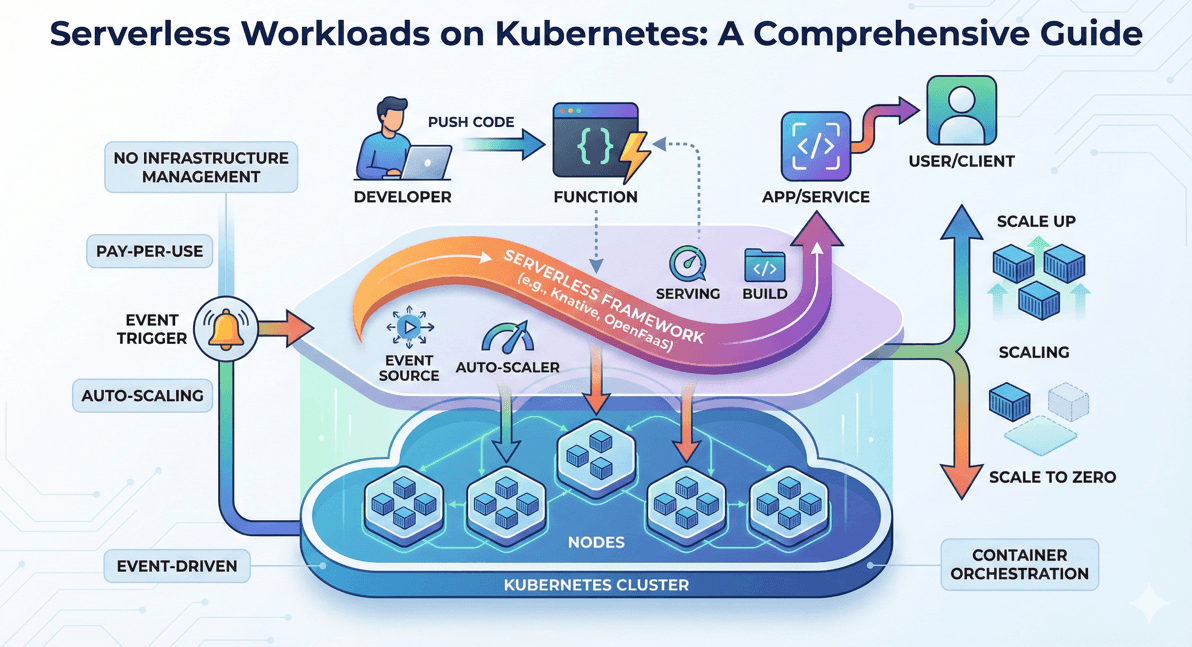
Serverless Kubernetes combines serverless computing principles with Kubernetes orchestration capabilities. This approach aims to deliver the best of both worlds: the portability and flexibility of Kubernetes with the operational simplicity of serverless computing. Rather than replacing one with the other, serverless on Kubernetes extends the platform’s capabilities.
2. Key Technologies Enabling Serverless on Kubernetes
Several open-source projects have emerged to make serverless workloads on Kubernetes a reality. Here are the most significant ones:
2.1 Knative: The Foundation for Serverless
Knative is a Kubernetes-based platform that provides middleware components for building and deploying serverless workloads. Knative addresses key challenges including application deployment complexity, serverless operations, and developer experience by providing higher-level abstractions that simplify development.
Knative consists of three main components:
| Component | Purpose | Key Capabilities |
|---|---|---|
| Knative Serving | HTTP-triggered autoscaling runtime | Manages service lifecycle, routing, automatic scaling including scale-to-zero |
| Knative Eventing | Event routing layer | Provides infrastructure for consuming and producing CloudEvents, enabling loose coupling |
| Knative Functions | Developer-focused framework | Simplifies building and deploying stateless functions |
Knative provides automatic scaling from zero to thousands of instances, intelligent traffic routing, and efficient resource utilization.
2.2 KEDA: Event-Driven Autoscaling
KEDA (Kubernetes Event-Driven Autoscaling) takes a different approach. With KEDA, you can drive the scaling of any container in Kubernetes based on the number of events needing to be processed. Rather than scaling based solely on CPU or memory metrics, KEDA allows workloads to scale based on external event sources like message queues, databases, or custom metrics.
KEDA offers several advantages:
- Extensive scaler catalog: Over 70 built-in scalers for various cloud platforms, databases, messaging systems, and more
- Scale-to-zero capability: Workloads can scale down to zero replicas when idle, reducing costs
- Works alongside HPA: KEDA extends rather than replaces Kubernetes’ native Horizontal Pod Autoscaler
- Event-driven model: Applications can automatically scale based on metrics like CPU usage, incoming requests, or custom triggers
2.3 Virtual Kubelet: Connecting to Serverless Backends
Virtual Kubelet is an open-source project that masquerades as a kubelet for the purposes of connecting Kubernetes to other APIs, allowing nodes to be backed by other services like Azure Container Instances, AWS Fargate, or IoT Edge.
This technology enables Kubernetes clusters to transparently extend into serverless container platforms. The virtual node appears as part of the cluster, but when tasks are assigned to it, they’re delegated to a configured provider to actually run.
3. Comparing Approaches: Knative vs. KEDA
While both Knative and KEDA enable serverless capabilities on Kubernetes, they serve different purposes:
| Aspect | Knative | KEDA |
|---|---|---|
| Primary Focus | Complete serverless platform with serving and eventing | Event-driven autoscaling for existing workloads |
| Scale Trigger | HTTP requests and connections | External event sources (queues, databases, metrics) |
| Deployment Model | Knative Services (higher-level abstraction) | Standard Kubernetes deployments |
| Learning Curve | Requires learning Knative concepts | Works with existing Kubernetes knowledge |
| Best For | New serverless applications | Adding event-driven scaling to existing apps |
Knative focuses more on comprehensive aspects including traffic splitting and integration with service meshes like Istio, while KEDA concentrates specifically on scalability.
4. Real-World Implementation: AWS EKS with Fargate
Amazon’s approach to serverless Kubernetes demonstrates practical implementation. Amazon EKS allows running Kubernetes pods on AWS Fargate, the serverless compute engine, making it easier to build and run Kubernetes applications in AWS.
This integration works through Fargate profiles, which define which pods should run on Fargate based on namespace and labels. When a pod targeting a specific namespace or annotated with custom labels reaches EKS, Kubernetes uses custom controllers to hand off the lifecycle to Fargate.
4.1 Benefits of EKS with Fargate
- No node management: Deploy and manage applications without managing servers, removing the operational overhead to scale, patch, secure, and manage infrastructure
- Right-sized compute: Each pod runs with exactly the resources it requests
- Enhanced security: Pods deployed in Fargate offer enhanced security because they run on isolated environments with no shared resources
- Cost optimization: You only pay for the resources used to run your pods, optimizing cloud spending by allocating resources only when processing requests
5. When to Choose Serverless on Kubernetes
Understanding when to implement serverless workloads on Kubernetes requires evaluating your specific needs:
5.1 Ideal Use Cases
Event-Driven Workloads
Serverless is highly efficient for event-driven workloads like API gateways, image processing, and IoT data streams. When your application responds to events rather than running continuously, serverless on Kubernetes provides excellent efficiency.
Variable Traffic Patterns
Applications with unpredictable or fluctuating workloads benefit significantly from automatic scaling and scale-to-zero capabilities. Serverless is excellent for handling unpredictable traffic patterns due to its flexibility.
Development and Testing Environments
Serverless is beneficial in test and development scenarios where you need to quickly spin up test environments and tear them down after testing with minimal overhead.
Hybrid Architectures
Organizations can leverage Kubernetes for core services and serverless for event-driven tasks, getting the best of both worlds. This hybrid approach allows teams to optimize different parts of their application stack appropriately.
5.2 When Traditional Kubernetes Is Better
Not every workload benefits from serverless. Consider traditional Kubernetes deployments when:
- Long-running processes: Serverless has limitations with long-running tasks and concurrency management
- Complex networking requirements: Applications needing intricate networking configurations may find serverless abstractions limiting
- Stateful applications: While not impossible, stateful workloads generally work better with traditional Kubernetes StatefulSets
- Predictable, consistent workloads: For predictable patterns that show almost sinewave-like graphs representing workday usage, traditional autoscaling with reserved instances can be more economical
6. Benefits of Serverless Workloads on Kubernetes
6.1 Operational Simplicity
One of the most significant advantages is reduced operational burden. Serverless on Kubernetes simplifies container deployment by enabling easy launch of pods without directly managing individual pods through Kubernetes.
6.2 Cost Optimization
This approach optimizes cloud spending by allocating resources only when processing requests or events, minimizing idle resource costs—especially advantageous for applications with fluctuating or unpredictable workloads.
6.3 Automatic Scaling
The combination provides sophisticated scaling capabilities. KEDA can scale in to zero instances when no events are occurring and out to numerous instances, exposing custom metrics for the Kubernetes autoscaler.
6.4 Developer Focus
Serverless means less hassle with infrastructure and more time to innovate, allowing developers to focus on writing code and building features rather than managing underlying systems.
6.5 Platform Portability
Unlike cloud-specific serverless solutions, Knative runs on any Kubernetes cluster, providing portability across cloud providers and on-premises environments, avoiding vendor lock-in.
7. Challenges and Considerations
7.1 Cold Start Latency
Serverless platforms often experience cold start latency—the delay that occurs when a function is invoked after being idle, as the platform needs to initialize a new instance. This can be problematic for latency-sensitive applications.
7.2 Complexity in Integration
Initially, integrating serverless functions with Kubernetes-managed environments can be challenging. Organizations need tools like Knative or careful planning to ensure smooth integration.
7.3 Monitoring and Debugging
With distributed serverless functions, debugging and monitoring can become complex, requiring tools and practices to evolve. Traditional Kubernetes monitoring may need augmentation with serverless-specific observability tools.
7.4 Learning Curve
Teams familiar with traditional Kubernetes face a learning curve when adopting serverless patterns. Kubernetes has a steeper learning curve which may require additional training for your team, and adding serverless concepts compounds this.
7.5 Vendor Considerations
While Kubernetes itself is portable, serverless is often tightly coupled with specific cloud platforms, making migrations challenging and potentially requiring code refactoring.
8. Implementation Considerations
8.1 Architecture Design
When implementing serverless on Kubernetes, consider these architectural patterns:
- Microservices alignment: Design services with clear boundaries that map well to serverless functions
- Event-driven design: Redesigning autoscaling infrastructure for event-driven applications helps focus on integrating event-driven mechanisms that dynamically respond to workload changes
- Stateless design: Serverless functions should be stateless, with state managed externally
- Decomposition strategy: Break monolithic applications into smaller, independently deployable functions
8.2 Resource Configuration
Proper resource configuration is critical:
- Define appropriate CPU and memory limits for functions
- Configure scaling thresholds based on actual usage patterns
- Set maximum concurrency limits to prevent runaway costs
- Implement circuit breakers and rate limiting
8.3 Security Best Practices
Kubernetes offers robust security features including role-based access control (RBAC), network policies, and encryption. For serverless workloads:
- Implement proper authentication and authorization for functions
- Use network policies to control traffic between serverless and traditional workloads
- Apply the principle of least privilege for service accounts
- Regularly scan container images for vulnerabilities
8.4 Cost Management
Serverless typically uses a pay-per-use pricing model where you’re billed for the number of requests and execution duration. To optimize costs:
- Monitor function execution times and optimize performance
- Implement caching strategies to reduce invocations
- Use scale-to-zero for development environments
- Set budget alerts and cost allocation tags
9. The Serverless Kubernetes Workflow
┌─────────────────────────────────────────────────────────────────┐
│                     Developer Experience                         │
├─────────────────────────────────────────────────────────────────┤
│  1. Developer writes function code                              │
│  2. Defines configuration (resources, triggers, scaling rules)  │
│  3. Deploys using kubectl or serverless framework               │
└─────────────────────────────────────────────────────────────────┘
                              ↓
┌─────────────────────────────────────────────────────────────────┐
│                    Kubernetes Control Plane                      │
├─────────────────────────────────────────────────────────────────┤
│  • Receives deployment manifests                                │
│  • Serverless platform (Knative/KEDA) processes specifications  │
│  • Creates necessary Kubernetes resources                       │
└─────────────────────────────────────────────────────────────────┘
                              ↓
┌─────────────────────────────────────────────────────────────────┐
│                      Scaling Layer                               │
├─────────────────────────────────────────────────────────────────┤
│  • Monitors metrics (requests, events, custom metrics)          │
│  • Makes scaling decisions (0 to N replicas)                    │
│  • Coordinates with Kubernetes scheduler                        │
└─────────────────────────────────────────────────────────────────┘
                              ↓
┌─────────────────────────────────────────────────────────────────┐
│                    Compute Resources                             │
├─────────────────────────────────────────────────────────────────┤
│  Traditional Nodes    │    Serverless Backend (Fargate/ACI)     │
│  • Long-running pods  │    • On-demand pods                     │
│  • Stateful services  │    • Event-driven functions             │
│  • Base capacity      │    • Burst capacity                     │
└─────────────────────────────────────────────────────────────────┘
This workflow illustrates how serverless workloads integrate seamlessly with traditional Kubernetes deployments, providing flexibility in how and where workloads run.
10. Future Trends and Evolution
The serverless Kubernetes ecosystem continues to evolve rapidly. Organizations are combining serverless with traditional architectures to create hybrid solutions, offering the best of both worlds.
Key trends include:
- Enhanced integration: Tighter integration between serverless frameworks and Kubernetes native features
- Improved observability: Better tools for monitoring and debugging distributed serverless applications
- Edge computing: Extending serverless patterns to edge locations for lower latency
- AI/ML workloads: Creating flexible and portable AI and ML development environments with scalable resources that boost server capacity while avoiding overprovisioning
11. What We’ve Learned
Throughout this exploration of serverless workloads on Kubernetes, we’ve discovered several key insights:
Complementary Technologies: Serverless and Kubernetes aren’t competing paradigms but complementary approaches that can work together effectively. The integration of Kubernetes and Serverless architectures represents a significant milestone in the evolution of DevOps.
Strategic Choice: The decision between serverless, traditional Kubernetes, or a hybrid approach depends on specific workload characteristics, team capabilities, and organizational goals. There’s no universal “right” answer.
Multiple Implementation Paths: Technologies like Knative, KEDA, and Virtual Kubelet provide different paths to serverless capabilities, each with distinct strengths. Knative offers a comprehensive platform, KEDA focuses on event-driven scaling, and Virtual Kubelet enables integration with cloud-native serverless services.
Real Business Value: When implemented appropriately, serverless on Kubernetes delivers tangible benefits including cost optimization through pay-per-use models, operational simplification by reducing infrastructure management burden, automatic scaling that responds to actual demand, and platform portability that avoids vendor lock-in.
Practical Considerations: Success requires careful attention to cold start performance, monitoring and debugging strategies, security implementation, and cost management.
Hybrid Architectures: Many organizations find the most value in hybrid approaches that use traditional Kubernetes for core services requiring consistent performance and serverless for event-driven, variable workloads.
The convergence of serverless computing and Kubernetes represents an important evolution in cloud-native architectures. By understanding the available technologies, their trade-offs, and appropriate use cases, organizations can make informed decisions about incorporating serverless workloads into their Kubernetes infrastructure. As the ecosystem matures, we can expect even better integration, tooling, and practices that make this powerful combination increasingly accessible to development teams of all sizes.
Further Resources
- Knative Official Documentation
- KEDA Official Website
- Virtual Kubelet GitHub Repository
- AWS Fargate with EKS Guide
- CNCF Serverless Working Group