Polyglot Programming: When Learning Multiple Languages Makes You a Better Developer

In today’s rapidly evolving tech landscape, the notion that developers should master a single programming language has become outdated. The most effective engineers are polyglots—professionals who leverage multiple languages to solve problems more elegantly and efficiently.
Why Language Diversity Matters
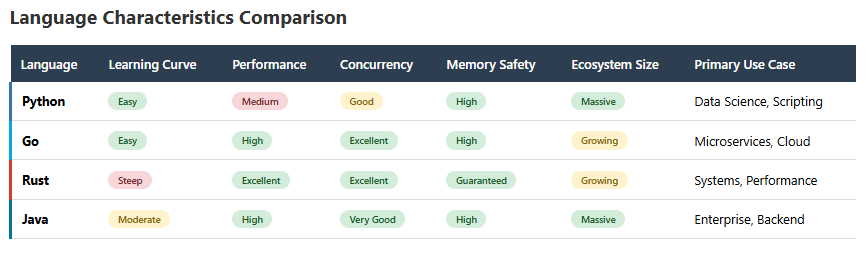
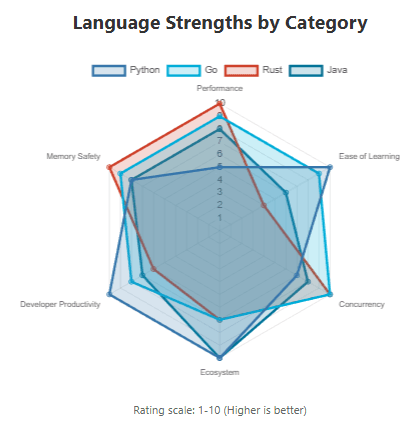
Every programming language embodies a particular philosophy and set of trade-offs. Python emphasizes readability and rapid development. Go prioritizes simplicity and concurrency. Rust guarantees memory safety without garbage collection. Java offers enterprise-grade stability and a vast ecosystem.
When you learn multiple languages, you’re not just adding syntax to your toolkit—you’re expanding your mental models for problem-solving. A developer who understands Go’s goroutines will approach concurrency differently than one who only knows Java’s threading model. Similarly, Rust’s ownership system teaches you to think about memory management in ways that make you write better code in any language.
The Strategic Four: Python, Go, Rust, and Java
Python: The Rapid Prototyper
Python excels at quick prototyping, data analysis, and AI/ML applications. Its extensive libraries like NumPy, Pandas, and TensorFlow make it indispensable for data science. The language’s dynamic typing and concise syntax allow developers to iterate rapidly.
Best for: Data science, scripting, automation, web development with Django or Flask
Go: The Cloud Native Champion
Created at Google, Go has become the language of cloud infrastructure. Docker, Kubernetes, and Terraform are all written in Go. Its built-in concurrency primitives and fast compilation make it ideal for building microservices and distributed systems.
Best for: Microservices, CLI tools, cloud infrastructure, concurrent applications
Rust: The Performance Guardian
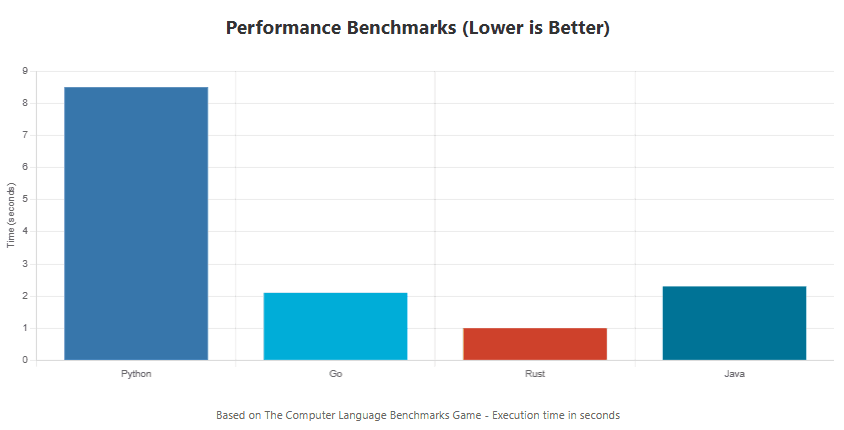
Rust delivers C-level performance with memory safety guarantees. Its ownership model eliminates entire classes of bugs at compile time. While it has a steeper learning curve, Rust is increasingly used for system programming, web assembly, and performance-critical services.
Best for: Systems programming, embedded systems, performance-critical services, WebAssembly
Java: The Enterprise Backbone
Despite newer alternatives, Java remains dominant in enterprise environments. Its mature ecosystem, strong typing, and the JVM’s stability make it reliable for large-scale applications. Modern Java (17+) has incorporated functional programming features while maintaining backward compatibility.
Best for: Enterprise applications, Android development, large-scale systems, backend services with Spring Boot
Real-World Benefits of Polyglot Programming
Better Architecture Decisions: When you know multiple languages, you can choose the right tool for each component. Use Python for data processing pipelines, Go for API gateways, Rust for performance bottlenecks, and Java for core business logic.
Improved Problem-Solving: Each language teaches different paradigms. Python’s functional programming features, Go’s CSP-style concurrency, Rust’s ownership model, and Java’s object-oriented design patterns all contribute to a richer problem-solving toolkit.
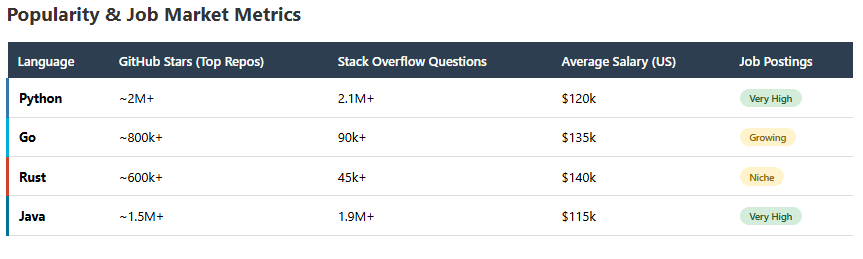
Enhanced Career Prospects: According to the 2024 Stack Overflow Developer Survey, developers who know multiple languages earn significantly more and have greater job flexibility. Being polyglot makes you adaptable in a changing job market.
Stronger Code Review Skills: Understanding multiple languages helps you recognize patterns and anti-patterns across codebases. You’ll spot issues faster and suggest more elegant solutions.
The Learning Path
Start with Python if you’re new to programming—its gentle learning curve builds confidence. Once comfortable, add Java to understand static typing and object-oriented principles at scale. Then explore Go for its simplicity and modern concurrency approach. Finally, tackle Rust when you’re ready for systems-level thinking.
Don’t try to learn all four simultaneously. Master one language deeply, then expand deliberately. Each new language should take less time to learn as you recognize familiar patterns.
Practical Integration
Modern projects often combine multiple languages. A typical architecture might use:
- Python for ML model training
- Go for the API layer serving predictions
- Rust for performance-critical data processing
- Java for integration with existing enterprise systems
Tools like gRPC enable seamless communication between services written in different languages, while containerization via Docker ensures consistent deployment regardless of the underlying language.
What We’ve Seen
Polyglot programming isn’t about collecting languages like trophies—it’s about becoming a more thoughtful, versatile developer. Python, Go, Rust, and Java each offer unique strengths that complement one another. By learning multiple languages, you gain access to diverse ecosystems, broaden your problem-solving capabilities, and position yourself as an adaptable engineer capable of navigating complex technical challenges.
The best developers don’t ask “What language should I learn?” They ask “What problem am I solving, and which tool is best suited for it?” That mindset—enabled by polyglot programming—is what separates good developers from great ones.