User Experience (UX) has transformed from a niche specialty into the cornerstone of digital product success. What began as basic usability testing has evolved into a sophisticated discipline drawing from cognitive science, behavioral psychology, and human-centered design. In 2025, understanding UX’s theoretical foundations isn’t just for designers—it’s essential for anyone making technology adoption decisions.
From Usability to Deep Experience: UX’s Expanding Definition
In its early days, UX design meant building interfaces that were simply “easy to use.” Companies focused on whether users could complete tasks without frustration. But as digital products began competing fiercely for attention and loyalty, something became clear: how software makes users feel—emotionally and cognitively—matters just as much as how efficiently it works.
Design-driven companies outperform the S&P Index by 228% over 10 years, proving that UX isn’t just a nice-to-have feature—it’s a strategic differentiator. Today, 77% of brands believe customer experience is a key competitive differentiator, and 67% of enterprises consider UX crucial to their competitive edge.

The Market Reality
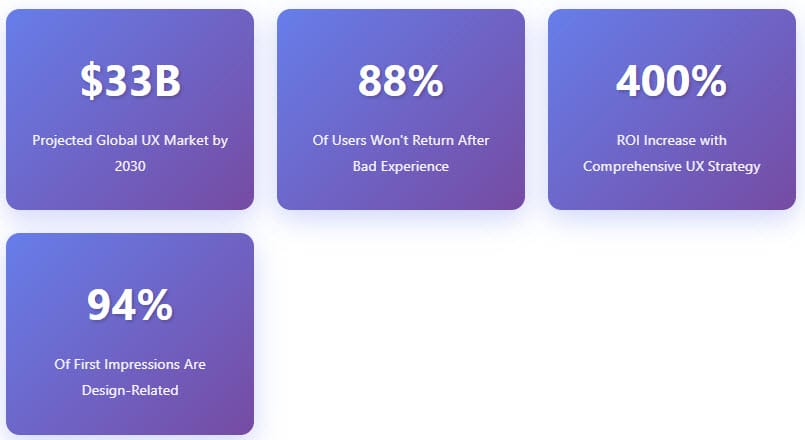
The global UX services market, valued at $2.59 billion in 2022, is projected to reach $32.95 billion by 2030, with a staggering CAGR of 37.8%. The UI design market is also booming, expected to grow from $2.43 billion in 2024 to $7.43 billion by 2032.
By 2050, there will be over 100 million UX professionals worldwide, up from around one million currently—a 100x growth that underscores UX’s evolution from specialty to necessity.
The Psychology Behind Great UX
Modern UX draws heavily from cognitive psychology—the study of how humans process information, make decisions, and form memories. These psychological principles form the foundation of the 21 Laws of UX, a comprehensive collection of design heuristics based on decades of behavioral research.
Understanding these principles isn’t academic exercise—it’s practical necessity. By applying cognitive psychology to design, we can create interfaces that feel intuitive and effortless, reducing mental strain and improving user satisfaction.
| Principle | Core Concept | UX Application | Further Reading |
| Cognitive Load Theory | John Sweller identified three types of load: Intrinsic (task complexity), Extraneous (presentation issues), and Germane (learning effort). Working memory is limited. | UX designers aim to reduce Extraneous Load by creating clear, simple, and uncluttered interfaces to prevent user overwhelm and strain. | Cognitive Load (Laws of UX) |
| Hick’s Law | William Edmund Hick & Ray Hyman found that decision time increases with the number of choices available. More choices lead to higher cognitive load. | Limit visible options and streamline user journeys (e.g., using progressive disclosure) to prevent decision paralysis and abandonment. | What is Hick’s Law (Interaction-Design.org) |
| Gestalt Principles | Describes how the human brain naturally organizes and seeks patterns in visual elements. Key principles include Proximity, Similarity, Closure, Continuity, and Figure-Ground. | Used to structure content logically, group related elements, and ensure a harmonious, easily digestible visual flow on the interface. | Gestalt Principles in UX Design (UserBit) |
| Emotional Design | Users form an emotional connection with a product. Don Norman introduced the three levels: Visceral, Behavioral, and Reflective. Aesthetically pleasing designs are perceived as more usable (Aesthetic-Usability Effect). | Leverage color, imagery, and delightful micro-interactions to evoke positive emotions, build brand loyalty, and create memorable experiences. | Emotional Design in UX / UI (Pukkas) |
User Behavior Statistics 2025
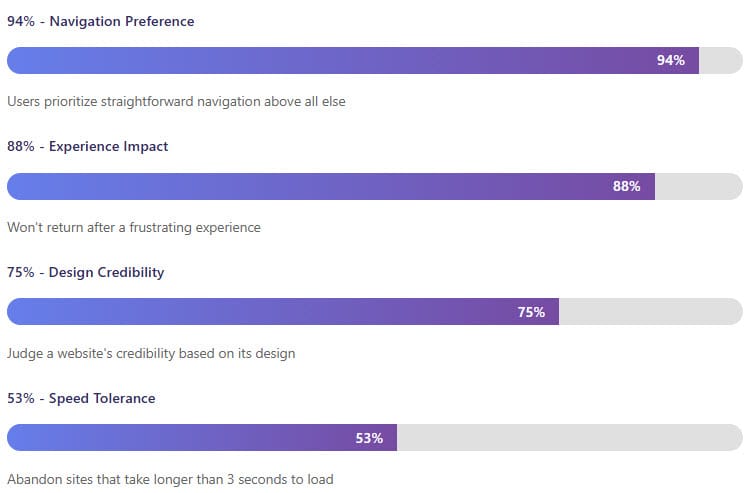
Understanding how users interact with digital products:
Technology Adoption and UX: A Symbiotic Relationship
The theory of technology adoption—specifically Everett Rogers’ Diffusion of Innovations model—reveals that even groundbreaking technology fails if users feel uncertain, anxious, or overwhelmed. Thoughtful UX eases the path from first encounter to regular use, addressing fears and reinforcing value at each step.
The Onboarding Challenge
Onboarding flows built around microlearning theory break complex tasks into bite-sized steps—a design rooted in adult learning science. Rather than overwhelming users with all features at once, progressive disclosure introduces functionality gradually as users demonstrate readiness.
Real-World Example: Slack’s onboarding uses a bot to engage users and teach messaging features consequence-free. Instead of dropping users into a fully-featured app after a few slides, Slack hides all features except the messaging input. Once users learn to message via Slackbot, they’re progressively introduced to additional features—a textbook application of both Hick’s Law and cognitive load reduction.
For businesses, UX is no longer just about aesthetics or functionality—it’s about creating emotional connections that drive loyalty and revenue. Design-driven companies don’t just survive; they thrive by turning user experience into their competitive advantage.
Modern UX: A Multidisciplinary Science
UX has evolved far beyond “making things look pretty.” Leading organizations now employ cognitive scientists, behavioral economists, data analysts, and accessibility experts on their UX teams. The goal? To predict—rather than react to—how people think, decide, and behave.
| Trend | Core Concept | Key Statistic / Impact | Further Reading |
| AI-Driven Design | AI/ML tools shift the design process toward predictive and adaptive interfaces. This allows for behavioral personalization and dynamic interface adjustments in real-time. | 42% of organizations have integrated machine learning into customer experience efforts to suggest actionable insights and optimize usability. | AI-Powered UX Design Trends (Cieden) |
| Inclusive Design | Prioritizing Accessibility and designing experiences that are usable by people of all abilities, including those with permanent, temporary, or situational disabilities. | While 55% of UX professionals prioritize this, a large majority of websites still fail WCAG (Web Content Accessibility Guidelines) standards. | Web Content Accessibility Guidelines (WCAG) 2.1 – W3C |
| Data-Driven Decisions | Making design choices based on quantitative (analytics, A/B tests) and qualitative (user research) data rather than assumptions. | 81.1% of professionals anticipate Big Data and AI as crucial for experience design, emphasizing the need to balance algorithms with user empathy. | Data-Driven Design Mastery (UX Academy) |
| Ethical UX | Focuses on user wellbeing, transparency, and control. It advocates against Dark Patterns—deceptive design tactics that misuse psychology to trick users into unwanted actions. | Modern discourse increasingly calls for design grounded in ethics, making transparency and user control non-negotiable standards, often driven by new legislation. | Ethical UX and Dark Patterns (Signal Inc) |
The 2025 Reality Check: According to the State of UX 2025 report, many companies are now optimizing flows for clicks, not clarity. The pursuit of growth is overshadowing the pursuit of meaning. While UX once had an aura of care for users, in 2024-2025 many organizations are “bluntly following the numbers,” shipping products before they’re ready, and spending more time on stakeholder alignment than actual design. The challenge? Balancing business objectives with genuine user advocacy.
The Mobile-First Imperative
Over half of global web traffic now originates from mobile devices, and nearly 60% of all web traffic comes from mobile in 2025. The implications are profound:
- Speed Matters More Than Ever: The average mobile webpage takes 8.6 seconds to load in 2024. However, 53% of mobile users abandon sites taking longer than 3 seconds. A 1-10 second increase in mobile page load time leads to a 123% higher bounce probability.
- Mobile UX Drives Loyalty: 74% of visitors are more likely to return to sites with good mobile UX, and 85% of adults believe mobile sites should be equal to or better than desktop versions.
- Thumb-Friendly Design: Mobile interfaces must account for how people actually hold phones. The “thumb zone”—the area easily reachable with one-handed use—should contain primary navigation and key actions.
- Touch Targets: Fitts’s Law states that the time to reach a target depends on its size and distance. Mobile designs need adequately sized tap targets (minimum 44×44 pixels per Apple guidelines) with sufficient spacing to prevent misclicks.
The Business Case for UX Investment
UX isn’t just a cost center—it’s a profit driver with measurable ROI. The numbers tell a compelling story:

For every dollar invested in UX, companies see a return of $100—a staggering 10,000% ROI. A comprehensive UX strategy can increase conversion rates by up to 400%, while 50% of users cite design as the key factor in determining brand credibility.
Perhaps most telling: 67% of customers say they’re willing to pay more for a great experience. UX isn’t about making things pretty—it’s about making businesses more profitable.
The Cost of Poor UX
Poor UX costs businesses $62 billion annually in lost customers. When users encounter frustrating experiences, they don’t just abandon your product—they tell others. 32% of customers stop doing business with a brand after just one bad experience.
The good news? 89% of users will switch to a competitor after a poor user experience, which means fixing your UX can capture competitors’ dissatisfied customers. In today’s market, UX excellence isn’t optional—it’s survival.
The Future of UX: Trends Shaping 2025 and Beyond
According to the 2024 UXness Survey of over 1,800 professionals, several key trends are defining the field’s evolution:
| Trend | Core Concept | Key Statistic / Challenge | Further Reading |
| AI Integration | Leveraging AI and Machine Learning for predictive design, automated personalization, and building intelligent, dynamic design systems. | Identified as the most important trend by 71% of UX professionals. The challenge is balancing automation with authentic human connection. | AI in UX Design (UX Collective) |
| Accessibility First | Prioritizing Inclusive Design to ensure products are usable by people of all abilities, adhering to standards like WCAG. | 55% prioritize it, but 68% of websites still fail basic accessibility standards, indicating a large implementation gap. | Web Accessibility (W3C) |
| Sustainable Design | Designing digital products and services to minimize environmental impact (e.g., through efficient code, reduced data transfer, and server use). | 38% of professionals focus on it, viewing digital sustainability as an emerging competitive and ethical advantage. | Sustainable UX Design (The Green Web Foundation) |
| Emotional Intelligence | Applying Emotional Design principles to create interfaces that sense, understand, and respond empathetically to a user’s current emotional state. | 33% prioritize it, focusing on empathetic elements like helpful microinteractions and supportive error messaging. | Emotional Design (Nielsen Norman Group) |
The Voice Interface Revolution
By 2025, 50% of all searches are predicted to be voice searches. This shift demands a fundamental rethinking of UX principles:
- Conversational Design: Interfaces must understand natural language, context, and intent
- Zero-UI Experiences: Design without traditional visual interfaces requires new mental models
- Accessibility Expansion: Voice interfaces can dramatically improve accessibility for users with motor or visual impairments
- Privacy Concerns: Always-listening devices raise new ethical considerations for UX designers
The Ethical Imperative: Dark Patterns and User Trust
With great psychological knowledge comes great responsibility. The same principles that create delightful experiences can be weaponized to manipulate users—a practice known as dark patterns.
Common Dark Patterns to Avoid:
- Disguised Ads: Advertisements designed to look like content or navigation
- Forced Continuity: Making cancellation difficult after free trials end
- Confirmshaming: Guilt-tripping users who decline offers (“No thanks, I don’t want to save money”)
- Hidden Costs: Revealing fees only at checkout
- Bait and Switch: Users think they’re doing one thing but something else happens
The State of UX 2025 report warns that many organizations are prioritizing metrics over meaning, using psychological tactics to maximize engagement at the expense of user wellbeing. The industry is at a crossroads: will UX become a tool for authentic value creation or sophisticated manipulation?
The answer shapes not just products, but trust in digital technology itself. Organizations building long-term brand value recognize that ethical UX—design that respects user autonomy, protects privacy, and prioritizes wellbeing—is the only sustainable path forward.
UX design is no longer about wireframes and workflows. It sits at the crossroads of psychology, technology adoption, and human-centered problem-solving. The teams who invest in UX as a theoretical discipline—grounded in cognitive and emotional science—build products that aren’t just usable, but unforgettable.
What We’ve Learned: The Path Forward
User Experience has evolved from a specialty focused on interface aesthetics into a multidisciplinary science rooted in psychology, behavioral economics, and human-centered design. The numbers tell a clear story: companies that invest in UX see measurable returns in revenue, customer loyalty, and competitive positioning.
But beyond the ROI calculations, we’ve learned something more profound: great UX isn’t about manipulation—it’s about understanding. It’s about recognizing that every interface is a conversation between humans and technology, and that conversation works best when it respects cognitive limitations, acknowledges emotional states, and prioritizes user wellbeing over short-term metrics.
The theoretical foundations matter because they transform UX from subjective taste into objective science. Cognitive Load Theory explains why users abandon cluttered interfaces. Hick’s Law reveals why endless options paralyze decisions. Gestalt Principles show how visual organization creates intuitive understanding. These aren’t just academic concepts—they’re practical tools that separate products people tolerate from products people love.
As we move deeper into 2025, the challenges facing UX practitioners are evolving. AI integration promises unprecedented personalization but risks algorithmic manipulation. Accessibility awareness is growing, yet 68% of websites still fail basic standards. The pressure to optimize for business metrics intensifies, even as users demand authentic, ethical experiences.
The path forward requires balance: leveraging data without losing empathy, embracing AI without sacrificing human connection, optimizing conversion without compromising trust. The organizations that succeed will be those that understand UX not as a department or a phase, but as a fundamental way of thinking about how humans and technology interact.
As technology continues its rapid evolution—from mobile-first to voice interfaces, from static screens to immersive experiences—the theoretical foundations of UX become even more critical. They provide the constant principles that guide us through changing platforms and emerging paradigms.
In the end, great UX isn’t about following trends—it’s about understanding people. And that understanding, built on solid psychological foundations and ethical principles, is what creates digital experiences that don’t just work, but endure.
References & Further Reading
- Nielsen Norman Group – Evidence-Based User Experience Research
- Laws of UX – Collection of Design Principles Based on Psychology
- State of UX 2025 – Comprehensive Industry Report
- UXness Survey 2024 – Professional Trends & Statistics
- DesignRush – UI/UX Statistics & Trends
- UserGuiding – UX Statistics Compilation 2025
- UXPin – Cognitive Psychology for UX Design
- Looppanel – Laws of UX Explained
- Dovetail – Hick’s Law in Practice
- MindInventory – UI/UX Design Market Statistics
- ProCreator – UX ROI & Business Impact Statistics
- Influencer Marketing Hub – UX Statistics & Future Predictions
- BCS – Psychology in Computing Research
- Maze – UX Research & Testing Statistics
- TechJury – Comprehensive User Experience Statistics