The quantum revolution isn’t coming—it’s already here. In 2025, we’re witnessing quantum computers transition from theoretical marvels to practical tools that are reshaping entire industries. This isn’t just about faster calculations; it’s about solving problems that were previously impossible.
Understanding Quantum Supremacy: The Breakthrough Moment
Quantum supremacy—the point where quantum computers solve problems that classical computers practically cannot—has moved from aspiration to reality. In December 2024, Google unveiled its Willow quantum chip, a 105-qubit superconducting processor that completed a computation in under five minutes that would take today’s fastest supercomputers an estimated 10 septillion years—that’s 10,000,000,000,000,000,000,000,000 years, far exceeding the age of the universe.

But Willow’s achievement goes beyond raw speed. The chip demonstrated a breakthrough in quantum error correction—combining physical qubits into logical qubits in a way that reduces error rates as you scale up. Testing arrays from 3×3 to 5×5 to 7×7 encoded qubits, researchers cut the error rate in half with each expansion. This is the holy grail of quantum computing: proving that bigger can actually be more reliable.
What Makes Quantum Computing Different?
Traditional computers process information in binary bits (0 or 1). Quantum computers use qubits, which leverage quantum mechanical properties like superposition and entanglement. A qubit can exist as 0, 1, or both simultaneously, allowing quantum computers to process vast amounts of information in parallel. This exponential advantage makes them uniquely suited for certain complex problems.
Recent Advances: Making Quantum Practical
According to McKinsey & Co., quantum technology startups attracted approximately $2 billion in 2024, setting the stage for explosive growth. The United Nations has designated 2025 as the International Year of Quantum Science and Technology, recognizing the field’s transformative potential.
Key 2024-2025 Milestones
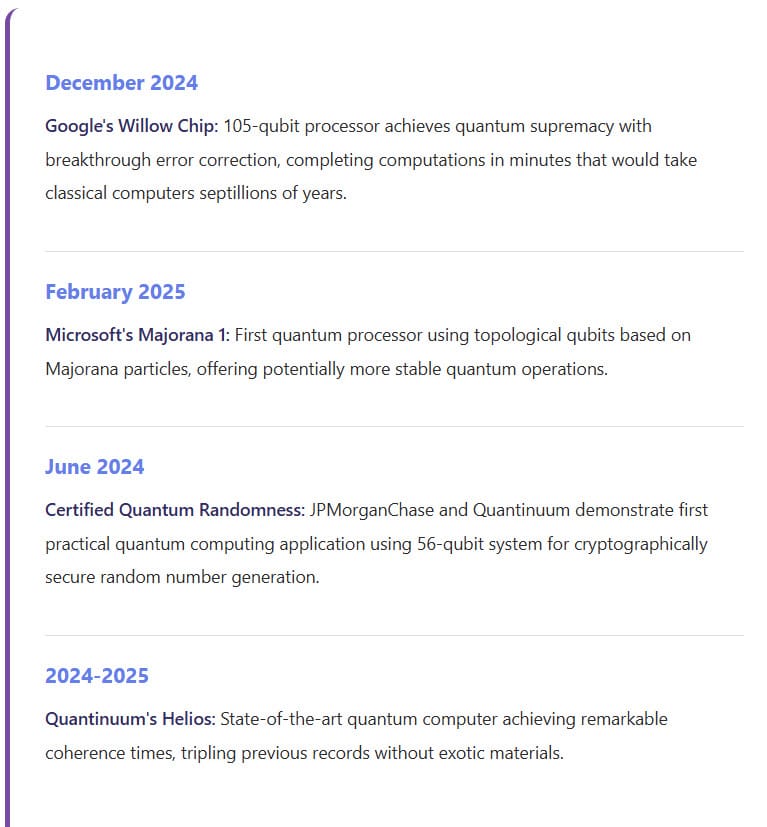
The field is experiencing rapid progress in quantum error correction, with researchers from Google, IBM, QuEra, and CSIRO making significant strides. Quantum chips with over 100 qubits are already available and being used by researchers worldwide to evaluate and improve current generation quantum computers.
Market Growth: Industry projections indicate the quantum computing market will grow from $3.52 billion in 2025 to $20.20 billion by 2030, representing a compound annual growth rate of 41.8%.
Impact #1: The Encryption Revolution (And Crisis)
The Double-Edged Sword of Quantum Power
Quantum computing presents perhaps the greatest cybersecurity challenge—and opportunity—of our generation. The same power that enables breakthrough discoveries also threatens to dismantle the encryption protecting our digital lives.
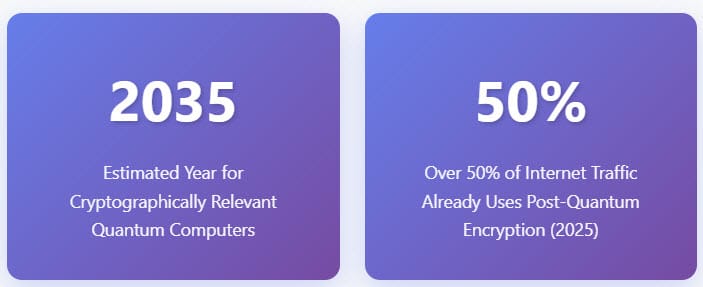
IBM’s quantum computing roadmap predicts processors scaling from today’s 433-qubit Osprey chip to systems exceeding 1,000 qubits within the next few years and potentially several thousand qubits by 2035. At that scale, quantum computers have a better than 50% likelihood of breaking widely used cryptographic algorithms such as RSA-2048.
The Harvest Now, Decrypt Later Threat
Attackers are already collecting encrypted data with the intent of decrypting it in the future, once quantum computers become powerful enough. This “store now, decrypt later” approach means that data considered secure today could be compromised tomorrow—a particular concern for organizations storing sensitive information with long-term value, such as banks, healthcare systems, and governments.
Post-Quantum Cryptography: Building the Defense
The race to develop quantum-resistant encryption is well underway. In March 2025, the U.S. National Institute of Standards and Technology (NIST) selected HQC as a fifth algorithm for post-quantum encryption, serving as a backup to ML-KEM (the main algorithm standardized in 2024). HQC is based on error-correcting codes—a different mathematical approach than ML-KEM’s structured lattices—providing crucial redundancy if vulnerabilities are discovered in one method.
As of late October 2025, over half of human-initiated traffic with Cloudflare is now protected with post-quantum encryption. What once was a science project has become the new security baseline for the Internet. Organizations in the EU must transition to post-quantum cryptography by 2030, with similar regulations being considered globally.
| Family | Core Principle | Leading Candidates |
| Lattice-Based Cryptography | Uses complex mathematical lattice problems believed to be intractable for even quantum computers to solve efficiently. | CRYSTALS-KYBER (Key Encapsulation) and CRYSTALS-Dilithium (Digital Signatures). |
| Code-Based Cryptography | Relies on the difficulty of decoding general linear error-correcting codes. This approach has been scrutinized for over 40 years. | HQC and Classic McEliece. |
| Hash-Based Signatures | Security is based on the properties of cryptographic hash functions (like SHA-256), which are not based on factoring or discrete logarithms, making them inherently quantum-resistant. | Used primarily for long-term data protection and secure firmware updates. |
Impact #2: Revolutionizing Medical Research and Drug Discovery
From Decades to Weeks: Accelerating Drug Development
Drug discovery has traditionally been a painstakingly slow and expensive process, often requiring 10-15 years and costing billions of dollars. In the United States, roughly 88% of drugs that reach clinical trials fail to make it through and gain approval. Quantum computing is changing this paradigm by enabling researchers to simulate molecular interactions at the quantum level—something classical computers struggle with.
Quantum computing, by optimizing processes such as ligand-protein binding and protein hydration, enables the design of more targeted and potentially more effective drugs. This could enhance clinical success rates and provide patients with treatments that are better tailored to their specific biological profiles.
— World Economic Forum, January 2025
McKinsey estimates quantum computing could create $200 billion to $500 billion in value for the life sciences industry by 2035. This value comes from QC’s unique ability to perform first-principles calculations based on fundamental laws of quantum physics, enabling truly predictive research without relying on existing experimental data.
Real-World Applications
- Protein-Ligand Interactions: Pasqal and Qubit Pharmaceuticals successfully implemented quantum algorithms to analyze protein hydration and ligand-protein binding—the first time quantum algorithms have been used for molecular biology tasks of this importance.
- Electronic Structure Simulations: Boehringer Ingelheim is collaborating with PsiQuantum to calculate electronic structures of metalloenzymes, which are critical for drug metabolism, achieving detail far beyond classical methods.
- Cancer Detection: Researchers have developed a liquid biopsy technique using quantum machine learning that distinguishes between exosomes from cancer patients and healthy individuals by analyzing their electrical “fingerprints,” offering faster, less invasive detection.
- Drug Candidate Prediction: Merck KGaA and Amgen are partnering with QuEra to leverage quantum computing for predicting biological activity of drug candidates based on molecular descriptors.
A 2024 study in Scientific Reports developed a hybrid quantum computing pipeline addressing real drug design challenges, including determining Gibbs free energy profiles for prodrug activation and simulating covalent bond interactions—marking a shift from proof-of-concept to practical applications.
| Application | Core Concept | Benefit / Impact |
| Molecular Simulation | Quantum computers can accurately simulate molecular interactions at the electron level (first-principles calculations). | Enables the prediction of drug effectiveness and potential side effects, accelerating drug discovery and materials science research. |
| Toxicity Prediction | Uses first-principles calculations and quantum-enhanced algorithms to model and predict the toxicity, stability, and reactivity of compounds. | Significantly reduces the need for lengthy, expensive, and resource-intensive traditional wet-lab experiments. |
| Personalized Medicine | Quantum-enhanced data analysis and machine learning algorithms are applied to individual genetic and molecular profiles. | Allows for the development of highly tailored treatments and drug dosages, leading to improved clinical success rates for individuals. |
Impact #3: Climate Forecasting and Weather Prediction
Predicting Climate Chaos with Quantum Precision
Weather and climate systems are among the most complex phenomena we attempt to model, involving countless variables interacting in chaotic, nonlinear ways. Traditional supercomputers struggle with the computational demands, but quantum computers excel at handling such complexity.
In June 2024, researchers from Chiba University introduced a novel quantum annealing approach to accelerate data assimilation—the main computational bottleneck for numerical weather predictions. They successfully solved data assimilation on quantum annealers for the first time, focusing on the four-dimensional variational data assimilation (4DVAR) method widely used in weather forecasting.

Real-World Breakthroughs
In late 2024, D-Wave’s quantum cloud service completed a 10-day European weather simulation in under 30 seconds—a task that would occupy the fastest supercomputers for hours. This jaw-dropping speed enables forecasters to update predictions in near real-time as storms develop. The World Meteorological Organization praised these advances in 2025, noting that “quantum acceleration promises a new era of instant, hyper-local weather updates.”
A 2024 study from Florence Quantum Labs explored hybrid quantum algorithms—specifically the Quantum Approximate Optimization Algorithm (QAOA) and Quantum-enhanced Markov Chain Monte Carlo (QMCMC)—to improve weather forecasting efficiency and accuracy. These algorithms can potentially reduce computational cost and time for complex predictions, though practical application remains limited by current hardware capabilities.
Climate Modeling Applications
- El Niño Simulation: A 2024 University of Tokyo study used quantum computing to simulate El Niño’s impact on global rainfall, revealing new insights into drought and flood risks quickly adopted by the UN for annual climate risk assessments.
- Extreme Event Prediction: In 2023, quantum gravimeters in Switzerland detected subtle underground water shifts, predicting flash floods hours before river levels rose. Quantum sensors are becoming “game changers” for global weather monitoring.
- Long-Range Forecasting: The IPCC highlighted in its 2025 report that quantum forecasts have improved long-term temperature and precipitation predictions by up to 40%, helping governments plan infrastructure and disaster response.
- Democratized Access: Microsoft Azure launched a public beta of its quantum weather API in 2024, letting developers integrate hyper-accurate forecasts into local apps. Small businesses in Kenya used these predictions to adjust irrigation schedules, boosting crop yields by 18% during the 2025 rainy season.
Challenges Remain
Quantum weather forecasting faces obstacles. Quantum computers require highly controlled environments (often near absolute zero temperatures), and error rates can still muddle results for long-range forecasts. As researchers note in the Bulletin of the American Meteorological Society, using quantum computers for full-scale, global forecasting remains constrained by noise, limited qubit counts, and the need for sophisticated hybrid algorithms. Yet even with these limitations, the trajectory is clear: quantum technologies are beginning to augment—not replace—classical systems in ways that dramatically expand forecasting capabilities.
The Road Ahead: A Quantum Future Taking Shape
Quantum computing is no longer a distant vision—it is rapidly becoming a foundational pillar of 21st-century innovation. But like every transformative technology before it, the benefits come intertwined with profound challenges.
In cybersecurity, we’re racing to secure the digital world before quantum processors can break it apart.
In medicine, a new era of precision drug design and patient-specific treatments is emerging.
In climate science, quantum acceleration is offering humanity a sharper lens on the planet’s most chaotic behaviors.
Across these domains, a central theme emerges: quantum computing is not replacing classical computation—it is expanding the boundaries of what’s computationally possible. Hybrid quantum-classical workflows, error-corrected qubit arrays, and scalable architectures are laying the groundwork for the first generation of practical, industry-defining quantum applications.
Yet the quantum revolution is not just a technological shift—it’s an economic, scientific, and geopolitical one. Nations are pouring billions into quantum infrastructure. Businesses are rethinking cybersecurity strategies. Universities are rewriting curricula to train a workforce capable of understanding, maintaining, and innovating in a quantum-powered world.
The next decade will determine how effectively we harness this power. Will quantum computing accelerate breakthroughs in clean energy, disease eradication, and climate resilience? Or will it deepen global inequalities between nations that have quantum capabilities and those that do not?
What’s certain is that the quantum era has already begun. The organizations, governments, and researchers who embrace it today will shape the discoveries—and the security landscape—of tomorrow.
Quantum computing is not just rewriting the rules of computation.
It’s redefining the possible.