
As AI and data science continue to evolve, developers are increasingly seeking ways to combine the strengths of multiple programming languages. Java offers robustness, scalability, and enterprise-level performance, while Python shines with simplicity, rapid prototyping, and a vast ecosystem of data science and machine learning libraries.
What if you could use both — seamlessly?
Welcome to the world of polyglot applications, where languages coexist and complement each other.
Why Mix Java and Python?
Before diving into how, let’s explore why integrating Java and Python makes sense:
| Aspect | Java Strength | Python Strength |
|---|---|---|
| Performance | High performance and JVM optimizations | Slower but flexible |
| Ecosystem | Enterprise-grade frameworks (Spring, Jakarta EE) | Data science libraries (NumPy, Pandas, TensorFlow) |
| Concurrency | Strong multi-threading | Easier async programming |
| Integration | Great with large systems | Great with prototypes & analytics |
| Use Case Fit | Back-end, data pipelines | Machine learning, data processing |
Best of both worlds: You can use Java for heavy lifting and Python for AI models and data analysis — all within the same application.
Common Use Cases for Java + Python Integration
- Enterprise AI systems: Use Java for the main application and Python for ML inference.
- Data-driven dashboards: Handle user interfaces and APIs in Java, run analytics in Python.
- IoT and Edge Computing: Use Java’s concurrency with Python’s scientific libraries for sensor data analysis.
- Financial modeling: Java handles transactions, while Python calculates risk and projections.
Techniques for Integrating Java and Python
Let’s explore multiple ways to mix the two languages effectively.
1. Using Jython — Python on the JVM
Jython is an implementation of Python that runs on the Java Virtual Machine.
It allows Python code to import and use Java classes directly, just like any Python module.
Example: Calling Java from Python (Jython)
# __define-ocg__ Example using Jython integration
from java.util import ArrayList

varOcg = ArrayList()
varOcg.add("Hello")
varOcg.add("from Jython!")
print(varOcg)
Output:
[Hello, from Jython!]
Pros:
- Tight integration with JVM classes
- Easy deployment in Java environments
Cons:
- Supports only Python 2.7 (no longer updated)
- Not suitable for modern AI libraries like TensorFlow or PyTorch
2. Using Py4J — Bridging JVM and CPython
Py4J allows Python programs to dynamically access Java objects in a JVM. It’s often used in Apache Spark to connect Python (PySpark) and Java-based cores.
Example: Calling Java Methods from Python
Java code (App.java):
public class App {
    public int add(int a, int b) {
        return a + b;
    }
}
Python code (app_client.py):
from py4j.java_gateway import JavaGateway

gateway = JavaGateway()  # connects to JVM
app = gateway.jvm.App()  # access Java class
result = app.add(10, 20)
print("Result from Java:", result)
Output:
Result from Java: 30
Pros:
- Works with Python 3+
- Excellent for Spark, Hadoop, or JVM data systems
Cons:
- Requires gateway setup
- Slight communication overhead
3. Using JPype — Native Java-Python Integration
JPype allows you to start the JVM inside Python and call Java code as if it were a Python library.
Example: Using JPype
import jpype

jpype.startJVM(classpath=['./'])
App = jpype.JClass('App')
app = App()
print("Sum:", app.add(5, 7))
jpype.shutdownJVM()
Pros:
- Lightweight, minimal overhead
- True in-process communication
Cons:
- Harder to debug in complex systems
4. Using REST APIs — The Most Scalable Option
If you want a loose coupling between Python and Java components, REST APIs are the way to go.
Architecture Diagram
+------------------+           +---------------------+
|   Java Service   |     |   Python Service    |
|  (Spring Boot)   |  HTTP     | (Flask / FastAPI)   |
+------------------+           +---------------------+
Example Flow:
- Java exposes an endpoint:
/predict - Python Flask app receives a POST request with input data.
- Python runs an ML model and returns predictions.
- Java consumes and displays the result.
Pros:
- Works across machines and platforms
- Easy to maintain and scale
Cons:
- Slight latency due to network calls
Example: End-to-End Polyglot Architecture
Imagine you’re building a fraud detection system:
| Component | Language | Technology | Responsibility |
|---|---|---|---|
| Web Frontend | Java | Spring Boot | User interface and APIs |
| ML Engine | Python | Scikit-learn / TensorFlow | Fraud prediction |
| Data Storage | Java | Hibernate + MySQL | Persist transaction data |
| Analytics | Python | Pandas + Matplotlib | Visual reports |
This approach allows teams to use the right tool for the right job — with minimal compromise.
Performance Considerations
When combining Java and Python, performance depends on how tightly the two languages interact and how data is transferred between them. Below is a comparative overview of the most common integration methods, their performance characteristics, and best-use scenarios.
Performance Comparison Table
| Integration Method | Relative Performance | Ease of Setup | Communication Type | Ideal Use Case |
|---|---|---|---|---|
| Jython | Medium | Moderate | In-process (JVM) | When running Python scripts directly on the JVM |
| Py4J | Medium-High | Easy | Socket-based bridge | Data platforms like Spark where JVM and Python coexist |
| JPype | High | Moderate | In-process (JNI) | Local applications requiring low latency |
| REST API / gRPC | Moderate | Very Easy | Network-based | Distributed or microservice architectures |
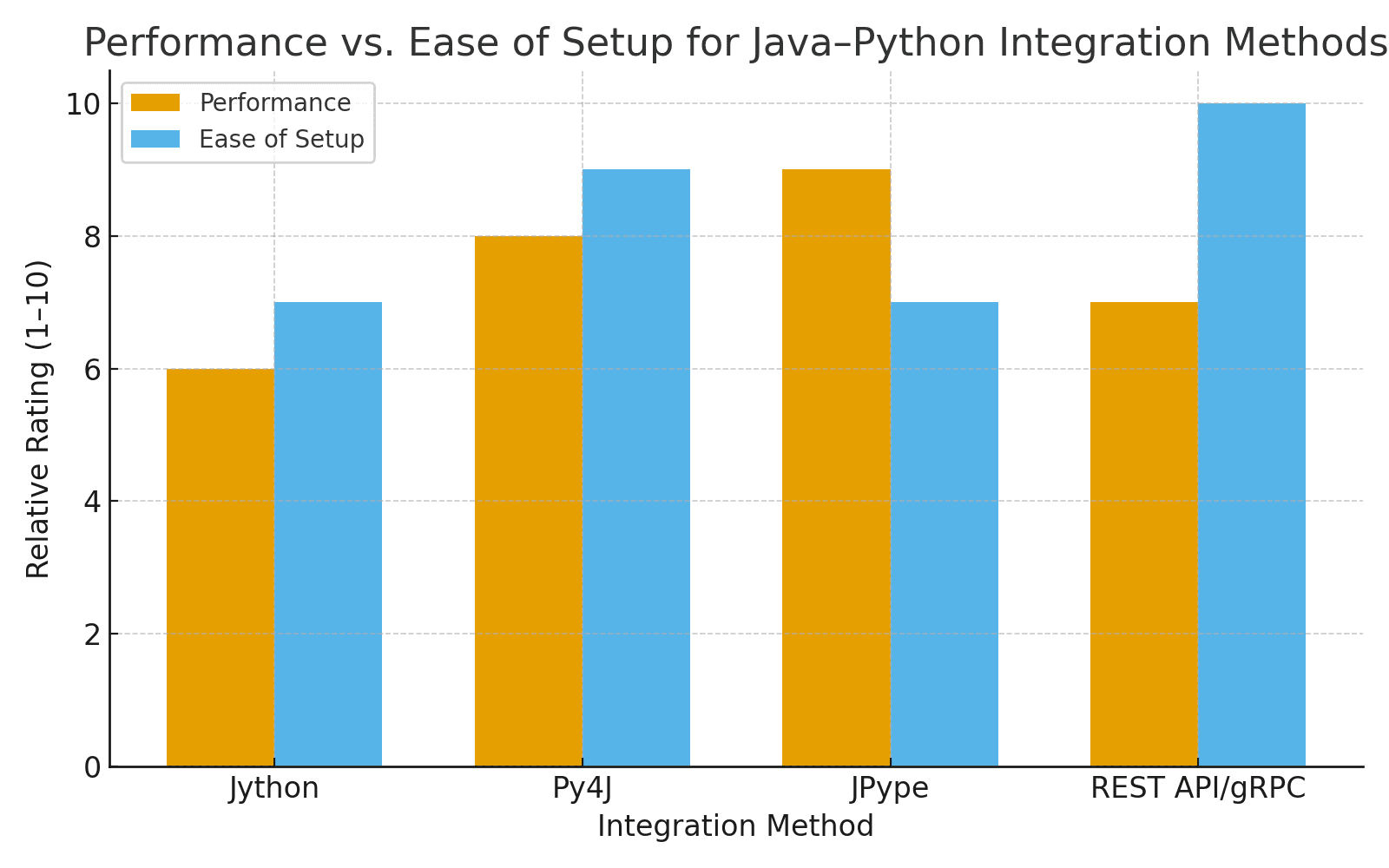
This chart visually compares performance and ease of setup across the main Java–Python integration methods — Jython, Py4J, JPype, and REST API/gRPC.
Performance vs. Integration Trade-offs
| Factor | Tight Integration (JPype/Jython) | Loose Integration (REST/gRPC) |
|---|---|---|
| Latency | Very low | Higher (network overhead) |
| Scalability | Limited to one runtime | Highly scalable |
| Data Transfer | Direct memory access | Serialization/deserialization required |
| Deployment Complexity | Moderate | Easier with containers |
| Language Independence | Lower (same environment) | Higher (can run separately) |
So
- JPype offers the best raw performance since it runs Java within the same process as Python using JNI (Java Native Interface).
- Py4J provides near-native performance with minimal integration effort and is ideal for data-intensive systems such as Apache Spark.
- Jython works well when the goal is seamless JVM compatibility, though it’s limited by Python version support.
- REST APIs or gRPC provide flexibility and scalability, suitable for distributed systems and microservices, albeit with a small latency cost due to network communication.
Challenges of Polyglot Development
- Debugging complexity: Tracing issues across two runtimes can be tough.
- Data serialization: Moving large datasets between Java and Python may need efficient formats like Avro or Protobuf.
- Dependency management: Managing both
pipandmavendependencies in CI/CD. - Team skill gap: Developers may need to be proficient in both languages or work closely across teams.
Best Practices
- Use REST APIs or gRPC for clean, maintainable boundaries.
- Prefer JPype for in-process performance.
- Use Docker for consistent environments across both ecosystems.
- Define data contracts (schemas) clearly between Java and Python components.
Useful Links
- Py4J Official Documentation
Learn more about how Py4J enables Python programs to access Java objects dynamically. https://www.py4j.org/ - JPype GitHub Repository
Explore the JPype project, which allows Python code to run Java classes natively using JNI.
https://github.com/jpype-project/jpype - Jython Project
Official website of Jython — the Python implementation on the Java Virtual Machine (JVM).
https://www.jython.org/ - FastAPI
Modern, high-performance web framework for building APIs with Python.
https://fastapi.tiangolo.com/ - Spring Boot
Comprehensive framework for building production-ready Java applications and microservices.
https://spring.io/projects/spring-boot - Apache Arrow
A cross-language, in-memory data format designed for efficient analytics and data interchange.
https://arrow.apache.org/
Conclusion
Mixing Java and Python allows developers to combine the power of enterprise systems with the flexibility of modern AI.
From Jython to REST APIs, each integration method offers trade-offs — but together, they open the door to truly polyglot, intelligent, and scalable systems.
Whether you’re adding a Python ML model to a Java backend or running Java logic inside Python analytics, this hybrid approach lets you build smarter, more adaptable applications.



This article should definitely mention GraalPy, which is runs Python in the context of Java applications at much higher performance than Jython; and including support for model Python 3.12 and native extensions: https://www.graalvm.org/python/