Something quietly historic happened in August 2025. For the first time ever, TypeScript surpassed JavaScript in total usage on GitHub — the platform that hosts more code than anywhere else on Earth. Not as a niche player, not as a trendy side project, but as the dominant language of modern web development. If you’ve spent your career in the JVM ecosystem — Java, Kotlin, Scala — this moment matters more than it might seem at first glance.
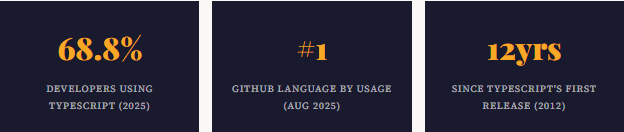
The shift didn’t happen overnight, but its implications are immediate — especially for backend engineers who want to go full-stack without abandoning the type-safe world they know and love.
TypeScript vs. JavaScript Developer Usage (2019–2025)

1. How Did We Get Here?
JavaScript was designed in ten days in 1995, and it shows. It was built for sprinkling interactivity on web pages, not for building million-line codebases serving millions of users. As web applications grew in complexity, JavaScript’s lack of static types became a genuine engineering problem — one that Microsoft set out to solve in 2012 with the release of TypeScript.
TypeScript’s proposition was elegantly pragmatic: take JavaScript exactly as it is, add an optional type layer on top, and compile everything back to plain JavaScript that browsers already understand. No new runtime, no forking the ecosystem — just a smarter development experience. You can read more about how it started in the official TypeScript blog.
“TypeScript is JavaScript with syntax for types. It’s designed for the development of large applications and compiles to plain JavaScript.” — typescriptlang.org
By 2025, that bet had fully paid off. Major frameworks like Angular made TypeScript mandatory. Vue and React now assume TypeScript as the default in new projects. Even Node.js — the server-side JavaScript runtime — has begun adding experimental native TypeScript support.
2. TypeScript’s Gradual Typing — A Friendly Introduction
Here’s what makes TypeScript genuinely different from Java’s type system, and why that difference matters: TypeScript is gradually typed. That means you choose how strict you want to be. You can annotate everything, or almost nothing — and the compiler will work with you wherever you are on that spectrum.
In Java, you declare a type and that’s the end of the conversation. In TypeScript, you have several options:
| Concept | Java | TypeScript |
|---|---|---|
| Type checking | Always at compile-time, mandatory | Compile-time, but opt-in strictness |
| Dynamic types | Not available | any type allows “escape hatch” |
| Null safety | Optional via @NonNull | Strict mode catches null/undefined |
| Generics | Yes, with type erasure | Yes, with structural typing |
| Interfaces | Explicit declaration required | Structural (“duck typing”) — implicit |
| Union types | Not natively available | Built-in: string | number |
| Type inference | Limited (Java 10+ var) | Very strong — infers most types |
2.1 What “Structural Typing” Actually Means
This is the concept that surprises Java developers most. Java uses nominal typing — two types are compatible only if one explicitly extends or implements the other. TypeScript uses structural typing — two types are compatible if they have the same shape, regardless of their names or declarations.
Think of it this way: in Java, a Dog is only a Animal if it explicitly says extends Animal. In TypeScript, if your object has a name property and a bark() method, it’s a valid Dog — no explicit declaration needed. This makes TypeScript dramatically more flexible when working with data from APIs, databases, or third-party libraries, because you don’t have to pre-plan every type relationship.
2.2 A Minimal Working Example
Prerequisites: Node.js 18+ installed. Run npm install -g typescript once, then tsc --version to verify.
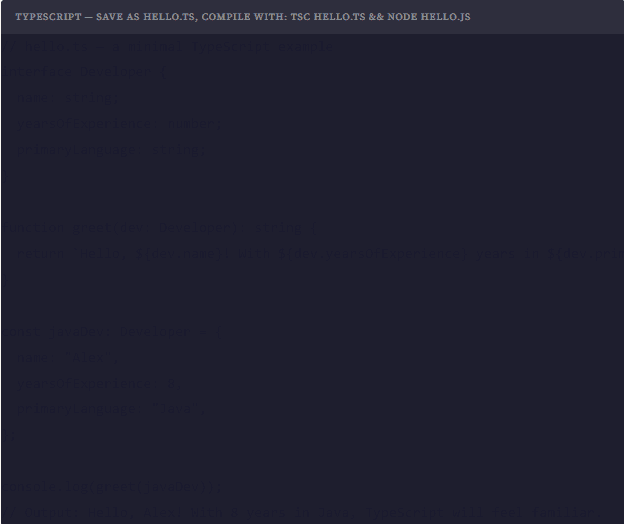
Notice the interface — it looks remarkably similar to a Java interface, but TypeScript infers its use structurally. Any object with those three fields will satisfy the contract, even without an explicit implements keyword.
Top Programming Languages on GitHub by Push Activity (2025)

3. TypeScript vs. Java: A Side-by-Side Reality Check
The good news for Java developers is that the mental models transfer surprisingly well. Both languages are statically typed, both have strong IDE support, and both reward careful upfront design. The differences are real but learnable — mostly a matter of different syntax for familiar ideas.
| Area | Java | TypeScript | Notes |
|---|---|---|---|
| Build tooling | Maven / Gradle | tsc / Vite / esbuild | Faster iteration cycles in TS |
| Package manager | Maven Central | npm / pnpm / yarn | Much larger package ecosystem |
| Runtime | JVM | Browser / Node.js / Deno / Bun | TS runs everywhere JS runs |
| OOP support | Full (classes, inheritance) | Full + functional patterns | TS classes compile to prototypes |
| Async handling | CompletableFuture / reactive | async/await (first-class) | TS async is more ergonomic |
| Null handling | Optional<T> | Strict null checks built-in | Both prevent NullPointerException-style bugs |
| Enums | Rich enum types | Enum + union types | TS union types are more flexible |
4. Why Backend Java Developers Should Care
Let’s be direct about the business case. Full-stack capability has become one of the most valuable skills in modern engineering teams. Companies running lean — which is most of them right now — need engineers who can work across the entire product, not just one slice of it. According to the 2024 Stack Overflow survey, full-stack developers are among the highest-paid and most sought-after profiles globally.
For a Java developer, TypeScript is the most natural path into that territory. You already understand interfaces, generics, type safety, and object-oriented design. TypeScript builds on all of that rather than asking you to forget it. You’re not learning a new paradigm — you’re learning new syntax for ideas you already hold.
TypeScript isn’t asking Java developers to leave their comfort zone. It’s building a bridge to the frontend world using the same guardrails Java developers already trust.
4.1 The Full-Stack Stack: What Java + TypeScript Looks Like in Practice
A common and highly productive setup in 2025 pairs a Spring Boot backend (your home turf) with a TypeScript frontend using Next.js or Angular. Both sides of the application communicate through REST APIs or GraphQL, and because TypeScript can share type definitions between client and server (especially with tools like tRPC), type safety extends across the wire. That’s something Java alone can never offer on its own.
4.2 Tooling That Feels Familiar
If you live in IntelliJ IDEA, you’re already set — JetBrains ships first-class TypeScript support with it. VS Code, developed by Microsoft (the same team behind TypeScript), offers exceptional TypeScript tooling that rivals any Java IDE experience. Refactoring, autocomplete, inline type hints — it all works as you’d expect.
5. The Learning Curve: Honest Expectations
Most Java developers who pick up TypeScript report being productive within two to four weeks. The syntax borrows heavily from modern Java — arrow functions, destructuring, template literals. The ecosystem is noisier (npm is vast and sometimes inconsistent), and JavaScript’s quirks do bleed through TypeScript in edge cases. But the learning investment is modest compared to learning, say, Rust or Haskell from scratch.
The best resource to start with is the official TypeScript Handbook, which is genuinely well-written. For Java-specific comparisons, Execute Program offers interactive TypeScript courses that assume prior programming experience and skip the basics.
6. What We Have Learned
In this article, we traced TypeScript’s remarkable rise from a Microsoft experiment in 2012 to the single most-used language on GitHub by August 2025, now with 68.8% developer adoption. We explored how TypeScript’s gradual typing system works — offering structural typing, type inference, and union types that go beyond what Java’s nominal type system provides, while still feeling deeply familiar to JVM developers.
We compared the two languages side by side across build tooling, runtime behavior, null safety, and async handling. Most importantly, we made the case for why Java backend engineers benefit from closing the TypeScript gap: full-stack capability, richer type safety across the entire application (frontend to backend), and access to a fast-moving ecosystem built on concepts they already understand. TypeScript is not a departure from Java’s philosophy of correctness — it is that philosophy, applied to the web.