WASI 0.3.0 brings native async, sub-second cold starts, and the promise of truly portable compute—from edge to embedded
When WebAssembly launched in 2017, the promise was simple: run compiled code in browsers at near-native speed. Mission accomplished. But that was just the beginning. Today, WebAssembly is quietly becoming the runtime that powers edge computing, replaces containers in serverless deployments, and enables truly portable applications across radically different hardware.
The catalyst? WASI 0.3.0, expected to finalize this month (February 2026), bringing native asynchronous I/O support to the WebAssembly Component Model. This isn’t another incremental update—it’s the piece that makes WebAssembly viable for the workloads currently dominated by Docker containers. And it’s already running at scale: Cloudflare Workers processes over 10 million WebAssembly-powered requests per second across 300+ global edge locations.
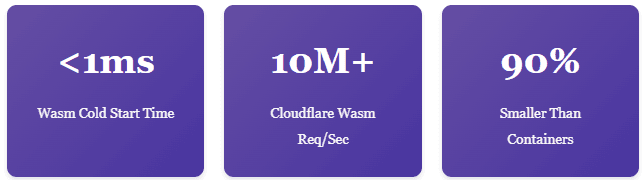
The industry is reaching a consensus: containers solved deployment portability, but they’re massively over-engineered for many workloads. WebAssembly offers something better—true compile-once, run-anywhere portability with security guarantees that containers can’t match. As The New Stack puts it: “You won’t know when WebAssembly is everywhere in 2026.”
WASI 0.3.0: The Final Piece Falls Into Place
The WebAssembly System Interface (WASI) standardizes how WebAssembly modules interact with the outside world—file systems, networks, clocks, random number generators. Without WASI, WebAssembly is a powerful calculator trapped in a sandbox. With WASI, it becomes a legitimate application runtime.
Previous WASI versions (0.1 “snapshot preview” and 0.2) provided basic synchronous I/O. That’s fine for simple scripts, but completely inadequate for modern applications. Want to handle HTTP requests? Every network operation blocks the entire execution thread. Need to process multiple concurrent streams? You’re out of luck.
Native Async Changes Everything
According to the Uno Platform’s State of WebAssembly report, WASI 0.3.0—currently in preview with release candidates expected this month—introduces native asynchronous support at the Component Model level, including:

As Enrico Piovesan explains, this solves the notorious “function coloring problem.” Instead of async infecting your entire codebase, concurrency becomes a runtime property. Components can be implemented synchronously or asynchronously without affecting their interface contracts.
The Component Model: LEGO Blocks for Polyglot Apps
The Component Model, standardized alongside WASI 0.3.0, enables something Docker never achieved: true polyglot composition without network overhead. Define interfaces in WIT (WebAssembly Interface Types), compile components in any supported language, and link them together like LEGO blocks.
// WIT interface definition
interface http-handler {
  handle-request: func(req: request) -> response
}

// Implemented in Rust
component rust-auth implements http-handler

// Implemented in Go
component go-business-logic implements http-handler

// Composed together - zero network overhead
component my-app {
  imports: [rust-auth, go-business-logic]
}
This isn’t theoretical. Adobe achieved cold starts under 1ms using wasmCloud for their Kubernetes deployments, replacing containerized microservices with WebAssembly components that communicate through interfaces, not HTTP calls.
Docker’s Bloat vs. Wasm’s Precision
Containers revolutionized deployment by packaging applications with their dependencies. But they carry enormous baggage: entire Linux distributions, system libraries, package managers, init systems. A “minimal” Alpine-based container still exceeds 5MB. Add a JVM and you’re looking at 200MB+. Starting up means booting a mini operating system.
The Cold Start Problem
According to Cloudflare’s benchmarking, Python Workers using WebAssembly start 2.4x faster than AWS Lambda (without SnapStart) and 3x faster than Google Cloud Run. The secret? Memory snapshots enabled by WebAssembly’s security model.an Google Cloud Run. The secret? Memory snapshots enabled by WebAssembly’s security model.

WebAssembly achieves this because it doesn’t need Address Space Layout Randomization (ASLR)—a security feature that makes memory snapshots complex in traditional OSes. WebAssembly’s Harvard architecture (code and data in separate address spaces) provides security guarantees that make ASLR unnecessary.

Binary size differences are equally dramatic. A typical Node.js application containerized with Alpine Linux:
- Alpine base image: 5MB
- Node.js runtime: 50MB
- Application + dependencies: 100MB+
- Total: 155MB+
The same application compiled to WebAssembly:
- Wasm binary (optimized with wasm-opt): 2-5MB
- No operating system required
- Total: 2-5MB (95% smaller)
For edge deployments distributing to thousands of locations globally, this size difference is transformative. Cloudflare deploys code to 300+ datacenters in under 30 seconds—try that with 155MB containers.
| Metric | Docker Container | WebAssembly | Improvement |
|---|---|---|---|
| Cold Start Time | 2-5 seconds | 50-500ms | 5-10x faster |
| Binary Size | 100-500MB | 2-10MB | 50-90% smaller |
| Memory Overhead | 100MB+ (OS + runtime) | 1-10MB (module only) | 90%+ reduction |
| Security Model | Kernel namespace isolation | Memory-safe sandboxing | Stronger guarantees |
| Portability | Linux containers only | Any WASI-compliant runtime | True cross-platform |
| Best Use Case | Long-running services | Edge, serverless, embedded | — |
Java Meets WebAssembly: GraalVM’s Bridge
For decades, Java’s promise was “Write Once, Run Anywhere”—compile to JVM bytecode and run on any platform with a Java runtime. WebAssembly offers something similar but more fundamental: compile to Wasm and run on any platform with a WebAssembly runtime (browsers, edge servers, embedded devices, you name it).
The challenge? Java wasn’t designed for WebAssembly. The JVM requires garbage collection, dynamic dispatch, and just-in-time compilation—features WebAssembly didn’t support until recently. Enter GraalVM.
Two-Way Bridge: Wasm in Java and Java as Wasm
GraalVM provides two distinct capabilities:
1. GraalWasm Runtime: Execute WebAssembly modules inside Java applications. Want to run Rust-optimized image processing in your Spring Boot application? Compile Rust to Wasm, load it through GraalVM’s Polyglot API, and call it like any Java method.
import org.graalvm.polyglot.*;

// Load and run WebAssembly in Java
try (Context context = Context.create()) {
    URL wasmFile = Main.class.getResource("image-processing.wasm");
    Value module = context.eval(Source.newBuilder("wasm", wasmFile).build());
    Value instance = module.newInstance();

    // Call Rust-compiled function from Java
    Value processImage = instance.getMember("exports")
                                  .getMember("process_image");
    byte[] result = processImage.execute(imageData).as(byte[].class);
}
2. Java to WebAssembly Compilation: Using GraalVM Native Image with WebAssembly backend (introduced in GraalVM for Java 25), compile Java applications directly to Wasm modules. This became possible with WebAssembly GC (garbage collection) standardization.
// Standard Java code
public class HelloWorld {
    public static void main(String[] args) {
        String name = (args.length > 0) ? args[0] : "World";
        System.out.println("Hello, " + name + "!");
    }
}

// Compile to WebAssembly with GraalVM Native Image
// Output: ~1MB Wasm binary (300KB with wasm-opt compression)
According to demonstrations at Wasm I/O 2025, GraalVM engineers Patrick Ziegler and Fabio Niephaus successfully compiled the entire Java compiler (javac) to WebAssembly. The result? A fully functional Java compiler running in browsers or edge runtimes—no JVM required.
Why This Matters for Polyglot Architectures
Consider a modern application architecture:
- Authentication service: Java (existing codebase)
- Image processing: Rust (performance-critical)
- Business logic: Go (team preference)
- ML inference: Python (ML frameworks)
Traditional approach: Run each as a separate microservice with network communication overhead, deployment complexity, and operational burden.
WebAssembly Component Model approach: Compile each to Wasm components, compose them using WIT interfaces, deploy as a single binary. Zero network latency between components, unified deployment, polyglot without the pain.
Real-World Example: Adobe reduced infrastructure costs by 30% and improved deployment speed by 80% after migrating from container-based microservices to WebAssembly components using wasmCloud with WASI 0.2. They achieved sub-millisecond cold starts and simplified their Kubernetes estate dramatically.

Where WebAssembly Wins (and Where Containers Still Rule)
Let’s be clear: WebAssembly isn’t replacing Docker for every workload. Both technologies solve different problems and excel in different contexts.
WebAssembly’s Sweet Spots
Edge Computing: When you need to run code close to users across thousands of locations, WebAssembly’s small binaries and instant cold starts are unbeatable. Fermyon’s Spin framework on Akamai’s edge network delivers <0.5ms cold start times.
Serverless Functions: The combination of tiny binaries, instant startup, and strong sandboxing makes WebAssembly ideal for FaaS. Cloudflare Workers, built on WebAssembly, processes billions of requests daily with pricing based on actual CPU time, not wall-clock time.
Embedded Systems: IoT devices with limited memory can’t afford Docker’s overhead. WebAssembly modules under 5MB with deterministic memory usage fit perfectly. The wasmCloud project targets this space specifically.
Plugin Architectures: Applications that need to safely run untrusted third-party code (e.g., content management systems, game engines, data processing pipelines) benefit from WebAssembly’s sandboxing. Each plugin is isolated by default with explicit capability grants.
Where Containers Still Win
Legacy Applications: Migrating existing applications to WebAssembly requires recompilation. If you have a complex app that runs fine in containers, the migration ROI may not justify the effort.
Stateful Services: Databases, message queues, and other stateful services with long-running processes don’t benefit from instant cold starts. Containers with persistent volumes work fine here.
Complex System Dependencies: Applications requiring specific OS features, kernel modules, or system-level debugging tools are better suited to containers with full OS access.
Ecosystem Maturity: Docker has a decade of tooling, orchestration platforms (Kubernetes), registry solutions, and enterprise support. WebAssembly’s ecosystem, while growing rapidly, is still catching up.
The Hybrid Future: Most organizations will run both. Use containers for core backend services and databases. Use WebAssembly for edge computing, serverless functions, and new microservices where instant startup matters. As WASI matures and tooling improves, the balance will shift toward WebAssembly.
Getting Started: From Java to Wasm
Want to experiment with WebAssembly and Java? Here’s a practical starting point using GraalVM:
# Install GraalVM for Java 25 (includes Wasm support)
sdk install java 25-graal

# Create a simple Java application
cat > Main.java << 'EOF'
public class Main {
    public static void main(String[] args) {
        System.out.println("Hello from Java compiled to WebAssembly!");
    }
}
EOF

# Compile Java to native binary, then to WebAssembly
# (Note: Full Java-to-Wasm pipeline still evolving)
javac Main.java
native-image Main

# For embedding Wasm in Java (reverse direction):
# Add GraalVM polyglot dependencies to pom.xml
// Example: Run Rust-compiled Wasm from Java
import org.graalvm.polyglot.*;
import java.io.IOException;
import java.nio.file.*;

public class WasmRunner {
    public static void main(String[] args) throws IOException {
        byte[] binary = Files.readAllBytes(
            Paths.get("function.wasm")
        );

        try (Context context = Context.newBuilder("wasm")
                .option("wasm.Builtins", "wasi_snapshot_preview1")
                .build()) {

            Source source = Source.newBuilder("wasm",
                ByteSequence.create(binary), "function").build();

            context.eval(source);

            Value function = context.getBindings("wasm")
                .getMember("function")
                .getMember("compute");

            int result = function.execute(42).asInt();
            System.out.println("Result: " + result);
        }
    }
}
For production deployments, consider frameworks like Fermyon Spin (serverless Wasm apps) or Wasmtime (standalone Wasm runtime). Both support WASI 0.3.0 and the Component Model.
The Path Forward
WebAssembly in 2026 is where containers were in 2015—proven technology with explosive growth potential. WASI 0.3.0’s native async support removes the last major technical barrier. The Component Model provides the composition story containers never achieved. And the performance numbers speak for themselves.
As Ralph Squillace, Microsoft’s principal product manager, notes: “WebAssembly has moved far beyond the browser. It is running reliably in production across browsers, servers, CDNs, and backend services, proving its maturity and broad applicability.”
The roadmap is clear: WASI 1.0 will arrive in late 2026 or early 2027, providing the stability guarantees enterprises require. Following releases (WASI 0.3.x) will add cancellation tokens, stream optimizations, and threading support. The ecosystem is maturing rapidly with major platform support from Cloudflare, Fastly, Shopify, and Adobe.
For Java developers specifically, GraalVM’s WebAssembly support opens new deployment targets—edge computing platforms, browser environments, and embedded systems—while preserving existing Java code investments. The “Write Once, Run Anywhere” promise is finally being fulfilled, but at the bytecode level that transcends the JVM.
What We’ve Learned
- WASI 0.3.0 (arriving February 2026) enables native async I/O with first-class future and stream types, solving WebAssembly’s biggest limitation for real-world applications and enabling composable concurrency across components written in different languages.
- WebAssembly achieves 5-10x faster cold starts than containers (50-500ms vs 2-5 seconds) and 50-90% smaller binaries (2-10MB vs 100-500MB) by eliminating OS overhead and leveraging memory snapshots enabled by WebAssembly’s security model.
- Cloudflare processes 10M+ Wasm requests/second across 300+ global edge locations, demonstrating production-scale viability with Python Workers starting 2.4x faster than AWS Lambda and 3x faster than Google Cloud Run.
- GraalVM provides bidirectional Java-WebAssembly integration allowing Java applications to embed Wasm modules (GraalWasm runtime) and compile Java code to Wasm (Native Image with Wasm backend), enabled by WebAssembly GC standardization.
- The Component Model creates polyglot composition without network overhead using WIT interface definitions to link components in different languages (Rust auth + Go logic + Python ML) into single deployable units with zero serialization costs.
- WebAssembly excels for edge, serverless, embedded, and plugins where instant startup and small size matter, while containers remain superior for legacy apps, stateful services, complex dependencies, and scenarios where ecosystem maturity outweighs performance benefits.