
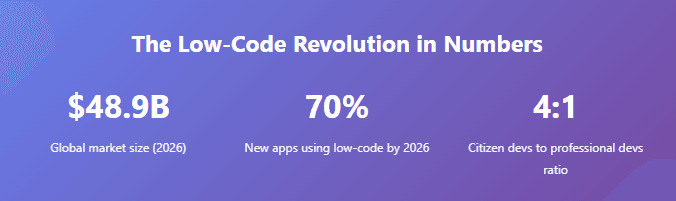
The enterprise software landscape just crossed a watershed moment. The low-code development platform market reached $48.91 billion in 2026, up from $37.39 billion in 2025. This isn’t hype—it’s a fundamental shift in how applications get built.
For Java developers who’ve spent years mastering Spring Boot, Hibernate, and microservices architecture, this raises an uncomfortable question: are we being replaced by drag-and-drop tools? The short answer is no. The nuanced answer is more interesting—and more strategic.
This article cuts through the noise to examine what’s actually happening in the market, where low-code platforms excel versus where they fail catastrophically, and how professional Java developers can leverage this trend rather than fight it.
1. The Market Reality: Numbers That Matter
Let’s start with what’s actually happening in enterprise IT departments across the globe. Gartner projects that 70% of new applications developed by organizations will use low-code or no-code technologies by 2025, up from less than 25% in 2020. That’s not a gradual increase—it’s an explosion.

The drivers are straightforward and undeniable. The United States faces a developer shortage of 1.2 million by 2026, growing from 500,000 in 2025. Meanwhile, 82% of organizations struggle to hire qualified engineers, with positions remaining unfilled for months. Traditional computer science education simply cannot produce developers fast enough to meet demand.
Into this talent gap stepped platforms like OutSystems, Mendix, and Microsoft Power Apps. By the end of 2025, 50% of all new low-code customers came from business buyers outside the IT organization. These aren’t developers trying to work faster—these are business analysts, operations managers, and domain experts building solutions themselves.
2. Citizen Developers: Threat or Opportunity?
Here’s where the anxiety kicks in for professional developers. Gartner forecasts that citizen developers will outnumber professional developers 4:1 by 2026. That sounds terrifying until you dig into what citizen developers actually build.

The data reveals a clear pattern. Nearly 60% of custom apps are now built outside IT departments, and of those, 30% are created by employees with limited or no coding skills. But what are they building? The top use cases tell the story:
- Forms and data collection apps (58%) – Simple CRUD operations that would bore most developers to tears
- Business process workflows (49%) – Approval chains, notifications, and routing logic
- Spreadsheet replacements (42%) – Turning Excel chaos into structured applications
Notice what’s missing? Complex algorithms. Real-time data processing. Sophisticated integrations. Performance-critical systems. Security-sensitive applications. These remain firmly in the domain of professional developers—and always will.
The Strategic Insight: Citizen developers aren’t replacing Java developers. They’re handling the long tail of simple internal tools that IT departments never had time to build anyway. This frees professional developers to focus on what actually moves the business forward: core systems, competitive differentiators, and technically complex solutions.
3. When Low-Code Wins (And It Does Win)
Professional developers often dismiss low-code platforms without actually testing them. This is a strategic mistake. Low-code platforms have legitimate strengths that make them the optimal choice for specific scenarios.
3.1 Speed for Standard Workflows
Organizations report up to 90% reduction in development time for appropriate use cases. A simple employee onboarding workflow that might take a Java developer two weeks to build (including frontend, backend, database schema, authentication, and deployment) can be created in a low-code platform in hours.
Is the low-code version as elegant as custom code? No. Is it maintainable by business users? Yes. Does it solve the problem? Absolutely. That’s the calculus that matters to business stakeholders.
3.2 Internal Dashboards and Admin Tools
Building a dashboard to display data from multiple sources is tedious work for professional developers. Low-code platforms like Retool, Appsmith, and Superblocks excel at this. They provide pre-built components for charts, tables, and forms that connect to databases, REST APIs, and GraphQL endpoints with minimal configuration.
A Java developer would spend days creating the same interface with React or Angular, configuring webpack, setting up API routes, handling state management, and writing boilerplate code. The low-code platform generates it in minutes.
3.3 Rapid Prototyping
When stakeholders want to see what an application might look like before committing to full development, low-code platforms enable faster feedback loops. You can build a clickable prototype in a day rather than spending a week on mockups and wireframes that stakeholders might reject anyway.
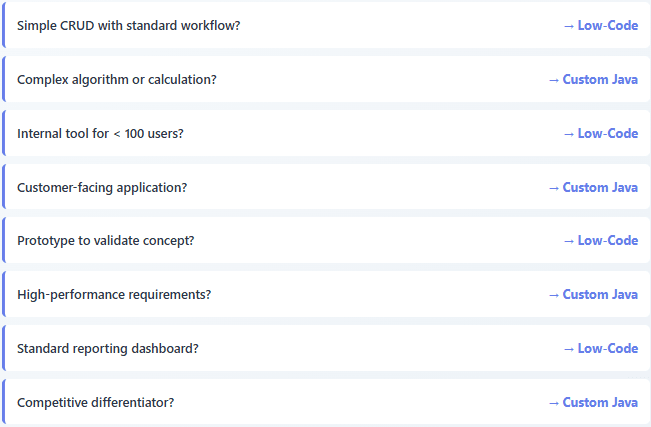
Best for Low-Code
- CRUD applications
- Internal workflow automation
- Simple approval processes
- Data entry forms
- Basic reporting dashboards
- Rapid prototypes
Avoid Low-Code For
- High-performance systems
- Complex algorithms
- Real-time processing
- Fine-grained security
- Competitive differentiators
- Customer-facing products
4. When Custom Java Development Is Non-Negotiable
The pendulum swings too far when organizations try to force-fit low-code platforms into scenarios where they fundamentally don’t belong. Here’s where Java developers provide irreplaceable value.
4.1 Performance-Critical Systems
Low-code platforms add abstraction layers that introduce latency. For systems processing millions of transactions per day, handling real-time streaming data, or serving high-traffic customer-facing applications, this overhead is unacceptable.
A well-optimized Spring Boot application with proper caching, database indexing, and asynchronous processing can handle 10-100x more throughput than a low-code equivalent. When milliseconds matter, custom code wins.
4.2 Complex Business Logic
Low-code platforms excel at linear workflows. They struggle with complex conditional logic, recursive algorithms, or sophisticated data transformations. Try implementing a dynamic pricing engine, fraud detection system, or recommendation algorithm in a low-code platform and you’ll quickly hit the platform’s ceiling.
Professional developers can write elegant, testable code that handles edge cases gracefully. Low-code platforms force you into visual workflow designers that become incomprehensible spaghetti when business rules get complex.
4.3 Security-Sensitive Applications
While enterprise low-code platforms offer SOC 2 compliance and basic security features, you’re trusting the platform vendor’s security implementation. For applications handling PII, financial data, or regulated information, custom code gives you complete control over encryption, access controls, audit logging, and compliance requirements.
Java’s mature security ecosystem (Spring Security, Apache Shiro, robust encryption libraries) combined with professional security reviews provides defense-in-depth that low-code platforms can’t match.
4.4 Unique Competitive Advantages
If an application is a competitive differentiator for your business, building it on a platform that competitors can access equally makes no strategic sense. Your proprietary algorithm, innovative user experience, or unique workflow is intellectual property worth protecting with custom code.
The Vendor Lock-In Risk: Low-code platforms create significant technical debt. Migrating an application off a low-code platform to custom code (or to a different platform) often requires a complete rewrite. Make sure the business value justifies accepting this constraint.
5. The Hybrid Strategy: How Java Developers Extend Low-Code Platforms
The most sophisticated development teams don’t treat this as an either-or decision. They use low-code platforms for what they’re good at and extend them with custom Java code where necessary. This is where professional developers create enormous value.
5.1 Custom Connectors and Integrations
Most enterprise low-code platforms provide extension SDKs. OutSystems lets you create components with Java that deploy as JAR files, encapsulated in reusable extension components. Mendix offers similar capabilities.
When a low-code platform needs to integrate with a proprietary internal system, legacy database, or complex API that requires custom authentication or data transformation, Java developers can write the integration layer once and expose it as a drag-and-drop component that business users can incorporate into their workflows.
5.2 Custom Business Rules Engines
For complex business logic that changes frequently, Java developers can build rule engines using technologies like Drools or custom implementations. The low-code platform calls these engines via REST APIs, getting the benefits of visual workflow design while delegating complex logic to code that’s properly tested and version-controlled.
5.3 Performance Optimization Layers
When a low-code application hits performance bottlenecks, Java developers can implement caching layers (Redis), message queues (Kafka), or async processing services that the low-code platform delegates to for heavy workloads. The low-code app remains simple, while custom services handle the hard parts.
Real-World Example: A Fortune 500 company used WaveMaker’s Java-based low-code platform to build their customer portal. Business analysts handled the UI and simple workflows using visual tools. Java developers wrote custom authentication integrations, built a real-time recommendation engine, and optimized database queries. The result? 3x faster development than pure custom code, with professional-grade performance where it mattered.
6. Strategic Positioning for Java Developers
So how should Java developers respond to the low-code wave? Here’s a framework based on what’s actually working in the market.
1. Learn One Low-Code Platform Deeply
Don’t dismiss these tools. Pick one enterprise platform (OutSystems, Mendix, or an open-source option like OpenXava or Jmix) and actually build something with it. You’ll gain credibility when discussing tradeoffs with business stakeholders, and you’ll discover legitimate use cases where it’s the right tool.
2. Position Yourself as the Extensibility Expert
As organizations adopt low-code platforms, they discover edge cases where visual tools fall short. This is your opportunity. Market yourself as the developer who makes low-code platforms work for complex scenarios by building custom extensions, integrations, and performance layers.
3. Focus on Architecture and Integration
The valuable skill isn’t writing CRUD operations—it’s designing systems that integrate multiple technologies elegantly. A senior Java developer who can architect a hybrid solution combining low-code apps, custom microservices, legacy systems, and third-party APIs is more valuable than ever.
4. Own the Complex and Critical
Let business users handle simple workflows. You focus on the systems that require deep technical expertise: performance optimization, security implementation, data architecture, algorithm development, and building the core platforms that low-code apps integrate with.
Decision Framework: Low-Code vs Custom Java
7. The Technology Landscape: Platform Comparison
Not all low-code platforms are created equal. Here’s what Java developers need to know about the major players and how they support extensibility.
| Platform | Java Integration | Use Case Fit | Extensibility |
|---|---|---|---|
| OutSystems | Excellent – Build custom extensions in Java, deploy as reusable components | Enterprise apps, customer portals, mobile apps | ★★★★★ |
| Mendix | Excellent – Java actions, custom widgets, REST APIs | Core business apps, workflow automation | ★★★★★ |
| Microsoft Power Apps | Good – Via Power Automate and Azure Functions | Internal tools, departmental apps, Office integration | ★★★☆☆ |
| Appian | Excellent – Java-based SDK for custom plugins | Process automation, case management, regulated industries | ★★★★☆ |
| OpenXava | Native – Built on JPA, pure Java model | Business apps for Java shops, open-source preference | ★★★★★ |
| WaveMaker | Native – Visual development for Java/Angular stack | Web apps, enterprise solutions | ★★★★☆ |
| Retool | Good – JavaScript-based with API integrations | Internal tools, admin panels, dashboards | ★★★☆☆ |
8. Real-World Case Studies: What Actually Works
Case 1: Financial Services Hybrid Approach
A major bank implemented Mendix for customer-facing loan applications. Business analysts built the application flow and UI using visual tools. Java developers created custom integrations with core banking systems, implemented fraud detection algorithms, and built performance-optimized microservices for credit scoring.
Result: 60% faster time-to-market compared to pure custom development, with no compromise on security or performance for critical operations.
Case 2: Manufacturing Dashboard Migration
A manufacturing company had 47 disparate Excel spreadsheets used for production tracking. They moved all of them to Microsoft Power Apps in six weeks using citizen developers from the operations team. IT developers built custom Power Automate flows connecting to SAP and built Azure Functions for complex calculations.
Result: Eliminated manual data entry, achieved single source of truth, freed IT team to work on strategic projects.
Case 3: When Low-Code Failed
An e-commerce company tried building their product recommendation engine in OutSystems. The visual workflow designer couldn’t handle the complex machine learning pipeline, real-time personalization requirements, or the performance needed to serve recommendations in under 100ms.
Result: Complete rewrite in Java using Spring Boot microservices. The lesson? Know when to stop forcing square pegs into round holes.
9. The AI Factor: What Changes in 2026
The integration of AI is reshaping both low-code platforms and custom development. According to recent data, 65% of businesses use AI in some business functions, and low-code platforms are increasingly incorporating AI capabilities.
Platforms like Salesforce Einstein 1 and Pega Infinity now include natural language-based app creation. You can describe what you want in plain English and the platform generates the initial workflow. This doesn’t eliminate developers—it changes what they work on.
Meanwhile, AI coding assistants like GitHub Copilot are making custom Java development faster. The productivity gap between low-code and custom code is narrowing from both directions.

9.1 The Economic Reality: ROI Comparison
Let’s talk money. Organizations report an average of $187,000 in annual savings per organization using low-code platforms, with 6-12 month payback periods. But this metric hides important nuance.
For simple applications, low-code platforms deliver clear ROI. You avoid hiring two additional developers (valued at approximately $4.4 million in business value over three years according to research). For complex applications, the calculation reverses—the platform licensing costs, vendor lock-in risks, and eventual technical debt outweigh the initial speed gains.
Professional Java developers add value by making these ROI calculations explicit. Can we build this in low-code and deliver in weeks? Or do we need custom code to avoid painting ourselves into a corner?
10. What We’ve Learned
The low-code revolution reached critical mass in 2026 with a $48.91 billion market and 70% of new enterprise applications using these technologies. But this isn’t a zero-sum game between citizen developers and professional Java developers—it’s a restructuring of who builds what.
Low-code platforms excel at simple CRUD applications, internal workflows, rapid prototypes, and dashboards. They enable business users to solve their own problems without waiting for IT, freeing professional developers to focus on complex, business-critical systems. Organizations see up to 90% faster development for appropriate use cases and average savings of $187,000 annually.
However, low-code platforms fail catastrophically for high-performance systems, complex algorithms, security-sensitive applications, and competitive differentiators. Custom Java development remains non-negotiable for customer-facing applications, real-time processing, sophisticated business logic, and systems requiring fine-grained control.
The strategic opportunity for Java developers lies in hybrid approaches: extending low-code platforms with custom integrations, building the complex services that low-code apps delegate to, and architecting systems that leverage the best of both worlds. Developers who position themselves as extensibility experts and system architects—rather than pure coders—will find themselves more valuable than ever.
The future isn’t about choosing between low-code and custom development. It’s about knowing which tool to use for which job, understanding the tradeoffs, and building systems that deliver business value efficiently. Java developers who embrace this nuance rather than fighting the tide will thrive in the low-code era.
Essential Resources
- Fortune Business Insights: Low-Code Market Analysis 2026
- Comprehensive Low-Code Statistics and Trends
- Enterprise Low-Code Use Cases and Best Practices
- OutSystems: Extending Low-Code with Java
- Mendix Low-Code Developer Guide
- InfoQ: Java-Based Low-Code Platforms Review
- Gartner Forecasts on Low-Code Market
- OpenXava: Open-Source Java Low-Code Platform






Eleftheeria,
After reading a few of you articles became a fan.
You made a very good point. The hybrid approach does seem to be the most promising to me. In my team building more or less sophisticated UI for example always been a pain point as it always looked like an endless process. And now thank to your valuable information I know there is a Jmix here to help! Well… Not just with building UI though…
Appreciate you, appreciate you valuable work.
Thank you very much indeed.
Thank you so much for your kind words — I truly appreciate it. I’m really glad the article resonated with you and that the hybrid approach sparked ideas for your team. UI development can absolutely become an endless cycle of refinement, so having tools like Jmix in the toolbox can make a real difference — especially when used thoughtfully. That said, tools are only multipliers. What ultimately determines success is the team’s architectural judgment and understanding of the problem space. If the article helped clarify that balance even a little, then it achieved its purpose. Thanks again for taking the… Read more »