Kotlin Multiplatform vs. Flutter vs. React Native: The 2026 Cross-Platform Reality

An objective comparison from a JVM-centric perspective on sharing code without sacrificing quality
The cross-platform mobile development landscape has consolidated around three serious contenders, each taking fundamentally different approaches to the “write once, run everywhere” promise. React Native brought JavaScript to mobile in 2015, becoming the established player with 35-42% market share. Flutter arrived in 2018 with Dart and custom rendering, rapidly climbing to 46% market share by 2025. And Kotlin Multiplatform, officially stable since November 2023, has exploded from 7% to 23% adoption in just eighteen months—a growth trajectory that’s forcing Java and Kotlin shops to pay attention.
For teams already invested in the JVM ecosystem, the question isn’t just about picking a framework. It’s about understanding where your existing expertise translates to mobile development, when pure native still makes sense, and what the hiring landscape looks like in 2026. The answer isn’t simple, because these aren’t interchangeable tools—they’re fundamentally different philosophies about how cross-platform development should work.
1. The Three Philosophies
1.1 Kotlin Multiplatform: Share Logic, Keep Native UI
Kotlin Multiplatform (KMP) represents JetBrains’ pragmatic approach: share your business logic, networking, data models, and platform-agnostic code across iOS, Android, web, and desktop, while keeping the UI fully native. Unlike frameworks that provide their own rendering engine, KMP compiles to native code on each platform—actual Kotlin/JVM bytecode on Android and native ARM binaries via Kotlin/Native on iOS.
For JVM developers, this is the most natural fit. You write Kotlin once for your data layer, persistence, validation, and business rules. Then each platform team builds UI using their native tools: SwiftUI on iOS, Jetpack Compose on Android. The expect/actual pattern allows platform-specific implementations when needed—accessing device cameras, handling push notifications, or integrating platform APIs.
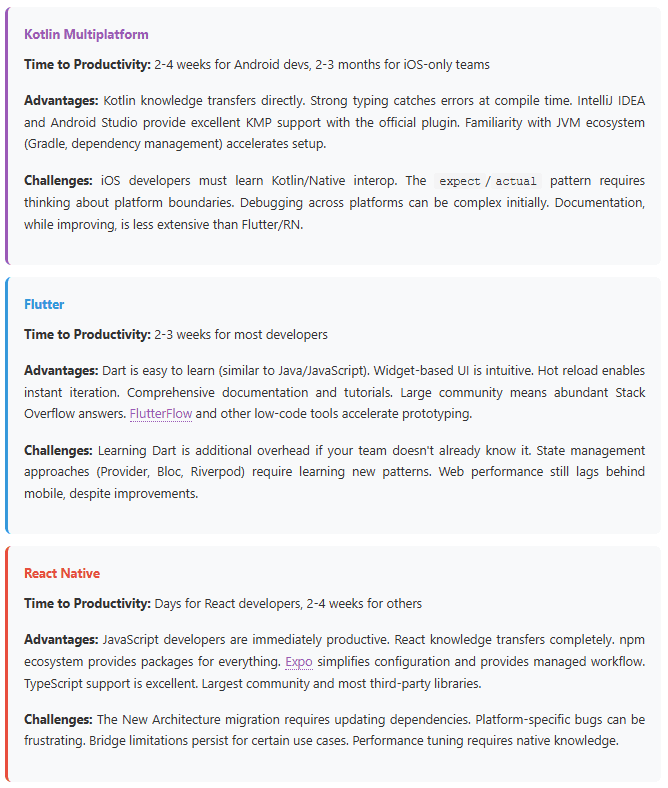
The JVM Advantage: Companies with existing Java or Android teams can leverage their current expertise. Your Android developers already know Kotlin. That knowledge directly transfers to KMP. Training iOS developers to consume shared Kotlin modules is measured in days, not months. This makes KMP the path of least resistance for shops with established JVM competency.
Major companies are proving this works at scale. Netflix shares logic for their mobile studio apps, reducing duplication. Google Workspace uses KMP in production for Gmail, Docs, and Calendar to ensure cross-platform consistency. Cash App has run KMP since 2018, handling critical financial transactions. These aren’t experiments—they’re production systems serving millions of users daily.
1.2 Flutter: Everything in Dart, Custom Rendering
Flutter takes a radically different approach: own the entire stack. Flutter doesn’t use native UI components—it renders every pixel using its own high-performance engine (formerly Skia, now Impeller). This gives Flutter complete control over appearance and behavior, ensuring pixel-perfect consistency across platforms.
The trade-off? You’re learning Dart, a language primarily used for Flutter. While Dart’s syntax is approachable for developers from Java, JavaScript, or C# backgrounds, it’s still an additional ecosystem to master. Flutter’s widget-based UI architecture requires thinking differently about composition and state management.
But the results speak for themselves: 2 million developers use Flutter worldwide, with 46% market share in 2025. Companies like BMW, Alibaba, and Nubank have achieved 30-35% faster development cycles using Flutter. The framework excels at creating beautiful, consistent UIs quickly—especially for teams without deep native expertise.
1.3 React Native: JavaScript Ecosystem, Native Components
React Native brings web development to mobile by leveraging JavaScript and React. Unlike Flutter’s custom rendering, React Native uses actual native UI components—iOS buttons on iOS, Material Design on Android. The New Architecture (stable in 2025) replaces the legacy bridge with Fabric renderer and TurboModules, bringing performance close to native levels.
For organizations with web teams already using React, React Native is the obvious choice. Your frontend developers can immediately start building mobile apps. The JavaScript ecosystem—npm packages, tooling, testing frameworks—all transfer directly. This explains why React Native still commands 35% market share despite increased competition: the barrier to entry for existing web teams is minimal.
2. Performance: Beyond the Benchmarks
Performance discussions often devolve into micro-benchmarks that don’t reflect real-world usage. Let’s examine what actually matters in production applications.

| Metric | Kotlin Multiplatform | Flutter | React Native |
|---|---|---|---|
| Startup Time (cold) | Native (300-600ms) | 400-800ms | 600-1200ms (improved with New Arch) |
| Frame Rate (complex UI) | 60 fps (native) | 60 fps (120Hz capable) | 60 fps (with Fabric) |
| Binary Size (baseline) | Native (~5MB Android, ~15MB iOS) | ~8-12MB | ~12-18MB |
| Memory Footprint | Native baseline | +15-30MB | +20-40MB (reduced with Hermes) |
| Animation Performance | Native (platform-specific) | Excellent (custom rendering) | Good (improved with Fabric) |
| Platform Integration | Direct access (zero overhead) | Platform channels (minimal overhead) | JSI/TurboModules (low overhead) |
KMP delivers native performance because it compiles to native code with zero runtime overhead. There’s no bridge, no virtual machine, no interpreter. Your shared Kotlin business logic runs at exactly the same speed as hand-written platform code. This is why performance-sensitive apps like Cash App chose KMP—financial transactions demand zero compromise.
Flutter’s performance is excellent for most use cases, hitting consistent 60 fps (and 120Hz on capable devices) through its custom Impeller rendering engine. The startup penalty is real but acceptable for most apps—hundreds of milliseconds, not seconds. Where Flutter struggles is app size; those baseline megabytes add up when considering bandwidth costs and download conversion rates.
React Native’s New Architecture (Fabric + TurboModules + JSI) has dramatically closed the performance gap. Early adopters like Shopify report 10% faster Android launch times and smoother animations. The Hermes JavaScript engine is now default, reducing memory usage by 20-30% compared to JavaScriptCore. For typical business apps, React Native performance is no longer a limiting factor.
3. Developer Experience: The Real Differentiator
Performance benchmarks matter less than developer productivity. How quickly can your team ship features, fix bugs, and onboard new engineers? This is where philosophy differences create tangible business impact.

4. Learning Curve and Ramp-Up Time
4.1 Code Sharing: Promises vs. Reality
Marketing claims often promise 95%+ code sharing. The reality is more nuanced and depends heavily on your application’s nature.
| Application Type | KMP Sharing | Flutter Sharing | RN Sharing |
|---|---|---|---|
| Business Logic Only | 90-95% | N/A (UI included) | N/A (UI included) |
| With Shared UI | 95%+ (Compose Multiplatform) | 95%+ | 85-90% |
| Platform-Heavy (Camera, AR) | 60-70% | 70-80% | 60-75% |
| Simple CRUD App | 80% (native UI) / 95% (Compose MP) | 95%+ | 90%+ |
KMP’s flexibility is both strength and complexity. You choose your sharing level: share everything except UI (typical), share UI with Compose Multiplatform (stable since May 2025), or share just specific modules (network layer, database, validation). This granularity means KMP adapts to your needs, but requires more architectural decisions.
Flutter and React Native push you toward maximum code sharing by default. This accelerates initial development but can create friction when you need platform-specific behavior or native look-and-feel. The 85-95% sharing rates are accurate for apps that embrace cross-platform conventions. Apps requiring deep platform integration see lower sharing percentages.
5. Hiring and Talent Availability
Technical excellence means nothing if you can’t find developers. The 2026 hiring landscape reveals interesting dynamics.
| Framework | Global Developers | Avg Senior Salary (US) | Hiring Difficulty | Transferable Skills |
|---|---|---|---|---|
| Kotlin Multiplatform | ~2.5 million (Kotlin total) | $135K | Medium-High | Android, Java, JVM ecosystem |
| Flutter | ~2 million | $125K | Medium | Mobile UI, Dart (limited) |
| React Native | ~8-10 million (React total) | $145K | Low-Medium | Web dev, React, JavaScript |
The Talent Paradox: React Native developers command the highest salaries ($145K average) but are easiest to find—the React ecosystem is massive. KMP developers are harder to find but cost less ($135K), and Kotlin skills transfer naturally from Android. Flutter sits in the middle on all metrics. The question isn’t just “who can we hire” but “who can we train from our existing team.”
For Java shops, the math is compelling. Your Android developers already write Kotlin. Training them on KMP is incremental—a few weeks, not months. You’re leveraging existing expertise rather than starting from zero. This dramatically reduces the risk and cost of cross-platform adoption.
For web-first organizations, React Native is the obvious path. Your frontend team can immediately start building mobile apps. The learning curve is measured in days, not weeks. This explains why startups with limited mobile expertise often choose React Native—it’s the fastest time-to-market with existing resources.
Flutter occupies interesting middle ground. It’s neither leveraging existing web skills (like RN) nor JVM expertise (like KMP), but the learning curve is gentle enough that teams can get productive quickly. The 30,000 developers joining Flutter annually suggest its approachability resonates with newcomers.
6. When to Choose Which: A Decision Framework
The right choice depends on your team’s background, application requirements, and strategic priorities. Here’s a practical framework based on real-world migrations.
6.1 Choose Kotlin Multiplatform When:
- You have existing Android/JVM expertise — Leverage your team’s Kotlin knowledge and JVM ecosystem familiarity
- You need truly native performance — Financial apps, games, or performance-critical applications benefit from zero-overhead compilation
- Platform-specific UI is important — Apps requiring authentic iOS and Android look-and-feel (banking apps, system tools)
- You want incremental adoption — Start by sharing a single module (networking, database) without rewriting your entire app
- Long-term maintainability matters more than short-term speed — KMP’s architectural flexibility prevents lock-in and supports gradual evolution
6.2 Choose Flutter When:
- You need rapid MVP development — Flutter’s widget system and hot reload enable fastest prototyping
- Visual consistency across platforms is critical — Custom rendering ensures pixel-perfect design implementation
- Your team lacks deep mobile expertise — Flutter’s approachable learning curve gets generalist developers productive quickly
- You’re building consumer apps with custom UI — E-commerce, social media, entertainment apps benefit from Flutter’s design flexibility
- You need web and desktop support — Flutter’s multi-platform capabilities extend beyond mobile (though web performance still lags)
6.3 Choose React Native When:
- You have existing React/JavaScript teams — Leverage web development skills for immediate mobile productivity
- Time-to-market is the primary constraint — React developers can ship mobile features in days, not weeks
- You need the largest ecosystem and community — More third-party packages, more Stack Overflow answers, more tutorials than alternatives
- You’re comfortable with JavaScript ecosystem quirks — npm dependency management, build tool configuration, and occasional platform bridging issues
- Native look-and-feel matters — React Native uses actual platform components, not custom rendering
7. Real-World Migrations: Lessons from the Trenches
Theory is one thing; production reality is another. Let’s examine how companies actually made these decisions and what they learned.
7.1 Airbnb’s Journey: From React Native to… Everything
Airbnb famously abandoned React Native in 2018, citing technical debt, debugging difficulties, and the limitations of the bridge architecture. But in early 2025, they quietly adopted Kotlin Multiplatform, achieving 95% code sharing for booking logic. The difference? KMP shares logic, not UI—eliminating the pain points that killed their React Native experiment. They kept native UI teams while unifying business rules, validation, and data handling.
7.2 Duolingo’s Success: KMP for Velocity
Duolingo’s language-learning platform serves 40+ million weekly users. After experimenting with six different shared-code initiatives, they adopted a KMP-first strategy. The results: 80% shared logic, simultaneous iOS/Android releases, and significantly accelerated development velocity. Their experience proves KMP works at scale for consumer applications with complex business logic.
7.3 Nubank’s Efficiency: Flutter for Speed
Nubank, Latin America’s largest digital bank (valued over $40 billion), switched to Flutter and reported a 30% better merge success rate compared to native development. For a fintech requiring rapid iteration and consistent cross-platform experience, Flutter’s single-codebase approach accelerated feature delivery while maintaining quality.
Pattern Recognition: Successful migrations share common traits. They started small with low-risk modules, measured results objectively, and expanded gradually. Failed migrations attempted “big bang” rewrites, underestimated platform-specific complexity, or chose frameworks misaligned with team expertise. The framework matters less than matching it to organizational capabilities and application requirements.
8. The 2026 Verdict
There is no universal winner. The cross-platform landscape has matured to the point where each framework excels in specific contexts:
Kotlin Multiplatform is the JVM ecosystem’s answer to cross-platform development. It’s pragmatic, performance-oriented, and designed for teams that value native quality. The 23% market share—up from 7% just two years ago—signals that developers appreciate its “share what makes sense, keep what doesn’t” philosophy. For Java and Android shops, KMP is the natural evolution path.
Flutter has proven itself as the framework for beautiful, consistent UIs built quickly. With 46% market share and 2 million developers, it’s the current market leader. Google’s continued investment (positioning it as their ambient computing centerpiece) suggests long-term viability. For teams prioritizing design consistency and rapid prototyping, Flutter delivers.
React Native remains the safest choice for web-centric organizations. The New Architecture resolved historical performance concerns, and the JavaScript ecosystem’s breadth remains unmatched. While market share has dipped to 35%, it’s still serving millions of production users. For companies with React expertise, React Native is the path of least resistance.
The real trend? Hybrid approaches. Companies increasingly run multiple frameworks simultaneously—KMP for performance-critical business logic, React Native for rapid prototyping, or Flutter for consumer-facing apps. The binary choice between frameworks is outdated; modern architectures strategically deploy each where it excels.
9. What We’ve Learned
The cross-platform mobile development landscape in 2026 has matured beyond the early hype cycles into a sophisticated understanding of trade-offs and strategic fit. The most striking development is Kotlin Multiplatform’s explosive growth trajectory, jumping from seven percent adoption in 2024 to twenty-three percent in 2025—a threefold increase that signals fundamental market validation. This isn’t speculative interest; companies like Netflix, Google Workspace, and Cash App are running KMP in production serving millions of daily users, proving that sharing business logic while maintaining native UI is a viable architectural pattern for enterprise scale.
Performance discussions have evolved beyond simplistic benchmarks to focus on real-world implications. Kotlin Multiplatform delivers genuinely native performance by compiling to platform-specific code with zero runtime overhead, making it the clear choice for performance-critical applications like financial services. Flutter’s custom rendering engine consistently hits sixty frames per second and even one hundred twenty hertz on capable devices, though with a baseline binary size penalty of eight to twelve megabytes. React Native’s New Architecture—Fabric renderer, TurboModules, and JSI—has closed historical performance gaps, with companies like Shopify reporting ten percent faster Android launch times and significantly smoother animations after migration.
The developer experience comparison reveals that team expertise matters more than framework capabilities. For Java and Android shops, Kotlin Multiplatform represents the path of least resistance since existing Kotlin knowledge transfers directly to cross-platform development with only weeks of ramp-up time. React Native offers the fastest time to productivity for organizations with existing React and JavaScript teams—literally days for experienced web developers to start shipping mobile features. Flutter occupies interesting middle ground with an approachable two to three week learning curve that doesn’t require prior mobile expertise, explaining why thirty thousand new developers join the ecosystem annually.
Code sharing percentages in production reveal nuanced realities behind marketing claims. KMP enables ninety to ninety-five percent sharing for business logic while keeping UI native, or near-complete sharing with Compose Multiplatform for teams wanting shared UI. Flutter and React Native achieve eighty-five to ninety-five percent sharing by default but this drops to sixty to seventy-five percent for platform-intensive applications requiring camera access, augmented reality, or deep system integration. The flexibility to choose sharing granularity gives KMP architectural advantages for complex enterprise applications, while Flutter and React Native’s opinionated approaches accelerate simple CRUD application development.
Hiring dynamics create unexpected considerations. React Native developers command the highest average salaries at one hundred forty-five thousand dollars but are paradoxically easiest to find given the eight to ten million strong React ecosystem. Kotlin developers average one hundred thirty-five thousand dollars with medium-high hiring difficulty, but the crucial insight is that existing Android teams already possess these skills. Flutter developers at one hundred twenty-five thousand dollars represent the middle ground on all metrics. For strategic planning, the question shifts from raw talent availability to leveraging existing team expertise.
Real-world migration experiences consistently emphasize starting small and expanding gradually. Airbnb’s return to shared code through KMP after abandoning React Native demonstrates that framework choice must match organizational culture and architectural priorities. Duolingo’s eighty percent logic sharing and simultaneous release cadence prove KMP scales for consumer applications. Nubank’s thirty percent efficiency gain with Flutter validates the single-codebase approach for fintech requiring rapid iteration. The pattern across successful migrations is measuring results objectively, while failures typically stem from attempting big-bang rewrites without proper evaluation.
The strategic recommendation for 2026 acknowledges that no framework universally dominates—success depends on aligning technology choices with team capabilities and application requirements. Java shops should seriously evaluate Kotlin Multiplatform for its natural ecosystem fit and native performance characteristics. Web-first organizations continue finding React Native the fastest path to mobile given existing JavaScript expertise. Teams without deep mobile experience or those prioritizing beautiful consistent UI should consider Flutter’s gentle learning curve and design-first philosophy. Most importantly, hybrid approaches are increasingly common with organizations strategically deploying multiple frameworks where each excels rather than forcing a single-technology mandate.