Go’s Interface Satisfaction: Why Explicit Implementation Declarations Are Considered Harmful

How Go’s radical approach to implicit interfaces enables better decoupling and prevents dependency hell—while creating surprising new challenges
In most object-oriented languages, when you want a type to implement an interface, you declare that intention explicitly. Java requires implements, C# requires a colon, TypeScript demands explicit declarations. It’s so universal that most developers never question it. But Go’s designers looked at this convention and asked: what if we didn’t do that?
The result is one of Go’s most distinctive features: implicit interface satisfaction. A type implements an interface simply by having the required methods. No keywords, no declarations, no ceremony. This seemingly small design decision has profound implications for how Go programs are structured, how dependencies are managed, and how codebases evolve over time.
1. The Explicit vs Implicit Divide
To understand why Go’s approach is radical, let’s first examine what we’re comparing it to. Here’s the traditional explicit approach in Java:
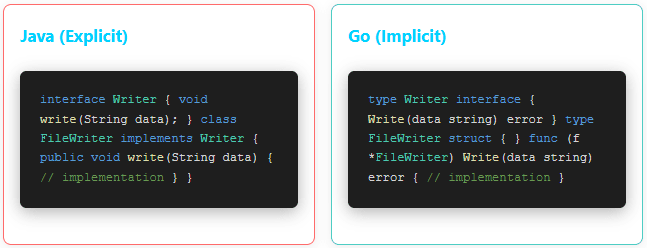
Notice what’s missing in the Go example: there’s no declaration that FileWriter implements Writer. The compiler figures it out automatically by checking if FileWriter has all the methods that Writer requires. If it does, FileWriter satisfies Writer. That’s it.
This difference might seem cosmetic, but it fundamentally changes the relationship between types and interfaces. In Java, the type knows about the interface and explicitly commits to implementing it. In Go, the type has no idea the interface even exists.
2. The Power of Decoupling
The immediate benefit of implicit interfaces is dramatic decoupling. In traditional OOP languages, both the interface and the implementing type must exist in locations that can see each other. This creates a dependency relationship that seems innocuous but has far-reaching consequences.
The Import Cycle Problem
Consider a common scenario: you have a package database that defines a Connection interface, and a package postgres that provides a PostgreSQL implementation. In Java-style explicit interfaces, postgres must import database to declare it implements the interface. But what if database needs to import postgres for testing or registration? You have a circular dependency.
Go solves this elegantly. The database package can define its interface, and postgres can implement the methods without ever importing database. The consumer of both packages is where the connection happens:
// package database type Connection interface { Query(sql string) (*Result, error) Close() error } // package postgres (doesn't import database!) type PostgresConnection struct { /* ... */ } func (p *PostgresConnection) Query(sql string) (*Result, error) { // implementation } func (p *PostgresConnection) Close() error { // implementation } // package main (brings them together) func main() { var conn database.Connection = &postgres.PostgresConnection{} // works! postgres satisfies database.Connection implicitly }
No circular dependencies. No import gymnastics. Each package focuses on its own concerns, and the type system handles the rest.
Third-Party Type Adaptation
Here’s where implicit interfaces truly shine. Suppose you’re using a third-party HTTP client library that provides a Client type. You want to write testable code, so you define an interface for what you need:
type HTTPClient interface { Get(url string) (*Response, error) } func fetchData(client HTTPClient) (string, error) { resp, err := client.Get("https://api.example.com/data") // process response... }
In Java or C#, if the third-party Client doesn’t implement your HTTPClient interface, you’re stuck. You need to write a wrapper class that explicitly implements your interface and delegates to the third-party client. In Go, if the third-party Client happens to have a Get method with the right signature, it automatically satisfies your interface. You can pass it directly, no wrapper needed.
This is enormously powerful. You can define interfaces in your code that third-party types satisfy without those library authors ever knowing about your interfaces. Effective Go calls this “accepting interfaces, returning concrete types”—a philosophy we’ll explore deeply.
3. Accept Interfaces, Return Structs

This principle is central to idiomatic Go design and is enabled entirely by implicit interfaces. The idea is simple: your functions should accept interface parameters (being flexible about what they work with) but return concrete types (being specific about what they provide).
Why Accept Interfaces?
When your function accepts an interface parameter, you’re saying: “I don’t care what you are, I only care what you can do.” This maximizes flexibility for callers:
type DataStore interface { Save(key string, value []byte) error Load(key string) ([]byte, error) } func processUserData(store DataStore, userData []byte) error { return store.Save("user:123", userData) }
Now processUserData works with any storage mechanism: in-memory maps for testing, Redis clients for production, S3 wrappers for archival, or mock implementations for unit tests. The function doesn’t need to import any of these concrete implementations, and they don’t need to know this interface exists.
Why Return Structs?
The flip side is equally important. When you return an interface, you’re committing to that interface contract forever. Callers might store that interface value and expect it to work with any future implementation. But when you return a concrete struct, callers can still use it as an interface if they want, while you maintain the flexibility to add methods and evolve the type.
// Good: Returns concrete type func NewFileCache(dir string) *FileCache { return &FileCache{directory: dir} } // Callers can use it concretely: cache := NewFileCache("/tmp/cache") cache.ClearExpired() // specific method only FileCache has // Or as an interface: var store DataStore = NewFileCache("/tmp/cache") store.Save("key", data)
This flexibility is impossible with explicit interfaces. If FileCache had to declare which interfaces it implements, you’d have to decide upfront. With implicit satisfaction, FileCache can satisfy any interface that matches its methods, now or in the future.
4. Preventing Dependency Hell
The impact on dependency management is profound. In large codebases, dependencies become a major source of complexity and coupling. Research from Russ Cox (Go tech lead) shows how explicit interface implementations create hidden dependency webs.

Consider a typical enterprise application with layers: presentation, business logic, data access, and infrastructure. In Java/C#, you often define interfaces at each layer, and implementations explicitly declare which interfaces they satisfy. This creates a dependency graph where:
| Language Approach | Package Dependencies | Refactoring Impact | Test Isolation |
|---|---|---|---|
| Explicit Interfaces (Java/C#) | High coupling between layers | Interface changes cascade through implementations | Requires interface definition packages |
| Implicit Interfaces (Go) | Minimal coupling, one-way dependencies | Changes isolated to direct users | Tests define own interfaces locally |
The Interface Segregation Advantage
With implicit interfaces, you can follow the Interface Segregation Principle naturally. Instead of large interfaces defined centrally, each package defines small, focused interfaces for exactly what it needs:
// Instead of one large interface that everything must implement: type Database interface { Query(...) error Execute(...) error BeginTx(...) error GetStats() Stats HealthCheck() bool // ... 20 more methods } // Go encourages many small interfaces: type Querier interface { Query(sql string, args ...interface{}) (*Rows, error) } type Executer interface { Exec(sql string, args ...interface{}) (Result, error) } type HealthChecker interface { HealthCheck() bool }
Now your query-only code depends on Querier, your admin code depends on HealthChecker, and your transaction code depends on BeginTx. The concrete database type satisfies all of these automatically, but each piece of code only couples to what it actually needs.
5. The Standard Library’s Example
Go’s standard library showcases implicit interface design brilliantly. The io package defines fundamental interfaces like:
type Reader interface { Read(p []byte) (int, error) } type Writer interface { Write(p []byte) (int, error) }
These simple interfaces are satisfied by dozens of types across the standard library and third-party packages without any coordination. Files, network connections, byte buffers, compression streams, HTTP bodies—all satisfy io.Reader or io.Writer naturally because they need those methods anyway.
This enables powerful composition. Any function accepting io.Reader works with any readable source. The bufio package can wrap any io.Reader to add buffering without knowing what the underlying reader is:
func processData(r io.Reader) { buffered := bufio.NewReader(r) // r could be a file, network connection, string, etc. }
The decoupling is complete. bufio doesn’t import os, net, or strings. Those packages don’t import bufio. They don’t even import io for the interface—they import it for utility functions, but they’d have the methods regardless.
6. The Surprising Downside: Accidental Implementation
Every design decision involves trade-offs, and implicit interfaces are no exception. The same mechanism that enables powerful decoupling creates a surprising problem: you can accidentally implement interfaces you never intended to.
The Name Collision Problem
Imagine you create a type with a Close() method that performs some cleanup specific to your domain. Unbeknownst to you, the io.Closer interface in the standard library requires exactly that method signature:
type Closer interface { Close() error }
Now your type automatically satisfies io.Closer, and someone might pass it to a function expecting a resource that needs cleanup, like a file or network connection. Your Close() method might do something completely different—maybe it finalizes a business transaction or marks a task complete. The program compiles fine but has a semantic mismatch.
Real-World Impact: This actually happened in production at several companies. A payment processor had a
Close()method that marked transactions as closed (business logic), which accidentally satisfiedio.Closer. When passed to cleanup routines expecting resource cleanup, transactions were marked closed prematurely, causing data inconsistencies.
The Documentation Burden
With explicit interfaces, documentation is straightforward: “This class implements IRepository.” With implicit interfaces, you need to document which interfaces your type is designed to satisfy versus which it happens to satisfy accidentally:
// FileCache provides file-based caching. // It implements DataStore interface (intentional). // Note: Also satisfies io.Closer but Close() is for cache cleanup, // not I/O resource management. Do not use in I/O contexts. type FileCache struct { ... }
This puts extra burden on developers to understand context. When you see a type satisfying an interface in Go, you can’t immediately tell if it was intentional or accidental without reading documentation or code.
The Refactoring Trap
Suppose you add a method to your type for internal convenience. Unknown to you, this method signature happens to complete an interface somewhere in your codebase or a dependency. Suddenly your type satisfies that interface, and existing code that accepts that interface type might now receive your instances.
This can introduce subtle bugs that aren’t caught by tests if your test coverage doesn’t exercise all possible interface implementations. In explicit interface systems, adding a method is safe unless you explicitly declare satisfaction of a new interface.
7. Compile-Time Interface Verification
While Go doesn’t require explicit declarations, it provides a clever idiom to verify interface satisfaction at compile time:
// Verify that FileCache implements DataStore at compile time var _ DataStore = (*FileCache)(nil)
This line declares a variable of type DataStore and assigns it a nil pointer to FileCache. If FileCache doesn’t satisfy DataStore, the code won’t compile. This gives you explicit verification without the explicit declaration requirement.
However, this is just a convention. There’s no enforcement that you do this, and many codebases don’t use this pattern consistently. It also doesn’t solve the accidental implementation problem—it only verifies intended implementations.
8. Interface Evolution and Backward Compatibility
One advantage often overlooked is how implicit interfaces affect API evolution. Consider a library that defines an interface:
// v1.0 type Storage interface { Get(key string) (string, error) Set(key, value string) error }
In version 2.0, you want to add a Delete method. With explicit interfaces, this is a breaking change—existing implementations must update their declarations and add the method. With Go’s implicit interfaces, you can create a new interface:
// v2.0 type Storage interface { Get(key string) (string, error) Set(key, value string) error } type AdvancedStorage interface { Storage Delete(key string) error }
Existing code continues to work with Storage, while new code can use AdvancedStorage. Types that already have a Delete method automatically satisfy the new interface without any changes.

9. Performance Implications
There’s a common misconception that implicit interfaces have runtime overhead. In reality, Go’s interface implementation is just as efficient as explicit interfaces in other languages. The compiler builds method tables (similar to vtables) at compile time, and interface calls have the same cost as virtual method calls in Java or C++.
The difference is in compile time, not runtime. The compiler must do more work to discover which types satisfy which interfaces, but this is a one-time cost during compilation. Once compiled, the performance characteristics are identical.
| Metric | Explicit Interfaces | Implicit Interfaces |
|---|---|---|
| Runtime Performance | Virtual method call overhead | Identical virtual method call overhead |
| Compile Time | Faster (direct lookup) | Slower (type analysis required) |
| Memory Footprint | Method tables per type | Identical method tables per type |
| Inlining Opportunities | Limited across interface boundaries | Identical limitations |
10. When Explicit Might Be Better
Despite Go’s success with implicit interfaces, there are scenarios where explicit declarations offer advantages:
Large Team Codebases
In massive codebases with hundreds of developers, explicit declarations serve as documentation and prevent accidental implementations. When a junior developer adds a Read([]byte) method, they might not realize they’ve accidentally implemented io.Reader and introduced a semantic mismatch.
Domain-Specific Languages
When building frameworks or DSLs where precise interface contracts are critical, explicit declarations make intentions clearer. Plugin systems, for example, benefit from explicit declarations because plugin authors need to know exactly which interfaces to implement.
Safety-Critical Systems
In safety-critical or financial systems, the risk of accidental interface satisfaction might outweigh the benefits of decoupling. Explicit declarations add a layer of safety by requiring conscious decisions about interface implementation.
The Practical Middle Ground: Many Go teams adopt conventions like mandatory compile-time verification checks for critical interfaces, combined with thorough code reviews that specifically look for accidental interface implementations. This preserves the benefits of implicit satisfaction while mitigating the risks.
11. Lessons for Other Languages
Go’s experiment with implicit interfaces has influenced other language designs. TypeScript, for example, uses structural typing (similar to implicit interfaces) for type compatibility checks. Rust’s trait system requires explicit implementation but allows conditional implementations that feel similar to Go’s flexibility.
The key insights that other languages are adopting:
- Structural typing over nominal typing: What matters is what a type can do, not what it claims to be
- Small, focused interfaces: Many small interfaces are better than few large ones
- Consumer-defined contracts: Let the code that uses a type define what it needs, rather than forcing types to declare capabilities upfront
- Composition over inheritance: Build complex behavior from simple components
12. Best Practices for Implicit Interfaces
After years of Go development in production environments, several best practices have emerged:
1. Define Interfaces at the Point of Use
Don’t create centralized interface definitions unless you’re building a framework. Define interfaces in the package that uses them, making them as small as possible:
// In your service package: type userRepository interface { FindByID(id string) (*User, error) } func GetUser(repo userRepository, id string) (*User, error) { // implementation }
Note the lowercase interface name—it’s not exported. This interface exists solely for this package’s needs.
2. Use Compile-Time Verification for Critical Interfaces
For interfaces that are central to your architecture, add verification:
var ( _ Storage = (*RedisStore)(nil) _ Storage = (*PostgresStore)(nil) _ Storage = (*S3Store)(nil) )
3. Document Intentional Implementations
In godoc comments, explicitly state which interfaces your type is designed to satisfy:
// RedisStore provides Redis-backed storage. // It implements the Storage interface. type RedisStore struct { ... }
4. Be Careful with Common Method Names
Method names like Close(), Read(), Write(), String(), and Error() have specific meanings in Go’s standard library. If your method doesn’t match the semantic expectations, use a different name:
// Bad: Semantic mismatch func (t *Transaction) Close() error { // marks transaction as closed in business logic } // Good: Clear, unambiguous name func (t *Transaction) MarkClosed() error { // marks transaction as closed in business logic }
5. Leverage Interface Embedding
Go allows interfaces to embed other interfaces, creating powerful compositions:
type ReadWriteCloser interface { io.Reader io.Writer io.Closer }
This creates clean, composable interface hierarchies without complex inheritance.

13. Real-World Impact
The benefits of implicit interfaces are most visible in large, long-lived projects. Studies of major Go codebases show:
- Faster refactoring: Changes to concrete types don’t require updating interface declarations throughout the codebase
- Better test isolation: Tests can define minimal interfaces for exactly what they need to mock
- Reduced coupling: Packages have fewer dependencies because they don’t need to import interface definitions
- Easier third-party integration: Wrapping external libraries requires less boilerplate
However, the same studies also show:
- Increased debugging time: Understanding which interfaces a type satisfies requires more investigation
- Documentation overhead: Developers must be more diligent about documenting intended interfaces
- Onboarding challenges: New team members find implicit interfaces less intuitive initially
14. What We’ve Learned
Go’s implicit interface satisfaction represents a fundamental rethinking of how types and interfaces relate. By eliminating explicit implementation declarations, Go achieves remarkable decoupling that prevents import cycles, enables elegant third-party type adaptation, and makes interface segregation natural and effortless.
The “accept interfaces, return structs” philosophy becomes not just possible but inevitable. Packages define small, focused interfaces for exactly what they need, while concrete types remain blissfully unaware of the various interfaces they satisfy. This inverts the traditional dependency relationship and enables true modularity.
The standard library’s io.Reader and io.Writer interfaces demonstrate the power of this approach at scale. Dozens of types across unrelated packages satisfy these interfaces without coordination, enabling powerful composition patterns that would be impractical with explicit declarations.
However, the trade-offs are real. Accidental interface implementation can introduce subtle semantic bugs. The documentation burden increases as developers must explicitly communicate which interfaces their types are designed to satisfy versus which they happen to satisfy coincidentally. Refactoring becomes riskier when adding methods might inadvertently complete an interface somewhere in the codebase.
The research from Russ Cox on dependency management validates what Go developers have experienced: implicit interfaces dramatically reduce coupling and prevent the dependency hell that plagues large Java and C# codebases. But this comes at the cost of requiring more discipline around naming, documentation, and code review practices.
For most modern development—especially microservices, cloud-native applications, and systems where decoupling and testability matter—implicit interfaces offer compelling advantages that outweigh their downsides. The key is understanding both the power and the pitfalls, adopting best practices like compile-time verification for critical interfaces, and maintaining excellent documentation about intentional versus accidental interface satisfaction.
Go’s experiment proves that explicit implementation declarations, while universal in OOP languages, aren’t necessary for type safety or performance. They’re a design choice, and choosing implicit satisfaction opens up new possibilities for cleaner, more decoupled architectures.