Java’s pragmatic evolution: borrowing functional programming’s best ideas while maintaining backward compatibility
Java isn’t trying to become Haskell. It’s not attempting to transform into Scala overnight. Instead, the language is doing something more interesting—and arguably more valuable: systematically adopting the most practical ideas from functional programming while staying true to its object-oriented roots and ironclad commitment to backward compatibility.
This evolution is accelerating. Records lead modern Java features with 55% developer adoption, pattern matching for switch reached production status in Java 21, and Project Valhalla’s value types are transitioning from research prototype to preview features. For developers writing Java in 2026, understanding these functional additions isn’t optional—it’s essential.

1. Project Valhalla: Codes Like a Class, Works Like a Primitive
When Java’s creators designed the language in the mid-1990s, memory fetches and arithmetic operations cost roughly the same. Today, memory fetches are 200 to 1,000 times more expensive. This fundamental shift in hardware economics makes Java’s pointer-heavy object model increasingly costly.
Project Valhalla addresses this mismatch by introducing value types—objects without identity that the JVM can optimize aggressively. Think of them as “codes like a class, works like an int.” Instead of every object living on the heap with its own identity, value types can be flattened directly into arrays and objects, eliminating pointer indirection.
1.1 The Performance Problem
Consider a simple Point class storing x and y coordinates. In traditional Java, creating an array of one million Points means allocating one million separate heap objects, each with object header overhead. Accessing array elements requires following pointers scattered throughout memory—a recipe for cache misses and garbage collection pressure.
// Traditional reference type - heap allocated class Point { double x; double y; } // With Valhalla - value type (preview syntax) value class Point { double x; double y; } // Array of traditional Points: 1M heap allocations + pointers Point[] traditional = new Point[1_000_000]; // Array of value Points: Flattened in memory, no indirection Point[] flattened = new Point[1_000_000];
The difference is dramatic. According to benchmark comparisons, flattened arrays can be 20 times smaller in memory and significantly faster to iterate. For data-intensive applications processing millions of small objects—financial systems, scientific computing, graphics—this represents a fundamental performance improvement.
1.2 Five Pillars of Valhalla
The project encompasses five distinct feature sets being delivered incrementally across multiple JDK releases:
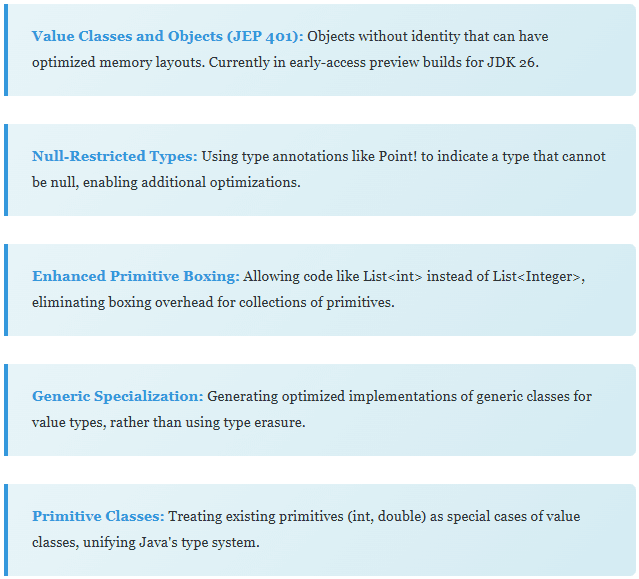
This isn’t vaporware. Early adopters are already prototyping with preview builds, measuring substantial performance improvements in specific workloads. The journey from research to production is complete—value types are arriving.
2. Pattern Matching: Deconstructing Data Elegantly
Pattern matching transforms how Java handles polymorphic code. Before JEP 441, checking types and extracting data required verbose instanceof chains with explicit casting. Pattern matching collapses this into elegant, type-safe expressions.
2.1 From Verbose to Concise
// Before Java 16 - the old way if (obj instanceof String) { String s = (String) obj; System.out.println(s.toUpperCase()); } // Java 16+ - pattern matching for instanceof if (obj instanceof String s) { System.out.println(s.toUpperCase()); } // Java 21 - pattern matching for switch static String format(Object obj) { return switch (obj) { case Integer i -> String.format("int: %d", i); case Long l -> String.format("long: %d", l); case Double d -> String.format("double: %.2f", d); case String s -> String.format("String: %s", s); case null -> "null value"; default -> obj.toString(); }; }
The evolution continued through four preview rounds (JDK 17-20) before finalization in Java 21. Each iteration refined the feature based on developer feedback—exactly the kind of careful, pragmatic evolution Java excels at.
2.2 Guarded Patterns and Exhaustiveness
Pattern matching becomes even more powerful with guard clauses using when. These allow additional conditions beyond type matching:
static void process(String response) { switch (response) { case String s when s.equalsIgnoreCase("YES") -> System.out.println("Confirmed"); case String s when s.equalsIgnoreCase("NO") -> System.out.println("Declined"); case String s -> System.out.println("Unknown: " + s); } }
Combined with sealed classes (covered next), pattern matching enables exhaustiveness checking. The compiler can verify you’ve handled all possible cases, catching bugs at compile time instead of runtime.

3. Records: Transparent Data Carriers
Introduced as a preview in Java 14 and finalized in Java 16, records eliminate the boilerplate plague that has long afflicted Java data classes. Before records, creating a simple immutable data carrier required writing constructors, getters, equals(), hashCode(), and toString()—often 50+ lines for three fields.
// Traditional class - ~60 lines of boilerplate public final class Person { private final String name; private final int age; public Person(String name, int age) { this.name = name; this.age = age; } public String getName() { return name; } public int getAge() { return age; } // ... equals, hashCode, toString } // Record - 1 line, all the same functionality public record Person(String name, int age) { }
Records are automatically final and provide canonical constructors, accessor methods (not getters—just field names), and implementations of equals(), hashCode(), and toString(). They’re perfect for DTOs, configuration objects, and any data that should be treated as a transparent tuple.
3.1 Beyond Simple Data
Despite their simplicity, records support custom logic. You can add validation in compact constructors, define additional methods, and implement interfaces:
public record Range(int start, int end) { // Compact constructor for validation public Range { if (start > end) { throw new IllegalArgumentException( "Start must be <= end" ); } } // Additional methods public boolean contains(int value) { return value >= start && value <= end; } }
The combination of records with pattern matching is particularly elegant. You can deconstruct records in switch expressions, extracting components inline—a capability that will expand further with future enhancements.
4. Sealed Classes: Controlled Hierarchies
Finalized in Java 17 through JEP 409, sealed classes address a fundamental limitation: in traditional Java, classes are either completely open for extension (the default) or completely closed (final). Sealed classes provide fine-grained control, allowing you to specify exactly which subclasses are permitted.
// Sealed interface with permitted implementations public sealed interface Shape permits Circle, Rectangle, Triangle { double area(); } public final record Circle(double radius) implements Shape { public double area() { return Math.PI * radius * radius; } } public final record Rectangle(double width, double height) implements Shape { public double area() { return width * height; } } public final record Triangle(double base, double height) implements Shape { public double area() { return 0.5 * base * height; } }
4.1 Algebraic Data Types in Java
The combination of sealed types and records creates algebraic data types—sum types (sealed hierarchies) and product types (records). This is the same pattern found in functional languages like Haskell and Scala, but adapted to Java’s type system.
With pattern matching, sealed hierarchies enable exhaustive checking. The compiler knows all possible subtypes, so it can verify you’ve handled every case:
// Compiler checks exhaustiveness - no default needed static double calculateArea(Shape shape) { return switch (shape) { case Circle c -> Math.PI * c.radius() * c.radius(); case Rectangle r -> r.width() * r.height(); case Triangle t -> 0.5 * t.base() * t.height(); // If we add a new Shape, compiler error here! }; }
Key Insight: Sealed classes flip the traditional extensibility model. Instead of defending against unexpected subclasses with defensive code, you explicitly declare the complete set of possibilities and let the compiler enforce exhaustiveness. This catches entire categories of bugs at compile time.
5. Java vs. Pure Functional Languages
How does Java’s pragmatic functional approach compare to languages designed from the ground up for functional programming? The answer reveals fundamental design philosophies.
5.1 The Purity Spectrum
| Aspect | Haskell | Scala | Java |
|---|---|---|---|
| Paradigm | Pure functional | Functional + OOP hybrid | OOP with functional features |
| Immutability | Default, enforced | Encouraged, not enforced | Opt-in (records, final) |
| Type System | Hindley-Milner, extremely powerful | Advanced, with inference | Nominal, improving |
| Side Effects | Tracked in type system (IO monad) | Not tracked, by convention | Not tracked |
| Pattern Matching | Comprehensive, core feature | Extensive, first-class | Growing, pragmatic |
| Backward Compatibility | Breaking changes accepted | Mostly stable | Sacred principle |
| Learning Curve | Steep | Moderate to steep | Gentle progression |
| Ecosystem Size | Academic, specialized | Growing, JVM-based | Massive, enterprise-focused |
5.2 Haskell: The Purist’s Dream
Haskell is uncompromising. Everything is immutable by default. Side effects are tracked in the type system through monads—the IO type explicitly marks functions that interact with the world. This referential transparency enables aggressive compiler optimizations and makes reasoning about code remarkably straightforward.
But this purity comes with costs. Haskell’s learning curve is legendary. Concepts like monads, functors, and type classes require fundamental shifts in thinking. The ecosystem is smaller, more academic, and finding production libraries can be challenging. When Facebook built its spam filter in Haskell, it made headlines precisely because industrial Haskell use is notable.
5.3 Scala: The Pragmatic Middle Ground
Scala attempts to bridge functional and object-oriented programming. Running on the JVM, it provides access to Java’s ecosystem while offering sophisticated functional features: advanced pattern matching, higher-kinded types, implicits, and powerful type inference.
The result is a language that can be as functional as you want. You can write pure functional code using immutable data structures and avoiding side effects, or mix paradigms freely. According to the Stack Overflow 2024 Survey, Scala has 2.6% active usage compared to Java’s 30.3%, indicating a more specialized niche—often in big data (Apache Spark) and high-performance systems.
Scala’s challenge is complexity. Its powerful features create a steep learning curve, and different teams can write Scala that looks completely different. The language offers so many ways to solve problems that establishing consistent patterns becomes difficult.
5.4 Java: Evolutionary, Not Revolutionary
Java’s approach is fundamentally different. Instead of forcing functional purity, Java adds functional tools to its object-oriented foundation. Records are immutable, but regular classes remain mutable. Pattern matching is growing, but not as comprehensive as Haskell’s. Value types will improve performance, but identity-based objects remain available.
This gradualism is intentional. Java’s installed base is enormous—billions of devices, millions of developers, trillions of lines of code. Breaking compatibility would be catastrophic. So Java evolves incrementally, ensuring every Java 8 program still compiles and runs on Java 21.

The trade-off is clear. Haskell offers mathematical purity and powerful guarantees but limited adoption. Scala provides sophisticated functional features at the cost of complexity. Java offers pragmatic functional tools with massive ecosystem support and gentle learning curves.
5.5 When to Choose What
Choose Haskell when: Correctness is paramount (financial systems, research), you have a team comfortable with advanced type theory, and you value compile-time guarantees over ecosystem size. Facebook’s spam filter and Jane Street’s trading systems show Haskell works at scale—but these are exceptions proving the rule.
Choose Scala when: You need sophisticated functional programming on the JVM, your team can handle complexity, and you’re working in domains where Scala excels (big data, distributed systems). Companies like Twitter, LinkedIn, and Disney Streaming demonstrate Scala’s production viability.
Choose Java when: You have existing Java codebases, need the massive ecosystem, want gradual adoption of functional concepts, or require absolute backward compatibility. Most enterprise applications fall here—and Java’s functional evolution means you don’t sacrifice modern programming paradigms.
6. The Future of Functional Java
Java’s functional evolution continues accelerating. Project Valhalla’s value types will reach production in upcoming LTS releases. Pattern matching will expand with record patterns for deconstruction. The integration of these features—records + sealed classes + pattern matching + value types—creates something approaching algebraic data types with performance characteristics competitive with C++.
According to industry analysis, functional programming adoption across all languages is growing, driven by concurrency demands and distributed systems complexity. Java’s approach—borrowing proven concepts while maintaining compatibility—positions it uniquely. Developers get functional tools without abandoning decades of investment.
The question isn’t whether Java will become a pure functional language. It won’t, and shouldn’t. The question is whether Java’s pragmatic, evolutionary approach succeeds in bringing functional programming’s benefits to the massive installed base of Java developers and applications.
The evidence suggests it’s working. Records achieved 55% adoption remarkably quickly. Pattern matching is being used extensively. Developers are already prototyping with Valhalla. Java isn’t trying to replace Haskell or Scala—it’s bringing functional programming to where the developers are.
7. What We’ve Learned
- Project Valhalla introduces value types that eliminate object identity to enable memory layout optimizations, potentially reducing memory usage by 20x for data-intensive applications while maintaining Java’s high-level abstractions.
- Pattern matching for switch (JEP 441) reached production in Java 21 after four preview rounds, transforming verbose instanceof chains into concise, type-safe expressions with guard clauses and exhaustiveness checking.
- Records eliminate boilerplate for immutable data carriers, achieving 55% developer adoption by replacing 50+ lines of traditional class code with single-line declarations while supporting validation and custom methods.
- Sealed classes enable controlled hierarchies by restricting which subclasses can extend a type, creating algebraic data types when combined with records and enabling compile-time exhaustiveness verification.
- Java’s pragmatic approach differs from pure functional languages like Haskell (enforced purity, tracked side effects) and hybrid languages like Scala (sophisticated but complex), choosing gradual evolution with backward compatibility over revolutionary change.
- The combination creates powerful patterns where records (product types) + sealed classes (sum types) + pattern matching + upcoming value types deliver functional programming benefits to Java’s massive ecosystem without forcing paradigm shifts.