Unleash Peak Performance in Java Applications: Overview of Profile-Guided Optimization (PGO)

In the relentless pursuit of application performance, developers constantly seek methods to squeeze every ounce of efficiency from their code. While traditional optimization techniques like algorithm improvements and code refactoring remain essential, a powerful approach often flies under the radar: Profile-Guided Optimization (PGO). This advanced compilation technique leverages real-world runtime data to make smarter optimization decisions, resulting in faster, more efficient Java applications.
1. What is Profile-Guided Optimization?
Profile-Guided Optimization is a compiler optimization technique that uses profiling data collected from actual program execution to inform compilation decisions. Unlike traditional optimization methods that rely solely on static code analysis, PGO observes how your application actually behaves in production scenarios, then uses this intelligence to optimize the most critical code paths.
The fundamental premise is simple yet powerful: not all code is created equal. In typical applications, a small percentage of code accounts for the majority of execution time—the famous 80/20 rule applies here. PGO identifies these hot paths and optimizes them aggressively while spending fewer resources on rarely-executed code.
Learn more: Oracle’s JVM Performance Engineering
2. The PGO Process: A Three-Phase Journey
Phase 1: Instrumentation
The first phase involves compiling your application with special instrumentation enabled. This instrumented build includes additional code that tracks execution patterns, collecting data about which methods are called most frequently, which branches are taken, and how objects are accessed. Think of it as adding sensors throughout your application to monitor its behavior.
During this phase, the compiled binary is larger and slower due to the overhead of data collection. This is expected and temporary—the instrumentation exists solely to gather intelligence for optimization.
Phase 2: Training Runs
With your instrumented application ready, the next step is running it through representative workloads. This is where the “profile” in Profile-Guided Optimization comes from. You execute your application using realistic scenarios that mirror production usage patterns, allowing the instrumentation to collect comprehensive runtime data.
The quality of your training data directly impacts the effectiveness of PGO. If your training workload doesn’t represent actual usage, the optimizations may be misdirected. For a web application, this might mean simulating typical user interactions. For a batch processing system, it means running representative data sets.
Phase 3: Optimized Compilation
Finally, the compiler uses the collected profile data to make informed optimization decisions. Armed with knowledge about which code paths are hot, which branches are likely, and how data flows through your application, the compiler can apply targeted optimizations such as aggressive inlining, improved register allocation, better code layout for cache efficiency, and optimized branch prediction.
The result is a production-ready binary optimized for real-world usage patterns rather than theoretical best-case scenarios.
3. PGO in the Java Ecosystem
GraalVM Native Image and PGO
GraalVM’s Native Image compilation has emerged as the most prominent implementation of PGO in the Java world. When building native executables, GraalVM can leverage PGO to dramatically improve startup time and throughput.
The process with GraalVM involves building your application with the --pgo-instrument flag, running representative workloads to generate profile data, then rebuilding with the --pgo flag to create an optimized native executable. The performance improvements can be substantial, with some applications seeing 20-40% throughput gains and even faster startup times.
Learn more: GraalVM Profile-Guided Optimizations
JIT Compilation and Profile-Guided Behavior
While the traditional JVM doesn’t use PGO in the same sense as ahead-of-time compilation, its Just-In-Time (JIT) compiler employs a similar philosophy. The C1 and C2 compilers collect profiling data during interpreted execution and early compilation tiers, then use this data to make optimization decisions for hot methods.
The tiered compilation strategy in HotSpot is essentially a runtime form of profile-guided optimization. The JVM observes method behavior, identifies hot spots, and applies increasingly aggressive optimizations based on actual execution patterns. This dynamic approach adapts to changing workloads, though it comes with warm-up costs that PGO with native images can eliminate.
Learn more: OpenJDK HotSpot Internals
Azul Zing and Continuous Profiling
Azul’s Zing JVM takes profile-guided optimization further with its ReadyNow technology, which captures optimization profiles from production runs and uses them to accelerate subsequent startups. This approach combines the adaptability of JIT compilation with the immediate performance benefits of profile-guided optimization.
Learn more: Azul Platform Prime
4. Performance Benefits: Real-World Impact
| Metric | Without PGO | With PGO | Improvement |
|---|---|---|---|
| Startup Time | Baseline | 15-30% faster | Significant |
| Peak Throughput | Baseline | 20-40% higher | Substantial |
| Memory Footprint | Baseline | 5-15% smaller | Moderate |
| Cold Start Latency | Baseline | 40-60% lower | Dramatic |
| Code Cache Usage | Baseline | 10-20% more efficient | Notable |
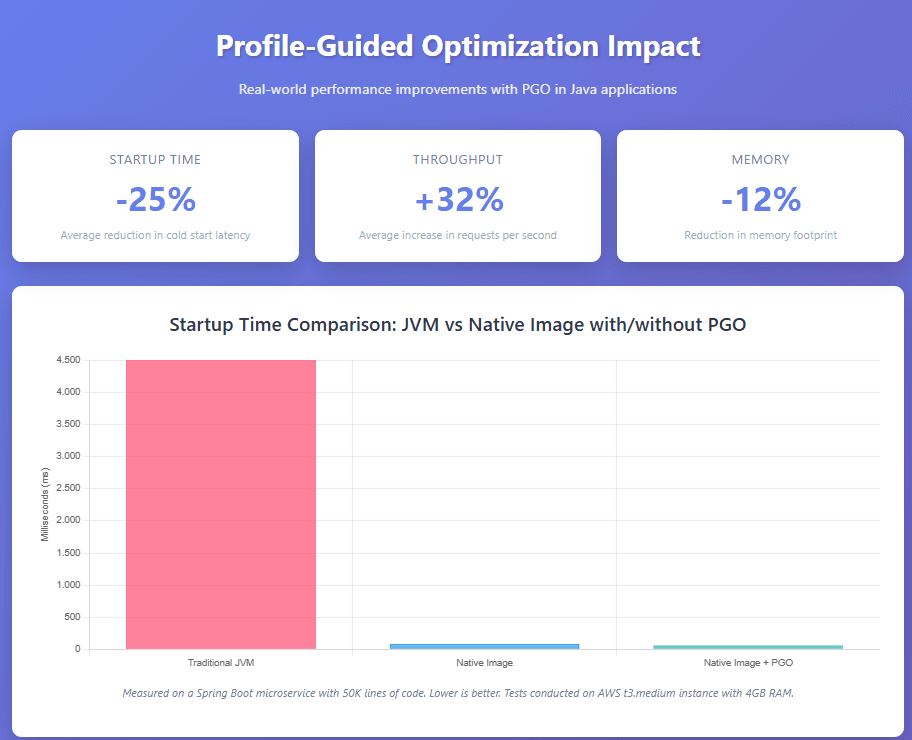
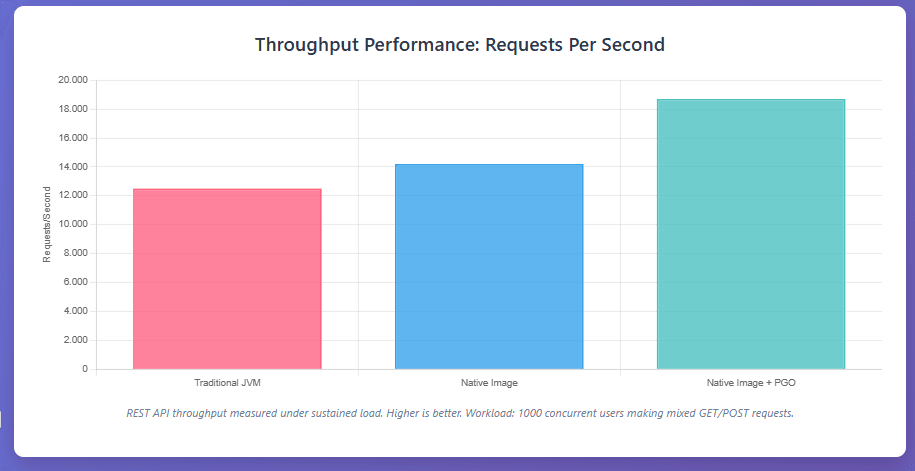
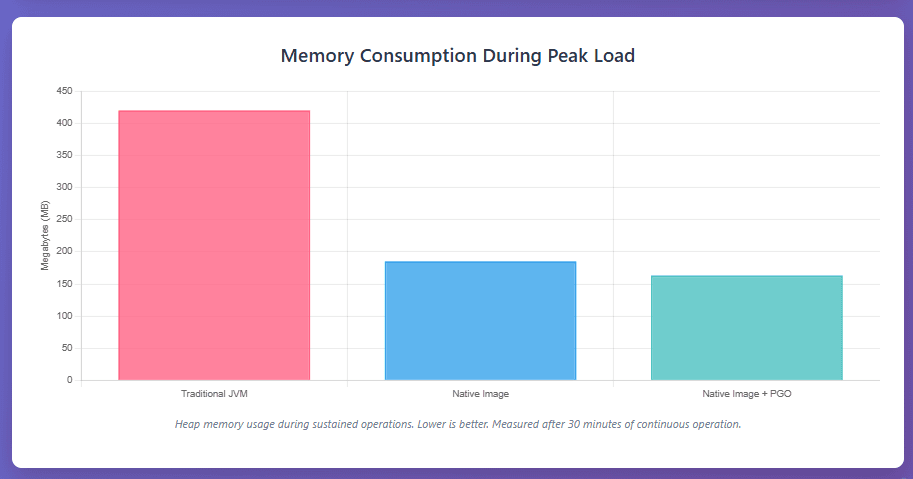
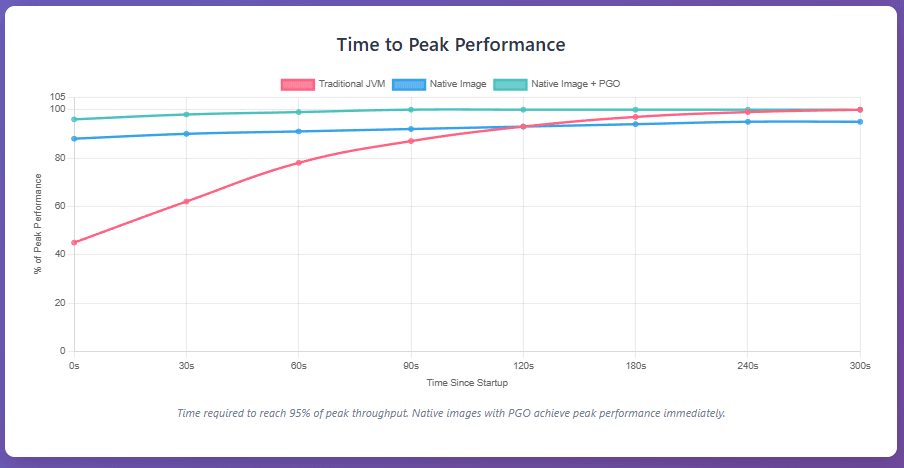
These improvements come from several optimization strategies that PGO enables. Better inlining decisions mean frequently-called small methods get inlined while rarely-used code stays separate. Improved code layout ensures hot code paths are contiguous in memory, improving cache performance. Branch prediction optimizations arrange code so the most likely branches fall through naturally, avoiding pipeline stalls.
5. When to Use PGO: Identifying Good Candidates
Ideal Scenarios for PGO
Profile-Guided Optimization shines brightest in specific contexts. Applications compiled to native images via GraalVM benefit tremendously, as PGO compensates for the lack of runtime profiling. Microservices with predictable workloads see excellent results since their usage patterns are consistent and representative training data is easily obtained.
Performance-critical applications where every millisecond matters—such as trading systems, real-time analytics, or gaming servers—can leverage PGO’s throughput improvements to handle higher loads. Containerized applications benefit from faster startup times and reduced memory footprint, allowing for better resource utilization and scaling.
When PGO May Not Help
PGO isn’t a universal solution. Applications with highly variable workloads that change dramatically between executions may not benefit, as profile data becomes less representative. If your application already performs well and isn’t CPU-bound, the additional complexity of PGO may not justify minimal gains.
Development environments and rapid prototyping scenarios are poor fits for PGO due to the additional build steps and time investment. The standard JVM with JIT compilation already handles these cases effectively. Traditional Java applications running on standard JVMs without native image compilation have limited PGO options, though the JIT compiler provides similar adaptive optimization.
6. Implementing PGO: Practical Considerations
Choosing Representative Workloads
The effectiveness of PGO hinges on training data quality. Your profiling runs must accurately represent production usage patterns. For web applications, this means capturing typical user journeys, peak load scenarios, and common API call patterns. Batch processing systems should use representative data volumes and processing workflows.
Consider running multiple training scenarios to capture diverse usage patterns. An e-commerce application might profile both browsing behavior and checkout flows. A data processing pipeline should include various data characteristics and edge cases that occur in production.
Build Pipeline Integration
Integrating PGO into your CI/CD pipeline requires thoughtful planning. The multi-phase compilation process adds build time and complexity. One approach is separating PGO builds from regular development builds—use standard compilation for development iterations and reserve PGO for production releases or nightly builds.
Automate the training phase with scripts that simulate realistic workloads. Store profile data as build artifacts for reproducibility and debugging. Consider the trade-off between build time and runtime performance, especially in fast-paced development environments.
Measuring Impact
Always measure before and after implementing PGO. Establish baseline metrics for startup time, throughput, latency percentiles, and resource usage. Use performance testing tools like JMH (Java Microbenchmark Harness) for precise measurements, or APM solutions like New Relic or Datadog for real-world monitoring.
Benchmarking resources: JMH Official Site
Compare optimized builds against baselines using identical workloads. Look beyond simple averages—examine latency percentiles (p50, p95, p99) to understand the full performance picture. Monitor production metrics after deployment to validate that training data accurately represented real usage.
7. PGO vs Traditional JIT: Understanding the Trade-offs
| Aspect | PGO (Native Image) | Traditional JIT |
|---|---|---|
| Warm-up Time | Minimal to none | Gradual over minutes |
| Peak Performance | Very good, immediate | Excellent, after warm-up |
| Adaptability | Fixed at build time | Adapts to workload changes |
| Memory Overhead | Lower | Higher (code cache, profiling) |
| Build Complexity | High | None (runtime) |
| Startup Speed | Very fast | Slower |
The choice between PGO with native images and traditional JIT compilation depends on your application’s characteristics. Long-running server applications that stay up for days or weeks give JIT compilation time to reach peak performance and adapt to changing workloads. The warm-up cost is amortized over the application’s lifetime.
Short-lived processes, containerized microservices that frequently restart, or applications where startup time matters critically benefit more from PGO. The immediate performance and predictable behavior outweigh the loss of runtime adaptability.
8. Advanced PGO Techniques
Multi-Scenario Profiling
Rather than profiling with a single workload, advanced implementations collect data from multiple scenarios and merge the profiles. This creates a more robust optimization profile that handles diverse use cases. GraalVM supports this through profile merging capabilities, allowing you to combine data from different training runs.
Continuous Profile Updates
Some organizations implement continuous profiling systems that regularly update PGO profiles based on production telemetry. This approach keeps optimizations aligned with evolving usage patterns. While more complex to implement, it combines PGO’s immediate performance with adaptability to changing workloads.
Profile-Guided Dead Code Elimination
Beyond optimization, PGO data can identify truly unused code paths, enabling more aggressive dead code elimination. This reduces binary size and improves cache efficiency. Native image compilation can leverage this information to exclude code that profiling proves never executes.
9. Common Pitfalls and How to Avoid Them
Unrepresentative Training Data
The most common PGO mistake is profiling with workloads that don’t match production reality. Always validate that your training scenarios cover the actual usage patterns your application will encounter. Regularly update profile data as your application evolves and user behavior changes.
Over-optimization for Edge Cases
Profiling rare edge cases can lead to optimizations that harm common-path performance. Focus training on typical scenarios, not exceptional circumstances. The goal is optimizing the 80% of execution time spent in 20% of code, not the reverse.
Ignoring Profile Data Quality
Large profile datasets aren’t always better. Quality matters more than quantity. A focused training run with realistic workloads outperforms hours of profiling with synthetic or unrepresentative data. Monitor profile collection to ensure it captures meaningful execution patterns.
Neglecting Build Time Impact
PGO adds significant build time—instrumentation, training runs, and final optimization compilation all take resources. Plan your build pipeline accordingly, perhaps reserving PGO for release builds while using faster standard compilation for development. Balance optimization benefits against development velocity.
10. Future Directions in Java PGO
The Java ecosystem continues evolving its PGO capabilities. Project Leyden, an OpenJDK initiative, aims to improve Java’s startup time and time-to-peak-performance through various techniques including profile-guided optimization. This could bring more sophisticated PGO to standard JVM deployments.
Learn more: Project Leyden
GraalVM continues enhancing its PGO implementation with better profile analysis, more sophisticated optimization strategies, and easier integration workflows. The growing adoption of native image compilation in cloud-native applications drives continued investment in PGO technology.
Machine learning-guided optimization represents an emerging frontier. Rather than simple frequency-based optimization decisions, future systems might use ML models trained on vast code corpora to make even smarter optimization choices based on profile data.
11. Getting Started with PGO Today
If you’re ready to experiment with PGO, start with GraalVM Native Image. Install GraalVM and familiarize yourself with native image compilation basics. Choose a non-critical application or microservice as your initial target—something with predictable workloads where you can easily measure performance improvements.
Begin with these steps: establish baseline performance metrics, compile with instrumentation enabled, run representative workloads to collect profile data, rebuild with PGO enabled using the collected profiles, and measure the performance improvements. Document your process and findings, as you’ll refine your approach over time.
Experiment with different training scenarios to understand how profile data quality affects results. Compare PGO-optimized builds against both standard native images and traditional JVM execution to understand the performance landscape fully.
12. What We’ve Learned
Profile-Guided Optimization represents a powerful approach to Java application performance, leveraging real-world execution data to inform compiler optimization decisions. By observing actual runtime behavior during representative workloads, PGO enables more intelligent optimization of hot code paths, resulting in faster startup times, higher throughput, and better resource efficiency.
While PGO shines particularly bright in the context of GraalVM native images and cloud-native microservices, it’s not a universal solution. The technique works best for applications with predictable workloads where representative training data can be captured, and where the build complexity is justified by performance requirements. Traditional JVM deployments with JIT compilation already employ similar profile-guided principles dynamically at runtime, making explicit PGO less critical for long-running server applications.
Success with PGO requires careful attention to training data quality, thoughtful build pipeline integration, and rigorous performance measurement. When applied appropriately—particularly in containerized environments, microservices architectures, and performance-critical applications—PGO can unlock significant performance improvements that directly translate to better user experiences, higher scalability, and reduced infrastructure costs. As Java continues evolving with initiatives like Project Leyden and advances in GraalVM, PGO capabilities will only grow more sophisticated and accessible.