1. Introduction: Java’s Evolutionary Trajectory
As we approach 2026, Java stands at a fascinating inflection point. Rather than merely maintaining its position, the platform is experiencing significant innovation through projects like Valhalla, Panama, Amber, and the Vector API. These initiatives represent more than incremental improvements—they fundamentally reimagine how Java handles data, interoperates with native code, and expresses developer intent.
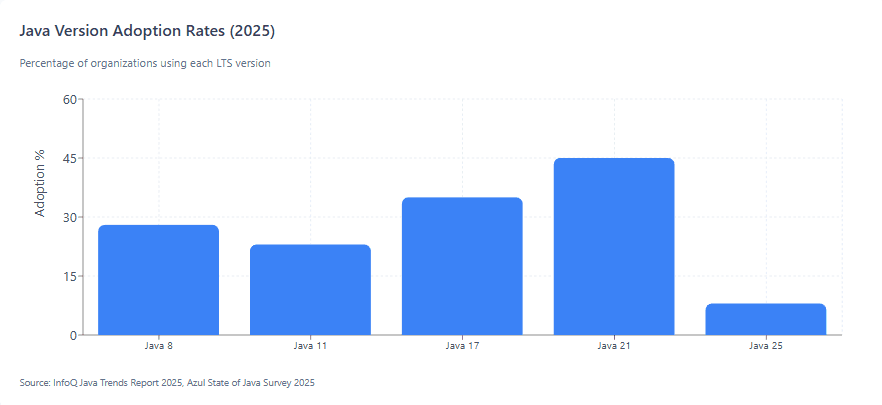
The six-month release cadence introduced with Java 9 has accelerated innovation while maintaining stability. Java 21 adoption has reached 45% within months of launch, demonstrating that the community embraces new capabilities when they deliver tangible value. This article examines the theoretical foundations, architectural principles, and strategic implications of Java’s most significant upcoming enhancements.
2. Project Valhalla: Rethinking the Object Model
2.1 The Memory Problem Java Must Solve
Java’s object model, elegantly simple since 1995, now faces a critical mismatch with modern hardware realities. When Java was conceived, memory fetch operations and arithmetic operations had roughly equivalent costs, but today memory fetches are 200 to 1,000 times more expensive than arithmetic operations. This fundamental shift in hardware economics makes Java’s pointer-heavy approach to data representation increasingly problematic.
Consider a simple data structure like coordinates or color values. Traditional Java creates full heap objects with identity and overhead for even the smallest data carriers. This indirection cascade—where an array of objects contains references that point to scattered heap locations—destroys cache locality and forces expensive memory traversals.
2.2 Value Types: Codes Like a Class, Works Like an Int
Project Valhalla introduces value classes that combine object-oriented abstractions with primitive performance characteristics, allowing objects without identity that can have optimized encodings. The conceptual breakthrough lies in recognizing that not all objects need identity. Many data structures—coordinates, complex numbers, tuples—represent pure values rather than entities.
Value classes sacrifice identity-dependent features (reference equality via ==, synchronization) in exchange for dramatic memory and performance improvements. Value classes still support null since they are reference types, while primitive classes subject to stricter constraints give up null support entirely but enable even more aggressive optimizations.
2.3 The Architectural Impact
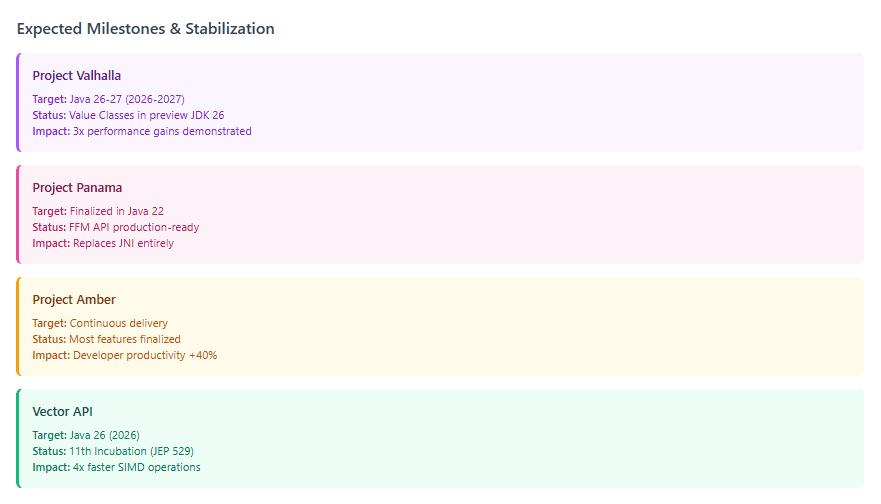
The implications extend far beyond individual objects. Early-access benchmarks from October 2025 show nearly 3x faster performance when summing years from a 50-million-element array of LocalDate instances, reducing average execution time from approximately 72 ms to 25 ms compared to identity-based objects.
This performance gain emerges from flattening—embedding value object data directly in arrays and fields rather than storing references. Instead of an array containing pointers to scattered heap objects, you get a contiguous block of actual data, perfectly aligned for modern CPU cache architectures.
2.4 Enhanced Generics and Reification
Valhalla’s scope includes addressing Java’s long-standing generic type erasure limitation. Enhanced generics aim to enable generic types for object references, primitives, value types, and potentially void, removing the need for boxing workarounds. This means List<int> becomes possible without wrapper objects, eliminating both memory overhead and allocation pressure.
2.5 Timeline and Current Status
As of October 2025, JEP 401: Value Classes and Objects has early-access builds implementing value classes with preview features available in early-access builds of JDK 26. The anticipated delivery spans multiple releases through a steady stream of enhancements rather than a single monolithic update. Realistic stabilization targets point toward Java 26-27 (2026-2027) for production readiness.
3. Project Panama: Bridging Java and Native Code
3.1 The JNI Problem Statement
For decades, the Java Native Interface served as Java’s gateway to native libraries, but its complexity imposed significant costs. JNI demands expertise in both Java and native programming, often leading to error-prone glue code with performance overhead from frequent crossing boundaries, manual memory management risking leaks or crashes, and safety concerns from direct memory access.
3.2 Foreign Function & Memory API Architecture
Project Panama’s Foreign Function and Memory API became standard in Java 22 after incubation since Java 14, providing developers a direct way to call native functions, allocate native memory, and map native data structures. The architectural elegance lies in type-safe memory access without sacrificing performance.
The API introduces several key abstractions:
Memory Segments: Bounded, temporal, thread-confined views over memory sources (on-heap or off-heap). Unlike raw pointers, segments carry size information and lifecycle management.
Linker: A bridge between the JVM and C/C++ native code (C ABI), with platform-specific implementations for Win64, SysVx64, LinuxAArch64, and MacOsAArch64.
Function Descriptors: Type-safe specifications of native function signatures, ensuring proper marshalling between Java and native conventions.
Arena-Based Memory Management: Scoped allocation that automatically releases resources, preventing the memory leaks that plague manual JNI code.
3.3 Performance and Safety Characteristics
The trade-off between safety and raw performance deserves examination. While interop code is written in Java, it cannot be considered 100% safe since the runtime must trust developer descriptions of native functions, which is why access to the foreign linker is a restricted operation requiring the foreign.restricted=permit flag.
This design intentionally surfaces the inherent risks of native interop while providing guardrails against common errors. The API prevents many categories of bugs—buffer overruns, use-after-free, null pointer dereferences—through compile-time and runtime checks, yet acknowledges that native code boundaries represent trust boundaries.
3.4 Production Status
As of 2025, the FFM API is considered largely stable after rigorous refinement since Java 19, with streamlined memory management, enhanced safety measures, and customization features. The transition from preview to production in Java 22 marks a significant milestone, positioning Panama as JNI’s modern replacement for new development.
4. Project Amber: The Evolution of Expression
4.1 The Ceremony Reduction Philosophy
Project Amber’s mission is identifying and incubating smaller, productivity-oriented language features that make everyday Java code more readable, writable, and maintainable through a process often called right-sizing language ceremony. Unlike projects targeting performance or interoperability, Amber focuses on developer ergonomics and expressiveness.
4.2 Completed Transformations
The delivered features have fundamentally altered how modern Java code looks and feels:
Local Variable Type Inference (var): Eliminates redundant type declarations where the compiler can infer types, reducing noise without sacrificing type safety.
Switch Expressions: Transformed switch from a statement to an expression with exhaustiveness checking and pattern matching capabilities, enabling concise, safe conditional logic.
Text Blocks: Multi-line string literals that respect formatting, eliminating concatenation gymnastics for SQL, JSON, and HTML.
Records: Compact syntax for immutable data carriers with automatically derived equality, hashing, and toString implementations.
Sealed Classes: Control over inheritance hierarchies by explicitly permitting which types can extend or implement a sealed type, enabling exhaustive pattern matching.
Pattern Matching: Enhanced instanceof and switch to allow pattern matching, eliminating explicit casting after type checks and enabling sophisticated data deconstruction.
4.3 Currently Evolving Features
For 2025, Amber focuses on finalizing four preview features: Flexible Constructor Bodies allowing code before super/this calls, Compact Source Files and Instance Main Methods simplifying entry points, Module Import Declarations for concise package imports, and Primitive Patterns for matching on primitive types.
Beyond these, exploratory work continues on:
Custom Deconstructors: Extending pattern matching beyond records to arbitrary classes, enabling deconstruction without requiring record constraints.
Withers: A with expression that deconstructs an instance into variables, allows reassigning their values, then calls a constructor to produce a modified copy.
String Templates: Mechanisms for safe, efficient string interpolation that disappeared from Java 23 for redesign but remains under active development.
4.4 The Data-Oriented Programming Paradigm
Amber’s development efforts align closely with Data-Oriented Programming, focusing on making data immutable, separating data from behavior, and designing data aggregates with clear, predictable structures. This represents a complementary approach to traditional object-oriented programming rather than replacement, providing tools for scenarios where transparent data modeling offers advantages over encapsulation.
5. Vector API: Explicit SIMD Programming
5.1 The Auto-Vectorization Limitation
Modern CPUs offer SIMD (Single Instruction, Multiple Data) capabilities that can perform operations on multiple data elements simultaneously. Today, developers writing scalar operations that should be vectorized need to understand HotSpot’s auto-vectorization algorithm and its limitations to achieve reliable performance, and in some cases it may not be possible to write transformable scalar operations.
This reliance on compiler heuristics makes performance unpredictable. Simple changes that seem semantically identical can prevent vectorization, leaving developers with no reliable way to express vectorizable intent.
5.2 Vector API Design Principles
The Vector API provides vector types, operations, and factories for performing SIMD operations directly in Java, with clear and concise API capable of expressing a wide range of vector computations generic with respect to vector size, enabling portability across hardware supporting different vector sizes.
The architectural approach prioritizes:
Platform Agnosticism: Code written using Vector API runs on x64 (SSE, AVX), ARM (NEON, SVE), and RISC-V platforms with appropriate specialization.
Predictable Compilation: On capable x64 architectures, HotSpot C2 should compile vector operations to corresponding efficient vector instructions with developer confidence that expressed operations map closely to relevant vector instructions.
Graceful Degradation: When vector computation cannot be fully expressed as vector instructions, perhaps because the architecture doesn’t support required instructions, the implementation degrades gracefully and still functions.
5.3 Performance Characteristics
Benchmarks show simplified cases of summing two large integer arrays achieving over 4x faster performance using the Vector API compared to scalar operations. Real-world gains depend heavily on data access patterns, cache behavior, and the specific operations involved.
The performance story includes important caveats. Main memory accesses cost 60–100+ CPU cycles per access, so as arrays grow beyond CPU cache sizes, more memory accesses reduce Vector API benefits. Additionally, JIT auto-vectorization sometimes achieves similar results for simple patterns, making the API most valuable for complex algorithms that defeat auto-vectorization.
5.4 Integration with Panama and Valhalla
The Vector API leverages Intel Short Vector Math Library on x64 and SIMD Library for Evaluating Elementary Functions on ARM and RISC-V, linking to native mathematical functions using Panama’s Foreign Function & Memory API. Furthermore, the Vector API uses box types as proxies for primitive types, forced by current generic limitations, with expected changes when Valhalla introduces more capable generics.
5.5 Current Status and Timeline
JEP 529: Vector API (Eleventh Incubator) targeted JDK 26 in December 2025, indicating continued refinement before finalization. The extended incubation reflects the complexity of achieving consistent performance across diverse hardware platforms while maintaining API stability. Realistic stabilization likely arrives with Java 26 (2026).

6. Module System: Adoption and Reality
6.1 JPMS Conceptual Foundations
The Java Platform Module System is a code-level structure that doesn’t change JAR packaging but adds a higher-level descriptor through the module-info.java file, making it easier for developers to organize large applications and libraries while improving platform structure and security.
The module system addresses several architectural problems:
Classpath Hell: The classpath ultimately becomes a large, undifferentiated bucket into which all dependencies are inserted, with the module path adding a level above that acts as storage for packages while choosing which ones are accessible.
Encapsulation: Modules explicitly declare which packages they export and which other modules they require, preventing accidental dependencies on internal APIs.
Explicit Dependencies: Compile-time verification of module dependencies reduces runtime surprises and facilitates static analysis.
6.2 Adoption Patterns and Challenges
As of 2025, JPMS usage has grown in GraalVM native image compilation, where modular applications enable ahead-of-time optimization by excluding unused code paths, resulting in compact executables suitable for serverless and edge scenarios.
However, enterprise adoption shows a measured pace. Spring Boot has progressed toward JPMS integration, offering partial support for modular JARs in version 3 and full modularization of auto-configuration in Spring Boot 4, splitting large artifacts into targeted modules to minimize classpath pollution.
The gradual adoption reflects practical constraints. Many organizations maintain substantial legacy codebases where modularization represents significant refactoring investment. The automatic module mechanism—where non-modular JARs receive implicit module descriptors—provides a migration path but doesn’t deliver full benefits.
6.3 Strong Encapsulation Evolution
From Java 16 onward, strong encapsulation became the default, turning illegal accesses into errors unless explicitly allowed via flags, with Java 17 making the –illegal-access option obsolete and enforcing strict encapsulation. This progression balanced migration compatibility with security goals.
The enforcement timeline demonstrates Java’s philosophy: provide warnings and migration paths, then strengthen guarantees once the community adapts. Libraries and frameworks that relied on internal JDK APIs faced breaking changes, but the extended timeline allowed orderly transitions.
6.4 Future of Modular Java
Enterprise adoption aligns with rising Java 21 use, with surveys showing 43% of developers leveraging it in Jakarta EE contexts, indicating broader integration of modular practices for maintainable, secure systems.
The module system’s future likely involves deeper tooling integration, improved IDE support, and clearer best practices. Java 25’s JEP 511 introduced module import declarations via import module M; syntax, allowing package-level imports of all public types from exported packages to simplify usage, showing continued evolution toward developer-friendly module interaction.
7. Community Governance and the OpenJDK Process
7.1 The JCP and JEP Relationship
The JEP process does not supplant the Java Community Process, as the JCP remains the governing body for all standard Java SE APIs and related interfaces, with accepted proposals requiring parallel efforts in the JCP through JSRs for standard interface changes.
This dual-track system balances innovation and standardization:
JEP (JDK Enhancement Proposal): Allows OpenJDK committers to work more informally before becoming formal Java Specification Requests, serving as long-term roadmaps for JDK Release Projects.
JSR (Java Specification Request): Formal proposals defining specifications that all Java implementations must follow, ensuring consistency across vendors.
7.2 Decision-Making Structure
The OpenJDK Lead ultimately decides which JEPs to accept for inclusion into the Roadmap but relies on demonstrated expertise of Reviewers, Group Leads, and Area Leads when evaluating incoming proposals. This hierarchy acknowledges that no single person can maintain expert-level understanding across Java’s vast complexity.
Successful JEPs require building consensus through reviewer endorsements and group/area lead support. Endorsement by a Group or Area Lead is meant to be a reasonably strong statement equivalent to “I will argue that this JEP should be funded”.
7.3 The Six-Month Release Cadence Impact
JDK 25 reached General Availability on 16 September 2025, with features and schedule tracked via the JEP Process as amended by the JEP 2.0 proposal. The predictable cadence fundamentally changed Java’s innovation model.
Previous multi-year release cycles created pressure to include immature features to avoid missing release windows. The six-month model allows features to mature through multiple preview rounds across releases without blocking other improvements. This patience-enabling structure proves crucial for complex initiatives like Valhalla, which require extensive real-world testing before stabilization.
7.4 Community Participation
The Java Community Process was initially formalized in December 1998, with much of Java’s success attributed to how the language evolves and how the worldwide community collaborates in that evolution. Today’s participation mechanisms include mailing lists, early-access builds, and public issue tracking.
The transparency requirements have evolved. JSR Expert Groups must hold discussions on public mailing lists, use public issue-tracking mechanisms to record progress, and publish working documents for all to see. This openness contrasts with earlier, more closed development models.
8. Java’s Competitive Positioning
8.1 The Multi-Paradigm Landscape
Java faces competition on multiple fronts, each representing different trade-offs:
Kotlin: Kotlin has gained considerable momentum, particularly after Google declared it the preferred language for Android development in 2017, though Java remains far more popular with 33.27% vs 9.16% in Stack Overflow’s 2022 survey. Kotlin’s appeal lies in interoperability—it runs on the JVM and integrates seamlessly with existing Java code, enabling gradual adoption rather than wholesale rewrites.
Go: Designed for simplicity and concurrency, Go targets microservices and cloud infrastructure where fast compilation and straightforward deployment matter more than rich ecosystems. Go’s garbage collection and lack of generics (until recently) represent intentional trade-offs favoring simplicity.
Rust: By 2025, Rust has established itself as the language of choice for systems programming, WebAssembly, and performance-critical applications, thanks to emphasis on memory safety and zero-cost abstractions. Rust’s steep learning curve and compile-time strictness target scenarios where safety and performance justify complexity.
8.2 Java’s Enduring Strengths
As of 2025, Java continues to hold around 15% to 16% of the programming language market, with 68% of applications running on Java or the JVM, and 99% of organizations actively using Java. Several factors sustain this position:
Ecosystem Maturity: Decades of library development, framework evolution, and tooling refinement create network effects difficult to replicate. Spring, Jakarta EE, testing frameworks, build tools, profilers—the complete development stack exists and works well.
Enterprise Stability: Frameworks and libraries are moving to support or require newer Java versions, with Java 17 emerging as a new baseline since Spring, JUnit, Gradle 9, and upcoming Maven 4 require Java 17 or higher. This coordinated evolution maintains ecosystem coherence while advancing capabilities.
Performance Evolution: Java’s performance continues improving through JIT advancements, garbage collector innovations (ZGC, Shenandoah), and now the Project Valhalla and Vector API initiatives. The performance gap with lower-level languages narrows for many workloads.
Cloud Native Adaptation: Interoperability between languages enables developers to integrate Rust’s high-performance components into existing Java programs, with 15% of developers using Java together with their Rust projects. This polyglot approach allows leveraging each language’s strengths rather than forcing all-or-nothing choices.
8.3 The AI and Machine Learning Context
New frameworks like Embabel, Koog, Spring AI, and LangChain4j drive rapid adoption of AI-native and AI-assisted development in Java. While Python dominates machine learning research and experimentation, Java’s role in production deployment—where reliability, monitoring, and integration with existing systems matter—remains substantial.
8.4 Threat Assessment
The greatest challenge isn’t displacement by a single competitor but fragmentation across specialized niches. Different languages optimize for different constraints:
- Development Speed: Ruby, Python remain faster for MVPs and startups racing toward product-market fit
- Native Performance: Rust, C++ maintain advantages for systems programming and embedded contexts
- Simplicity: Go’s minimalism appeals to teams prioritizing maintainability over expressiveness
- Mobile: Swift (iOS) and Kotlin (Android) offer superior native platform integration
Java’s strategy appears to be expanding its range rather than defending a single niche. Valhalla targets performance-critical scenarios, Panama enables systems-level integration, Amber improves developer productivity, and the Vector API addresses numerical computing. This multi-front evolution aims to keep Java relevant across the broadest possible spectrum of use cases.
9. Conclusion: What We’ve Learned
As we survey Java’s trajectory toward 2026 and beyond, several principles emerge:
1. Performance Through Smarter Data Representation: Project Valhalla’s value types address a fundamental architectural mismatch between Java’s object model and modern hardware, with demonstrated 3x performance improvements that could reshape Java’s positioning in performance-sensitive domains.
2. Simplified Native Interoperability: Project Panama’s Foreign Function & Memory API eliminates JNI complexity while maintaining type safety, finally providing a modern mechanism for the native integration that enterprise systems regularly require.
3. Expressive Power Without Ceremony: Project Amber’s continuous stream of enhancements—from pattern matching to records to sealed classes—demonstrates that productivity improvements need not compromise type safety or runtime performance.
4. Explicit Parallelism: The Vector API provides developers direct access to SIMD capabilities with platform-agnostic abstractions, addressing performance-critical scenarios that auto-vectorization cannot reliably handle.
5. Measured Module Adoption: While JPMS provides architectural benefits, practical adoption shows gradual progression driven by specific use cases (GraalVM native images, cloud-native applications) rather than wholesale migration pressure.
6. Transparent Governance: The combination of JEP and JCP processes, accelerated by the six-month release cadence, enables rapid innovation while maintaining stability and community input.
7. Competitive Resilience Through Evolution: Java maintains relevance not by defending historical strengths but by expanding capabilities into adjacent domains, from low-level performance to modern language features to AI integration.
The Java platform entering 2026 represents something more interesting than merely maintaining legacy systems. Through careful attention to hardware realities, developer ergonomics, and ecosystem evolution, Java positions itself as a platform that can grow with changing requirements rather than one frozen in past successes. Whether this evolutionary approach successfully navigates the challenges ahead will depend on execution, community response, and the ability to deliver promised capabilities as stable, production-ready features rather than perpetual previews.
The timeline ahead demands patience. Valhalla’s value types won’t reach production before 2026-2027. The Vector API continues incubating toward finalization. Yet this measured pace reflects a mature platform that values stability over rushing features to market. For organizations building systems meant to operate for decades, Java’s careful evolution and backward compatibility represent assets, not liabilities.