How a backwards compatibility decision from 2004 still causes problems two decades later.
Imagine buying a car where the GPS only works while you’re in the dealership parking lot. Once you drive away, it vanishes. That’s essentially what happens with Java generics. You write List<String> in your source code, the compiler checks that you’re only adding strings, and then at runtime… poof. All that type information disappears. The JVM sees only List.
This is called type erasure, and it’s one of the most controversial decisions in Java’s history. It was a compromise made in 2004 to maintain backwards compatibility with existing Java code. Twenty years later, we’re still living with the consequences.
1. The 2004 Decision That Changed Everything
Before Java 5, collections weren’t type-safe. You created an ArrayList and put anything in it—strings, integers, your cat’s photo. The compiler couldn’t help you, so you got runtime errors when you retrieved the wrong type.
- 1995: Java launches without generics. Collections store Object references.
- 1998: Generic Java (GJ) project begins, exploring how to add type parameters.
- 2004: Java 5 ships with generics using type erasure for backwards compatibility.
- 2005: C# implements reified generics—full runtime type information.
- 2024: Twenty years later, we’re still dealing with type erasure limitations.
The Java team faced a choice: break compatibility with millions of lines of existing code, or implement generics in a way that left old code working. They chose compatibility through type erasure.
Joshua Bloch, who helped design Java generics, later acknowledged the trade-offs: “We had to make generics work with existing bytecode. That constraint led to type erasure.”
2. What Actually Happens at Compile Time
When you write generic code, the Java compiler performs a kind of magic trick. It checks all your types, ensures type safety, then throws away the type information before generating bytecode.

The compiler inserts type casts automatically. This is why generic code is type-safe at compile time—the compiler verifies everything—but at runtime, the JVM sees only raw types and casts. The generic type information is erased.
2.1 The Technical Process
Type erasure happens in stages during compilation:
- Replace type parameters:
TbecomesObject, or the upper bound if specified (likeT extends NumberbecomesNumber) - Insert type casts: Wherever you retrieve from a generic type, the compiler adds explicit casts
- Generate bridge methods: To preserve polymorphism when overriding generic methods
- Discard type parameters: All generic type information is removed from the bytecode
3. The Problems This Creates
Type erasure isn’t just an implementation detail—it creates real limitations that affect how you write Java code every day.
Problem 1: You Can’t Create Generic Arrays

Why? At runtime, arrays need to know their component type to enforce type safety. But after type erasure, T doesn’t exist anymore—it’s just Object. The JVM can’t create an array of a type that doesn’t exist.
This forces ugly workarounds. You end up writing code like this:
// Ugly, but necessary
@SuppressWarnings("unchecked")
T[] array = (T[]) new Object[10];
You’re creating an Object[] and casting it to T[]. The compiler warns you this is “unchecked” because it can’t verify type safety. You suppress the warning and hope for the best.
Problem 2: instanceof Doesn’t Work with Generics

You can check if something is a List, but you can’t check if it’s specifically a List<String>. That type information doesn’t exist at runtime. The best you can do is:
if (obj instanceof List<?>) {
List<?> list = (List<?>) obj;
// Now what? You don't know what's in it
}
Problem 3: No Reflection on Type Parameters
Reflection lets you inspect classes at runtime. But with type erasure, generic type information isn’t available to reflection. Try to ask “what’s the type parameter of this List?” and the answer is “I don’t know, that information was erased.”
This breaks many frameworks that rely on reflection. Frameworks like Spring, Hibernate, and JSON serializers have to jump through hoops using techniques like TypeToken patterns to capture type information.
| What You Want to Do | Why It Doesn’t Work | Workaround Complexity |
|---|---|---|
Create generic array: new T[10] | No runtime type info | Medium (cast from Object[]) |
Check type: instanceof T | Type doesn’t exist at runtime | High (pass Class<T> parameter) |
| Get type parameter via reflection | Information was erased | Very High (TypeToken pattern) |
| Overload on generic types | Same erasure = same signature | Impossible (rename methods) |
4. How C# Got It Right
Microsoft watched Java’s generics launch and made a different choice. When C# added generics in 2005, they used reified generics—the type information is preserved at runtime.
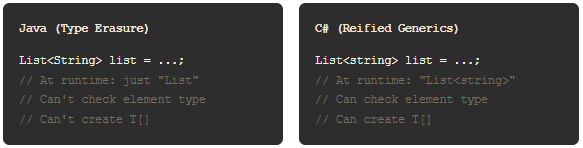
In C#, you can write new T[10] and it just works. You can use typeof(List<string>) and get accurate type information. Reflection sees the full generic types. All the things that Java can’t do, C# handles naturally.
4.1 But There Was a Cost
C# could do this because they controlled both the language and the runtime. When they added generics, they updated the .NET CLR (Common Language Runtime) to understand generic types. They didn’t have billions of lines of existing bytecode to worry about—.NET was newer.
Java couldn’t make that choice. The JVM had to remain compatible with pre-Java 5 bytecode. Updating the JVM would mean every Java application ever written might need recompilation. For a language deployed on billions of devices, that wasn’t viable.
The Fundamental Trade-off: Java chose broad compatibility over complete features. C# chose complete features over backwards compatibility with older .NET versions. Neither decision was wrong—they reflected different priorities.
5. Performance Implications
Type erasure has subtle performance effects that aren’t immediately obvious.
5.1 The Hidden Costs

Boxing overhead: When you use generics with primitive types like List<Integer>, every int gets boxed into an Integer object. Type erasure means the JVM can’t create specialized versions for primitives. This costs both memory and CPU time.
Runtime casts: The compiler inserts type casts everywhere you retrieve from generic collections. While these casts are fast, they’re not free. Modern JVMs optimize them aggressively, but they still represent overhead that C#’s reified generics avoid.
No specialization: The JVM can’t create optimized versions of generic code for different types. List<Integer> and List<String> use exactly the same bytecode at runtime, preventing type-specific optimizations.
| Operation | Java (Erasure) | C# (Reified) | Overhead |
|---|---|---|---|
| List<int> add | Box to Integer object | Direct primitive store | ~10-20x slower |
| List<int> get | Unbox from Integer | Direct primitive load | ~5-10x slower |
| List<String> get | Runtime type cast | No cast needed | ~2-5% slower |
| Generic method call | Same code for all types | Can specialize per type | Varies |
For reference types like String, the overhead is minimal. For primitives, it’s significant. This is why Java developers often avoid List<Integer> in performance-critical code, using primitive arrays instead.
6. Project Valhalla: Hope on the Horizon?
Project Valhalla is Java’s ambitious effort to address these limitations. It’s been in development since 2014—a decade-long project to fundamentally improve Java’s type system without breaking existing code.
6.1 What Valhalla Promises
Specialized Generics: The JVM would generate specialized versions of generic classes for different types. List<Integer> and List<String> would have different runtime implementations, eliminating boxing overhead for primitives.
Value Types: New lightweight types that have class-like features but primitive-like performance. Think of them as “objects without identity”—they can’t be null and don’t have object headers.
Backwards Compatibility: Existing code keeps working. The JVM would support both erased and specialized generics, migrating gradually.

6.2 Why It’s Taking So Long
Valhalla is complex because it must satisfy contradictory requirements. The JVM must support old erased generics and new specialized generics. Bytecode from 2004 must run alongside bytecode from 2024. Every change must be invisible to existing code yet provide benefits to new code.
It’s like renovating a house while people live in it, without them noticing construction, and ensuring their furniture fits in the new layout exactly as it did before.
- 2014: Project Valhalla announced at JavaOne.
- 2018: Early prototypes of value types and specialized generics.
- 2022: Preview features in OpenJDK builds for testing.
- 2024: Still in development, with no definitive release date.
- 2026?: Optimistic target for production-ready features.
7. Living with Type Erasure Today
Until Valhalla arrives, you work around type erasure’s limitations. Here’s how experienced Java developers cope:
7.1 Pass Class Objects Explicitly
When you need runtime type information, pass it as a parameter:
public <T> T create(Class<T> type) {
// Now you have runtime type info
return type.getDeclaredConstructor().newInstance();
}
This is verbose but works. Frameworks like Spring use this pattern extensively.
7.2 Use TypeToken Pattern
Libraries like Gson use the TypeToken pattern to capture generic type information through subclassing:
// Captures List<String> at compile time
Type type = new TypeToken<List<String>>() {}.getType();
It’s clever but feels like a hack because it is one—you’re exploiting Java’s type system to preserve information that should have been there naturally.
7.3 Avoid Generic Arrays
Just don’t use them. Use ArrayList instead of arrays when working with generics. Yes, it’s less efficient, but it’s less buggy too.
7.4 Accept the Limitations
Sometimes the best solution is designing your code to not need what type erasure removes. If you can’t check instanceof List<String>, design APIs that don’t require that check.
8. The Lesson for Language Design
Java’s type erasure teaches us something important about language evolution: backwards compatibility has long-term costs.
In 2004, type erasure was pragmatic. Java had millions of users and billions of lines of code. Breaking compatibility wasn’t realistic. But that pragmatic choice created technical debt that compounded for twenty years.
Modern languages like Kotlin, Rust, and Go learned from this. They designed generics (or equivalent features) correctly from the start, even though it meant their type systems were more complex initially.
The Backwards Compatibility Paradox: Maintaining compatibility keeps existing users happy but can prevent improvements that would attract new users. Java chose existing users over potential users—a defensible choice, but one with lasting consequences.
9. What We’ve Learned
Type erasure is a compromise, not a mistake. In 2004, Java’s architects faced an impossible choice: break millions of lines of existing code or implement generics with limitations. They chose the path that kept Java’s massive ecosystem intact.
Twenty years later, we live with those limitations daily. We can’t create generic arrays. We can’t use instanceof with parameterized types. We pay boxing overhead for primitive collections. We write workarounds that feel like hacks because they are hacks—patches over a decision made when backward compatibility trumped perfect design.
C# showed that reified generics are superior technically. But C# had the luxury of a younger ecosystem and control over their entire runtime. Java didn’t have that luxury—they had billions of devices running Java bytecode that couldn’t be updated.
Project Valhalla represents Java’s attempt to fix this without breaking the world. It’s taking years because the problem is genuinely hard. You can’t simply add reified generics to Java—you must support both erased and specialized generics simultaneously, maintaining compatibility with twenty years of existing bytecode.
For developers today, type erasure is a reality you work around, not against. Pass Class objects explicitly. Use TypeToken when needed. Avoid generic arrays. And remember that these limitations aren’t failures of imagination—they’re the price of compatibility with one of the most successful programming platforms in history.
Every language makes trade-offs. Java traded complete generics for backwards compatibility. It’s easy to criticize in hindsight, but that decision kept Java viable when other languages that broke compatibility faded into obscurity. Type erasure haunts us, yes—but it haunts us while we build systems that serve billions of users on millions of devices. That’s a compromise worth understanding, even if we don’t always like it.