Building an ecommerce website represents one of the most significant investments you’ll make in your business, yet answering the seemingly simple question of “how much will it cost?” proves remarkably complex. The digital marketplace has evolved dramatically, and with the U.S. eCommerce market looking to surpass $6.8 trillion in 2025, the stakes for getting your online presence right have never been higher. Your investment could range anywhere from a few hundred dollars for a basic setup to well over $150,000 for an enterprise-grade solution, and understanding why this range exists is crucial for making informed decisions about your business.
The truth is that ecommerce website costs aren’t determined by a single factor but by a constellation of choices you’ll make throughout the development process. The platform you select, the design complexity you require, the features your customers expect, and even the geographic location of your development team all play significant roles in shaping your final investment. What makes this even more challenging is that the visible development costs represent only part of the equation—ongoing expenses for hosting, maintenance, marketing, and payment processing can significantly impact your total cost of ownership over time.
This guide cuts through the complexity to provide you with a clear, realistic understanding of ecommerce website costs in 2025. We’ll explore different approaches from DIY website builders to custom development, break down the various cost components, reveal hidden expenses that catch many business owners by surprise, and help you determine which investment level makes sense for your specific situation.
1. Understanding the Cost Spectrum
The phrase “building an ecommerce website” means vastly different things depending on your business needs, technical capabilities, and growth ambitions. According to industry analysis, building an eCommerce site in 2025 can cost anywhere from $3,000 to well over $150,000+, and this wide range reflects fundamentally different approaches to creating your online presence.
At the entry level, you’ll find DIY solutions using platforms like Shopify, Wix, or Squarespace where businesses with limited technical expertise can launch functional stores relatively quickly. These platforms provide templates, integrated payment processing, and hosting as part of their subscription packages. A simple single-page or template-based site could be $500, while a basic 5-page site without custom work might be about $1,500. For solopreneurs or small businesses testing product-market fit, this represents an accessible entry point into ecommerce.
The middle tier encompasses businesses that need more customization, professional design, and integration with other business systems. According to research on development costs, more complex sites with 5-10 pages and custom code can range from $2,500 to $5,000, while average eCommerce website design and development prices range from $10,000 to $250,000 or more depending on complexity. These projects typically involve working with developers or agencies to create branded experiences that differentiate your store from competitors.
At the enterprise level, you’ll find businesses investing in completely custom platforms built to handle large product catalogs, complex customer journeys, and high-traffic volumes. Enterprise-level ecommerce sites often require significant customization and can take over 200 hours with costs starting from $20,000 to $100,000 or more. These solutions offer maximum flexibility and control but require substantial upfront investment and ongoing technical expertise to maintain.
The key to making a smart investment lies not in finding the cheapest option but in aligning your spending with your actual business needs. A $50,000 custom platform wastes money if you’re testing a business concept with uncertain demand, while a $2,000 template-based store limits growth if you’re an established business ready to scale aggressively.
2. Platform Choices and Their Cost Implications
Your choice of ecommerce platform fundamentally shapes both your initial development costs and ongoing operational expenses. The platform decision isn’t just about today’s budget—it’s about your total cost of ownership over years of operation and your ability to grow without hitting technical limitations. Let’s examine the most popular options and their true cost implications.
Shopify: The All-in-One Solution
Shopify has emerged as perhaps the most popular ecommerce platform for businesses of all sizes, offering a balance between ease of use and capability. Shopify pricing starts at $29/month for basic plans, with mid and advanced tiers at $79 and $299, while Shopify Plus starts at $2,500/month targeting enterprise brands. These subscription fees include hosting, security, and basic functionality, making budgeting relatively straightforward.
However, the listed plan prices represent only part of your actual Shopify investment. According to platform analysis, a professional Shopify website may cost $2,000 to $15,000 to set up when accounting for themes, apps, and customization. Premium themes typically range from $100 to $500, while the apps you’ll need for features like email marketing, reviews, and inventory management can quickly add $50 to $300 monthly to your operational costs.
The platform shines in its simplicity and reliability. Shopify offers a fully hosted solution with step-by-step onboarding, where hosting, SSL, security, and updates are all included. For businesses without technical expertise or those prioritizing speed to market, Shopify eliminates many headaches associated with website management. The trade-off comes in flexibility—deeper customization requires learning Liquid, Shopify’s proprietary templating language, or hiring developers who specialize in the platform.
Transaction fees represent another consideration. Shopify Payments charges 2.9% plus $0.30 for Basic Shopify, 2.6% plus $0.30 for Shopify, and 2.4% plus $0.30 for Advanced Shopify, with third-party providers adding extra fees. Over time, these percentage-based fees can significantly impact profitability, particularly for high-volume stores.
WooCommerce: The Flexible Alternative
WooCommerce takes a fundamentally different approach as a free WordPress plugin rather than a standalone platform. The base WooCommerce and WordPress software is free and open-source, meaning you pay only for the additional features you need. This gives you exceptional control over costs and functionality, but shifts responsibility for hosting, security, and maintenance onto your shoulders.
The real costs of WooCommerce emerge when you account for the supporting infrastructure. The most cost-effective WooCommerce approach uses basic hosting at $20-50/month and a premium theme at $50-100, with total startup costs ranging from $2,000-5,000 including essential plugins and basic customization. Payment processing follows similar patterns to Shopify, with WooCommerce’s WooPayments plugin offering standard pricing from 2.90% plus 30¢ per transaction.
The platform excels in customization and scalability on your own terms. WooCommerce gives you complete control over costs and can handpick enhanced functionality as needed, without upgrading to arbitrarily-priced plans full of features you won’t use. This flexibility proves particularly valuable as your business grows and your needs evolve beyond standard platform capabilities.
However, WooCommerce demands more technical expertise or budget for developer support. WooCommerce requires hosting and setup with a steeper learning curve but offers greater flexibility. For businesses with development resources or those willing to invest in agency partnerships, this trade-off often proves worthwhile for the long-term control and customization options it provides.
BigCommerce and Other Enterprise Solutions
For businesses outgrowing Shopify but not ready for fully custom development, platforms like BigCommerce offer middle-ground solutions. BigCommerce is often better for high-volume stores because it charges no transaction fees on any plan, while Shopify adds 0.5-2% fees if you don’t use Shopify Payments. For stores generating significant revenue, these fee differences can translate to thousands of dollars in annual savings.
At the enterprise level, solutions like Magento (Adobe Commerce) provide maximum flexibility and scalability. Magento Open Source appears free but typically costs $15,000-40,000 for professional implementation, while Magento Commerce starts at $22,000/year licensing plus $40,000-200,000 development costs. These platforms make sense primarily for large enterprises with complex B2B requirements and sufficient revenue to justify the investment.
3. Breaking Down Development Costs
Beyond platform selection, the actual building of your ecommerce store involves multiple cost components that vary dramatically based on your approach. Understanding these elements helps you make informed decisions about where to invest and where to economize.
Design and User Experience
Your store’s visual appearance and usability directly impact customer trust and conversion rates. Research shows that 94% of first impressions relate to design, and while custom design costs more upfront, it can significantly improve conversion rates and customer trust. This makes design one of the most consequential investments you’ll make.
Pre-built themes represent the most economical design option. Many ecommerce platforms offer pre-designed themes with options ranging from free to over $100, while premium themes can cost between $100-$500. These templates provide professional aesthetics and proven functionality without custom development costs. Modern themes often include responsive design, optimization for mobile devices, and integration with popular platform features.
Custom design becomes necessary when your brand requires unique visual identity or specific user experience flows that templates can’t provide. Hiring a professional for ecommerce website design typically starts at around $3,000-$10,000, and can go up, because an ecommerce website usually requires a complex setup and additional plugins. This investment buys you distinctive branding, optimized conversion paths, and design elements tailored to your target audience.
The choice between template and custom design often correlates with your market position and competitive environment. Established brands competing in crowded markets typically benefit from custom design that differentiates them, while new businesses testing concepts can often succeed with well-chosen templates that allow faster, less expensive launches.
Development and Technical Implementation
The technical work of building your store encompasses everything from configuring your platform to implementing custom features and integrations. Development for smaller sites often matches or exceeds design time, with costs ranging from $3,000 to $15,000 depending on deliverables. This work includes setting up product catalogs, implementing checkout flows, configuring payment gateways, and ensuring everything works reliably across devices.
For businesses with specific requirements beyond standard platform capabilities, custom development becomes necessary. A basic example might involve creating a specialized product configurator or implementing unique pricing rules for wholesale customers. More complex projects require substantial development investment:
// Example: Basic custom product recommendation engine
class ProductRecommendations {
  constructor(products, userHistory) {
    this.products = products;
    this.userHistory = userHistory;
  }

  generateRecommendations(currentProduct, limit = 4) {
    // Calculate similarity scores based on categories and user behavior
    const recommendations = this.products
      .filter(p => p.id !== currentProduct.id)
      .map(product => ({
        product,
        score: this.calculateScore(product, currentProduct)
      }))
      .sort((a, b) => b.score - a.score)
      .slice(0, limit)
      .map(item => item.product);

    return recommendations;
  }

  calculateScore(product, currentProduct) {
    let score = 0;

    // Category matching
    if (product.category === currentProduct.category) score += 50;

    // Price range similarity
    const priceDiff = Math.abs(product.price - currentProduct.price);
    score += Math.max(0, 30 - (priceDiff / currentProduct.price) * 30);

    // User history
    if (this.userHistory.viewedCategories.includes(product.category)) {
      score += 20;
    }

    return score;
  }
}

// Usage in your ecommerce store
const userHistory = {
  viewedCategories: ['electronics', 'accessories'],
  purchases: []
};

const recommendations = new ProductRecommendations(
  allProducts,
  userHistory
);

const suggested = recommendations.generateRecommendations(
  currentProduct,
  4
);
This simplified example demonstrates custom functionality that improves customer experience and potentially increases sales through intelligent product suggestions. Real implementations would be more sophisticated, but such features require developer time that adds to project costs.
Integration with third-party services represents another significant cost factor. Each third-party add-on integration adds up to $1,000 to $10,000, depending on the add-on price and customization required. Common integrations include accounting software, inventory management systems, email marketing platforms, and shipping providers. The complexity of these integrations varies—some platforms offer pre-built connectors while others require custom API work.
Content Creation and Product Data
Many businesses underestimate the work involved in creating quality content for their ecommerce store. Beyond the technical development, someone needs to write product descriptions, capture or source product images, and create supporting content that helps customers make purchase decisions.
Professional product photography makes a substantial difference in conversion rates but adds considerable expense. Professional product photography costs $50-$500 per product, while copywriting runs $50-$200 per product for your initial catalog. For stores with hundreds of SKUs, these costs multiply quickly and can rival development expenses.
Some businesses attempt to economize by using manufacturer-provided images and descriptions, but this approach has drawbacks. Generic content often underperforms custom content in search rankings, fails to differentiate your brand, and may be identical to what competitors display. The investment in original content frequently pays for itself through improved conversion rates and search visibility.
4. Hidden Costs That Catch Business Owners by Surprise
The quoted development price for your ecommerce website rarely tells the complete story. A constellation of additional expenses—some one-time, others recurring—can significantly impact your total investment. Understanding these hidden costs helps you budget accurately and avoid unpleasant surprises.
Infrastructure and Operational Expenses
Domain registration and SSL certificates represent relatively modest but necessary expenses. Domain names cost $15 to $60 per year for a .com domain, while SSL certificates ensure secure transactions between your store and customers. Many platforms include SSL as part of their hosting packages, but self-hosted solutions require separate SSL management.
Hosting costs vary dramatically based on your chosen approach and traffic levels. Web hosting can range from $3/month for basic shared hosting to hundreds of dollars per month for dedicated or cloud hosting solutions, with eCommerce websites often requiring more robust hosting plans due to traffic and transaction handling needs. Budget hosting may suffice initially, but growing stores typically need to upgrade to handle increased traffic and ensure acceptable page load times.
Payment Processing and Transaction Fees
Every sale you make incurs payment processing fees that eat into your profit margins. Payment processing fees typically follow a percentage of the transaction plus a fixed amount, with Shopify Payments charging 2.9% + $0.30 for Basic Shopify plans. While these percentages seem small, they compound significantly at scale. A store generating $500,000 in annual revenue at 2.9% processing fees pays $14,500 just for the privilege of accepting payments.
Different platforms take different approaches to these fees. Shopify adds an additional 2% fee when not using Shopify Payments processor, dropping to 1% on the Shopify plan. This penalty for using alternative payment processors can make platform-native solutions more economical despite potentially less favorable terms.
Chargebacks add another layer of expense and complexity. When customers dispute transactions, businesses lose the sale and pay an additional fee. Beyond the immediate financial impact, high chargeback rates can lead to increased processing fees or even losing payment processing privileges entirely, making fraud prevention and customer service investments crucial.
Apps, Plugins, and Feature Additions
The base functionality of most ecommerce platforms covers core shopping experiences, but competitive stores typically require additional capabilities. Major hidden costs include app and plugin subscriptions ranging from $200-1,000+ per month, plus premium themes and customizations. Email marketing, customer reviews, advanced analytics, subscription management, and loyalty programs usually require paid extensions.
These monthly fees accumulate surprisingly quickly. A moderately complex Shopify store might use apps for email marketing ($50/month), advanced product options ($20/month), customer reviews ($15/month), back-in-stock alerts ($10/month), and loyalty rewards ($30/month), totaling $125 monthly just for enhanced functionality. Over a year, these “small” additions represent $1,500 in operational costs beyond your platform subscription.
Maintenance and Ongoing Development
Websites aren’t “set it and forget it” assets—they require continuous maintenance, updates, and improvements to remain secure, functional, and competitive. Budget 15-25% of your initial development cost annually for maintenance and updates, with monthly operational costs of $200-2,000 depending on your platform, traffic, and tool stack. This includes hosting, apps, payment processing, and security monitoring.
Security particularly demands ongoing attention. Hidden costs include SSL certificates, backup services, and ongoing security monitoring. Ecommerce sites are attractive targets for hackers given the sensitive customer and payment information they handle. Regular security audits, prompt patching of vulnerabilities, and monitoring for suspicious activity require either internal resources or service provider relationships.
Technology debt accumulates as platforms evolve, browsers change, and customer expectations shift. The store that looks modern and functions smoothly at launch may feel dated within two years without updates. Add 15-20% to your quoted development cost for hidden expenses like testing and QA, which runs $5,000-$25,000 for comprehensive testing across browsers, devices, and payment systems. This buffer prevents budget surprises and ensures smooth launches and ongoing operation.
Marketing and Customer Acquisition
Building your store represents only half the battle—driving traffic and converting visitors into customers requires sustained marketing investment. A common rule of thumb is to allocate 10-20% of your projected revenue to marketing, covering SEO, content marketing, social media, and paid advertising.
Many new ecommerce businesses underestimate customer acquisition costs and burn through development budgets before establishing sustainable traffic sources. The most beautifully designed, technically sophisticated store generates zero revenue without customers. Smart budgeting allocates substantial resources to marketing from day one rather than treating it as an afterthought once the site launches.
5. Making Smart Investment Decisions
With costs ranging so dramatically and numerous hidden expenses lurking, how do you decide what to invest in your ecommerce website? The answer lies in aligning your spending with your specific business situation, goals, and constraints rather than defaulting to either the cheapest or most expensive option.
Start with Business Requirements
Your investment should reflect your actual business needs rather than what’s possible or what competitors appear to do. A business testing a new product concept with uncertain market demand approaches ecommerce investment very differently than an established retailer with proven products moving online.
For early-stage businesses, the priority is validating demand quickly and economically. Smart strategies include starting with an MVP, using pre-built themes, and leveraging open-source platforms to control your budget. A $3,000 functional store that launches in three weeks teaches you more than a $50,000 perfect store that takes six months. You can always invest in improvements once revenue validates the business model.
Established businesses with proven products and customer bases justify larger investments in custom features, branded design, and integrations that improve operational efficiency. When you’re confident in demand and understand customer preferences, investing in experiences that increase conversion rates and average order values makes economic sense. A 2% conversion improvement on $1 million in annual traffic justifies substantial design and optimization investment.
Consider Total Cost of Ownership
Comparing ecommerce options based solely on initial development costs misses crucial differences in ongoing expenses. Budget 15-20% of annual revenue for continuous improvements to keep your store competitive and growing with customer expectations. A platform that costs $5,000 more initially but saves $200 monthly in operational expenses pays for itself within two years.
Transaction fees particularly impact total cost of ownership for successful stores. A platform charging 2% on transactions versus one with no transaction fees makes little difference at $50,000 in annual sales ($1,000 difference) but creates a $10,000 annual difference at $500,000 in sales. Choosing platforms based on your growth projections rather than just current sales helps avoid expensive migrations later.
Consider also the cost of changing platforms if your initial choice proves limiting. Data migration for moving products, customers, and orders from old systems typically costs between $2,000 and $20,000. Platform lock-in becomes expensive when you’ve invested heavily in platform-specific customizations or integrations that don’t transfer to alternatives. Building on more flexible, portable foundations may cost more initially but preserve future optionality.
Balance DIY and Professional Help
The equation between doing work yourself versus hiring professionals depends on your skills, available time, and opportunity cost. Technical founders with web development backgrounds can reasonably build initial stores themselves, saving tens of thousands in development costs. Business owners without technical skills who attempt DIY approaches often invest months of time to achieve mediocre results that require expensive rebuilds.
Agencies offer specialized expertise, scalability, and a fresh perspective, often accelerating development timelines, though the overall cost might be higher. The value lies not just in execution but in avoiding costly mistakes. Experienced agencies have built dozens or hundreds of stores and understand patterns that work, potential pitfalls, and efficient approaches to common requirements.
Hybrid approaches often provide the best balance. You might handle content creation and product data yourself while hiring designers and developers for technical implementation. Or you could launch with a template-based DIY approach to validate demand, then invest in professional redesign and custom development once you’re confident in the business model. The key is honestly assessing your capabilities and being willing to invest in professional help for areas outside your expertise.
Plan for Iteration and Growth
No ecommerce store launches perfect, and attempting perfection before launch often leads to delays and wasted resources. Start with a clear scope or MVP, use open-source or flexible platforms when possible, and leverage pre-built components for faster development. Launch with core functionality that allows customers to browse products, add items to carts, and complete purchases, then add refinements based on actual customer behavior and feedback.
Building iteratively requires choosing platforms and approaches that support ongoing development. Custom-coded solutions on proprietary platforms or tightly coupled architectures become expensive to modify. More flexible foundations using popular platforms, standard technologies, and modular architectures make future enhancements economical and straightforward.
Budget not just for initial launch but for ongoing improvements. Set aside 10-15% of annual revenue for continuous improvements to your store. Competitive ecommerce requires constant evolution—new features, design refinements, performance optimizations, and experience improvements based on customer data. Stores that stagnate after launch lose ground to competitors investing in their customer experience
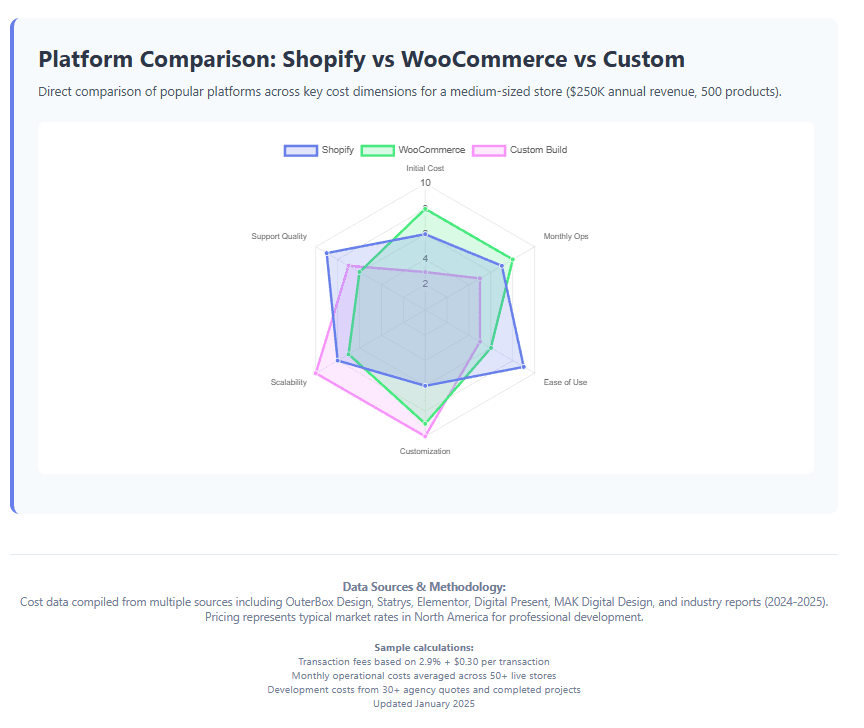
Understanding ecommerce costs becomes clearer when you see how different approaches compare across multiple dimensions. The following interactive visualizations present real-world cost data to help you evaluate options.
The visualizations include comprehensive breakdowns across three key perspectives:
Chart 1: Initial Development Costs by Platform – Compares startup investments for different platform choices and complexity levels. DIY Shopify setups start around $2,500 including themes and basic apps, professional Shopify development ranges from $8,000-$25,000, WooCommerce implementations span $3,000-$15,000, and enterprise custom solutions begin at $40,000 and can exceed $150,000 for complex marketplaces.
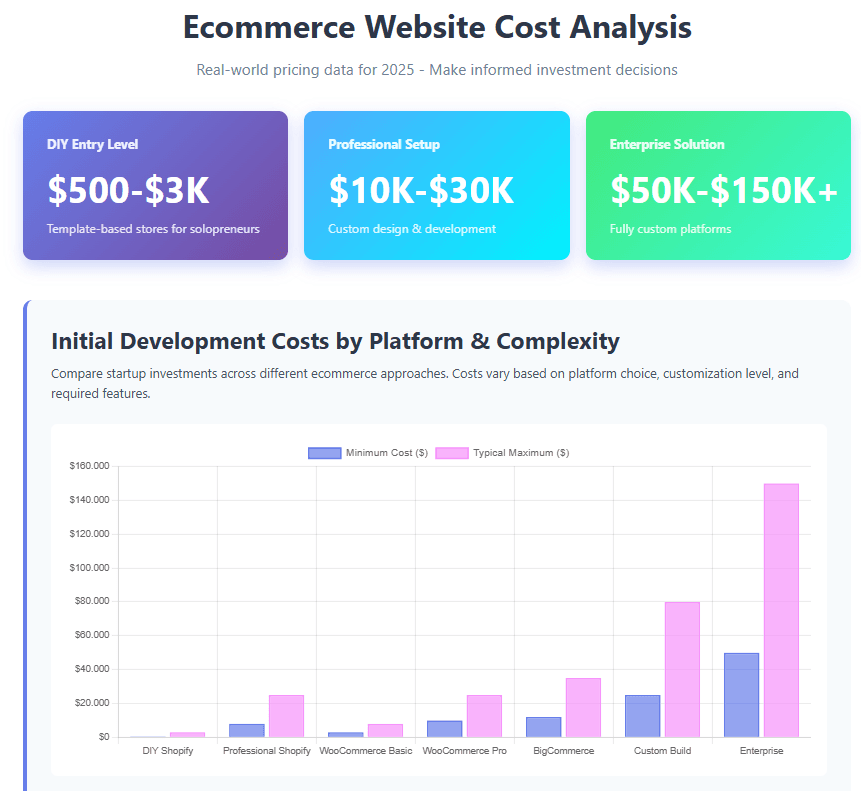
Chart 2: Monthly Operational Expenses – Shows recurring costs across different store sizes and platforms. Small stores typically spend $100-$300 monthly on hosting, apps, and maintenance. Medium-sized stores average $400-$1,200 monthly covering enhanced features, better hosting, and security. Large enterprise operations require $2,000-$5,000+ monthly for robust infrastructure, advanced tools, and dedicated support.
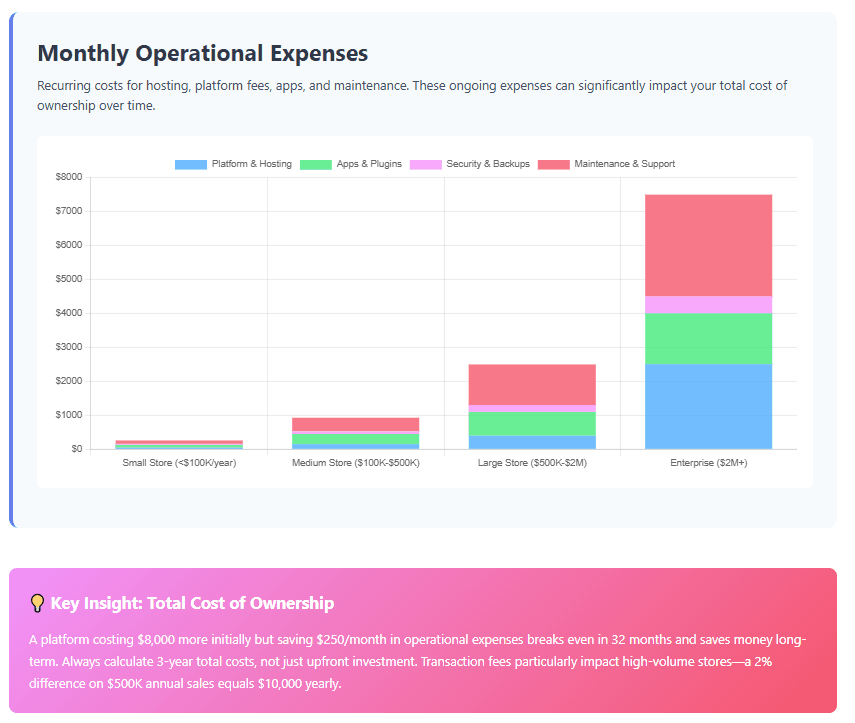
Chart 3: Total Cost of Ownership Comparison – Illustrates cumulative three-year costs factoring in development, operations, transaction fees, and maintenance. This reveals how platforms with higher upfront costs but lower ongoing expenses can prove more economical long-term, while initially cheaper options may cost more over time due to transaction fees and scalability limitations.
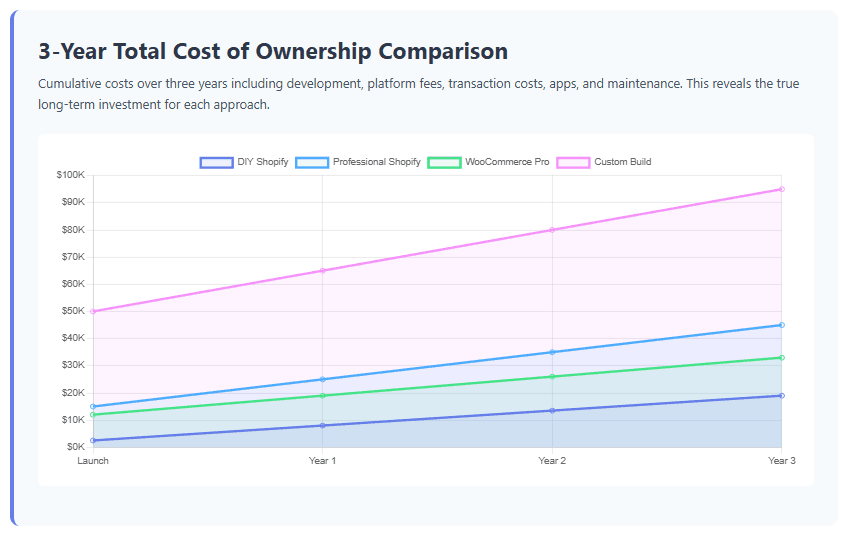
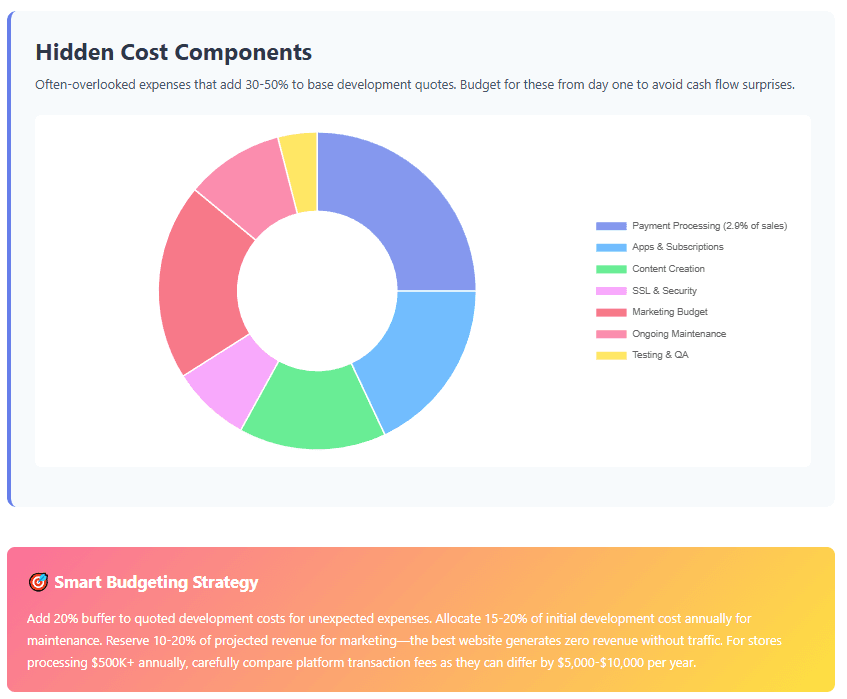
Chart 4: Hidden Cost Components – Breaks down often-overlooked expenses that add 30-50% to base development quotes. Payment processing fees (2.4-2.9% of revenue), third-party app subscriptions ($200-$1,000+ monthly), SSL and security ($200-$500 annually), content creation ($50-$500 per product), marketing (10-20% of revenue), and ongoing maintenance (15-25% of initial development cost annually) all compound to significantly impact total investment.
These visualizations use real pricing data from platform providers, agency quotes, and actual business operational data to give you realistic budget expectations based on your store size and complexity requirements.
6. Conclusion: Investing Wisely in Your Ecommerce Future
Building an ecommerce website represents a significant investment that can range from a few thousand dollars to well over $150,000 depending on your approach, requirements, and growth ambitions. We’ve explored how platform choice fundamentally shapes both initial and ongoing costs, with Shopify offering simplicity and reliability at premium pricing, WooCommerce providing flexibility and control for technically capable businesses, and enterprise solutions like Magento serving complex, high-volume operations.
The true cost of ecommerce extends well beyond the initial development quote. Hidden expenses including payment processing fees, app subscriptions, security measures, content creation, marketing, and ongoing maintenance can add 30-50% to your total investment if not properly planned. Understanding these costs upfront helps you budget realistically and avoid the cash flow pressures that derail many ecommerce ventures.
Perhaps most importantly, we’ve seen that the “right” investment level depends entirely on your specific situation. Early-stage businesses testing concepts benefit from lean, economical approaches that enable fast learning, while established businesses with proven demand justify larger investments in custom features and branded experiences that drive competitive advantage. The mistake isn’t spending too much or too little—it’s failing to align your investment with your business stage, goals, and constraints.
Success in ecommerce comes not from building the perfect store but from launching quickly, learning from real customer behavior, and iterating based on data rather than assumptions. Start with a clear minimum viable product that delivers core functionality, choose flexible platforms that support growth, budget appropriately for ongoing improvements, and remember that your ecommerce presence is never truly finished—it evolves continuously alongside your business and customer expectations. With realistic expectations and smart investment choices, your ecommerce website becomes not just a cost center but a powerful engine for business growth.