If you spend enough time building modern distributed systems, you eventually run into a familiar crossroads: should your services speak GraphQL, or should they speak Protobuf? It’s a bit like choosing between two very different communication styles. One is expressive, flexible, and conversational. The other is fast, efficient, and almost militaristically precise. And the truth is, both have their place — but for very different reasons.
GraphQL grew out of a world where frontends were constantly starving for the “right shape” of data. It’s a query language first and foremost, designed to let clients ask for exactly what they need. Nothing more, nothing less. That alone makes it feel incredibly liberating for product teams. You can almost sense the relief of a mobile app developer who no longer has to fetch an entire payload just to extract two fields.
Protobuf, on the other hand, comes from a completely different universe — one where performance is king, payload size matters, and services talk to each other constantly. It’s a binary serialization format, and it doesn’t apologize for being strict. In fact, that strictness is part of its charm. When you’re building a high‑throughput microservice architecture, you don’t want ambiguity. You want messages that are small, predictable, and fast to parse.
These two technologies often get compared as if they’re competing, but the more you work with them, the more you realize they’re solving different problems. GraphQL is about shaping data for humans. Protobuf is about moving data efficiently between machines.
1. Comparison Table: GraphQL vs Protobuf
| Feature | GraphQL | Protobuf |
|---|---|---|
| Primary Purpose | API query language | Binary serialization format |
| Transport | Typically HTTP | Typically gRPC (HTTP/2) |
| Data Format | JSON (text‑based) | Binary (compact, fast) |
| Client Flexibility | Very high | Low |
| Performance | Moderate | Extremely high |
| Schema Definition | GraphQL SDL | .proto files |
| Tooling Ecosystem | Strong for frontend & API gateways | Strong for backend & microservices |
| Learning Curve | Moderate | Higher |
| Best For | Public APIs, multi‑device apps | Internal microservices, high‑throughput systems |
2. A Visual Look at Their Philosophies
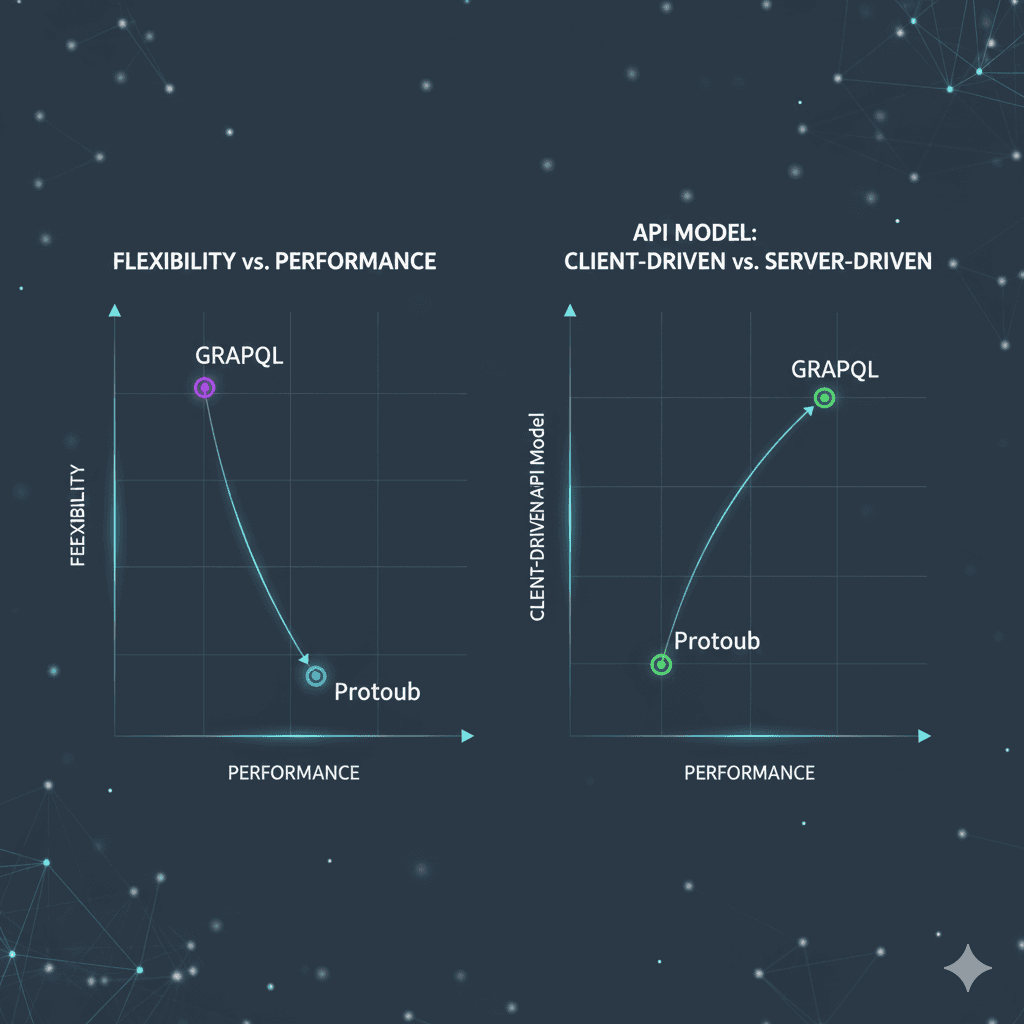
Sometimes it helps to visualize the difference in mindset. GraphQL feels like a conversation — the client asks questions, the server responds with exactly what was requested. Protobuf feels more like a contract — both sides agree on a message format, and then they exchange those messages as efficiently as possible.
Here’s a conceptual graph that captures the trade‑off between flexibility and performance:
3. How They Overlap More Than You’d Expect
Despite their differences, GraphQL and Protobuf share a surprising amount of DNA. Both are strongly typed. Both rely on schemas to keep things predictable. Both are language‑agnostic and supported by rich ecosystems. And both allow you to evolve your schema without breaking existing clients — which is a lifesaver in real‑world systems where nothing stays still for long.
But the way they express that structure is wildly different. GraphQL’s schema feels almost conversational, like a blueprint for the questions clients are allowed to ask. Protobuf’s schema feels more like a legal document — precise, compact, and optimized for machines rather than humans.
4. When GraphQL Feels Like the Right Choice
GraphQL shines when you’re building something that real humans interact with — mobile apps, dashboards, web clients, anything where the shape of the data matters as much as the data itself. It’s especially powerful when your backend is a patchwork of services and databases. GraphQL can sit in front of all of it, stitching together a unified view that feels elegant and predictable.
If your team iterates quickly, GraphQL becomes even more appealing. You can evolve your API without breaking clients, and clients can evolve without waiting for backend changes. It’s a kind of freedom that’s hard to give up once you’ve experienced it.
5. When Protobuf Is the Clear Winner
Protobuf is the tool you reach for when performance is non‑negotiable. If your services talk to each other constantly, or if you’re building something that needs to scale horizontally under heavy load, Protobuf is almost always the better choice. It’s compact, fast, and designed for machine‑to‑machine communication.
And when you pair Protobuf with gRPC, you get a communication stack that feels almost frictionless. Streaming, bidirectional communication, built‑in code generation — it’s the kind of setup that makes backend engineers smile.
6. The Secret: You Don’t Have to Choose
One of the best-kept secrets in modern architecture is that you can use both. In fact, many companies do exactly that:
- GraphQL at the edge, where clients need flexibility
- Protobuf inside the system, where services need speed
It’s a hybrid model that gives you the best of both worlds. Clients get the freedom to shape their queries. Services get the efficiency of binary messages. And your architecture becomes cleaner, more scalable, and easier to evolve.
7. What We Learned
GraphQL and Protobuf aren’t rivals — they’re complementary tools with very different philosophies. GraphQL is about expressiveness and client empowerment. Protobuf is about efficiency and precision. Understanding the strengths of each helps you design systems that feel both elegant and powerful. And once you see how naturally they can coexist, the question stops being “Which one should I choose?” and becomes “Where does each one fit best in my architecture?”