The perimeter has dissolved. Traditional security models that trusted everything inside the corporate network while defending against external threats have become dangerously obsolete. In their place rises Zero Trust—a security philosophy born from the reality that breaches are inevitable and trust must be continuously earned, never assumed.
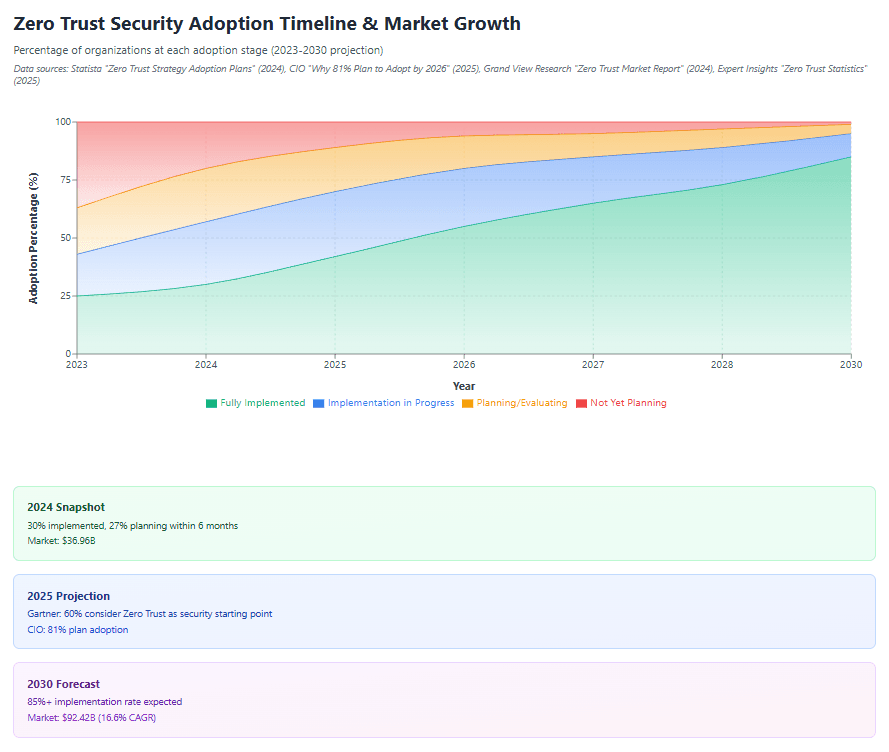
As of 2025, the zero trust market reached $38.37 billion and is projected to grow to $86.57 billion by 2030, reflecting urgent recognition that conventional security models no longer suffice in our distributed, cloud-native world. For Java developers and architects, implementing Zero Trust isn’t merely adopting new tools—it’s fundamentally rethinking how applications authenticate, authorize, and communicate.
1. Understanding Zero Trust Principles
Zero Trust operates on a deceptively simple premise: verify explicitly, use least privilege access, and assume breach. Unlike perimeter-based security that creates a fortress with a soft interior, Zero Trust treats every access request—whether from inside or outside the network—as potentially hostile until proven otherwise.
The principle of “never trust, always verify” means continuous authentication and authorization. A user authenticated five minutes ago isn’t automatically trusted now. A service that successfully called an API once must prove its identity again. This granular, persistent verification extends to every connection, every transaction, every data access.
Least privilege access ensures entities receive only the minimum permissions necessary for their immediate task. A microservice needing read access to customer names shouldn’t receive write permissions or access to payment information. This containment strategy limits blast radius—when (not if) a component is compromised, the damage remains localized rather than cascading through the system.
Assuming breach shifts security thinking from prevention-only to prevention-plus-containment. Security architectures built on this assumption implement micro-segmentation, continuous monitoring, and automated response mechanisms. The goal isn’t preventing every attack (impossible) but ensuring attacks that succeed cause minimal damage and are quickly detected and contained.
2. Service-to-Service Authentication: Beyond Simple Secrets
In microservices architectures, services continuously authenticate to one another. Traditional approaches using shared secrets or API keys create single points of failure and operational nightmares. Rotating a compromised API key across dozens of services becomes a high-stakes coordination challenge.
Modern service-to-service authentication leverages mutual TLS (mTLS) and service meshes. With mTLS, both client and server present certificates, cryptographically proving their identities. This bidirectional authentication eliminates many attack vectors—a compromised API key can’t impersonate a service without the corresponding private key and valid certificate.
Service mesh platforms like Istio automate mTLS certificate management, handling certificate generation, rotation, and distribution transparently. Services communicate through the mesh’s sidecar proxies, which enforce authentication policies without modifying application code. This separation of concerns allows security teams to evolve authentication mechanisms without requiring application deployments.
However, mTLS alone doesn’t address authorization. A service proves its identity through mTLS, but should it access this particular endpoint with these parameters? This requires additional layers—OAuth2 tokens, JWT claims, or proprietary authorization systems that evaluate context beyond mere identity.
Java applications integrate these patterns through frameworks like Spring Security. Configuration might declaratively specify that certain endpoints require mTLS with specific certificate attributes, while others additionally require OAuth2 tokens with particular scopes. The framework handles verification, exposing authenticated identity and claims to application logic.
3. API Gateway Patterns: The Security Enforcement Point
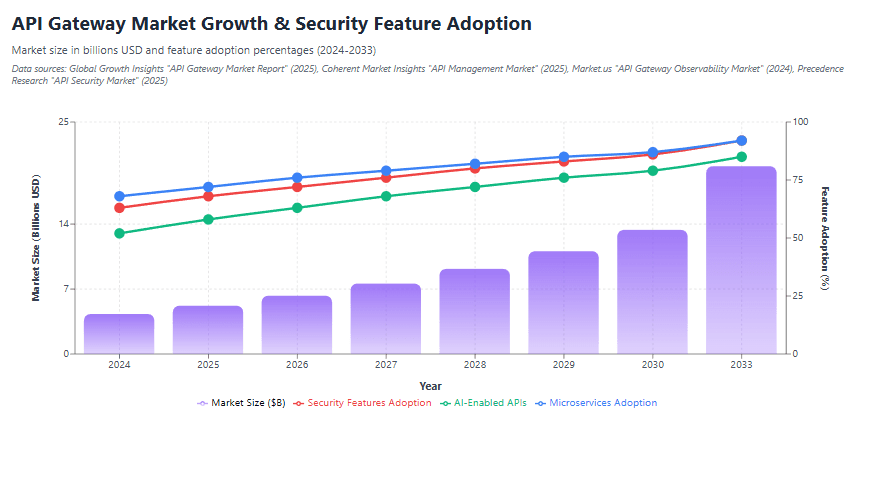
API gateways serve as centralized enforcement points for security policies, rate limiting, authentication, and authorization. The API gateway segment commands 37.2% of the API management market, reflecting their critical role in modern architectures.

A well-architected gateway handles authentication before requests reach backend services. It validates OAuth2 tokens, verifies JWT signatures, checks token expiration, and confirms required scopes. Invalid requests are rejected immediately, preventing unauthenticated traffic from touching internal systems. This defense-in-depth approach creates multiple validation layers—even if a backend service’s authentication logic has bugs, the gateway provides a safety net.
Beyond authentication, gateways enforce rate limiting to prevent abuse and DDoS attacks. They can implement sophisticated rules: allow 100 requests per minute for standard users but 10,000 for premium accounts; throttle requests from suspicious IP addresses; temporarily block clients exhibiting bot-like behavior. These policies protect backend services from overwhelming traffic while maintaining availability for legitimate users.
Gateways also provide observability—logging all API requests with correlation IDs that trace requests across services. This visibility is crucial for security monitoring. Anomalous patterns—a service suddenly calling APIs it rarely uses, requests from unexpected geographic locations, unusual data access patterns—can trigger alerts for security teams to investigate.
Java ecosystem offers mature gateway solutions. Spring Cloud Gateway provides a lightweight, programmable gateway for Spring Boot applications. Kong, built on NGINX, offers enterprise features like plugin architecture for custom authentication mechanisms. Apigee, Google’s API management platform, combines gateway functionality with analytics and developer portals.
The gateway pattern introduces a potential single point of failure. Organizations mitigate this through redundancy—deploying gateways across multiple availability zones, implementing health checks and automatic failover, and ensuring gateway infrastructure scales independently from backend services. Properly designed, the gateway becomes a force multiplier for security rather than a bottleneck.
4. Secret Management: Keeping Keys Away from Code
Hardcoded credentials represent one of the most persistent security anti-patterns. API keys, database passwords, and encryption keys embedded in source code or configuration files inevitably leak through version control history, container images, or log files. As of 2023, 36% of companies identified securely authenticating remote or offline workers as their most difficult challenge.
Modern secret management systems like HashiCorp Vault, AWS Secrets Manager, and Azure Key Vault provide centralized, audited storage for sensitive credentials. Applications authenticate to the secret management system and receive short-lived credentials valid only for their specific needs. When those credentials expire, applications request renewals—a cycle that dramatically reduces exposure windows.
Dynamic secrets take this further. Rather than storing static database passwords, Vault generates unique credentials on-demand for each application instance. When an application requests database access, Vault creates a new database user with appropriate permissions, provides those credentials to the application, and automatically revokes them after a configured TTL. If an attacker compromises one application instance, they gain credentials valid only for that instance’s limited lifetime.
Java applications integrate secret management through client libraries. A Spring Boot application might use Spring Cloud Vault to automatically populate configuration properties from Vault at startup. Rather than reading database passwords from application.properties, the application fetches them from Vault using its authenticated identity. The configuration looks similar to traditional approaches, but credentials never touch the filesystem.
Encryption keys deserve special attention. Applications often need to encrypt sensitive data—personally identifiable information, payment details, health records. Rather than storing encryption keys alongside encrypted data, applications should use envelope encryption: encrypt data with a data encryption key (DEK), encrypt the DEK with a key encryption key (KEK) stored in a key management service, and store the encrypted DEK with the encrypted data. This indirection ensures key rotation doesn’t require re-encrypting all data—just re-encrypting DEKs with new KEKs.
5. OAuth2 and OpenID Connect: Delegated Authentication Done Right
OAuth2 and OpenID Connect (OIDC) form the foundation of modern federated authentication. 87% of technology companies implement multi-factor authentication solutions, with OAuth2 and OIDC as primary enablement technologies. However, 46% of daily signup attempts meet attack criteria, highlighting persistent implementation challenges.
OAuth2 provides authorization—allowing applications to access resources on behalf of users without handling user credentials. OIDC extends OAuth2 with authentication—providing applications with verified user identity information. Together, they enable single sign-on, social login, and secure API access delegation.
A typical flow: user attempts to access a protected resource in your Java application. The application redirects to an identity provider (Google, Okta, Auth0). User authenticates and consents to sharing information with your application. Identity provider redirects back to your application with an authorization code. Your application exchanges that code for tokens: an access token for API calls and an ID token containing user information. The application validates tokens, establishes a session, and grants access.
Security vulnerabilities plague OAuth2 implementations. Open redirect attacks exploit misconfigured redirect URI validation. CSRF attacks trick users into unknowingly authorizing malicious applications. Token leakage through browser history or referer headers exposes sensitive credentials. PKCE (Proof Key for Code Exchange) mitigates many attacks for public clients by cryptographically binding authorization codes to the clients that requested them.
Java developers typically integrate OAuth2 through Spring Security OAuth2. The framework handles the complex protocol dance, provides hooks for custom validation logic, and secures endpoints based on token scopes. Configuration specifies identity provider details, required scopes, and token validation rules. The framework manages token storage, refresh, and invalidation.
ID tokens are JWTs—JSON Web Tokens signed by the identity provider. Applications must validate signatures using the provider’s public key, verify issuer and audience claims match expected values, confirm tokens haven’t expired, and check nonces prevent replay attacks. Skipping any validation step opens security vulnerabilities. The NGINX OIDC nonce bug (CVE-2024-10318) allowed session fixation attacks due to improper nonce validation.
Token storage presents challenges. Access tokens in browser local storage are vulnerable to XSS attacks. Storing them in HTTPOnly cookies provides XSS protection but requires CSRF protections. Refresh tokens, which issue new access tokens without user interaction, demand even more careful handling—they’re essentially bearer credentials for long-term access. Best practice stores refresh tokens server-side, associated with session identifiers, never exposing them to client-side code.
6. Certificate Management: The Foundation of mTLS
Mutual TLS authentication depends on valid, properly managed certificates. Organizations implementing mTLS for service-to-service authentication suddenly face operational challenges: generating certificates for hundreds of services, distributing them securely, rotating them before expiration, and revoking compromised certificates immediately.
Certificate authorities (CAs) issue certificates after verifying identity. Public CAs like Let’s Encrypt provide free certificates for internet-facing services. Internal CAs, whether self-managed or services like AWS Private CA, issue certificates for internal services. The CA signs certificates using its private key; anyone with the CA’s public key (the CA certificate) can verify certificate authenticity.
Short-lived certificates reduce compromise impact. A certificate valid for 90 days means a stolen certificate grants access for at most 90 days, likely less before automated rotation replaces it. Organizations increasingly adopt certificates valid for hours or days, accepting operational complexity for security gains. Automation becomes mandatory—manual certificate management fails at this cadence.
cert-manager automates certificate lifecycle for Kubernetes workloads. It requests certificates from configured CAs (Let’s Encrypt, internal CAs, Vault PKI), stores them as Kubernetes secrets, and automatically renews certificates before expiration. Services reference these secrets for mTLS configuration, receiving updated certificates transparently as cert-manager rotates them.
Java applications access certificates through keystores—password-protected files containing private keys and certificates. Modern approaches use external secret management to provision keystores dynamically rather than baking them into container images. A sidecar container might fetch certificates from Vault at startup, write them to a shared volume, and trigger the Java application to reload. This pattern keeps private keys out of version control and container registries.
Certificate revocation poses challenges. CRLs (Certificate Revocation Lists) and OCSP (Online Certificate Status Protocol) provide mechanisms to check if certificates have been revoked. However, checking revocation for every TLS handshake introduces latency and availability dependencies. OCSP stapling, where servers periodically fetch their own OCSP responses and include them in TLS handshakes, provides a middle ground—clients receive revocation status without contacting OCSP responders.
7. Security Scanning in CI/CD Pipelines: Shifting Left
Zero Trust extends beyond runtime to development pipelines. Security scanning in CI/CD catches vulnerabilities before they reach production, embodying the “shift left” philosophy of addressing security early in development lifecycles.
Static Application Security Testing (SAST) analyzes source code for security vulnerabilities without executing it. Tools like SonarQube, Checkmarx, and Fortify identify issues like SQL injection vulnerabilities, hardcoded secrets, insecure cryptographic algorithms, and improper input validation. Integrated into CI pipelines, SAST fails builds when critical vulnerabilities are detected, preventing vulnerable code from progressing.
Dependency scanning audits third-party libraries for known vulnerabilities. Java applications typically depend on hundreds of transitive dependencies—libraries that your dependencies depend on. Vulnerabilities in any dependency compromise your application. OWASP Dependency-Check and Snyk scan dependencies against vulnerability databases, identifying libraries with known CVEs and recommending version upgrades or alternative libraries.
Container image scanning examines Docker images for vulnerabilities in base images and installed packages. Even if application code is secure, using a base image with vulnerable system libraries creates exposure. Trivy, Clair, and commercial tools scan images during CI builds and in registries, alerting on newly discovered vulnerabilities in previously scanned images.
Infrastructure as Code (IaC) scanning analyzes Terraform, CloudFormation, or Kubernetes manifests for security misconfigurations. Tools like Checkov and tfsec identify issues like overly permissive IAM roles, unencrypted storage, public S3 buckets, and missing security groups. Catching these before infrastructure deployment prevents exposing production systems to easily preventable attacks.
Secret scanning prevents credentials from entering version control. Tools like git-secrets and TruffleHog scan commits for patterns resembling API keys, passwords, and tokens. Pre-commit hooks reject commits containing secrets, while repository scanning audits history for accidentally committed credentials. When secrets are found, they must be rotated immediately—scanning only provides awareness, not protection, since compromised credentials require remediation.
Dynamic Application Security Testing (DAST) probes running applications for vulnerabilities. Unlike SAST’s static analysis, DAST actually interacts with applications, detecting runtime issues like authentication bypass, session management flaws, and server misconfigurations. OWASP ZAP and Burp Suite automate attacks against staging environments, identifying vulnerabilities that manifest only during execution.
Integration patterns vary by organizational maturity. Initial adoption often begins with warnings on vulnerability detection, progressing to failing builds for critical issues, eventually blocking deployment of any artifact with known vulnerabilities above a risk threshold. This gradual approach prevents security from becoming a bottleneck while steadily raising baseline security posture.
8. Implementing Zero Trust: Practical Java Patterns
Translating Zero Trust principles into working Java code requires thoughtful architecture. Consider a Spring Boot microservice participating in a Zero Trust environment:
Authentication Layer: The service requires mTLS for all incoming connections. Spring Security configuration validates client certificates and extracts identity claims:
@Bean
public SecurityFilterChain filterChain(HttpSecurity http) throws Exception {
    http
        .x509()
            .subjectPrincipalRegex("CN=(.*?)(?:,|$)")
            .userDetailsService(userDetailsService())
        .and()
        .authorizeHttpRequests()
            .requestMatchers("/admin/**").hasRole("ADMIN")
            .anyRequest().authenticated();
    return http.build();
}
Authorization Context: Every request includes JWT access tokens with scopes defining permitted operations. The service validates tokens and enforces scope-based access control.
Secrets Management: Database credentials come from Vault, refreshed hourly. Connection pools handle credential rotation transparently by reconnecting with new credentials.
Observability: Every request generates structured logs with correlation IDs, user context, and security decisions. These logs flow to a SIEM system for analysis.
Graceful Degradation: When external dependencies fail (Vault unavailable, certificate renewal failures), the service continues operating with cached credentials or certificates but alerts operators and enters a degraded state preventing new connections.
This architecture embodies Zero Trust—continuous verification, minimal privilege, failure isolation, and comprehensive observability. No single component compromise grants broad system access.
9. Challenges and Trade-offs
Zero Trust isn’t free. Performance overhead from constant authentication and encryption affects latency-sensitive applications. Certificate management complexity overwhelms teams without automation expertise. Observability requirements generate massive log volumes requiring sophisticated tooling and storage.
Organizational challenges often exceed technical ones. Zero Trust requires coordinated changes across application teams, security teams, and infrastructure teams. Developers must understand security implications of their code. Security teams must enable rather than block. Infrastructure teams must provide reliable secrets management and certificate infrastructure.
The transition from perimeter security to Zero Trust can’t happen overnight. Organizations typically adopt incrementally—starting with new microservices, gradually retrofitting legacy applications, eventually achieving comprehensive Zero Trust architecture. During transition, hybrid approaches maintain perimeter defenses while implementing Zero Trust principles for new components.
10. What We’ve Seen: Building Security into Modern Java Applications
Zero Trust represents a fundamental paradigm shift from “trust but verify” to “never trust, always verify.” Over 30% of organizations have already implemented Zero Trust strategies, with 27% planning implementation within six months, reflecting widespread recognition that perimeter-based security no longer suffices.
For Java developers, Zero Trust isn’t a single technology but an architectural approach implemented through service-to-service authentication, API gateways, secrets management, OAuth2/OIDC federation, certificate management, and automated security scanning. Each component addresses specific aspects of the broader Zero Trust philosophy.
Service meshes and mTLS provide cryptographic identity verification for every service interaction. API gateways centralize security enforcement, providing defense-in-depth. Secrets management systems eliminate hardcoded credentials, reducing exposure windows through dynamic secrets and automatic rotation. OAuth2 and OIDC enable federated authentication while preventing applications from handling user credentials directly.
Certificate management, once a manual administrative burden, becomes automated infrastructure that transparently rotates certificates and distributes them to services. Security scanning in CI/CD pipelines catches vulnerabilities before they reach production, reducing the cost and risk of security defects.
The BFSI sector leads Zero Trust adoption with 28.8% market share, driven by stringent regulatory requirements and high-value targets. Healthcare follows close behind, motivated by HIPAA compliance and the sensitive nature of health data. These sectors demonstrate that Zero Trust provides both security and compliance benefits.
Success requires balancing security with operational reality. Perfect security that prevents applications from functioning serves no one. Zero Trust architectures must enable business objectives while dramatically reducing attack surface and blast radius. This balance comes through thoughtful design, extensive automation, and organizational commitment to security as a first-class concern rather than an afterthought.
The journey to Zero Trust is ongoing. New attack vectors emerge, technologies evolve, and organizational needs change. The principles remain constant: verify explicitly, grant least privilege access, and assume breach. Java applications built on these foundations adapt more readily to emerging threats and scale more securely than those clinging to obsolete perimeter-based models.
In our distributed, cloud-native world, Zero Trust isn’t optional—it’s the foundation upon which resilient, secure systems are built. The question isn’t whether to adopt Zero Trust, but how quickly you can implement it before the inevitable breach occurs.