The choice between Spring Boot and Node.js for microservices architecture is one of the most consequential decisions an engineering team will make. Both platforms have proven themselves in production at scale, yet they approach the same problems from fundamentally different philosophies. This article examines both frameworks through the lens of enterprise requirements: performance, scalability, developer productivity, and operational complexity.
1. The Fundamental Divide
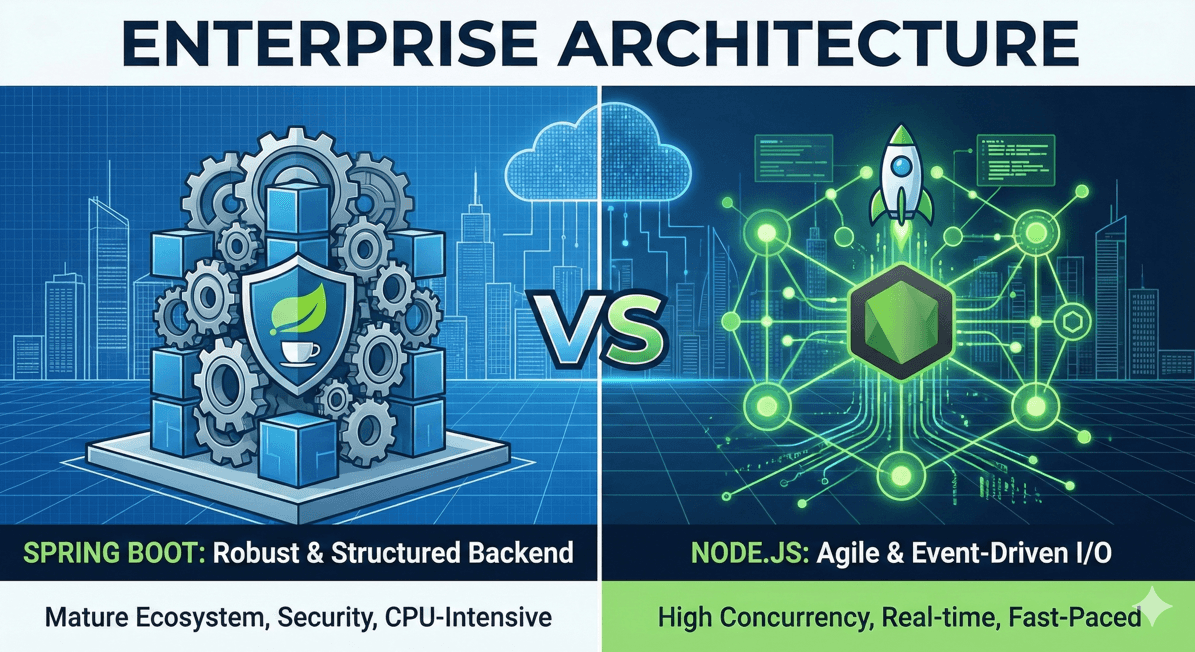
Spring Boot represents the evolution of Java’s enterprise ecosystem—a mature, opinionated framework built on decades of distributed systems experience. Node.js, by contrast, brings JavaScript’s event-driven model to the backend, offering a lightweight, flexible approach that appeals to teams seeking rapid development cycles.
The architectural implications run deeper than language preference. Spring Boot applications typically follow object-oriented patterns with dependency injection, while Node.js services embrace asynchronous, functional programming. These differences cascade into every aspect of system design.
2. Performance Characteristics
Performance discussions often oversimplify the comparison. Node.js excels at I/O-bound operations—handling thousands of concurrent connections with minimal resource overhead. Its single-threaded event loop efficiently manages asynchronous operations, making it ideal for services that coordinate multiple external API calls or maintain persistent WebSocket connections.
Spring Boot leverages the JVM’s mature threading model and just-in-time compilation. For CPU-intensive operations or services requiring complex business logic, Spring Boot often outperforms Node.js. The JVM’s garbage collection has been optimized over decades, and modern versions handle memory management with impressive efficiency.
| Metric | Spring Boot | Node.js |
|---|---|---|
| Startup Time | 3-10 seconds | < 1 second |
| Memory Footprint | 200-500 MB base | 50-150 MB base |
| I/O Operations | Good (thread-based) | Excellent (event-driven) |
| CPU-Intensive Tasks | Excellent (multi-threaded) | Limited (single-threaded) |
| Cold Start | Slower (JVM warmup) | Fast |
2.1 Performance Visualization
The following graphs illustrate key performance differences between the two platforms across various workload types (see separate visualization document for interactive versions).
1. Throughput Comparison by Workload Type
Requests per second handled by each platform across different workload patterns. I/O-bound tasks include database queries and API calls. CPU-bound tasks include data processing and complex calculations.

2. Resource Utilization at Scale

3. Startup Time and Cold Start Performance

4. Development Velocity Comparison

3. Developer Experience
Spring Boot provides comprehensive tooling and conventions that guide developers toward best practices. The framework’s opinionated nature means less decision fatigue—security, data access, and service communication patterns come preconfigured. For large teams or organizations with varied skill levels, this structure prevents architectural drift.
Here’s a minimal Spring Boot REST service:
// File: UserController.java
package com.example.demo;

import org.springframework.boot.SpringApplication;
import org.springframework.boot.autoconfigure.SpringBootApplication;
import org.springframework.web.bind.annotation.*;
import java.util.*;

@SpringBootApplication
@RestController
@RequestMapping("/api/users")
public class UserService {

    private List<User> users = new ArrayList<>(Arrays.asList(
        new User(1, "Alice Johnson", "alice@example.com"),
        new User(2, "Bob Smith", "bob@example.com")
    ));

    @GetMapping
    public List<User> getUsers() {
        return users;
    }

    @GetMapping("/{id}")
    public User getUser(@PathVariable int id) {
        return users.stream()
            .filter(u -> u.getId() == id)
            .findFirst()
            .orElse(null);
    }

    @PostMapping
    public User createUser(@RequestBody User user) {
        user.setId(users.size() + 1);
        users.add(user);
        return user;
    }

    public static void main(String[] args) {
        SpringApplication.run(UserService.class, args);
    }
}

class User {
    private int id;
    private String name;
    private String email;

    public User() {}

    public User(int id, String name, String email) {
        this.id = id;
        this.name = name;
        this.email = email;
    }

    public int getId() { return id; }
    public void setId(int id) { this.id = id; }
    public String getName() { return name; }
    public void setName(String name) { this.name = name; }
    public String getEmail() { return email; }
    public void setEmail(String email) { this.email = email; }
}
Node.js offers flexibility and a minimal learning curve for teams already familiar with JavaScript. The ecosystem moves quickly, with new patterns and libraries emerging constantly. This agility comes with responsibility—teams must establish their own conventions and guard against inconsistent implementations across services.
An equivalent Node.js service with Express:
// File: server.js
const express = require('express');
const app = express();

app.use(express.json());

let users = [
    { id: 1, name: 'Alice Johnson', email: 'alice@example.com' },
    { id: 2, name: 'Bob Smith', email: 'bob@example.com' }
];

app.get('/api/users', (req, res) => {
    res.json(users);
});

app.get('/api/users/:id', (req, res) => {
    const user = users.find(u => u.id === parseInt(req.params.id));
    if (!user) return res.status(404).json({ error: 'User not found' });
    res.json(user);
});

app.post('/api/users', (req, res) => {
    const user = {
        id: users.length + 1,
        name: req.body.name,
        email: req.body.email
    };
    users.push(user);
    res.status(201).json(user);
});

const PORT = process.env.PORT || 3000;
app.listen(PORT, () => {
    console.log(`Server running on port ${PORT}`);
});
The Node.js version requires fewer lines and runs immediately without compilation. However, Spring Boot’s type safety catches errors at compile time that Node.js developers only discover at runtime or through testing.
4. Ecosystem and Tooling
Spring Boot benefits from the Java ecosystem’s maturity. Libraries for every conceivable enterprise requirement exist and are battle-tested. Spring Data simplifies database access, Spring Security handles authentication and authorization, and Spring Cloud provides service discovery and configuration management out of the box.
Node.js’s npm registry dwarfs Maven Central in package count, but quantity doesn’t equal quality. The JavaScript ecosystem’s rapid evolution means dependencies can become outdated quickly, and the infamous “left-pad incident” highlighted risks around micro-dependencies. However, for modern web APIs, GraphQL integration, and real-time features, Node.js libraries often lead in innovation.
5. Operational Considerations
Spring Boot applications typically require more resources per instance but can handle more complex workloads. Container orchestration platforms like Kubernetes work well with both, though Node.js’s smaller footprint allows for higher service density.
Monitoring and observability differ between platforms. Spring Boot Actuator provides production-ready metrics and health checks by default. Node.js requires more manual setup, though libraries like Prometheus client and Pino logging close the gap.
The JVM’s warmup time affects autoscaling scenarios. Spring Boot services take longer to reach peak performance after startup, which can impact burst traffic handling. Node.js services respond to scaling events more quickly, making them suitable for highly variable workloads.
6. Team Dynamics and Hiring
Your existing team’s expertise should heavily influence this decision. Retraining Java developers for Node.js or vice versa introduces risk and delays. However, JavaScript’s ubiquity makes Node.js developers easier to hire in many markets, while experienced Spring Boot developers often bring deeper understanding of enterprise patterns.
Organizations with separate frontend and backend teams sometimes choose Node.js to enable code sharing and cross-functional work. Companies with strong Java traditions leverage existing expertise and infrastructure by choosing Spring Boot.
7. Real-World Patterns
Netflix famously uses both—Spring Boot for backend services requiring complex business logic, Node.js for API gateway and UI backend-for-frontend services. This hybrid approach optimizes each service for its specific requirements rather than enforcing platform uniformity.
PayPal migrated from Java to Node.js for certain services and reported faster development cycles and improved developer satisfaction. However, they maintained Java for core transaction processing where the JVM’s performance characteristics proved superior.
LinkedIn runs thousands of Spring Boot services but uses Node.js for their mobile API layer, where rapid iteration and reduced overhead matter most.
8. Decision Framework
Choose Spring Boot when:
- Your team has strong Java expertise
- Services require complex business logic or CPU-intensive operations
- Enterprise features like security and transaction management are critical
- Long-term stability outweighs rapid iteration
- You’re building services that integrate with existing Java infrastructure
Choose Node.js when:
- You need rapid prototyping and deployment
- Services are primarily I/O bound or coordinate multiple external calls
- Your team prefers JavaScript or needs frontend/backend code sharing
- Container density and resource efficiency are priorities
- Real-time features or WebSocket connections are core requirements
9. The Hybrid Approach
Many organizations successfully run both platforms. Establishing clear guidelines for when to use each framework prevents fragmentation while allowing teams to choose the right tool for each service’s requirements. This approach demands strong DevOps practices and unified observability solutions to manage heterogeneous deployments.
The overhead of maintaining expertise in both platforms is real but manageable for organizations above a certain size. Smaller teams should typically standardize on one platform to maintain focus and build deep expertise.
10. What We’ve Learned
The Spring Boot versus Node.js debate has no universal winner. Spring Boot excels in complex, computation-heavy enterprise scenarios where the JVM’s performance characteristics and comprehensive framework features justify the higher resource requirements. Node.js shines in I/O-intensive, rapidly evolving services where developer velocity and operational efficiency matter most.
Performance differences rarely determine real-world success or failure—most microservices spend their time waiting on databases and external APIs rather than maxing out CPU or memory. Developer productivity, operational maturity, and team expertise ultimately drive better outcomes than theoretical performance benchmarks.
The most successful architectures align technology choices with organizational strengths. A team of experienced Java developers will build better systems with Spring Boot than they would forcing themselves into Node.js, regardless of what benchmarks suggest. Similarly, a JavaScript-fluent team will deliver more value faster with Node.js than struggling with Java’s ceremony.
Consider starting with a single platform and only introducing the second when specific requirements clearly justify the added complexity. Premature optimization toward “best of breed” for every service creates operational burden that outweighs technical benefits. Let genuine need, not theoretical advantage, drive architectural decisions.
Both platforms have proven themselves at enterprise scale. Your choice should reflect where you are now and where you’re going, not an abstract notion of which technology is “better.” The real competition isn’t between frameworks—it’s between teams who choose deliberately and those who chase trends without examining their own context.