1. Introduction
The microservices versus monolith debate has evolved dramatically. In 2025, it’s no longer about picking sides—it’s about understanding context. While 89% of organizations have adopted microservices, major tech companies like Amazon Prime Video have actually moved back to monolithic architectures for specific use cases.
The surprising twist? Modular monoliths are now considered serious competitors to microservices, offering a middle ground that combines the best of both worlds. Let’s cut through the hype and explore when each approach actually wins.
2. Understanding the Architectures
2.1 Traditional Monolith
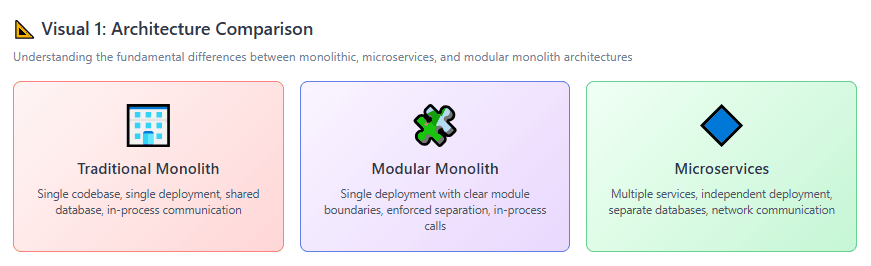
A monolithic application is a single, unified codebase where all components—authentication, business logic, database access, and UI—are tightly coupled and deployed as one unit. Think of it as a single building where everything is interconnected.
Key characteristics:
- Single deployment unit
- Shared database
- In-process communication
- Centralized codebase
2.2 Microservices
Microservices are modular systems where you can deploy, scale, and update independently. Each service owns a specific business capability and communicates with others through APIs or message queues.
Key characteristics:
- Multiple independent services
- Distributed deployment
- Service-specific databases
- Network-based communication
2.3 Modular Monolith: The Middle Ground
Modular monoliths combine the simplicity of monoliths with good practices from microservices architecture. The application runs as a single system but is clearly divided into independent modules with well-defined boundaries.
This architectural pattern has gained significant traction because it delivers modularity benefits without distributed system complexity.
3. The Real-World Trade-Offs
3.1 When Monoliths Win
Simplicity Wins for Small Teams
Microservices benefits only appear with teams larger than 10 developers. Below this threshold, monoliths consistently perform better. The overhead of managing distributed systems simply doesn’t justify itself.
Faster Initial Development
For startups and new projects, monoliths offer significant advantages:
- Faster time to market
- Simpler debugging (everything in one place)
- Lower infrastructure costs
- Easier end-to-end testing
Companies like Basecamp and Shopify have successfully scaled with monolithic foundations, proving this approach remains viable even at scale.
Real Example: GitHub’s core application remains largely a Ruby on Rails monolith, serving millions of developers daily without issues.
3.2 When Microservices Win
Scale and Team Independence
Microservices shine when:
- Multiple teams need to work independently
- Different parts of your system have vastly different scaling needs
- You need fault isolation (one service failure shouldn’t crash everything)
- Technology diversity is required
Performance at Scale
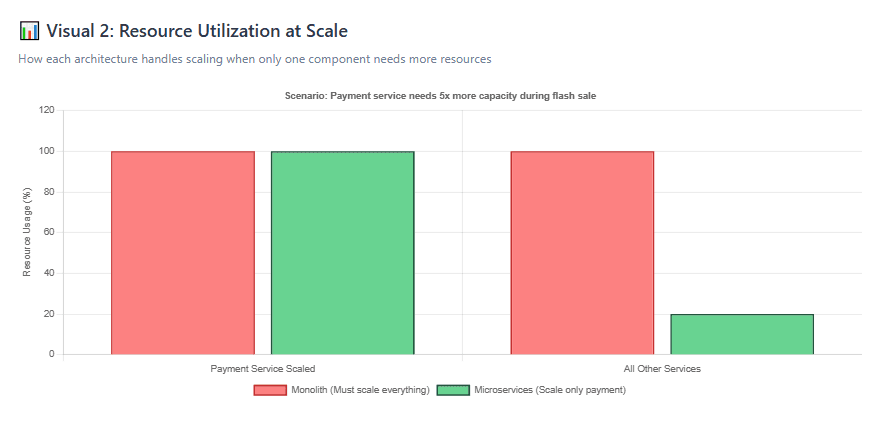
You can scale only what you need—your payment service gets more traffic? Scale just that component without over-provisioning resources for your entire application.
Real Example: Netflix runs over 1,000 microservices, deploying code thousands of times daily. Their scale and need for independent service evolution make microservices the right choice.
3.3 The Modular Monolith Sweet Spot
A modular monolith is a single deployed application made of well-separated modules or components, keeping the simplicity of one codebase while avoiding the extra load of a distributed system.
Perfect for:
- Growing startups (10-50 developers)
- Products with unclear domain boundaries
- Teams wanting microservice benefits without operational overhead
- Organizations planning eventual microservices migration
Modern frameworks like Spring Modulith enforce module boundaries at compile time, preventing the “big ball of mud” problem that plagues traditional monoliths.
4. Team Size Matters: The Breaking Point
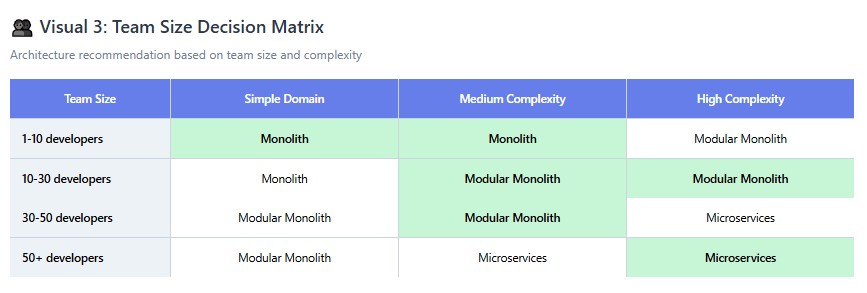
Here’s the practical reality based on industry data:
- 1-10 developers: Start with a monolith. Microservices overhead will slow you down.
- 10-50 developers: Modular monolith is ideal. Get structure without distribution complexity.
- 50+ developers: Microservices become beneficial as coordination costs justify the investment.
Amazon, known for microservices, is now grouping services into well-bounded contexts, recognizing that not everything needs to be split into tiny services.
5. Migration Strategies That Actually Work
5.1 The Strangler Fig Pattern
Much like a vine that slowly envelops a tree, this strategy involves gradually building microservices around the monolith and routing traffic to them.
How it works:
- Identify a bounded context to extract (e.g., authentication)
- Build the new microservice alongside the monolith
- Route new requests to the microservice
- Gradually migrate existing functionality
- Retire the monolithic component once complete
This approach maintains business continuity while reducing risk. Learn more about this pattern in Martin Fowler’s comprehensive guide.
5.2 Start with Modular Monolith
Use a modular monolith structure with layered architecture for maintainability. This provides a clear migration path:
- Build modular from day one: Define clear module boundaries
- Enforce boundaries: Use tools that prevent cross-module violations
- Extract when needed: Modules with clear interfaces can become services later

5.3 Avoid the Distributed Monolith
The worst outcome is a distributed monolith—all the complexity of microservices with none of the benefits. This happens when:
- Services are tightly coupled through synchronous calls
- Shared databases across services
- No clear service boundaries
- Deployment of one service requires coordinating others
This anti-pattern results from incomplete migration or insufficient decomposition.
6. Cost Considerations
6.1 Infrastructure Costs
Monolith:
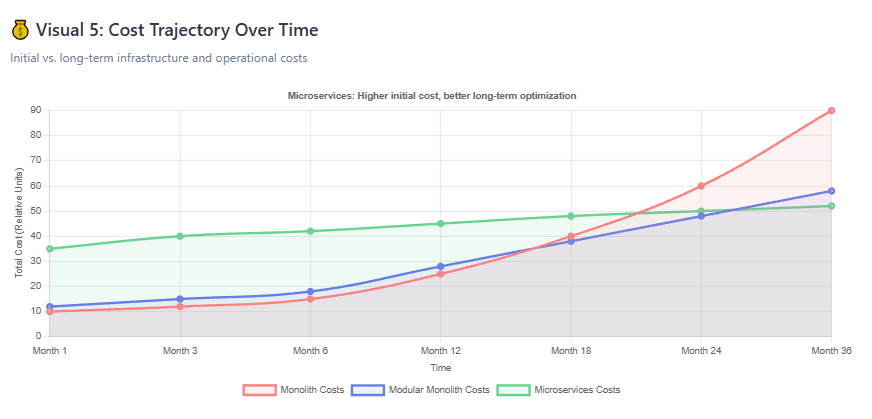
- Lower initial costs
- Single deployment environment
- Simpler monitoring setup
- Predictable resource usage
Microservices:
- Higher initial infrastructure costs but better long-term resource optimization
- Kubernetes operational overhead
- Service mesh complexity
- Multiple databases and message queues
6.2 Development Costs
Developers have seen companies fail because their CTO spent nine months building microservices architecture for an app with forty-seven users. Premature optimization wastes resources that could validate product-market fit.
The rule of thumb: start simple, scale when pain is real.
7. Decision Framework for 2025
Use this practical checklist to guide your architecture choice:
Choose Monolith/Modular Monolith if:
- Team size under 50 developers
- Launching a new product with uncertain requirements
- Need fast iteration and deployment
- Budget constraints limit operational complexity
- Domain boundaries aren’t clear yet
Choose Microservices if:
- Multiple independent teams working simultaneously
- Clear domain boundaries with stable requirements
- Different components need independent scaling
- Fault isolation is critical (e.g., payments shouldn’t fail because recommendations are down)
- Have DevOps expertise and resources
Warning signs you’re not ready:
- No automated testing infrastructure
- Limited DevOps capabilities
- Unclear service boundaries
- Team lacks distributed systems experience
8. Real-World Success Stories
8.1 Monolith Success: Basecamp
Basecamp has operated successfully as a Ruby on Rails monolith for nearly two decades. Their pragmatic approach shows monoliths can thrive when properly maintained.
8.2 Hybrid Success: Shopify
Shopify started as a monolith and evolved into a modular monolith. They extract microservices only for specific needs like checkout and fraud detection while maintaining their core monolith.
8.3 Microservices Success: Uber
Uber operates thousands of microservices, essential for their scale and global operations across different regions with varying requirements.
9. What We Learned
After examining the landscape of architectural patterns in 2025, several key insights emerge:
1. Context Over Hype In 2025, simplicity and developer experience often lead to more sustainable systems. The best architecture is the one that fits your current needs, not what worked for Netflix or Amazon.
2. Modular Monoliths Are Underrated The modular monolith pattern deserves serious consideration. It provides structure without distribution complexity, giving you an evolutionary path forward without premature investment.
3. Team Size Is Critical Architecture decisions must account for team size. Small teams drowning in microservices complexity can’t ship features. Large teams working in a monolith create bottlenecks.
4. Migration Is a Journey, Not a Switch Migrating from monolithic architecture to microservices represents one of the most significant transformations an organization can undertake. Successful migrations are incremental, using patterns like Strangler Fig to reduce risk.
5. Avoid the Distributed Monolith The worst outcome is achieving neither the simplicity of monoliths nor the independence of microservices. Clear boundaries and proper decomposition are essential.
6. Start Simple, Evolve Deliberately Most products don’t fail due to scalability—they fail due to lack of product-market fit. Choose an architecture that lets you learn fast and iterate quickly.
7. There’s No Universal Answer Both monoliths and microservices are tools, not religions. The right choice depends on your team, domain, scale, and business goals.
10. Looking Forward
The future isn’t about choosing monolith OR microservices—it’s about the ability to move between them with purpose. Modern infrastructure tools make architectural evolution less painful than before.
In 2025, smart organizations:
- Start with modular monoliths
- Extract microservices when pain points are clear
- Maintain architectural discipline regardless of pattern
- Measure success by delivery velocity and system reliability, not service count
The bottom line: Build the simplest architecture that solves your actual problems. You can always evolve later when real constraints demand it.