Managing state is one of the most challenging parts of building modern React applications. While React provides local state with hooks like useState and useReducer, larger applications often require a more powerful solution for global state management.
Three popular choices in 2025 are:
- Redux (battle-tested and widely adopted)
- Context API (built into React)
- Zustand (a lightweight, modern alternative)
In this article, we’ll compare them side by side with examples, pros/cons, and use cases to help you choose the right tool.
1. Redux
Redux is one of the oldest and most widely used state management libraries. It enforces a strict unidirectional data flow and encourages immutability, making it a solid choice for large and complex apps.
Example (Counter with Redux Toolkit)
'// store.js
import { configureStore, createSlice } from '@reduxjs/toolkit';

const counterSlice = createSlice({
  name: 'counter',
  initialState: { value: 0 },
  reducers: {
    increment: (state) => { state.value += 1; },
    decrement: (state) => { state.value -= 1; },
  }
});

export const { increment, decrement } = counterSlice.actions;
export const store = configureStore({ reducer: counterSlice.reducer });
// App.js
import React from 'react';
import { Provider, useSelector, useDispatch } from 'react-redux';
import { store, increment, decrement } from './store';

function Counter() {
  const value = useSelector((state) => state.value);
  const dispatch = useDispatch();

  return (
    <div>
      <h2>{value}</h2>
      <button onClick={() => dispatch(increment())}>+</button>
      <button onClick={() => dispatch(decrement())}>-</button>
    </div>
  );
}

export default function App() {
  return (
    <Provider store={store}>
      <Counter />
    </Provider>
  );
}
✅ Pros
- Predictable and structured
- Huge ecosystem and tooling (Redux DevTools)
- Great for large applications
❌ Cons
- Boilerplate (though reduced with Redux Toolkit)
- Can feel heavy for small projects
2. Context API
The Context API is built directly into React. It allows you to pass state down the component tree without prop drilling.
Example (Counter with Context API)
import React, { createContext, useContext, useReducer } from 'react';

const CounterContext = createContext();

function counterReducer(state, action) {
  switch (action.type) {
    case 'increment': return { value: state.value + 1 };
    case 'decrement': return { value: state.value - 1 };
    default: return state;
  }
}

function CounterProvider({ children }) {
  const [state, dispatch] = useReducer(counterReducer, { value: 0 });
  return (
    <CounterContext.Provider value={{ state, dispatch }}>
      {children}
    </CounterContext.Provider>
  );
}

function Counter() {
  const { state, dispatch } = useContext(CounterContext);
  return (
    <div>
      <h2>{state.value}</h2>
      <button onClick={() => dispatch({ type: 'increment' })}>+</button>
      <button onClick={() => dispatch({ type: 'decrement' })}>-</button>
    </div>
  );
}

export default function App() {
  return (
    <CounterProvider>
      <Counter />
    </CounterProvider>
  );
}
✅ Pros
- Built into React (no extra dependency)
- Easy to use for small-medium apps
- Great for sharing theme, auth, and config state
❌ Cons
- Performance issues when many components re-render
- Not ideal for very large applications
3. Zustand
Zustand is a small but powerful state management library that uses simple hooks. It avoids boilerplate and provides a minimal API.
Example (Counter with Zustand)
import create from 'zustand';

const useStore = create((set) => ({
  value: 0,
  increment: () => set((state) => ({ value: state.value + 1 })),
  decrement: () => set((state) => ({ value: state.value - 1 })),
}));

function Counter() {
  const { value, increment, decrement } = useStore();
  return (
    <div>
      <h2>{value}</h2>
      <button onClick={increment}>+</button>
      <button onClick={decrement}>-</button>
    </div>
  );
}

export default function App() {
  return <Counter />;
}
✅ Pros
- Minimal API, no boilerplate
- Fast and efficient (selective re-renders)
- Easy learning curve
❌ Cons
- Smaller ecosystem compared to Redux
- Less opinionated (may lead to inconsistent patterns)
4. Head-to-Head Comparison
| Feature | Redux | Context API | Zustand |
|---|---|---|---|
| Boilerplate | High (less with Toolkit) | Low | Very Low |
| Learning Curve | Steep | Easy | Easy |
| Performance | Good with memoization | Can cause re-renders | Excellent (fine-grained updates) |
| Ecosystem | Huge (middlewares, devtools) | None (built-in only) | Growing, but smaller |
| Best Use Case | Large/complex apps | Small/medium apps | Medium/large apps needing speed |
| DevTools | Excellent | None | Basic support |
4.1 Visualizing the State Flow
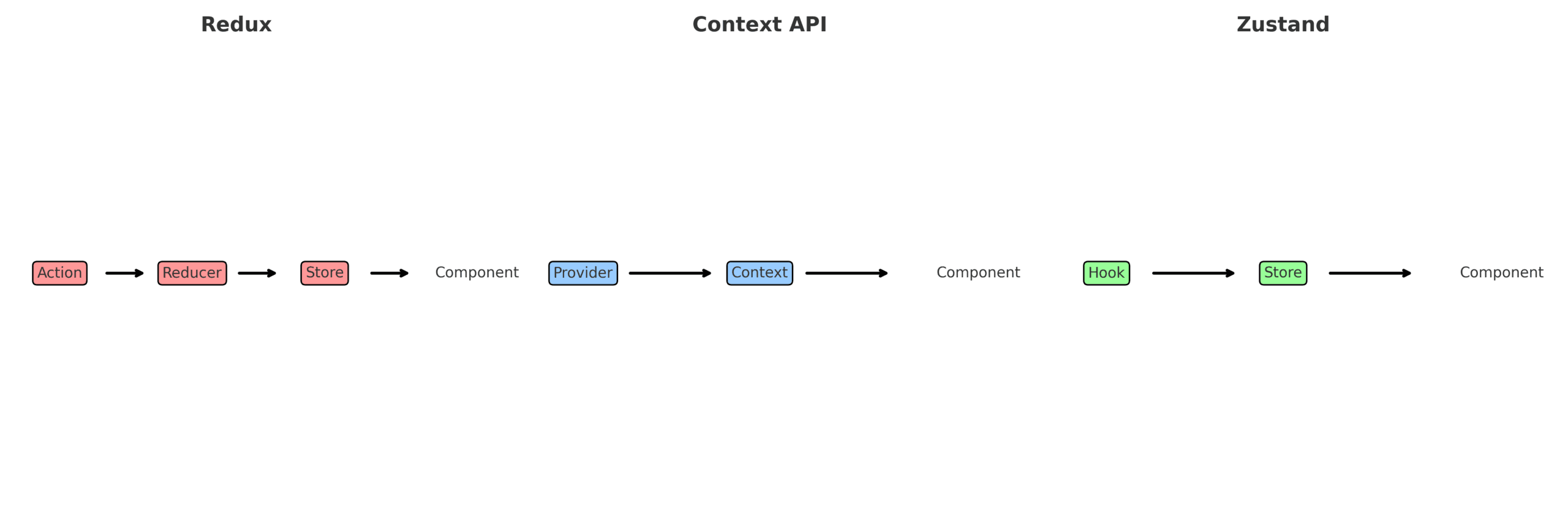
While the table shows the features side by side, sometimes a visual explanation helps to understand how state travels through these libraries.
Below is a simplified diagram comparing the state flow in Redux, Context API, and Zustand:
- Redux → State flows in a strict unidirectional cycle: Action → Reducer → Store → Component.
- Context API → State is provided from the top-level Provider, accessed by components through Context.
- Zustand → State is managed in a central store and consumed via hooks, making it simple and direct.
5. When to Use What?
- Use Redux → If you’re building a large-scale app that requires strict structure, debugging tools, and middleware (e.g., enterprise dashboards, e-commerce platforms).
- Use Context API → If you just need to avoid prop drilling for smaller apps or specific cases like authentication, theme, or language.
- Use Zustand → If you want a lightweight, fast, and modern solution with minimal boilerplate and good performance.
Final Thoughts
There’s no one-size-fits-all solution. The right choice depends on your project’s complexity and team size:
- For small projects, Context API is enough.
- For scalable apps, Redux is battle-tested.
- For modern and flexible apps, Zustand strikes a great balance.
Useful Links