In the world of Java development, application performance is often closely tied to how well the Java Virtual Machine (JVM) manages memory. At the heart of this memory management lies Garbage Collection (GC)—the automated process that reclaims unused objects to free up heap space. While GC works invisibly in the background, its behavior can have a significant impact on application responsiveness, throughput, and scalability.
Over the years, the JVM has evolved to include several advanced garbage collectors, each with unique strengths and trade-offs. This article explores three modern GC algorithms—G1 (Garbage-First), ZGC (Z Garbage Collector), and Shenandoah—and explains their design philosophies, how they impact Java application performance, and when to choose each for your projects.
Why Garbage Collection Matters
Java’s automatic memory management frees developers from manual memory allocation and deallocation headaches, reducing errors like memory leaks and dangling pointers. However, GC pauses can affect application latency, particularly in high-throughput or low-latency systems such as microservices, financial trading platforms, or real-time analytics.
Effective garbage collection strives to minimize pause times while maintaining throughput—often a balancing act. Choosing the right GC algorithm for your JVM version, workload, and deployment environment is critical to achieving optimal performance.
Garbage-First (G1) Collector: The Workhorse of Modern JVMs
Introduced as a replacement for the older CMS (Concurrent Mark Sweep) collector, G1 aims to provide predictable pause times and high throughput by partitioning the heap into numerous small regions. Rather than scanning the entire heap, G1 focuses on the “garbage-first” approach by collecting regions with the most reclaimable memory first.
Key features:
- Divides the heap into equal-sized regions, enabling targeted GC cycles.
- Balances between concurrent and stop-the-world phases to reduce pause lengths.
- Allows users to specify pause-time goals, enabling a trade-off between latency and throughput.
- Available as the default GC in Java 11 and later.
Use cases:
G1 is suitable for many applications that need predictable pause times without sacrificing overall throughput. It’s the go-to collector for many enterprise Java applications, especially those running in server environments or microservices.
Z Garbage Collector (ZGC): Low Latency at Scale
ZGC is a relatively new GC designed by Oracle to support applications with very large heaps—multi-terabyte ranges—and stringent low-latency requirements. It employs a concurrent, region-based, and load barrier technique to achieve pause times typically under 10 milliseconds.
Key features:
- Designed for heaps ranging from a few gigabytes to multiple terabytes.
- Performs most of its work concurrently with application threads, minimizing stop-the-world pauses.
- Uses colored pointers and load barriers to track object movement efficiently.
- Still evolving, but available and production-ready in Java 15+.
Use cases:
ZGC is ideal for large-scale, low-latency applications where pause times must be minimized regardless of heap size—think real-time data processing, in-memory databases, and large-scale microservices clusters.
Shenandoah: Another Low-Pause, Concurrent Collector
Developed initially by Red Hat, Shenandoah is another low-pause concurrent GC similar in goals to ZGC but with a distinct implementation. It’s integrated into OpenJDK and supported in various JVM distributions.
Key features:
- Performs evacuation (moving objects to compact memory) concurrently with running application threads.
- Minimizes pause times to a few milliseconds, even with large heaps.
- Compatible with a variety of workloads, offering stable performance.
- Supports Java versions 8 and up.
Use cases:
Shenandoah is a great choice when running large JVM heaps that require minimal GC pauses but where ZGC might not be available or optimal due to JVM version constraints. It’s often favored in OpenJDK or Red Hat environments.
Comparative Overview of G1, ZGC, and Shenandoah
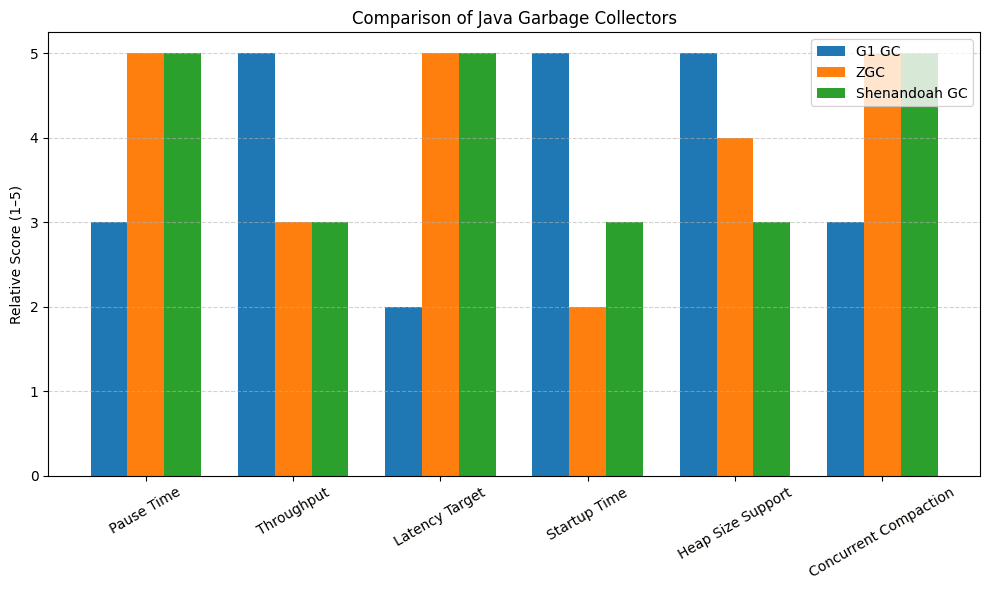
To make the performance trade-offs more tangible, here’s a comparative table summarizing key characteristics of the three garbage collectors. This overview should help clarify which collector might suit your application depending on your performance goals—whether that’s minimizing pause times, maximizing throughput, or achieving consistent low latency.
| Feature | G1 GC | ZGC | Shenandoah |
|---|---|---|---|
| Pause Time | Medium | Low | Low |
| Throughput | High | Medium | Medium |
| Latency Target | Weak | Strong | Strong |
| Startup Time | Fast | Moderate | Moderate |
| Heap Size Support | Large (up to ~4 TB) | Very Large (multi-TB) | Moderate (~2 TB) |
| Concurrent Compaction | Partial | Full | Full |
The chart below visualizes these metrics on a relative scale (1–5), making it easier to see where each GC stands in terms of performance goals:
Choosing the Right Garbage Collector: Factors to Consider
When selecting a GC algorithm, consider:
- Heap size: For smaller heaps, G1 is often sufficient. For huge heaps (tens or hundreds of GB), ZGC or Shenandoah excel.
- Pause time requirements: If ultra-low latency is essential, lean toward ZGC or Shenandoah.
- JVM version and environment: ZGC requires newer JVMs; Shenandoah supports slightly older ones.
- Application workload: CPU-bound versus memory-bound workloads may respond differently to GC tuning.
- Cloud and container environments: Some collectors perform better in containerized, resource-constrained setups.
Conclusion
Garbage collection is a foundational component of Java application performance, often underestimated yet crucial for smooth operation. Modern collectors like G1, ZGC, and Shenandoah represent significant leaps in managing memory efficiently, balancing throughput, and minimizing latency.
Understanding their differences helps Java developers and architects make informed choices tailored to their application’s unique needs—whether it’s a scalable microservice, a real-time analytics engine, or a cloud-native distributed system.
As the JVM continues to evolve, staying current with garbage collection advances is key to unlocking the best performance and reliability from your Java applications.
Useful Reference Links
Here are official resources and detailed references for deeper reading:
🔹 G1 Garbage Collector
- Oracle Docs – G1 Garbage Collector Tuning
- Inside the G1 GC – HotSpot GC Tuning Guide (Java 17)
🔹 ZGC (Z Garbage Collector)
- Oracle Docs – ZGC Overview
- ZGC GitHub Wiki – ZGC Design and Internals
🔹 Shenandoah GC
- Red Hat Guide – Understanding Shenandoah GC
- OpenJDK Wiki – Shenandoah GC