
Difference between @RestController and @Controller Annotation in Spring MVC and REST

The @RestController annotation in Spring MVC is nothing but a combination of the @Controller and the @ResponseBody annotation. It was added into Spring 4.0 to make the development of RESTful Web Services in Spring framework easier. If you are familiar with the REST web services you know that the fundamental difference between a web application and a REST API is that the response from a web application is a generally view of HTML + CSS + JavaScript while REST API just return data in form of JSON or XML. This difference is also obvious in the @Controller and the @RestController annotation. The job of the @Controller is to create a Map of model object and find a view but the @RestController simply returns the object and object data is directly written into HTTP response as JSON or XML.
This can also be done with the traditional @Controller and the use of the @ResponseBody annotation but since this is the default behavior of RESTful Web services, Spring introduced @RestController which combined the behavior of @Controller and @ResponseBody together.
In short, the following two code snippets are equal in Spring MVC:
@Controller
@ResponseBody
public class MVCController {
   .. your logic
}
@RestController
public class RestFulController {
  .... your logic
}
Obviously, everybody would like to declare just one annotation instead of two. Also, the @RestController is more obvious than the previous two.
What are @Controller and @RestController in Spring?
In Spring framework, a Controller is a class which is responsible for preparing a model Map with data to be displayed by the view as well as choosing the right view itself. It can also directly write into response stream by using @ResponseBody annotation and complete the request.
The behavior of writing directly into response stream is very useful for responding calls to RESTful web services because there we just return data instead of returning a view as explained in my earlier post about how Spring MVC works internally.
If you have developed RESTful Web services before Spring 4 e.g. in Spring 3 or Spring 3.1, you would have been familiar by using a combination of the @Controller and the @ResponseBody to create a RESTful response. Spring guys take cognizant of this issues and created the @RestController.
Now, you don’t need to use the @Controller and the @RestponseBody annotation. Instead you can use the @RestController to provide the same functionality. In short, it is a convenience controller which combines the behavior of the @Controler and the @Response body into one.
You can further join Eugen Paraschiv’s REST with Spring Master class if you are more curious about learning the advanced techniques to develop RESTFul Web Service in Spring.
Difference between @RestController and @Controller in Spring
Now that, you are familiar with both of these annotations, it’s a good time to analyze some factual difference between the @RestController and the @Controler. This is a very important concept, not just from Interview point of view but also from Spring Core and Spring Web Application developer Certification. If you are preparing for Spring certifications, you should be familiar with such subtle differences. Additionally, you can also take a look at free Spring tests to get an idea about exam format and level of questions.
Anyway, let’s get back to the point, here are some important differences between these two annotations.
- The
@Controlleris a common annotation which is used to mark a class as Spring MVC Controller while the@RestControlleris a special controller used in RESTFul web services and the equivalent of@Controller + @ResponseBody. - The
@RestControlleris relatively new, added only on Spring 4.0 but@Controlleris an old annotation, exists since Spring started supporting annotation, and officially it was added on Spring 2.5 version. - The
@Controllerannotation indicates that the class is a “Controller” e.g. a web controller while the@RestControllerannotation indicates that the class is a controller where@RequestMappingmethods assume@ResponseBodysemantics by default i.e. servicing REST API. - The
@Controlleris a specialization of@Componentannotation while@RestControlleris a specialization of@Controllerannotation. It is actually a convenience controller annotated with@Controllerand@ResponseBodyas shown below.@Target(value=TYPE) @Retention(value=RUNTIME) @Documented @Controller @ResponseBody public @interface RestController
and here is how the declaration of
@Controllerlooks like:@Target(value=TYPE) @Retention(value=RUNTIME) @Documented @Component public @interface Controller
- One of the key difference between
@Controlerand@RestCotrollerin Spring MVC is that once you mark a class as@RestControllerthen every method is written a domain object instead of a view. You can see Bryan Hassen’s Introduction to Spring MVC 4 to learn more about how to use the@RestControllerannotation in your Spring based application. - Another key difference between
@RestControllerand@Controlleris that you don’t need to use@ResponseBodyon every handler method once you annotate the class with@RestControlleras shown below:with @RestControler:
@RestController
public class Book{

@RequestMapping(value={"/book"})
public Book getBook(){
//...
return book;
}
}
without @RestController:
@Controller
public class Book{

@RequestMapping(value={"/book"})
@ResponseBody
public Book getBook(){
//...
return book;
}
}
You can see that if you use Spring MVC @Controller annotation to create a RESTful response you need to annotate each method with the @ResponseBody annotation, which is not required when you use @RestController. It not only makes your code more readable but also saves a couple of key strokes for you.
Here is a simple HelloWorld example using @RestController and SpringBoot framework:
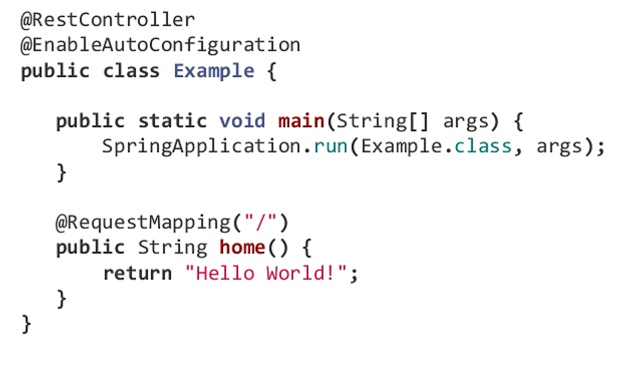
That’s all about the difference between @Controller and @RestController annotation in Spring MVC and REST. @RestController is nothing but the shortcut to use both @Controller and @ResponseBody annotation together.
Spring purposefully added this annotation in Spring 4 to make the development of RESTful web services easier using Spring framework. It can directly convert the response to JSON or XML depending upon MIME type of request.
So, if you are creating a RESTful Web Services it’s better to use @RestController than combining the @Controller to @ResponseBody.
If you want to learn more about developing RESTful Web Services using Spring and Spring Security framework, I suggest you join Eugen Paraschiv’s REST with Spring Coaching class. Eugen has some good real world experience in developing and securing RESTful web services in Java and this class is a good opportunity to benefit from his immense experience.
| Reference: | Difference between @RestController and @Controller Annotation in Spring MVC and REST from our JCG partner Javin Paul at the Javarevisited blog. |





nice explanation. very helpful for beginner like me. thanks . . .
On the other hand @Controller is more versatile. Its methods can return both view names (normally) or complex objects (if the method extra annotated)
great job nice explanation..
Awesome explanation on rest controller vs spring controller.