
In organic reactions, certain unstable species are formed as intermediates. One such important intermediate is the carbocation, in which a carbon atom carries a positive charge. Due to the presence of only six electrons in its valence shell, it is electron-deficient and highly reactive. Carbocations play a significant role in many organic reaction mechanisms.

Structure of Carbocation
Carbocation has sp² hybridisation, a trigonal planar shape, and an empty p-orbital, making it electron-deficient. In a carbocation, the positively charged carbon atom is sp² hybridised. It forms three sigma (σ) bonds with three atoms or groups.
- The bond angle is approximately 120°.
- The carbon atom has an empty unhybridized p-orbital, which is perpendicular to the plane of the molecule.
- Due to the presence of only six electrons, the carbocation is electron-deficient and unstable.
Characteristics of Carbocations
Carbocations exhibit certain characteristic properties due to the presence of a positive charge and electron deficiency.
- Electron-deficient nature: Carbocations have only six electrons in their valence shell, so they are electron-deficient.
- Positive charge: The carbon atom carries a positive charge (C⁺).
- sp² hybridisation: The positively charged carbon is sp² hybridised and forms three σ bonds.
- Planar structure: Carbocations have a trigonal planar geometry with bond angle around 120°.
- Presence of empty p-orbital: They contain an empty unhybridized p-orbital, which makes them reactive.
- Highly reactive and unstable: Due to electron deficiency, carbocations are unstable intermediates and react quickly.
- Electrophilic nature: Carbocations act as electrophiles because they accept electron pairs.
Formation of Carbocation
Carbocations are formed when a carbon atom loses a pair of electrons and becomes positively charged (C⁺). This generally occurs by heterolytic bond cleavage or during electrophilic addition reactions.
1. Formation by Heterolytic Bond Cleavage
- In heterolytic cleavage, a covalent bond breaks unequally.
- Both electrons of the bond are taken by one atom (usually more electronegative).
- The carbon atom loses electrons and becomes a carbocation.
R–X → R⁺ + X⁻
- R⁺ = Carbocation
- X⁻ = Leaving group
Example: CH3–Cl → CH3⁺ + Cl⁻
Mechanism
- The bond between carbon and chlorine breaks.
- Chlorine takes both electrons (due to higher electronegativity).
- Carbon is left with only six electrons, forms CH3⁺ (carbocation).
2. Formation during Electrophilic Addition (from π bonds)
- Occurs in alkenes or alkynes containing π bonds.
- The π electrons are electron-rich and attack an electrophile (like H⁺).
- This leads to breaking of the double bond and formation of a carbocation intermediate.
Example: Ethene reacts with HBr (or HCl, HI)
CH2=CH2 + HBr → CH3−CH2Br
Mechanism
Step 1: Formation of Carbocation
CH2=CH2 + H+ → CH3−CH2+
- π electrons attack H⁺
- One carbon gets bonded to H, the other carbon becomes positively charged (carbocation)
Step 2: Reaction of Carbocation
CH3−CH2+ + Br- → CH3−CH2Br
- The carbocation formed is highly reactive and is attacked by a nucleophile (like Br⁻).
Types of Carbocations
Carbocations are classified on the basis of the number of alkyl groups attached to the positively charged carbon atom.
1. Primary (1°) Carbocation
- The positively charged carbon is attached to one alkyl group.
- Structure: R–CH2+
Example: CH3–CH2⁺

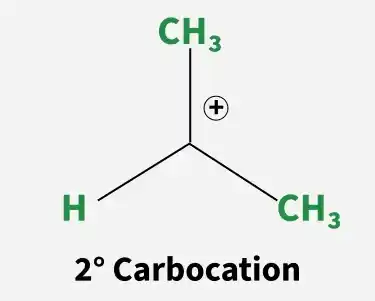
2. Secondary (2°) Carbocation
- The positively charged carbon is attached to two alkyl groups.
- Structure: R2CH+
Example: (CH3)2CH +
3. Tertiary (3°) Carbocation
- The positively charged carbon is attached to three alkyl groups.
- Structure: R3C+
Example: (CH3)3C +

4. Methyl Carbocation
- The positively charged carbon is attached to no alkyl group.
- Structure: CH3+
Example: CH3 +
Stability of Carbocation
Carbocations show different stability depending on their structure and substituents. The stability of a carbocation depends on the ability of groups attached to the positively charged carbon to donate electron density and reduce its electron deficiency. Carbocations attached to π systems are stabilized by resonance.
Order of Stability:
3° > 2° > 1° > CH3 +
- Tertiary (3°) carbocation is most stable
- Methyl (CH3⁺) carbocation is least stable
Reasons for Stability
1. +I Effect (Inductive Effect)
- Alkyl groups donate electron density (+I effect) towards the positively charged carbon
- More alkyl groups, more electron donation and more stability
2. Hyperconjugation
- It is the Delocalisation of σ-electrons (C–H bonds) into the empty p-orbital.
- More alkyl groups, more hyperconjugation and greater stability
3. Resonance Effect
- Carbocations attached to a double bond or benzene ring are stabilised by resonance because the positive charge gets delocalised.
- Example include Allylic carbocation and Benzylic carbocation
- Resonance stabilised carbocations are more stable than ordinary alkyl carbocations.